Summarize Content With:
Introduction
The scenario: A dispatcher at a mid-sized 3PL starts his shift at 6 AM. Before he ever makes it to his desk, he has eleven missed calls: two carriers confirming dock slots, four drivers calling in about their load assignments, and five customers calling to ask where their shipments are. By 9 AM, he has yet to touch a single decision in the operation. He has been on the phone the entire time.
This is a conversation that occurs every single morning in distribution centers across this country. It is not a staffing issue or a training issue. But, a communication infrastructure issue. This is considered as one that the industry has been quietly absorbing for years. It is one that is now impossible to ignore in 2026.
The intent of this playbook is simple. It is intended for operations managers, 3PL managers, and logistics decision-makers. They understand that there is a problem with their communication infrastructure. They just have not seen a clear and honest picture of what it is truly costing them.
The issue is far more complex than most teams understand. WISMO calls consume up to 40 percent of the incoming support traffic. Drivers are left idle waiting for dispatch confirmations that should only take seconds. First deliveries are missed not because the driver didn’t arrive at the stop on time, but because no one checked the window time before.
The answer is no longer an idea. AI call assistant designed for the logistics sector are live, integrated, and churning out tangible results for 3PLs that have already acted on them. This playbook will take you through exactly how they work, where they pay off the quickest, and what implementing them looks like.
The Problem Nobody Talks About Loud Enough
Let’s be honest. The majority of 3PLs and distribution centers are wasting time in phone calls. Not on the dock. Not in the warehouse. On the phone. Dispatchers waiting hours to find driver checkin. Customer services reps waist deep in WISMO calls. Appointing babysitting of the warehouse staff rather than running the operations. This is not a technological issue. It is an infrastructure issue of communication. And in 2026 we should not be able to disregard it.
The Numbers Are Ugly
The numbers are ugly. WISMO calls (an abbreviated form of Where Is My Order) may take up to 40 percent of the total number of customer support contact requests within logistics operations. Each of such calls consumes money, agents time and still leaves the customer waiting. In the meantime, trucks wait outside the doors of the warehouse as warehouse scheduling is handled in a spreadsheet and praying. This is the level that most 3PLs are presently operating at.
AI call assistants are not in the future anymore. They are:
- Operational
- In-service
- Producing quantifiable outcomes
to logistics operations throughout the nation. Whether or not your 3PL ought to implement an AI call assistant is not a question. The issue is, how quickly you can go and then your rivals.
The Communication Failure That’s Eating Up More of Your Money than You Realize
Enter any distribution center and inquire of the operations manager what irritates them the most on a daily basis. On nine out of ten occasions, the solution is in communication. Whether it is:
- Driver coordination
- Late notifications of delivery
- Carrier scheduling chaos.
- First delivery failed since no one had made a call to the recipient to confirm a window.
These are not edge cases. Most 3PLs have these as their daily operations.
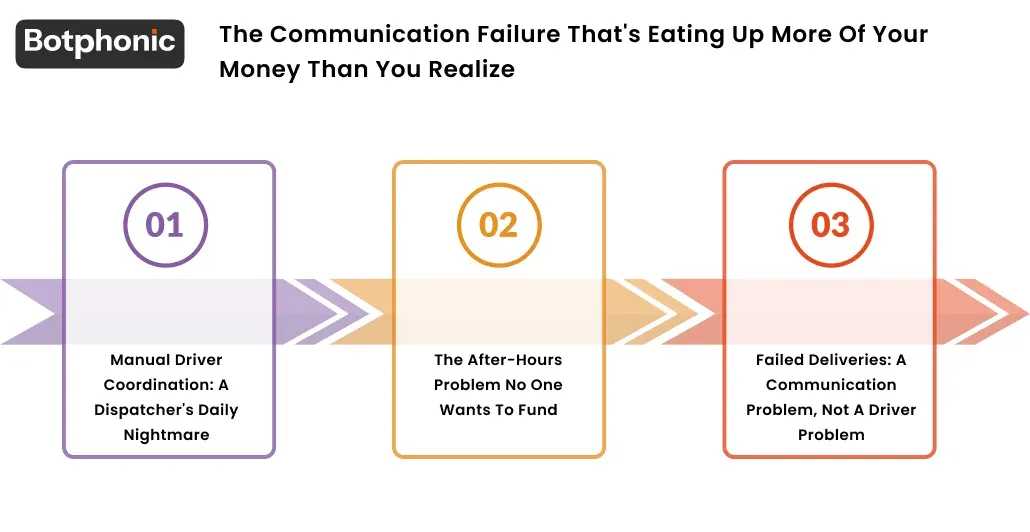
1. Manual Driver Coordination: A Dispatcher’s Daily Nightmare
A nightmare to a dispatcher is manual driver coordination. In fleets, dispatchers continue to make dozens of calls to determine status and revision routes. That is a small call center that is doing the bare minimum to keep the fleet busy. Each call is a distraction. Each missed call is a delay. Every breakdown in relay is an unsuccessful transmission. The cascade is actual and costly.
2. The After-Hours Problem No One Wants to Fund
And then there is the after hours issue. Logistics does not sleep. Trucks move overnight. Saturdays evenings are the days when customers monitor packages. Drivers hit issues at 2 AM. However, the round-the-clock live support is inhumane in terms of cost. Night shift staffing or outsourcing is a rapid cannibalizer of margins. The majority of the 3PLs will select restricted after-hours service and compensate it with customer satisfaction and driver frustration.
3. Failed Deliveries: A Communication Problem, Not a Driver Problem
The ultimate gasp is failed deliveries. It is not a driver problem when a driver comes and the customer is not there. That would be a breakdown in communication. The delivery window was not verified by anyone. Nobody sent a real-time alert. The customer was unaware that the truck was on its way. Each time an initial failure occurs, it results in the re-routing of costs, a second delivery attempt and a slower supply chain. This is done away with by AI call assistants.
How an AI Call Assistant Actually Works in a 3PL Environment
Forget the marketing fluff. This is how an AI voice agent for logistic operations works in the real 3PL or distribution center. It also supports inbound and outbound calls on volume, hold times are nonexistent, shifts are unrestricted and the per-agent cost of scaling a human call center is removed.
1. What It Does on the Customer Side
On the customer side, it takes tracking requests, offers real-time shipment position, verifies delivery schedules, gathers reschedule requests, and makes phone calls after delivery to get satisfaction ratings. Such are not complicated discourses. They are volume repetitive interactions that consume agent time and have no strategic value at all when done manually.
2. What It Does on the Operations Side
On the inside, AI call assistants verify load assignments, dispatch information, record driver responses, and route amendments when required by traffic and weather. An example is Botphonic, which is designed with the high-pressure logistics conditions in mind and requires the assistant to interface with the TMS and WMS environments and operate in real-time, as well as serve in multilingual communication without losing its precision.
3. Why This Is Nothing Like the Old IVR Systems
The difference between the older IVR systems and the newer ones is essential. In the traditional IVR, the callers are required to press 1 or yes. It interrupts when anybody deviates. AI call assistants can comprehend natural unscripted speech. They deal with follow up questions., adapt mid-conversation, and most importantly, they do not make callers go through menu designed by the person that has never even made a call to a warehouse.
Botphonic: Designed to Support the Pace of Real Logistics Operations
Majority of AI phone call for logistics are designed with general applications and are subsequently retrofitted with logistics. That is backwards. The needs of logistics are particular and the generic platforms cannot satisfy them. Noisy warehouse floors. Populations of drivers having different accents. Shelf TMS systems that require real time integration. Regulations regarding data management. Any AI call assistant within the context must be designed to work within it rather than ported to it.
1. Built for Latency, Integration, and Real-World Complexity
It is to this very context that Botphonic is intended. The platform provides sub-100 millisecond response latency, which is of crucial importance in dispatch coordination where half a second delay can ruin fleet communication. It is natively integrated with existing CRMs, TMS systems, and WMS systems without needing a complete stack redesign. You do not restructure everything around it, you rub it in where it goes.
2. Multilingual Support That Goes Beyond English
With Botphonic, multilingual support is not something of an afterthought. In the logistics of the US, you are dealing with drivers, warehouse employees, and clients who represent dozens of languages and regional dialects. A logistics platform is not a platform that can be good in English but with a very poor grasp of Spanish or Mandarin. It is a limited range customer service tool.
3. Compliance That Comes Standard
The compliance architecture is also important. In the cases, when an AI call assistant is recording shipment data, customer information and driver interactions, The information must be encrypted, documented appropriately, and subject to privacy rules. Botphonic addresses SOC 2, HIPAA, and PCI-DSS compliance by default, and thus your 3PL is not selling its operation efficiency at the cost of exposing data.
Where AI Call Assistants Deliver the Highest ROI in Distribution Centers
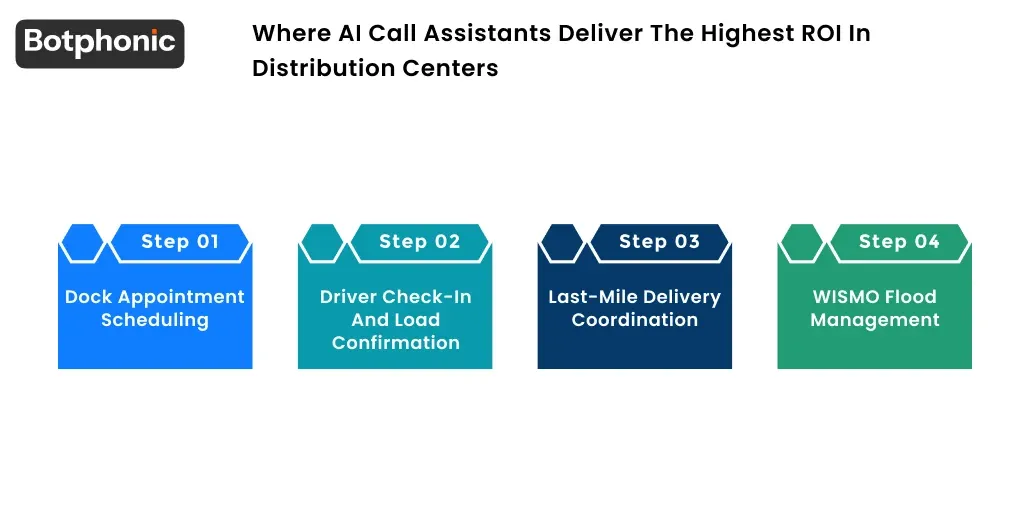
1. Dock Appointment Scheduling
The problem is not staffing the warehouse so that warehouse employees take the whole day on the phone arranging carrier appointments. It is a systems problem. The AI call assistants automation will include inbound scheduling calls, integrating with the existing dock management systems, slot confirmation, reminders, and rescheduling without a human touch. The outcome is reduced queues of trucks at the dock due to inefficient appointment and greater predictable throughput.
2. Driver Check-In and Load Confirmation
A 24/7 3PL would not be able to have dispatchers 24/7 without significant cost implications. The AI call assistants deal with overnight loads confirmation, dispatch confirmation, driver acknowledgment log, and only go to a human when there is something really to be judged. Firms operating under this model are not only making savings in labor costs. They are achieving consistency in data.
3. Last-Mile Delivery Coordination
The final mile is the personal and costly side of logistics. AI call assistants take the initiative to call recipients before delivery to ensure that they are available, give ETAs, and gather redelivery options where necessary. This is one intervention that could save the first attempts by a significant margin. Less failed deliveries will reflect in less re-routing and shorter fleet cycles, and customers that are not left waiting wondering where their package is.
4. WISMO Flood Management
A contact center that is tracking inquiries with 40 percent of its inbound call volume is basically not in the right place. WISMO is taken off by the AI call assistants. They retrieve live tracking data, provide accurate status updates and close the call without human agent intervention. Exception, escalation, and judgment actually have to be dealt with agents. Do not order status requests on the evening of Friday.
The Honest Talk About Implementation Most Vendors Skip
Such is what the sales decks do not touch. In a logistics setting, voice AI is actually facing the reality of obstacles to implementation. Warehouses are loud. Docks loading are not conferences. Artificial intelligence call assistants must be able to work in the noisy environments without necessarily misunderstanding the commands or causing the workers to repeat themselves thrice before a task can be logged in the right way.
1. The Legacy System Wall
The other wall that you will meet is legacy system integration. The majority of distribution centers are operating TMS platforms. It has not been architected in API-first. To have a voice AI to make a real-time connection to a system developed in 2009, middleware, serious configuration, and even a bit of creative problem solving are necessary. Any vendor who informed that this is a plug and play without being aware of your stack is not telling you the truth.
2. The Human Adoption Factor
The employment adoption is an actual variable. Warehouse managers and dispatchers who have been doing things their way over the years will not necessarily rejoice over a new system. The worry on the possibility of being replaced is actual and comprehensible. The implementation must put AI call assistant in perspective as the tool, which will decrease the grunt work, but not the expertise. Adoption is faster when the framing is appropriate. Passive resistance occurs when it is wrong, and it silently sabotages the deployment.
3. ROI Timelines: Faster Than Most Expect
ROI schedules are quicker than anticipated most. Typically, logistics activities which implement AI call assistants are realized to give returns which can be measured in 60 to 90 days. Its key driving forces are fewer manual call handling, fewer failed deliveries, and less staffing during after hours. When the system is implemented properly, those three levers move at an extremely high rate.
Post-Deployment: Measuring What Actually Matters
Implementation of Botphonic or any other AI-based call assistant is not a plug-and-leave action. What you will get out of the investment in the long-term will be dependent on the metrics that you monitor within the first 90 days. Begin with first-call resolution rate. In case the AI is answering questions without being escalated, the basic functionality is in place. The rates of escalation are high, conversation design or system integration will have to be adjusted.
1. Average Call Handling Time and Escalation Rate
The second lever is average call handling time. A reduction in time spent on routine queries decreasing to less than 2 minutes is possible and indicates the system is operating at an operational pace. Monitor it weekly and match it with agent escalation rate to have a complete view of automation coverage.
2. SLA Compliance: The Metric That Ties It All Together
The business-level measure that brings it all together is SLA compliance. Is it improving shipments with regard to meeting delivery windows? Are on-time dock appointments in place? Do drivers receive load confirms in time? These results are linked to the contractual obligation and customer retention. Where the true financial argument of AI call assistants resides.
3. Intent Recognition: Training the System on Your Language
The initial weeks should be monitored closely in terms of intent recognition accuracy. The system must be trained on your real language of operation in noisy logistical environments with mixed accents and vocabulary in your domain i.e. your route codes, warehouse zones, carrier names, and SKU references. Generic models are floundering. Specially designed systems such as Botphonic learn on your data, hence accuracy in practice is maintained.
The 2026 Logistics Communication Stack Is Under Construction
The most popular 3PLs that will take over the next five years are not necessarily those that have the greatest fleet or the most square feet of a warehouse. It is they which can work with minimum communication friction. All manual calls which are automated are a saving. Any unsuccessful delivery that occurs is a recovery of margins. All customer inquiries that are sorted out without an agent effort are capacity that is returned to your team to do more valuable work.
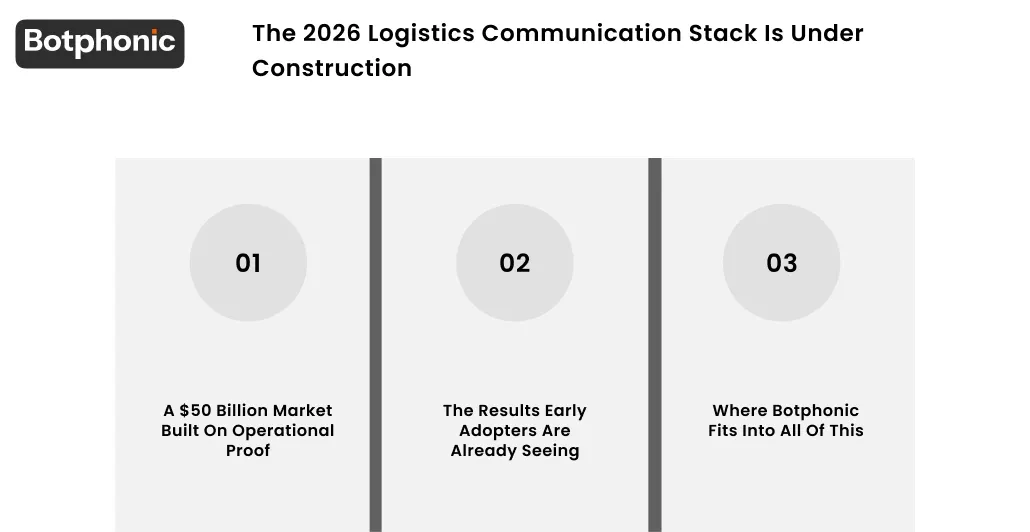
1. A $50 Billion Market Built on Operational Proof
By the year 2030, the voice AI market will reach 50 billion dollars. It is not the capital that is flowing to speculative technology. It is drifting toward operational infrastructure that can be proven to save money. Also, it helps enhance the reliability of the service in an industry with a high volume of communication and a low margin. The logistics is right in the center of that target.
2. The Results Early Adopters Are Already Seeing
Some of the first to adopt 3PL and distribution are already reporting 15 percent decreases in logistics costs, 35 percent decreases in inventory-related errors, 30 percent increases in customer satisfaction following the implementation of voice AI at scale. These do not represent pilot program figures. They are the results of production of companies that acted swiftly and synchronized their systems appropriately.
3. Where Botphonic Fits Into All of This
Botphonic is what the current AI call assistant would resemble for appropriate AI call automation for U.S. logistics, in case it is designed according to the ground-up logistics instead of being based on a chatbot that provides customer support. It handles the volume and is compatible with the systems that you are currently operating. Also, it works at latency requirements of logistics. It operates in languages that your drivers as well as customers understand.
Conclusion
The 3PLs and distribution centers poised to lead this industry through the next five years aren’t waiting for the right moment to transition into the future. They are doing it now – one automated call, one recovered delivery, one dispatcher at a time. The communications infrastructure that once required a room full of people to support is being rebuilt on a platform. It runs 24/7, speaks the language of your operations, and plugs directly into the applications you already use.
This isn’t about replacing people. This is about stopping the bleed – the hours lost to manual coordination, the money lost to failed deliveries, the trust lost to poor follow-through. The problem of call handling in 3PL operations isn’t a feature upgrade away. It is a structural change to a problem that has quietly been eating away at this industry for years.
The tools are ready. The question is whether or not you will start making the transition now.