Summarize Content With:
Introduction
Travel agents are in a business that is highly communicative. Long before a client makes a dream of visiting a place, until they get back home, the questions, updates, alterations and logistics will keep on flowing. And unlike most industries where the interaction between clients can take a predictable pattern, travel planning can and tends to be very personal and in many cases emotional which makes the stakes high on any interaction.
Meanwhile, the travel agencies, especially their independent agencies and medium sized operations do not have a large number of staff. An agency that is busy may get busy calls regarding:
- Visa requirements
- Change fees with the airlines
- Hotel cancellation fees
- Cruise itinerary change
- New booking closures
It is a volume issue with a quality component of relations and precisely what an AI call assistant, as a travel agent, is created to help solve.
Handling Destination Research & Booking Confirmations
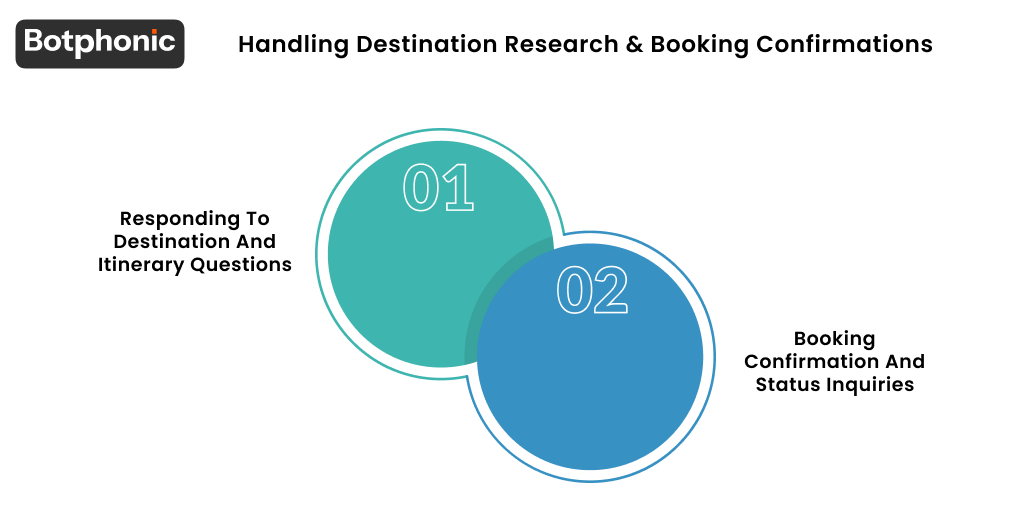
1. Responding to Destination and Itinerary Questions
Among the most time consuming types of calls received by travel agencies are destination research inquiries which the client desires to be answered before he/she makes a commitment to a vacation.
- How is the weather in Thailand during the month of March?
- Should I be visa free to Portugal, being a US citizen?
- Which is the best airport to use when traveling to central London between Heathrow and Gatwick?
They are questions that need destination knowledge but not the entire knowledge that an established travel advisor can offer. A call assistant based on AI with detailed destination information, visa databases, and general information on traveling can respond to these questions and release the expert hand to the consultative aspect of the work, which is to create itineraries and complex relations with clients.
The preliminary queries could also assist the AI receptionist to develop the interest of travel and travel dates of the caller and this forms a lead profile which a human agent can pursue in a full consultation in case the caller is willing to book.
 PRO TIP
2. Booking Confirmation and Status Inquiries
After a trip has been booked, clients make frequent calls to confirm a detailed confirmation number, time of a flight, hotel check-in procedures, transfers, and trip inclusions. These are valid questions, but they are, to a large extent, administrative. An agent who goes to the booking and verifies that the check-in is within the system is doing something that does not involve his or her expertise. Even in studies it has been stated that using AI in systems has helped them engage customers by using natural language which has resulted in fewer ticket creation and boosted CSAT score.
An AI call assistant connected to the agency’s booking platform can address these questions.The system identifies the caller by their booking, retrieves the necessary information, and delivers it quickly and accurately without using agent time.
This is a significant decrease in the number of administrative calls that go through agent queues in agencies that handle hundreds of active bookings at a given time.
Managing Flight Disruptions & Pre-Departure Preparation
1. Flight Re-accommodation, Flight Delays and Flight Changes
Cancellations of flights are a sad reality of travelling. When a client needs to cancel their flight or experiences a significant delay, they require assistance as soon as possible, and they often feel stressed or angry. During high-disruption times such as weather events, air traffic control problems or airline-based operational problems, the number of clients calling the agency at once can easily overwhelm a small agency team.
AI receptionist for travel agents can easily be used as a first-line of attack in case of disruptions. It is able to accept the situation, verify the booking affected by the client, give the options to the client based on the rebooking policy of the airline and either can make immediate rebooking requests in case the system integration allows or can triage the call to the corresponding agent and already have the context.
The disruption is one of the situations in which this triage feature comes in handy. Instead of all lost travelers calling a general queue and waiting on hold as the agents answer calls sequentially, the AI will be able to prioritize cases by urgency and complexity, so that the clients who need a connection on the same day or have a special need are connected to a human agent earlier.
 NOTE
NOTE
2. Pre-Departure Reminders and Document Verification
Travel agents also waste a lot of time in outbound communication in the weeks leading to departure of a client sending reminders on passport validity, visa, travel insurance, check-ins, and any other destination documentations. It is valuable service-providing work, yet, it is also mostly routine and pre-formulated.
- If the client is traveling to a country that needs proof of vaccination, the AI system will check if the client has confirmed compliance.
- If the client’s visa documentation is incomplete, the AI system will highlight the issue and notify the human agent team.
- Reminders about check-in, travel insurance, and transferring luggage are common tasks that the AI system will assist with.
This proactive outreach of has two functions.
- It lowers the number of panics and disruptions at the last minute.
- And, increases the effectiveness of the agency by being a full service partner and not a booking intermediary.
Lead Capture, Travel Insurance Education & After-Hours Availability
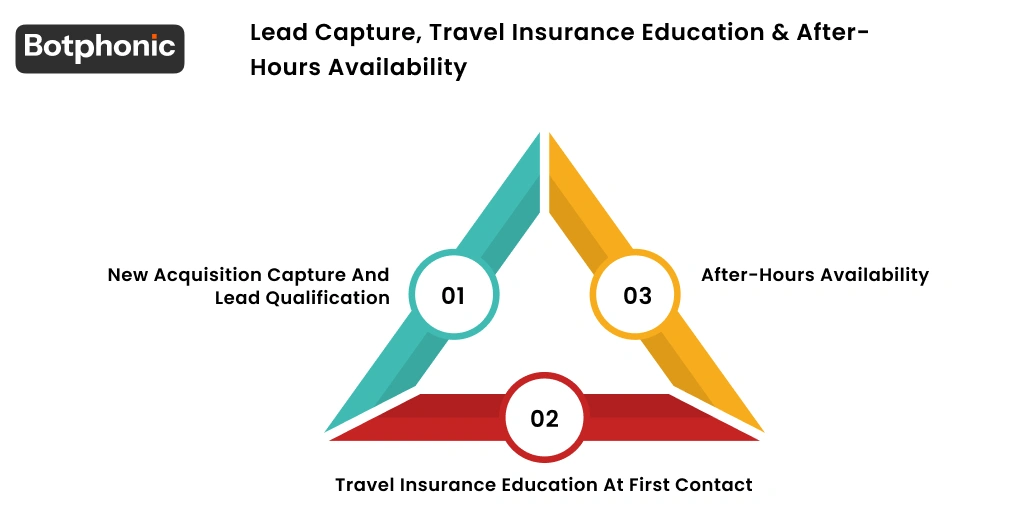
1. New Acquisition Capture and Lead Qualification.
In the case of the travel agencies every enquiry made is a possible booking. However, not every inquiry leads to a reservation; some callers are in the early dreaming stage and will not make a reservation for months, while others have a definite departure date and are ready to book.An AI call assistant can collect the newest inquiries based on the:
- Destination interest
- Travel dates
- Group size
- Budget range
- Special requests and then used to qualify and direct leads accordingly.
High intent leads immediately go to the callback queue of an agent on a priority basis.Opportunities at the initial stages get recorded in the CRM along with their interest profile, allowing agents to track them at the appropriate time by providing relevant offers.
This makes sure that agents are using their outreach time on the leads with the highest chances of conversion, as opposed to going through a single undifferentiated list of calls.
2. Travel Insurance Education at First Contact
Travel insurance is a subject that the clients always misunderstand. And common questions include:
- What is covered by cancellation for any reason?
- Will my medical evacuation cover extant to my pre-existing condition?
- What is the difference between trip interruption and trip cancellation?
An AI call assistant can walk clients through the main aspects of travel insurance options. Offering a better understanding of the main issues. And, explaining them clearly without providing specific insurance advice, which requires a licensed agent.
This type of educational first-contact interaction is beneficial. It makes the client ready to have a more fruitful dialogue with a human agent. And, it can resolve most of the questions that would not otherwise lead to repeated calls.
3. After-Hours Availability
Travel is not business based. The clients move with time zones, and the emergencies are experienced at the wrong time. Conversational AI agents for travel and hospitality ensures that an agency does not merely have a box to leave voicemails, but a real interactive system capable of:
- Responding to routine questions
- Capturing urgent cases
- Directing emergencies where they belong
Travel agency AI solutions like Botphonic have been developed to support a constant service layer. Enabling small and mid-size travel agencies to offer the same sense of after-hours responsiveness. An experience that clients previously felt only with larger online travel agencies.
NOTE
What the AI Doesn’t Replace
It is worth clarifying what an AI call assistant is weak at in the travel industry. Convoluted itinerary planning, subtle destination suggestions based on a customer’s travel style, handling emotions, and addressing challenging travel crises all require human judgment, empathy, and skill.
- Complex itinerary development and curation of destinations that fit the client’s travel style
- In-depth nuances in recommending destinations based on established client relationships
- Emotional support in crisis situations that are “genuine emergencies”
- Managing extremely complex situations such as lost international flights, medical emergencies, or supplier issues
The most successful travel agencies have applied AI to manage the quantity of the monotonous communication in such a way that their senior agents can do the things that machines truly cannot copy. The differentiator is the agent, infrastructure is the AI.
Interested in seeing how an AI call assistant can help your agency manage call volume? Learn more about what Botphonic can do for your travel business
Request a Free DemoConclusion
The AI call assistant in the case of travel agents is not technology of the future. It is a current technology that agencies are using in their operations nowadays. It helps handle the volume of communication and enhance their response times as well as safeguard the capacity of their staff to perform high value work.
These systems receive a significant portion of the calls. That would have landed on an agent desk before destination queries and booking confirmations, as well as disruption triage and lead capture.
In the real world where travel agencies are competing in a fiercely competitive market. And where the demand of the clients is high and the workforce has limited capacity, that is no small change. It is an organizational change in their functioning.