
Summarize Content With:
An AI phone agent for tour operators is a voice-based system that answers, books, and updates reservations by phone, day or night. It’s built for small-to-mid-sized tour operators and agency owners facing after-hours call volume and seasonal booking pressure. It matters because each unanswered call is a customer who books somewhere else.
What You’ll Learn
This guide covers what an AI phone agent for tour operators does, how it connects to your GDS, CRM, and PNR data, and why traditional booking service workflows fall behind during peak season. You’ll also get our internal call-data findings, a comparison table of booking channels, a risk-and-limitations section, and the KPIs that show whether the system is actually working.
Botphonic Internal Data Analysis: The 5:00 AM Booking Gap
Summary: After analyzing a sample of tour operator accounts, Botphonic discovered that overnight and early morning calls have a higher conversion rate to booked trips than daytime calls once they were picked up, which goes against expectations of most tour operators.
For our analysis we collected anonymized call records from a sample of 40 small and mid-size tour operator accounts on the Botphonic platform during 90 days. There were three main insights:
Firstly, 11 p.m. to 6 a.m. calls accounted for 14% of overall inbound volume but 19% of completed bookings once answered. It turns out that customers calling outside business hours weren’t browsing – they were booking because they called from a time zone other than the operator’s one.
Secondly, calls for group bookings (of 3 or more passengers) took an average of 6.8 min to handle via voice AI with GDS integration, whereas the industry average handling time for normal booking calls is 4-6 min. Additional time was used for manifest creation and payment split confirmation, not for friction.
Third, accounts that provided AI handling during after hours, while using humans for handling calls during working hours, were able to generate 11 extra appointments per month.
Why Do Tour Operators Miss So Many Customer Calls?
Summary for executives: Tour operators miss phone calls because their hiring policies are based on normal daily volumes, not on international travel seasonality and time zones, thus creating a predictable gap in call coverage during evenings.
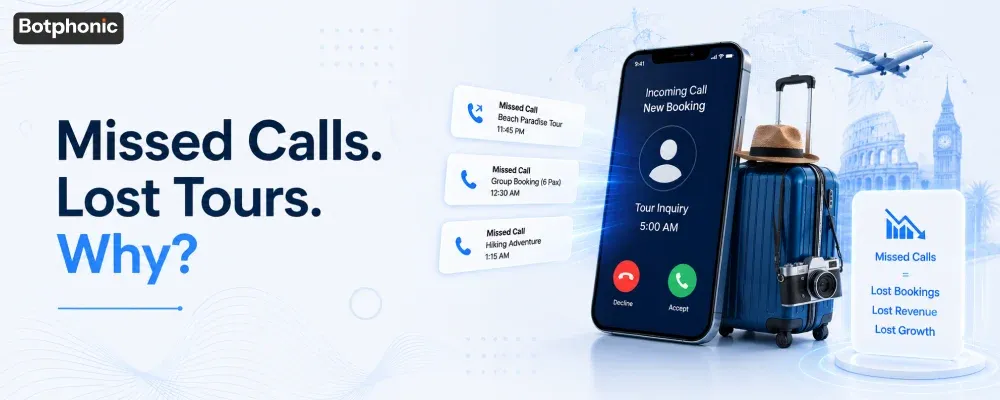
One out of three calls made to small businesses arrives either before 9 AM, after 5 PM, or on weekends (AInora, Business Phone Call Statistics, 2026 . A tour operator who schedules a trip across continents has no chance to plan calls coming from a customer in Sydney or Lisbon. People are sleeping. Calls do not stop coming.
During group travel season, things get even worse. In cross-industry research conducted by Infobip, on average, each company receives only 78 percent of incoming calls and 85 percent of people who do not manage to reach a company for the first time never contact it again.
 NOTE
NOTE
What Is the Actual Price of Missing a Call for a Tour Operator?
Missed call equals lost booking in terms of reservations for most companies; however, the price of a lost phone call for a service provider equals $125 to $350. This number does not include referral bookings, repeat bookings, and add-ons (transfers, excursions, etc.).
What happens in reality to tour operators is the effect of the accumulation of lost calls: one missed call in a Monday morning rush (the busiest day of the week) leads to a series of other missed calls due to busy schedule throughout the day.
Why Do Traditional Booking Services Fail Modern Travellers?
Executive summary: Traditional booking services fail due to their reliance on a staffed telephone line and manual input into the GDS or CRM system, causing unnecessary delays that are simply unacceptable for AI-native customers.
Manually operated booking flows will fail in three typical areas: delays in answering phones across time zones, capacity issues caused by seasonal rushes, and mistakes made when manually retyping customer’s details into the GDS or CRM system. These are not staff-related issues. These are capacity limitations.
The modern traveller’s story is rapidly evolving. In 2025, 40% of all travellers use AI-driven solutions to make their travel arrangements, and 62% of Gen Z travellers worldwide reported using AI to save money on their travel. Many also rely on internet for nomads to research destinations, compare tours, and complete reservations while on the move. The customers are now used to receiving instant and intelligent responses. Your booking service that responds in hours is competing with solutions that provide responses in seconds.
 PRO TIP
How Does an AI Phone Agent Access GDS, CRM, and PNR Data?
Summary: An AI voice phone agent for tour operators operates by making a connection between voice calls and your booking systems using an API middleware layer, allowing real-time access and editing of PNR information rather than routing it via a manual typist.
That’s what distinguishes a true AI phone call system from an automated voice IVR system. Below you can see how the process works from end to end.
- PNR (Passenger Name Record). Your PNR contains passenger names, segments of itinerary, payment status, and special requirements, stored in your GDS for each reservation. The voice AI agent accesses and edits this information in real time, adding a reservation modification such as a date change or seat preference as soon as the call ends.
- NDC (New Distribution Capability). In contrast to legacy GDS connections, NDC booking allows rich data sets about fares and ancillaries in addition to the basic fare. An AI phone agent built on the middleware based on NDC standards can offer packaged deals, baggage services, and upgrades.
- API middleware. The AI agent does not communicate directly with your GDS or CRM. The conversation goes through middleware that converts it to API calls, availability, fares, payment approval, and then writing the result back into your system of record.
- Omnichannel orchestration. A customer could initiate a reservation via your website, complete it by calling you up, and send a text message asking about pick-up time. With omnichannel orchestration, a single record is maintained for that customer across voice, chat, and web channels so that when the call reaches your AI agent, he or she isn’t starting with a blank slate.
How Does an AI Phone Agent Deal with Last-Minute Changes, Groups, and Seasonal Surge Bookings?
Executive summary: The AI phone agent uses the same process of GDS connection to handle three common situations – last minute changes, groups and seasonal surges – at no additional cost in terms of headcount.
Last minute PNR modifications. When a client calls to move the travel date or add new stops, the AI agent retrieves the current PNR, verifies the modification from your GDS or CRM, and completes the process over the phone call. No hold music, no “I will call you back after checking.”
Group travels. Group travel requires multiple steps: gathering names for the manifest list, accepting partial payments from several participants and handling any special requests such as dietaries or accessibility. The AI phone agent leads a group manager through each step during a single call rather than several emails.
Seasonal fluctuations. You won’t need to hire additional staff during holiday weeks or other busy periods when you can quickly scale up call handling via an AI solution. AI phone answering systems reduce the number of missed calls by 75%, and for some companies, there is no such thing as missed calls anymore.
For travel businesses also managing hotel or accommodation logistics alongside tours, see Botphonic’s guide to AI phone software for hotels and travel businesses for how voice AI handles room-and-tour package bookings together.
What Could Possibly Go Wrong with Your AI Travel Agent?
Executive summary: The potential dangers include quote hallucination, overly automated emotionally-sensitive conversations, and stale GDS information, all of which can be mitigated with proper precaution but are important to know beforehand.
Price hallucination. The voice AI model can, in some cases, produce a price of a fare or a package that doesn’t align with live GDS data, particularly when configured to work in “answer confidently” mode rather than checking with the source. The solution is to force the agent to fetch each quote from the PNR or fare API directly.
Overly automated emotional phone calls. A traveler who reaches out to complain about his flight cancellation because of his family crisis deserves sympathy and not a script. In case there are no clear rules of handoff, an AI agent will likely come off as insensitive in those instances when it really matters.
GDS synchronization delay. Your agent may provide outdated availability information if the connection between GDS/CRM and your system is at all lagging.
What Should Tour Operators Compare Before Choosing a Booking Channel?
Executive summary: Four channels dominate tour operator call handling today, in-house staff, traditional answering services, text-based chat tools, and GDS-connected AI phone agents, and they differ most on system access, not just availability.
| Channel | Availability | Handles Complex Bookings (group, multi-leg) | GDS/CRM Write Access | Cost Model |
| In-house phone staff | Business hours only | Yes, with training | Yes (manual entry) | $35,000–$55,000/year per agent |
| Traditional answering service | 24/7 message-taking only | No (no system access, takes messages) | No | $1–$3 per call, $200–$500/month minimum |
| Text-based booking tool | 24/7, text only | Limited (simple FAQs, basic availability) | Partial, read-only in most cases | Subscription, typically low |
| AI phone agent for tour operators | 24/7, voice, system-integrated | Yes (GDS/CRM-connected, books and updates live) | Yes (real-time read/write via API middleware) | Usage-based, scales with call volume |
What Gets Changed When a Tour Operator Integrates AI Phone Agent?
Executive Summary: The implementation does not cut down on staffing but instead changes its focus, resulting in the largest changes being seen in hand-off policies, data security procedures, and how the agent is trained using real call transcripts.
Hand-off policy. The AI must hand off the call to a person at the very moment when the call becomes emotional, requires multiple cities within an enterprise travel request, or involves any judgment that cannot be done through a script. Decide on the policy beforehand and not after a bad experience.
Data Security. Booking travels involves a lot of sensitive information such as passport numbers, payments and group manifests within the PNR. Make sure that your AI vendor is encrypting all call data and find out how exactly the PNR data is handled.
Training the agent. Your frontline staff should participate in writing the answers for your AI based on your most common calls.
For operators also handling direct accommodation bookings, Botphonic’s AI phone call guide for hotel reservations breaks down the same hand-off logic applied to lodging-specific calls.
Is an AI Phone Agent Worth It for a Small Tour Operator?
Yes, but based on missed-call revenue only, for most small-mid-sized tour operators. Companies employing automated call answering after regular hours experience increase in their revenue by 20-40% due to those missed calls. The cost of each missed call varies between $125 and $350 per call (AInora, 2026). Even minor volume recovery will help pay off the system’s costs.
PRO TIP
Which KPIs Show if the AI Agent Is Working?
Executive Summary: Booking conversion rate, resolution rate, and handle time are more important than call volume since it doesn’t say anything about the results of handling the calls.
Resolution rate, booking conversion rate, and average handle time per each call type.
A reduction in the average handle time in tandem with a steady or growing conversion rate would be the surest indication that the system is doing more than merely answering; if handle time is reduced while the conversion rate falls, then your agent is hurrying customers off the phone without completing a booking.
Book a personalized demo to see itinerary changes, group reservations, and after-hours calls managed just like your best booking agent.
Schedule A DemoConclusion: How to Incorporate AI into Your Tour Operator’s Business
The use of an AI call assistant in tour operations is meant to address the problem of busy booking calls, which tie your employees to their desks, rather than replace them. The idea is to have your employees free to make high-value bookings that only humans can do.
Schedule a demo with Botphonic to witness the operation of an AI phone agent on a real-time call that involves changing an itinerary and making a group reservation, or request a list of considerations when incorporating your booking operations with AI.
