Summarize Content With:
“AI voice technology is silently transforming the way policies are handled, queries are addressed, and trust is established, and that is why insurers who are ready to reconsider communication with their customers can change how insurance works.”
Introduction
If you have ever taken a job in an insurance company, then you know the noise: you hear phone calls all the time.
There is a need by a policy holder to get clarification on coverage. One of them wants a follow-up on a claim. Somebody is making a payment on a policy that is out of time. Add in thousands of customers, day-in day-out. The effort of the majority of insurers is to address this by enlarging call centers
“Size in itself is not the solution”
Customers still wait. Agents continue repeating the same information dozens of times in a day. Administrative teams find it hard to maintain consistency of service. And leadership still poses the question:
The Best Method To Deal With Insurance Communicatio
It’s the phase where an AI call assistant for business is starting to bring some tangible change.
Not as a gimmick. Not as a futuristic concept. But as it means practical facilities to contemporary insurance work.
“The change is gradual initially – then radical
Customer expectations do not change slowly. Technology is either up to date or they are phased out.
The insurers who have realized this early enough are silently re-inventing the functionality of the whole phone experience.
The AI in insurance delivers customers what, when, and where answers correctly like :
What is my policy number?
When will my policy be over?
Where can I download my premium slips?
The Reason Why Insurance Communication Is Under Pressure
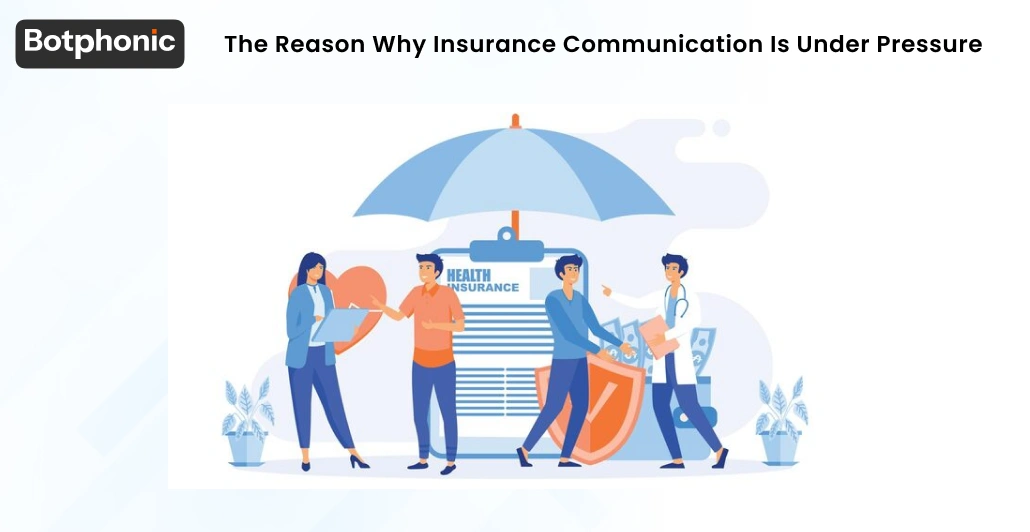
Insurance is a personal business. Any policy is a sign of trust, risk and commitment in the long run. However, on the negative side, most companies use the old system of communication.
This has been a gap that has become more pronounced.
Those customers that place orders on grocery apps and monitor packages on their position do not realize why they need to wait on hold 20 minutes to have a claim updated. Companies like Botphonic and international consultancy firms like KPMG have repeatedly referenced artificial intelligence as a breakthrough to insurers – especially in making decisions and serving the audience.
However, voice communication is one of the most ignored opportunities.
“The moment that is most emotionally laden in the insurance journey is still the phone call”
A slow reaction to a claim or policy emergency may define the perception of a customer on an insurer over a long period of time. That fact is driving businesses to more intelligent communication infrastructure.
Deep Dive Into The AI Call Assistant – Beyond the Buzzword
The term AI call assistant at first sight appears to be yet another automation program. As a matter of fact, it is much more subtle. The AI call assistant for business purposes nowadays understands speech, retrieves company data, and provides feedback in natural language, in the real time.
They do not confine customers in fixed routes as the traditional phone menus. Rather, they act more as an informed front-line person who never feels fatigued and never keeps the callers on hold.
The technology is the crossroads of:
- conversational AI
- voice recognition
- insurance data systems
- workflow automation
Context is what makes the difference.
An AI call assistant for business motive does not hear a question. It realizes the motive of it. It is not about being robotic or human. This is to be useful immediately. That minor difference is why the latest AI personal assistant for insurance sector are completely different to the old IVR tools.
At What Core Areas, The AI Call Assistant Revolutionize The Insurers Work
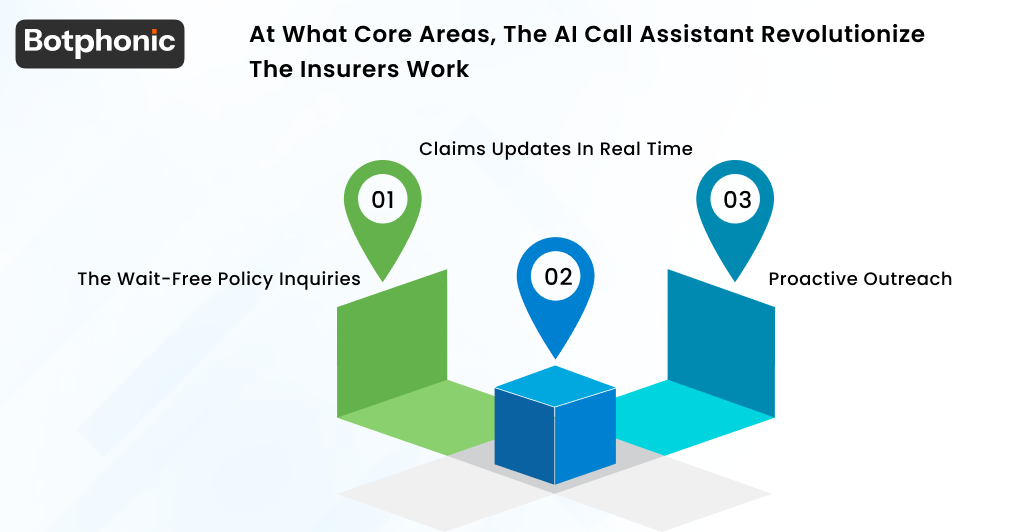
The majority of the people envision the AI call assistant for business, responding to easy questions. The truth within the insurance organizations is more interesting. Below AI call assistant for business start reconfiguring the flow of everyday activities when implemented wisely :
1. The Wait-Free Policy Inquiries
Simple information, such as confirmation of coverage, renewal dates, and deductible, after requested by policyholders.
These are valuable discussions, yet not necessarily ones that involve human intervention. The appropriate policy data are retrieved by the AI systems and provided with the answer in real-time
The impact of an AI call assistant for business is so strong that customers receive immediate clarity, and agents are not busy with difficult dialogues.
“Service is not undermined by speed. It amplifies it.”
2. Claims Updates in Real Time
A claim is one of the few important moments to a policy holder. Conventionally the customers would have to call, wait and identify and update. The procedure is sometimes slow and baffling.
AI call assistant for business operations reduces that whole chain. The system identifies the caller, records the claim and gives the most up-to-date status in a few seconds.
To most insurers, this alone is an ability that cuts the pressure on the call center by a significant margin.
3. Proactive Outreach
Outbound communication is one of the least considered advantages of an AI call assistant for business. Instead of customers calling the insurers, they can automatically call them about:”
- upcoming premium deadlines
- missing documents
- policy renewals
- coverage opportunities
These discussions can be timely and not forceful when properly done.
“AI just makes this time scale-wise possible. It is the best factor of customer retention “
Conventional IVR and Smart AI Call Assistant
A large number of insurance executives believe that their current phone infrastructure is satisfactory. A closer examination tends to indicate a bleak contrast.
| Capability | Conventional IVR | AI Call Assistant |
| Interaction | Menu-driven | Conversational |
| Response Speed | Dependent on queues | Instant |
| Personalization | Minimal | Data-informed |
| Learning Ability | Static scripts | Continuous improvement |
| Customer Frustration | High | Significantly reduced |
| Operational Insight | Limited reporting | In-depth conversation analytics. |
The shift here isn’t cosmetic
The AI in insurance modifies the speed of customer service and the effectiveness of teams working in the background.
“Friction should not be introduced on top of another layer”
That principle determines whether AI in insurance enhances service or is only a case of the replacement of one frustration with another.
Insurance Call Audio: A New Area of Exploration
Customer calls are viewed as one time interactions by most companies. After the end of the call, the information is wiped away in recordings and compliance archives.
The AI call assistant for business does not make calls in the same way. All discussions are organized into data.
Patterns begin to emerge:
- recurring policy confusion
- delays in claim processing
- coverage misunderstandings
- customer sentiment trends
These revelations tend to expose areas of operation that the leadership has never observed.
Customer feedback can be most valuable when it is not surveyed but rather when it comes as a result of a real conversation.
The product design and communication to customers becomes better when the insurers analyze call intelligence in a proper manner.
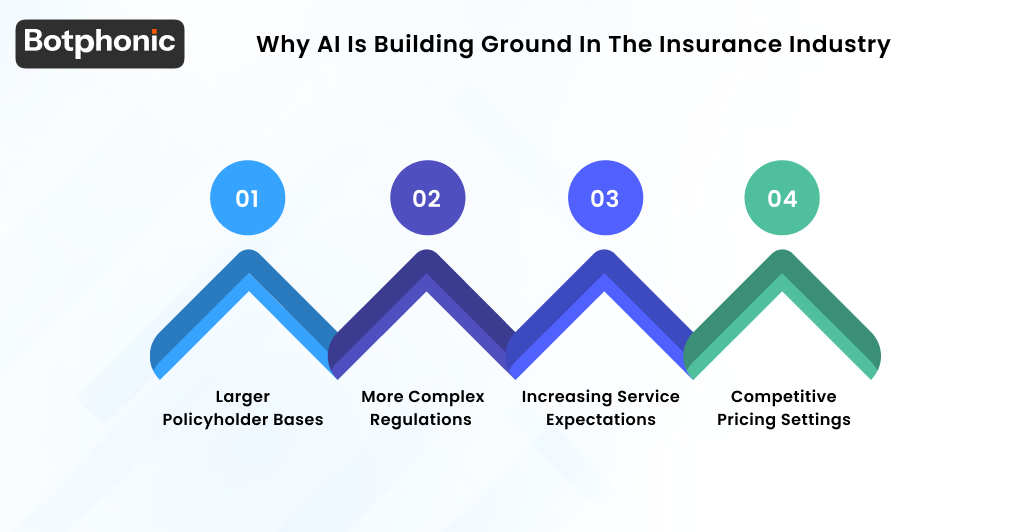
Why AI Is Building Ground In The Insurance Industry
Artificial intelligence is no longer an experiment across the industry.
The AI call assistant for business becomes an acknowledged part of a more comprehensive strategy to transform the firms that start to consider the AI implementation.
Conversational interfaces service platforms like Ada have highlighted the increasing importance of customer experience platforms in the scaling of service operations.
The incentive of insurers is not fashionable.
The pressure of operations continues to grow:
- larger policyholder bases
- more complex regulations
- increasing service expectations
AI call assistants take the burden off on many fronts simultaneously.
“Adoption of Insurance technology is typically a slow one, until it is not.
As soon as some companies can demonstrate that they have gained efficiencies, other companies in the industry become likely to adopt it promptly.
Botphonic attends every client inquiry, seamlessly detects frauds, forecasting risks, automatically updates policies, and easily handles operational work.
Request a Free DemoA Strategic Framework: Where AI Provides the Highest Short-term Value
Before taking up new technology, insurance leaders usually pose the same question:
How AI receptionists for insurance agencies actually work for improving business?
As shown in the table below, the AI call assistant for business is reliable in yielding quantifiable returns in their areas of operation.
| Insurance Function | AI Capability | Strategic Impact |
| Customer Support | Quick response | Increased satisfaction and reduced call lines. |
| Claims Assistance | Automated status updates | Faster service perception |
| Policy Management | The information on coverage and renewal. | Reduced agent workload |
| Sales Inquiries | Conversations on qualifying leads | Increases conversion efficiency |
| Payment Reminders | Automated outbound calls | Fewer policy lapses |
| Service Analytics | Conversation insights | Better strategic decisions |
To most insurers, the three categories are enough to warrant adoption.
And all after that is extra upside.
Core Factors To Address Before Implementation
Even with all the hype around AI, intelligent implementation is important. The process of insurance companies takes place in a very regulated environment and communication networks cannot be lax. A number of practical points are worth to note down :
Insights on Legacy Technology Integration
Numerous insurers continue to use the core systems of their decades past.
AI assistants should be able to communicate with policy databases and CRM systems as well as claims engines.
“Automation will be superficial without such integration”
Customer Comfort and Trust
All callers do not instantly accept automation. An intelligent AI experience takes this into consideration and ensures that human escalation is made smooth.
The customers are never to be held prisoner by technology
“Automation has succeeded when the customer doesn’t realize its AI voice . Such a level of comfort cannot be designed accidentally.”
Data Compliance and Protection
The issue of insurance often implies personal and financial data. Any AI communication layer should comply with high privacy and regulatory requirements. Companies that do not take this step seriously end up in grave consequences.
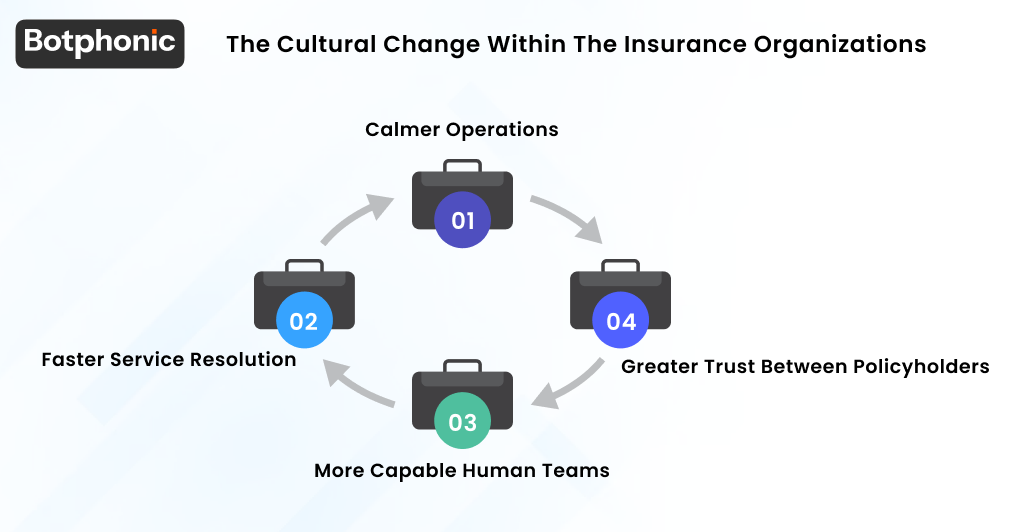
The Cultural Change within The Insurance Organizations
Customers are not the only ones that are influenced by technology. Also, it transforms the culture internally.The agents who previously used to take hours to respond to repetitive questions are placed in different schedules.
They deal with subtle cases instead of asking mundane questions that demand judgment and compassion. The primary concern of many teams is that automation will take away jobs.
The opposite often happens.
When IT eliminates mind-numbing work, experience is finally seen. The net outcome is that the workforce is not as preoccupied with mechanical work but rather decision making and customer relations.
Such a shift is likely to enhance both job satisfaction and quality of the services.
The Strategic Opinion
In the next several years, a revolution in the communication of the insurance industry will take place silently. It is not that companies are suddenly desiring to be innovative; but that they simply do not have an operational alternative.
The expectations of the customers have changed already. It has become the thinking of people that information must be instant, customized and accessible at all times. Insurance firms who are still depending on the traditional call centers will become strained under strain.
In the meantime, companies that invest in intelligent communicational systems will feel something different:
- calmer operations
- faster service resolution
- more capable human teams
- greater trust between policyholders
Automation is not interesting in particular about AI call assistants.
It is the redistribution of attention. The mundane activities become subdued. Human knowledge shifts up to the front. It is where insurance companies make real value.
“The future of insurance service is not human vs. AI. It’s human focus enabled by AI.”
The insurers that realize this in time will not merely operate more efficient call centers. They will transform the experience of policyholders towards the whole company.