
Summarize Content With:
What You’ll Learn:
- What AI phone call software for insurance does during FNOL intake, and where it stops
- How conversational AI for insurance manages renewal-season call spikes without adding staff
- How voice biometrics strengthens fraud detection on claims calls
- Which state recording laws apply to AI insurance calls in 2026, and why they’re still evolving
- What separates purpose-built insurance call center software from general VoIP tools
AI phone call software for insurance is a category of voice automation tools built specifically for high-stakes inbound and outbound calls, FNOL intake, renewal reminders, billing inquiries, and compliance-heavy recording disclosures. It’s designed for agencies and carriers that handle structured, repeatable call types at volume. If your operation deals with claims calls or seasonal renewal surges, this directly affects daily workflows.
What Is AI Phone Call Software for Insurance, and Why Do Agencies Need It?
AI phone call software for insurance is a voice-based automation technology used to engage in structured insurance conversations without having to have live agents on every single call. Here’s why you need this for your agency: calls are answered instantly, incident information is consistently recorded, and nothing slips through the cracks during peak times.
The insurance industry is one of the most high-pressure phone call industries out there. Someone calling in following an accident or a fire isn’t window shopping – they’re in distress. Renewal callers who go into voicemail usually switch to another carrier by the end of the day.
Why Legacy IVR Fails Under Pressure
Older Interactive Voice Response (IVR) technology was designed to route calls, but not to have a conversation. It asks callers to push 1 or say “claims,” and transfers to an agent queue that’s already overloaded.
This waiting period in renewal season or following a regional weather event turns out to be counterproductive. In a survey conducted by Salesforce, in its State of the Connected Customer Report (2023), more than 83% of people expect immediate engagement upon reaching out to a company. This is something not easily accomplished via existing systems in most insurance call centers.
What happens as a consequence? Long waiting times, data inaccuracies, and missed opportunities.
How is AI used for First Notice of Loss (FNOL) Calls?
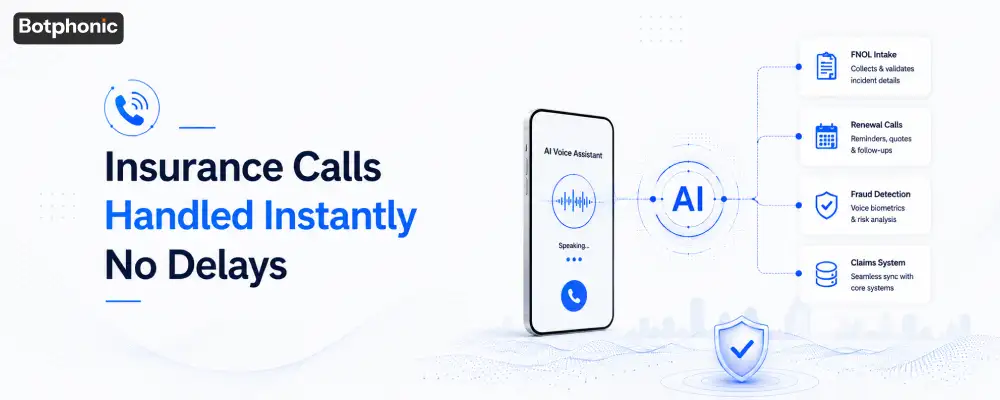
First Notice of Loss (FNOL) is defined as the notification that a customer reports to an insurance provider about an occurrence that could lead to a claim. AI processes FNOL calls in a systematic and conversational way that involves the collection of all necessary information, identity verification, and pushing all information in a structured way to connected claims management systems.
And it does make sense since the information collected from that call influences the whole further process adjuster workload, possible fraud, claim handling time, etc.
What a Full AI-Handled FNOL Call Looks Like
Take a look at how auto accident FNOL call looks like when handled with conversational AI for insurance:
- Call answered without delay – no hold, anytime day or night
- Identity verification – policy number, full name and date of birth validated against the policy
- Incident intake – date, time, location, vehicle(s), injuries and third party contact information captured
- Urgency detection – if injuries are mentioned, an escalation flag is automatically raised
- Record creation – structured FNOL record posted to the integrated claims management system (Guidewire, Majesco or Duck Creek)
- Claimant confirmation – claim number confirmed, and instructions for what happens next provided
 PRO TIP
Transfers of AI to a Human Representative Needed
AI takes care of routine structured intake without problem. However, it is not appropriate for all scenarios. Transfer immediately if:
- Injury or death is reported by the caller
- The call concerns a commercial fleet or high loss property incident
- Fraud signals present themselves – inconsistent dates, pressure from a third party, frequent references to prior claims becomes emotionally distressed and asks for a person
- Litigation or representation by a lawyer is mentioned at any stage
The following triggers should be programmed into your escalation logic and not decided upon during real-time AI analysis.
How Does Voice Biometrics Enhance Insurance Claim Calls?
Voice biometrics refers to using a caller’s voice characteristics including pitch, cadence and formants to authenticate and evaluate the potential fraud threat in real time. The implications for AI in insurance are: it provides an additional layer of verification which does not rely on knowledge-based questions that a fraudster could easily research.
This is precisely what is currently missing from most insurance AI applications. Identity verification on claims calls has traditionally relied on requesting for a policy number and date of birth – information which is more readily available after data breaches and social engineering.
Why Voice Biometrics is Important for Insurance Claim Calls
There are two ways in which voice biometrics solves insurance fraud problem:
Passive enrollment and matching: A voiceprint of the speaker is created based on their normal conversation; no requests like “say these three words” are needed. Upon further calls, the live voice is matched to the voiceprint in the background without disrupting the conversation.
Anomaly and spoofing detection: Contemporary voice biometrics solutions detect synthesized voices, replay attacks, and voice alteration tools. Specifically in insurance, that’s important since tools to create deep fake audio are now easily available and can be used to commit insurance frauds.
Currently existing platforms providing voice biometrics useful for insurance include Nuance Gatekeeper, Pindrop, and Verint Voice Authentication. The platforms integrate into claims management systems differently; notably, Pindrop offers detailed data regarding how they work in insurance industry which is recommended to study prior to purchasing.
What Voice Biometrics Does Not Replace
Voice biometrics reduces insurance fraud risk. It does not remove the risk completely. Agencies should consider it as an additional layer in the stack of fraud detection tools, namely:
- Comparing claim information with policy history
- External data verification (CLUE reports, ISO ClaimSearch)
- Fraud adjusters’ examination of suspicious calls
- Voice biometrics works best when integrated into FNOL call flow itself.
Voice biometrics data is governed by biometric privacy legislation in some states, such as Illinois (BIPA), Texas (CUBI), and Washington (My Health MY Data Act). Before launching voice biometrics for calls made to insurers, the agencies will have to secure explicit informed consent from callers in states that fall under these legislations. Seek legal advice, this is no mere compliance tick-box process; this is the emergence of case law.
How Does AI Phone Software Assist Insurance Agencies during Renewal Season?
The renewal season is that period when a number of policies expire at once, usually causing a predictable operational crisis for insurance firms. The AI phone software deals with this surge by undertaking an outbound campaign, responding to the influx of queries, and directing the callers to licensed advisors, all without hiring any temporary staff.
For independent agencies, the customers that will probably switch are those that won’t be able to reach the agency during this period.
How Proactive Outbound AI Retention Works
AI finds policies expiring within a configurable time frame usually 30, 60, or 90 days using integration with agency management software including Applied Epic, HawkSoft, or AgencyZoom. Automatic dialing is conducted on this list.
Typical components of an outbound renewal call include:
- Explanation of premium change, if applicable
- Summary of current coverage and any changes from previous period
- Payment options and deadlines
- Warm transfer to a licensed advisor if the client needs coverage adjustment
According to the research conducted by Bain & Company on insurance customer loyalty(2022), the 5% customer retention increase results in profit growth of 25% to 95% in insurance industry. Renewal calls that get to customers before they start their shopping are the most straightforward approach to achieve this objective.
PRO TIP
What Are the Recording Consent Requirements for AI Insurance Calls, and Are They Evolving?
Recording consent for insurance calls is regulated both federally and on a state-by-state basis. AI call recording software must use the right disclosures depending on caller location, rather than using a one-size-fits-all approach to disclosure.
It’s this compliance piece that many agencies overlook, but which continues to evolve.
Federal vs. State Recording Requirements: What Insurance Agencies Need to Know
Federally, the Electronic Communications Privacy Act (ECPA) is a one-party consent requirement. But 13 states have a two-party (all party) requirement for consent before a call may be recorded. Important states for insurance agencies include California, Florida, Illinois, Maryland, Massachusetts, Michigan, Montana, Nevada, New Hampshire, Oregon, Pennsylvania, Washington, and Connecticut.
| Jurisdiction | Consent Standard | Disclosure Timing | Notable Penalty |
| Federal (ECPA) | One-party | Before recording begins | Civil liability |
| California (Penal Code §632) | All-party | Before recording begins | Up to $5,000 per violation |
| Florida (§934.03) | All-party | Before recording begins | Felony + civil damages |
| Illinois (Eavesdropping Act) | All-party | Before recording begins | Class 4 felony |
| Texas | One-party | Before recording begins | Civil liability |
| New York | One-party | Before recording begins | Civil liability |
| Washington | All-party | Before recording begins | Civil liability + criminal exposure |
Why AI-Specific Recording Consent Law Is Still Evolving
Recording consent requirements were made for human representatives and human callers. The AI adds an important twist in at least two respects that aren’t yet being litigated.
First: When the use of AI technology involves the AI system making a call, and not merely recording a call, questions exist regarding whether current consent frameworks even apply in the same way. In some states, attorneys general have started providing guidance, while other attorneys general have yet to do so. The Federal Trade Commission’s 2024 guidelines on AI and deception create a further level of guidance for government agencies conducting AI-based outbound calls.
Second: Voice biometrics added to the call recording process creates a separate issue of collecting biometric data outside of the consent issue related to the recording. The two issues are covered by different laws and have different exposure.
This means that government agencies should not rely only on platform-based compliance logic. Geo-dynamic consent handling processes deal well with the consent issue, but they don’t address the whole situation regarding the data collection and processing aspects of AI technology. Engage legal counsel before using AI technology to conduct insurance calls, especially when voice biometrics is part of the solution.
For a more detailed breakdown of encryption, audit trails, role-based access controls, and data retention standards for insurance call platforms, see AI phone call security and compliance explained.
Criteria for Choosing AI Phone Call Software for Insurance Agencies
The right AI phone call software for insurance will be specifically built for insurance use-cases and not simply generic VoIP telephony software plus conversation on top. What does this mean for practical application? This difference will be apparent in how well the system will handle edge-cases, escalations, and claims system integration.
General VoIP vs. Purpose-Built Insurance AI: A Direct Comparison
| Feature | General VoIP + IVR | Purpose-Built Insurance AI |
| Call answering availability | Business hours only | 24/7 |
| FNOL intake | Manual agent note-taking | Automated structured intake |
| Claims system integration | Rarely included | Native API connections to Guidewire, Duck Creek, Majesco |
| Renewal outbound campaigns | Not available | Built-in campaign logic with CRM sync |
| Compliance disclosures | Static scripts | Geo-dynamic by caller state |
| Escalation logic | Rule-based menu trees | Intent-based real-time detection |
| Voice biometrics | Not available | Integrated or third-party API |
| Conversation analytics | Basic call logs | Full transcript plus sentiment output |
| Insurance-specific templates | None | Pre-built for FNOL, renewal, billing, COI requests |
What Insurance Agencies Get When Deployed
Insurance agencies that have implemented the AI phone call software for insurance during renewal season have seen the following results in 90 days after deployment.
The first one is that there will be an improvement in inbound call answer rate since calls are immediately handled by the system instead of being queued. The second one is the quality of FNOL data collected by the agency due to the fact that AI handles each call according to the same intake protocol – without fluctuations associated with agent fatigue and inconsistencies in training and shifts.
Implementation Approaches Yielding Verifiable Results
Avoid theoretical implementation scenarios. Instead, consider these practical approaches:
- Identify one type of call to begin with after-hours FNOL intake is the quickest verifiable achievement
- Develop using existing scripts import your existing FNOL intake script and your top 20 recorded calls
- Connect to your claims management system prior to launch make sure your system will integrate successfully with Guidewire, Duck Creek, or Majesco
- Create all escalation scenarios initiate test calls where injuries are mentioned, where fraud flags are raised, and where distressed customers speak
- Analyze transcripts on a weekly basis during the first 60 days optimize based on customer utterances rather than assumptions about their needs
For a broader review of how AI phone assistants perform across call types and agency sizes, see AI phone call assistants compared including what to look for in platform evaluations before committing to a vendor.
For your upcoming renewal season or CAT activity, check two numbers from your current call handling system: How many FNOL calls go to voicemail outside of business hours? How many renewal calls never reach a licensed agent on the same day they called? Those will be your current performance indicators – and strongest evidence for or against implementing AI phone call software. Learn how purpose-built insurance agency AI phone call software solves those issues.
