Summarize Content With:
Introduction
IVR has become a household name to you, as long as you have been working in a dealership, or calling one as a client. The automated call management tool has been decades old and it is the interactive voice Response Systems. Press 1 for sales. 2 for service, 3 for parts. 0 to repeat these options.
There are numerous dealerships that are operating on these systems and most of their customers fear calling in because of them. It is not a helping experience, but a friction one. And yet when it is time to talk about the issue of AI call assistant, the question that the dealership operators usually ask first is: How is this any different from the IVR we already have?
It is a reasonable question, and the answer is far beyond marketing language. The distinction between the conventional IVR and the modern AI call assistant to car dealers is grounded in functionality and consequences, on how the technology functions, what it is capable of, and what the customer experience actually feels like.
IVR Routes Calls, AI Resolves Them
This constitutes the basic difference. IVR systems are routing systems. They are supposed to ensure that the caller is directed to the appropriate department or the appropriate human. They do not even aid the caller into achieving anything, they simply categorize the call.
An AI call assistant is created to complete the interactions and not to transfer the interactions.
For example:
- A caller who needs to know the status of oil change on a Thursday morning
- AI will have access to the scheduling system
- It will confirm the slots.
- And lastly, make the appointment.
That is achieved by addressing the need of the caller in that one interaction. No handover to service advisor required, no hold up time, no phone tag.
IVR would dial 2, place the caller on hold and then wait until a service advisor picked up. The AI closes the loop.
Quick Comparison
| Feature | IVR | AI Call Assistant |
| Primary role | Route calls | Resolve requests |
| Interaction type | Menu navigation | Conversational |
| Appointment booking | Requires human agent | Can complete automatically |
| Customer experience | Waiting and transfers | Immediate resolution |
 PRO TIP
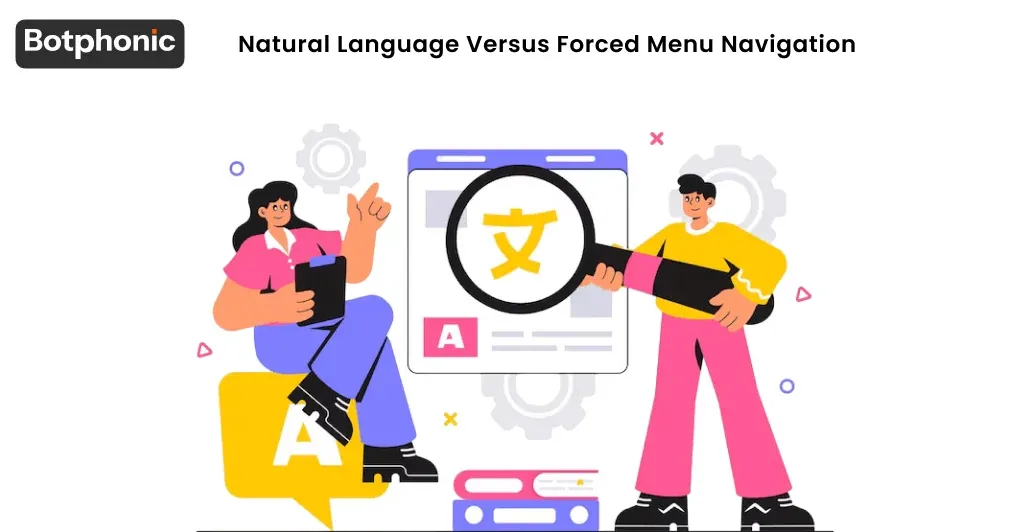
IVR is a system where the caller is supposed to adhere to a set menu. The caller must determine which numbered choice relates to what he/she really desires and this is not always evident. When their need does not fit easily in the menu categories, which is often the case, they dial 0 to the operator and the automated system offers no value whatsoever.
A car dealer AI call assistant is inputted by talking to it. A customer can request a used F-150 that he/she had purchased with the company last month and state that the check engine light appeared on the dashboard, and the AI deciphers the intention, retrieves the necessary information about the vehicle, and directs the call accordingly – or schedules an appointment to a service station in case it is required.
This is no minor difference in conveniences. It is the difference between the caller who hangs up in frustration and the caller who achieves his mission. In the case of dealerships, that difference is reflected directly in service reservations, lead acquisition, and satisfaction rates.
 NOTE
NOTE
IVR: Stateless Interaction
IVR systems are stateless. They forget what was previously going on in the call. Traditional IVR includes
- When a caller chooses the wrong menu option and needs to restart
- He or she begins at zero
- They get to a department and are passed back to another department
- Each agent asks same
AI: Context-Aware Conversations
AI call assistants are able to keep the context of a conversation. They rcan:
- Recall the words of the caller two minutes ago
- Take it into consideration in the further responses
- In case of the human escalation, the AI transfers that context
- The agent is informed on who called, the reason for the call and what was already discussed.
The call center person does not need to repeat. The AI system allows managers to keep track of call, chat, and other interaction collected by the system for keyword or sentiment tracking. This context continuity in a dealership setting where the customer might call in with various issues, and the customer might call a service appointment but begins by inquiring about a recall alert, it is what will have a great impact on the experience of the customer making the phone call.
Live Data vs. Static Scripts
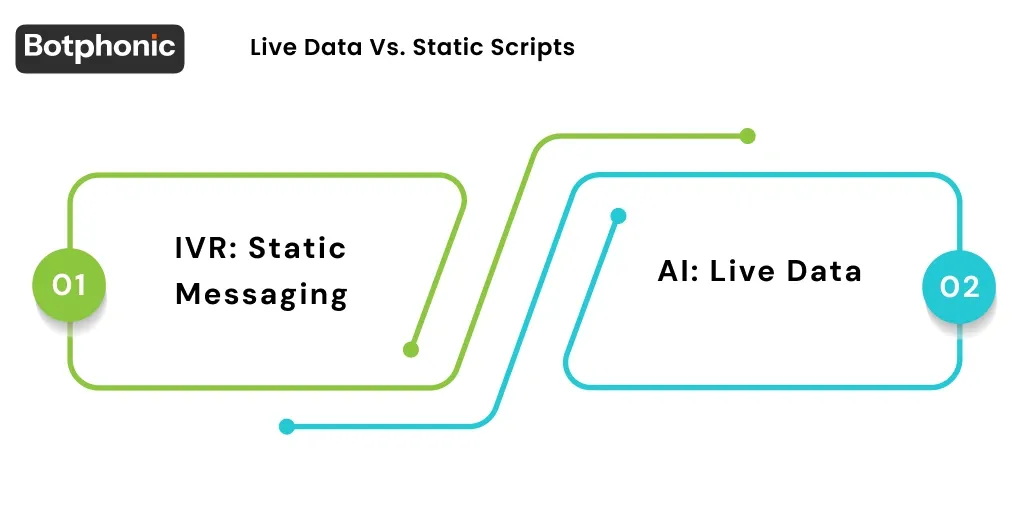
1. IVR: Static Messaging
Conventional IVR systems read out canned messages or voice scripts.
- They can’t access live data.
- They are unable to answer a call, whether a specific vehicle is in stock or whether this day has service time available due to being not attached to the real systems of the dealership.
An effectively linked artificial intelligence call assistant links to the dealership DMS (dealer management system), service booking application, CRM and inventory management site. The
2. AI: Live Data
AI can scan up-to-date inventory on demand when a caller wants to know whether a particular model is in red. When they have to make a service appointment, the AI does not provide them with general time slots, but rather with actual availability.
It is this live data access that allows the AI to actually make transactions and not just direct calls. In its absence, the AI is more advanced than IVR but is not essentially more helpful.
Feeling Detection and Adaptive Reactions
The IVR is not aware that a customer is frustrated. It repeats the prompts whether the caller is calm and relaxed or mad and time-starved. This is one of the most prevalent causes of increasing frustration in an automated phone system due to its tone-deafness.
The present-day AI call assistants are meant to identify sentiment based on the tone of voice, the rate at which one talks, and linguistic schemes. As a caller becomes impatient, the AI adapts, it:
- Delivers shorter, more direct responses
- Avoids asking unnecessary clarifying questions
- Escalates to a human agent as quickly as possible
In dealerships where customers are occasionally calling in regarding stressful events a car that won’t start, a service that was not done properly, the issue with the billing, etc. this flexibility is what makes the difference between a call that de-escalates and one that gets escalated even further.
Learning and Growing Better With Time
IVR systems don’t learn. The menu options remain until a person changes it manually. When the callers continually choose the wrong options or often go to operator since their need does not match the menu that trend is not captured or responded to.
Call assistants become better with the use of AI.
- It records the interactions
- Recognizes patterns in the types of calls,
- Records where conversations fail
- Offers data which will be utilized to enhance its configuration.
With time, an AI system that is controlled well is more precise and competent in responding to the types of calls that are presented by dealership clients.
This loop of improvement is especially useful when it comes to dealerships, where the types of calls vary according to the inventory, promotions, service campaigns, and the season life cycles. A customizable AI receptionist that evolves with such changes delivers more and more superior service with time instead of growing older like a rigid IVR framework.
The Customer Experience Perception
The callers usually are aware of speaking to an IVR, and they prepare themselves on the experience. They are aware that it will be finite, frustrating, and hardly capable of assisting them. Even the very image of that pre-recorded welcome message causes a certain form of fear.
The sense of conversation with an AI call assistant that has been designed is truly unlike. Describing their conversations, callers tend to use such words as surprisingly helpful, actually understanding what I was asking. This is important to dealerships since customer experience perception leads to short-run and long-run loyalty.
A client with an irritating phone experience with an automated service when one calls to book service is marginally less likely to come and get their next service period. When applied to hundreds of service customers in a year, that attrition is a significant revenue.
The Way Botphonic enters the dealership situation
AI call assistant such as Botphonic is designed to be used with the dealership software ecosystem, rather than being a separate tool that is added to the set of systems. It would imply that the AI will have the ability to interact with scheduling, inventory, and CRM data natively, and that is what allows it to accomplish interactions instead of redirecting them as a more advanced IVR.
This difference is important in cases where dealerships are considering technology. A dealership-specific AI knows what types of calls, words, and transactions car dealerships make. It is not a generic AI that just so happens to make and receive calls.
Stop routing calls and start resolving them
Book a demo today!Conclusion
The difference between an AI call assistant for car dealers and an IVR is not one of degree, but of kind. IVR systems route calls, whereas AI systems solve them. They require callers to adapt to the menu, whereas AI voice assistant for car dealership understand natural conversations. Moreover, IVR systems play static messages, whereas these modern systems access dynamic data. And lastly, IVR systems are oblivious to customer sentiment, whereas AI systems sense and respond to it.
To car dealers who have resigned themselves to the inevitability of IVR frustration as a necessary evil of customer service, AI call assistance is indeed an improvement. To those still weighing whether or not the investment is worthwhile, the proper query is not whether AI is inherently superior to IVR, for it is, obviously so. Rather, the proper query is whether or not either platform is well-enough engineered for the needs of the auto retail industry.