Summarize Content With:
Introduction
The business process outsourcing has always been an industry that is people-intensive. Over decades, BPOs have built their value framework on the basis of big groups of trained agents able to go round the issues of customers, adjust to varying accents, and speak straightforwardly in time segments. But language, the sheer variety of it has always been the most challenging variable to maintain in large numbers.
The majority of BPOs have clients who are represented by dozens of languages of differing customers. Hiring all language combinations will involve higher staffing costs, protracted onboarding periods, and a constant threat of attrition. It is hard to find a single agent, who is fluent in Tagalog, Spanish, and English and even more so to maintain them. This is exactly the reason why the implementation of the AI call assistant to BPO has been so relevant not as a cost cutting hoax, but as an actual operation solution to a practical communication issue.
This article unravels precisely how these systems handle multilingual support, what distinguishes them over previous translation tools and why more BPOs are secretly rearranging their language activities around those.
Why Multilingual Support Is So Difficult in BPO Environments
The size of the language requirement in BPO is not the same as in most companies. A BPO with an average size that deals with customer support of an international retail brand may get English, French, Arabic, Mandarin and Portuguese calls within the same shift. The traditional model presupposes the existence of two agent pools, two training curricula, two quality assurance systems, and two supervisory systems of each language group.
Operational and Staffing Challenges
There is also a quality consistency issue besides the logistics. Having a team of English-speaking-agents who make a call and a smaller team of Spanish-speaking-agents who make a call, the experience of the service can be recorded differently. It can affect:
- Response time
- Empathy calibration
- Script adherence
- Tone can differ greatly among language teams,
And result in disproportionate customer satisfaction scores across regions.
The Low-Volume Language Problem
It is also the problem of low-volume language demand. In the case where a BPO takes occasional calls in Dutch or Swedish, then it might not be cost-efficient to hire a special team to perform the task. It might lead situations such as:
- The callers would find themselves on hold longer
- Transferred to agents in other departments
- Call centres who do not understand their language
All this harms the client relationship.
Learn more: Best AI Receptionist Software for BPOs in 2025
How AI Call Assistants Actually Process Multiple Languages
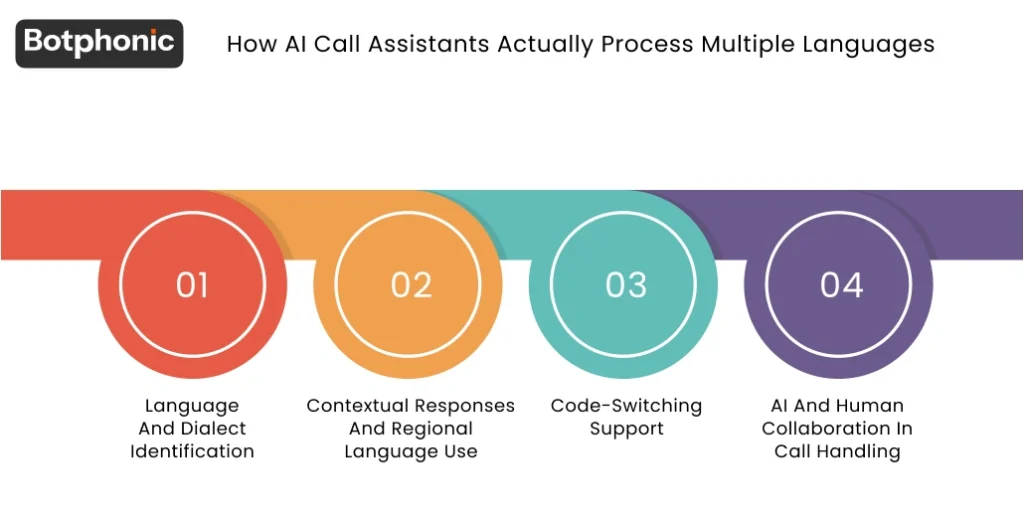
The current AI call assistant operates a hybrid of automatic speech recognition (ASR), natural language processing (NLP) and multilingual trained large language model. The AI receptionist reconstructs the language in a few seconds of a spoken call even in a half-sentence, sometimes even into the required language processing channel.
1. Language and Dialect Identification
This identification does not only deal with vocabulary. The system also reads elements such as:
- Phonetic patterns
- Grammatical structure
- Regional accent markers
To identify the language and also the probable dialect.
For example:
- Brazilian Portuguese
- European Portuguese
Callers will be treated differently, and the responses will be adjusted accordingly.
2. Contextual Responses and Regional Language Use
After identifying the language, the AI will produce answers in that language, and this will be based on a knowledge base that has been structured to consider
- Phrasing of the region
- Local jargon
- Cultural context
This is important as the literal translations do not work in the scenario of customer services. Speaking technically right but culturally clumsy is more likely to ruin the trust than a minor factual mistake.
3. Code-Switching Support
There are also platforms that facilitate code-switching which is the tendency of a human being to mix two languages in one sentence. This is usually instinctive especially when
- Multilingual callers switch between languages
- English is a second language
- Customers feel more comfortable mixing languages while sharing issues
A multilingual assistant that has been trained using actual multilingual call logs can track such switches without any loss of context.
4. AI and Human Collaboration in Call Handling
Where AI Takes Over
An optimally designed AI call centre software for BPO customer service does not attempt to process all the calls completely. The best implementations are those executed in a tiered operational model.
The AI handles the initial level of interaction, including:
- Language recognition
- Intent recognition
- Data gathering
- Answering common questions
The system escalates to human agents when dealing with subtle judgment, emotive de-escalation, or complicated account access.
Intelligent Escalation to Human Agents
The AI does not simply hand over the call. It transmits a summary of the conversation in real-time, the language and mood detected by the caller and any information that had been collected. This implies that the human agent is able to resume the conversation without demanding that the caller restate himself or herself; this is one of the most frequent areas of frustration in BPO customer experience.
The AI phone call software for BPO providers enables them to have smaller teams of highly trained human agents who make complex interactions on a larger number of accounts whereas the AI takes the volume of the routine repetitive queries that used to consume high levels of headcount.
 NOTE
NOTE
The Training of Multilingual AI Training
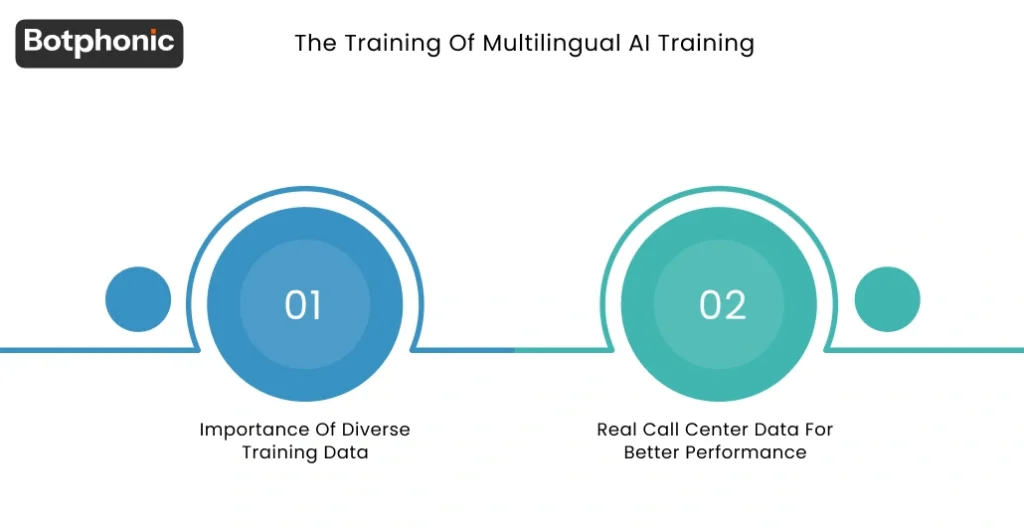
1. Importance of Diverse Training Data
The quality and variety of the training data and the quantity of the information used to train a multilingual AI assistant is a crucial factor. The systems that are trained mostly on written and formal documents might not be able to manage:
- Spoken language
- Slang
- Expression of emotions
- Informal grammar
2. Real Call Center Data for Better Performance
The most competent systems are trained on real-life audio of call centers on a variety of languages including regional differences. This exposes them to the way of how individuals actually speak when they are:
- Frustrated
- Lost
- Rush
Which is very different to how text-based language models are traditionally trained.
Training data diversity is one of the questions that BPOs should potentially ask AI vendors. It is not a multilingual system in a real operational sense to have seven European languages that it manages but has difficulties with Southeast Asian languages or Arabic dialects.
Quality Assurance Scale Across Languages
Quality assurance is one of the aspects of AI-driven multilingual assistance that has been underestimated. Under normal BPO business, the few available resources can only allow:
- QA teams monitor a fraction of calls, usually five to ten percent.
- Non-English call QA needs multilingual staff,
- Staffing issue leads to monitoring accuracy
AI-Powered Call Monitoring
A machine intelligence system captures and processes all communications, in or out of language. It is able to identify calls in which the:
- Sentiment had worsened
- Call lasted above an average length
- Caller posed the same question several times
This information is language-independent; the analytics would operate regardless of the language the call was made in Swahili or Swedish.
This can give a very realistic view of the quality of service among all the language groups, and it can also determine the training gaps that would not have been detected by the traditional QA approach.
 PRO TIP
How Botphonic Supports BPO Multilingual Operations
Software such as Botphonic have designed its AI call assistant services towards the requirements of the BPO setting. Instead of considering multilingual assistance as an optional feature, Botphonic incorporates the multilingual assistance into the very core of the conversation flow the system routes, responds and escalates the conversation in the language of the caller, without the need to manually configure new languages.
In the case of BPO customers dealing with large numbers of calls and international clientele, such a native multilingual structure implies that the coverage and range of languages grows in line with the number of calls, without comparable changes in staffing expenses.
1. Are there Still Accent Bias Problems in AI Systems?
This is a valid issue which has been fought by the industry in the public. Previous versions of voice AI were significantly less accurate on non-native accents, on regional dialects and on lower-resource languages. Strongly accented callers would be forced to repeat themselves several times or were rerouted completely.
The newer systems are much better, but this is due to intentional attempts by developers of AI to diversify training datasets. BPOs must test any AI system under consideration with real callers that represent their actual customer demographics. Not just with internal test users who speak standardized forms of each language.
The candid response is that AI-based multilingual assistance has improved significantly compared to what it was three years back. Yet it performs better on high-resource languages with numerous training data than on low-resource languages with minimal digital presence.
This should be a consideration of BPOs serving the markets in such low-resource language regions.
2. The Operational Outcome: Reduced Language Isolations, Increased Service uniformity
The greatest organizational transformation that is associated with the implementation of an AI call assistant to BPO is not technology but the shift in the structure of operational silos that are based on language. With the centralization of language management to an AI layer, BPOs are able to merge their teams of agents, stream their training, and create a more service-oriented culture.
Human agents discontinue to cover escalations, challenging instances, emotionally fraught dialog work that indeed needs human consideration as opposed to squandering most of their days on automatic queries that just occur to be in a specific language.
Deploy Botphonic AI and focus on what actually matters, let AI handle tedious tasks.
Try NowConclusion
This has not been a resolved issue. Multilingual support in BPO has been a persistent issue of operation that demanded continued investment of staffing, training and quality control. AI call assistants don’t exactly remove this challenge. But has changed its approach to tackling the problem. As per IBM reports, 2 out of 3 leaders have reported AI has helped them by driving a greater than 25% improvement in revenue growth rate.
These systems enable BPOs to scale their language coverage with no corresponding increases in costs, ensure the consistency of their services to all language groups, and leave their human agents to do the work that machines continue to fail to do well. It is not something minor to BPOs interested in competing based on quality and efficiency.