Summarize Content With:
Introduction
In the crowded market today, agencies are competing to win over every medium email, social media, chat, SMS… however there is still one place in the process of a potential client move where phone calls are becoming the event that changes everything. A call comes across as urgent, interested, intent, and willing to interact. This is a crucial point, however, that is left to chance by many agencies.
What would happen in case your agency could answer immediately each time, day or night? How would it be to connect with every inbound call having the same calmness and quality of their answering, having them screened and being redirected in a manner that not only boosts conversions, but also makes the company thrive?
This is where AI based agency call assistants can help, making your phone line an asset instead of a liability and a lead conversion machine.
In this paper, we will unravel how AI call assistant, such as Botphonic’s Conversational AI, can transform regular calls into paying clients and why agencies that fail to embrace this transformation will be leaving money on the table.
Why Phone Calls are Still Relevant in Client Conversion
Calls will still be among the most desired conversion channels despite the use of chatbots, emails, and contact forms. With the person picking up the phone, he is not browsing but is in fact seeking help, clarification or solution.
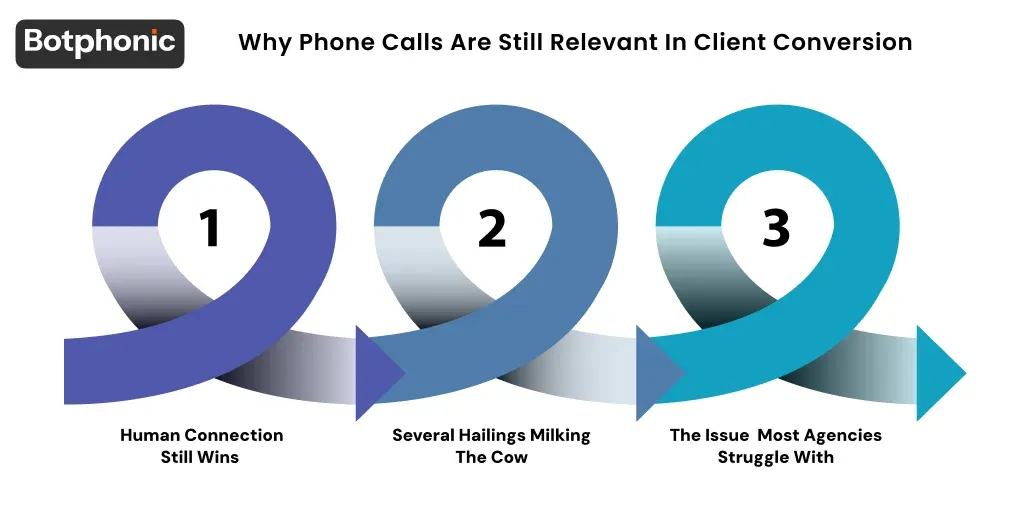
1. Human Connection Still Wins
Trust is created in voice communication immediately. The prospects are assured by hearing an educated voice or even a considerate automated voice. Quick and smart response by agencies is an indicator of professionalism and credibility, a crucial psychological process in the conversion process.
2. Several Hailings Milking the Cow
Callers also have a higher conversion rate than form fillers. Why? Dialing a number particularly to make high value services takes effort and deliberate effort. Any agency that takes advantage of such a behavior will have better chances of closing clients.
3. The Issue Most Agencies Struggle With
Many agencies continue to handle: in spite of the obvious merits of phone calls.
- Out of business missed calls.
- Bad traffic jamming the pipelines.
- Bottlenecks in manual scheduling, follow-up.
- Poor consistency of human responses.
And all this translates into lost revenue.
This is where the AI receptionist rewrites the story and eliminates bottlenecks and standardizing results.
 PRO TIP
So What Is an AI Call Assistant to Agencies?
In its simplest form, an AI call assistant is a computer program responding to a call, listening to speech, conversing with the caller, and analyzing calls by use of artificial intelligence.
However, the AI assistants that modern generation implements are far beyond the mere voice commands. It employs natural language understanding (NLU) and speech intelligence such that the interactions are natural rather than artificial. Artificial intelligence call assistants on top platforms such as Botphonic can:
- Get callers into interactive dialogue.
- Qualifying questions should be asked in accordance with your custom requirements.
- Make scheduled appointments automatically.
- High-value leads to the right person, route high-value.
- Record and store the conversation information in your CRM.
- Response 24/7, fatigue-free, human error.
It is the transformation of the automated phone scripts, into the smart virtual receptionists.
The Conversion Gap The Majority of Agencies Face
We can deconstruct the reasons why phone calls do not convert without the appropriate tooling:
1. Missed Calls = Missed Revenue
When no one picks up a call, the prospects would hardly leave voicemails, they would just pass on. Based on the trends surveyed, a large proportion of the prospects did not dial back after a bad phone experience.
 NOTE
NOTE
2. Slow or Generic Responses
Generic greetings or no structure at all in the way of dealing with the leads, even answered calls, does not help in connecting with the lead or getting the information that your sales teams require.
3. Unorganized Follow‑Ups
Late or intermittent follow-ups murder momentum. Research indicates that the likelihood of conversion declines at a fast rate within the initial hours. However, most of the agencies are not able to react promptly using manual style.
4. Inexperienced Qualification
Not all the callers are qualified leads. Reps fail to reach high potential prospects as they spend time on low-intent prospects without a structured flow of qualification.
The result? Leaky pipeline Calls occurring but conversions not. That is when AI can be a source of revenue rather than an auxiliary.
How an AI Call Assistant Converts Calls into Clients
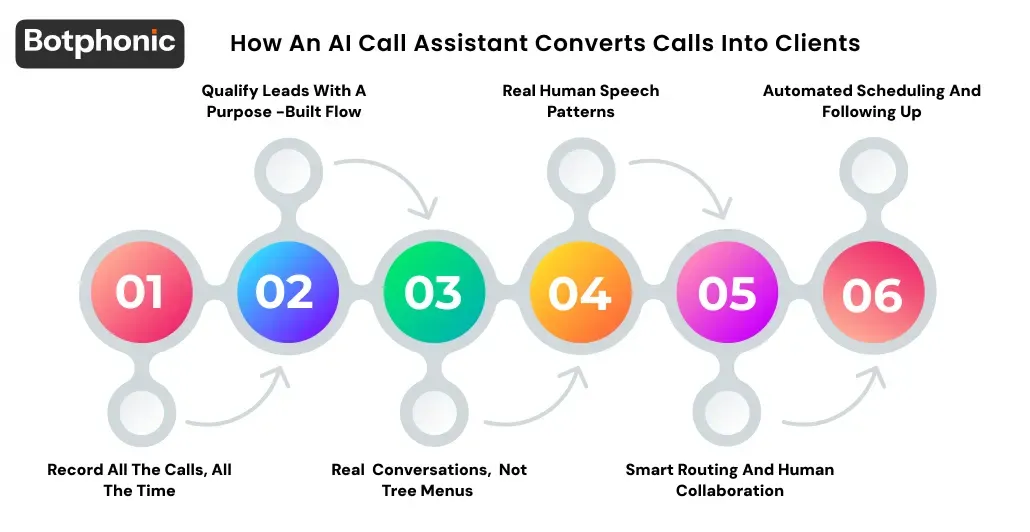
Now we are going to step through the conversion journey step-by-step demonstrating the manner in which AI-powered assistant for agencies modifies each step.
1. Record All The Calls, All The Time
An AI call assistant never makes a caller leave, unlike individuals who go to sleep, have lunch, or are stuck in a meeting.
It could be a lead calling at 8 AM or 8 PM on a Sunday, and an AI system:
- Answers instantly
- Positioning itself with the brand voice of your agency.
- Initiates participation intentionally.
This in itself radically enhances first contact rates.
Why it is important: Industry statistics have shown that a delay of a couple of minutes in responding can cut down the chances of a conversion by more than 400 percent. A call assistant AI completely removes that delay.
2. Qualify Leads With A Purpose-Built Flow
Most agency sales processes are the least efficient due to ineffective qualification. A call assistant AI modifies that by posing intelligent, pre-programmed questions such as:
- What kind of service are you interested in?
- When do you want to start?
- What’s your budget range?
- Have you ever dealt with an agency previously?
Based on responses, the AI can:
- Score the lead
- Label them with priority levels.
- Pass high intent prospects to live agents.
- Auto-nurture the lower priority leads with SMS or email.
This will make sure the sales staff only gets involved when the indicators are ready.
3. Real Conversations, Not Tree Menus
Old-fashioned phone trees, where the customer has to press 1 to get this, 2 to get that, etc., soon make hot leads go cold.
The contemporary AI assistants such as Botphonic are interactive. They understand context:
Interruptions
There was more than one intention in a sentence.
4. Real Human Speech Patterns
Rather than the use of hard-coded scripts, AI takes calls as a trained receptionist, but without burnout and variation.
This improves the completion rates of calls drastically and it lowers the level of frustration by the caller.
5. Smart Routing And Human Collaboration
AI does not separate human beings, it collaborates with them.
In case discussions are pointing to value or need delicate negotiation, the call assistant can:
- Pass on the call to the appropriate salesperson.
- Notify the team in real time
- Discuss with a manager in case of necessity.
The hybrid strategy implies that people are concentrated on high-value selling, and artificial intelligence is applied to routine tasks.
6. Automated Scheduling And Following Up.
Paper scheduling murders conversions.
With AI:
- Teams can have their calendars checked in real time by calls.
- Slots are provided immediately as the prospects are offered.
- Confirmations and reminders are sent.
- Rescheduling is done automatically.
It will result in reduced no-shows, reduced scheduling bottlenecks, and a smooth buyer experience.
It’s not just about minor changes but it has become an undeniable truth that AI receptionists are transforming agencies.
The Botphonic Role in This Workflow
The hybrid of automation and intelligence is in the form of solutions such as the AI call assistant of Botphonic. In filling in where traditional systems fail stagnant IVRs, minimal speech recognition, or manual miss-handling AI-based platforms come in with:
- Individual conversation is flowing.
- Real‑time CRM integration
- Smart follow-ups and cultivating.
- Call analytics and lifelong learning.
Botphonic does not simply respond to the calls it’s knows intent, reaches out to the prospects and pushes them further into your sales funnel.
To progressive agencies, it is no luxury; it is a strategic resource.
NOTE
Case Study: A Case Study on Boosted Conversion
Imagine this scenario:
Agency: Med-size web marketing company.
Issue: Large number of calls, poor handling.
Before AI:
- Unanswered calls out of business hours 30%
- One out of every two inbound leads did not follow-up in 24 hours.
- This is caused by low qualification, which results in time wastage in sales.
AI Call Assistant Implementation:
- 24/7 call handling
- Organized qualification procedure.
- Automated scheduling
- CRM recording and prioritization.
Outcome:
- Doubling of planned consultations.
- Previously, one out of every four sales representatives spent time on something that was not productive.
- A 25-percent growth in the general conversion rate.
Once AI is left to do the monotonous, manual, time-insensitive aspects of the call lifecycle, your sales team gets to do what they are good at selling.
Common Concerns and Perceptions
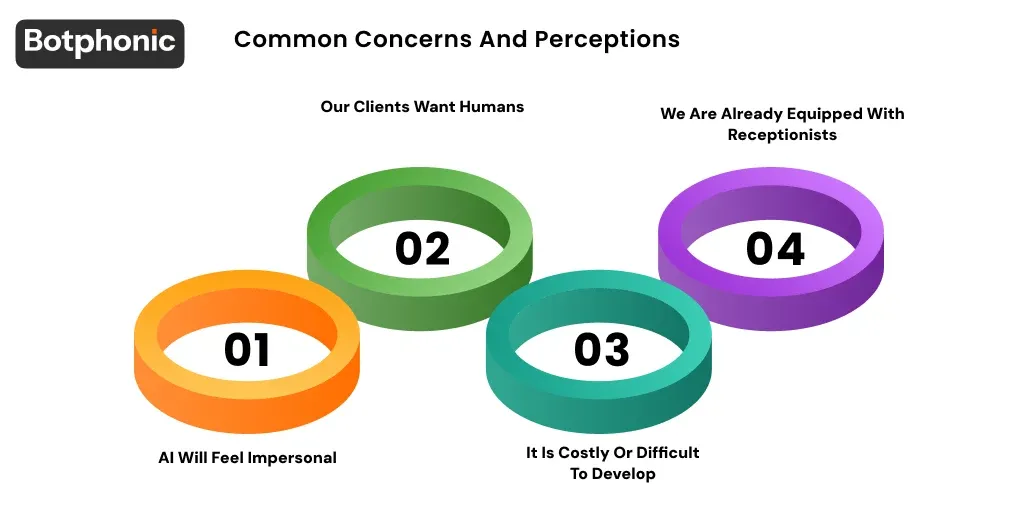
Even though the value appears obvious, not all the agencies are enthusiastic since they think:
- AI will feel impersonal: The current conversational AI is not robotic. The use of natural language flows and custom voice tones develops a human-like experience, as well as consistency.
- Our clients want humans: Clients are already unhappy if your agency is not able to respond to all calls within a short amount of time. AI enhances responsiveness, an aspect that clients are concerned about.
- It is costly or difficult to develop: Cost of initialization can take time, however, the majority of the agencies recover the revenue hit within 30-60 days after the deployment.
- We are already equipped with receptionists: Artificial intelligence does not displace human beings, it enhances them. Receptionists will be able to prevent receiving routine and repetitive questions and concentrate on strategic activities.
Best Practices of Agencies that use AI Call Assistants.
In order to get the optimum conversions, apply the following:
- Personal Qualification Scripts: Make questions match with your dream client.
- Connect with CRMs: This maintains information in check and activities automated.
- Review & Refine: Monitor analytics and transcripts to optimize flows.
- Train Humans & AI Together: Have AI to deal with volume, people to close.
- Track Core KPIs: Measure call answer rate, scheduled appointments, lead quality and conversion velocity.
A Strategy is the Real Start of ROI, Not the Tool
AI call assistants are no silver bullets. They succeed when:
- There are well-defined qualifications criteria in your agency.
- You bring sales and marketing into line on procedures.
- The automation of automatable things is done.
- You maximize human relationships where they are most significant.
Together with an intelligent placement, AI will turn the whole conversion process into the first ring of the phone.
Learn more: AI Phone Call Assistant for Insurance Agencies
Conclusion
Phone calls are still one of the best conversion scenarios of the agencies but most teams do not use them regularly. The conversion equation is altered by an AI call assistant to agencies in particular, such as Botphonic, which is a very powerful platform. Such systems respond to all calls, qualify all leads in an intelligent manner, automatically schedule meetings and therefore no opportunity can escape into an unnoticed hole. Even in reports its stated that about 31% of companies are planning to invest in AI within the next 24 months.
Here’s the reality:
- Calls will not lose their importance.
- Expectations demand immediate feedback.
- Paper work slows you down.
- AI accelerates growth
Making calls to clients not conversations not only agencies of the future would have a strategic advantage, and an increase in the number of converts, they also would create time to spend on sales that do not progress.
Transform every call into a client opportunity
Try Botphonic Now!!