Summarize Content With:
Summary
U.S. automated call segmentation strategies allow companies to deliver timely, relevant, and personalized voice outreach to these small groups of interested customers on a specific topic, increasing engagement and conversion, and, as such, these segments are usually better for the performance of the overall campaigns.
When intelligent segmentation is involved, businesses can make sure that they call only relevant contacts and thus also get to build a deeper relationship with their audience as part of the AI segmentation usa, AI call assistant, AI receptionist, etc.
Introduction
Imagine if you could run call campaigns that seem like they were made only for every recipient; that’s the actual power of segmentation. We’ve found that generic call blasts rarely work in competitive U.S. markets. Marketers using focused audience segmentation get much better results across channels, including voice outreach with segmented campaigns driving up to 76% more revenue than one‑size‑fits‑all approaches (even for channel-agnostic marketing assets).
In order to reach the right people at the right time and scale future-oriented teams, they rely on AI segmentation, AI call assistants, and AI receptionist technologies. These solutions provide targeted dialing with precision and relevance by transforming generic dial-outs into conversations. Many organizations are now integrating these capabilities into AI call automation for U.S. businesses to streamline how campaigns are delivered at scale.
Understanding Call Campaign Segmentation
Segmentation means breaking your larger audience into distinct groups based on one or more common traits, behaviors, or preferences. In U.S. automated calls, this is crucial because American consumers expect targeted messaging; generic campaigns go unnoticed or result in high opt‑outs. Segmentation helps to make each campaign smarter and less frustrating and encourages greater engagement overall.
Marketers can send tailored messages based on age, behavior, location, or previous interactions through different segmentation strategies. AI segmentation USA tools help reveal patterns a human might miss, allowing you to send the right message to the right person at the right time. This shift toward personalization is one of the reasons why AI voice campaigns & marketing automation platforms are becoming central to modern outreach strategies across the United States.
How Segmentation Improves Campaign Performance
By shifting the focus from volume to relevance, segmentation helps each aspect of a campaign:
- More engagement: Audiences engage with messages that resonate with their interests.
- Higher conversion: You get more replies, meetings, or sales on relevant calls.
- Lower costs: You spend less time and resources calling folks who aren’t going to answer.
- Enhanced reputation: Galvanization of brand trust through a careful balance of preferences.
Segmentation should be a regular thing; keep going back to this, and the dynamic nature of segmentation lies in integrating new data structures. For that ‘fresh’ feeling to your segments, use tools such as the AI call assistant and AI receptionist systems!
Types of Segmentation for U.S. Automated Call Campaigns
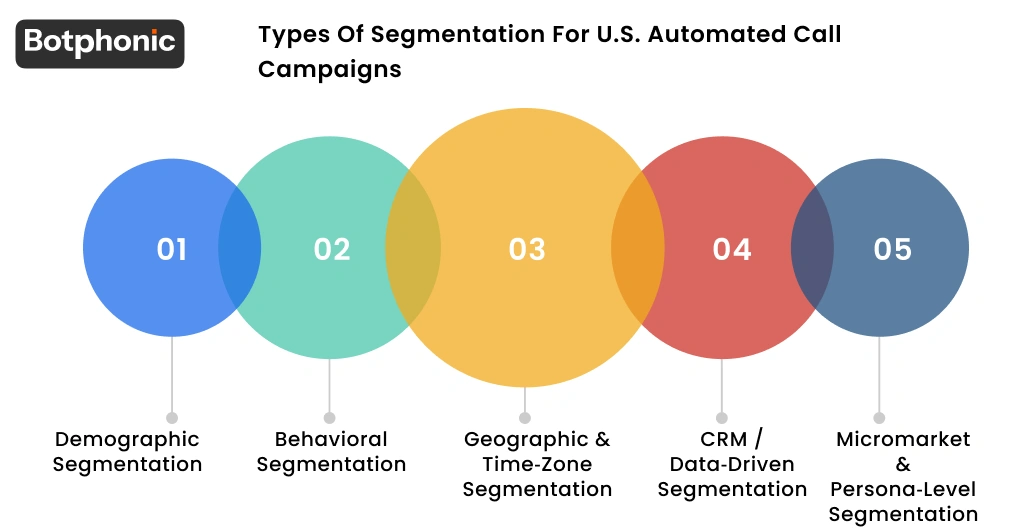
Smart segmentation doesn’t initiate or end at the individual segment. The best campaigns actually combine different types of segmentation to tailor outreach as much as possible.
1. Demographic Segmentation
Demographic segmentation categorizes contacts by characteristics like age, gender, income, or occupation. For U.S. automated call campaigns, this enables lifecycle- or lifestyle-based messaging, retirement planning messages for mature segments, and student-related offers for younger groups. It adds a messaging layer of basic relevance and makes calls feel more intimate.
2. Behavioral Segmentation
Behavioral segmentation looks at how people behave, what they’ve bought, how regularly they interact, or if they opened prior calls or messages. This segment enables you to customize follow‑ups and automated outreach based on actual behaviors.
| Behavior Type | Campaign Use Case | Outcome |
| High Purchase Frequency | Reward programs via an AI call assistant | Increased loyalty |
| Recent Engagement | Follow‑up calls within 24 hours | Higher conversions |
| Lapsed Users | Win‑back automated campaigns | Renewal or reactivation |
3. Geographic & Time‑Zone Segmentation
U.S. campaigns need to be sensitive to regional preferences and calling hours. When it comes to geographic segmentation, you can group contact data based on location, state, city, or even local region so that calls are sent only when contacts are most likely to answer. Time zone awareness stops calls at awkward hours and drives answer rates.
4. CRM / Data‑Driven Segmentation
CRM‑based segmentation uses your customer data to create groups around measures like lifetime value, purchase history, support interactions, and more. Not only is this form of segmentation rich, as it relies on real experience with your brand, but it also allows you to create high-impact automated call flows.
5. Micromarket & Persona‑Level Segmentation
Micromarket segmentation targets micro-niches within a larger audience, for instance, urban professionals or rural families. Persona segmentation creates fictional personas (e.g., “Budget‑Savvy Shopper” vs. “Tech Pro”) to represent your ideal customers. These methods can be combined into very targeted groups for a custom call.
Don’t miss high-value opportunities. Persona and micro market segmentation can help you uncover high-value opportunities otherwise lost in the noise of top‑level broad categories. Companies analyzing AI ROI voice vs SMS USA often discover that segmented voice campaigns outperform traditional SMS blasts when conversations are personalized and timed correctly.
How AI Supercharges Segmentation
With the test‑measure‑repeat process playing out faster than ever, AI elevates segmentation to a new level: massive dataset processing to build complex patterns and, crucially, the ability to constantly refine segments in light of real‑time feedback. AI doesn’t only prepare segments for U.S. automated call campaigns; it fuels smarter, real-time outreach.
1. The Role of AI in Identifying Patterns
Based on historical data and engagement signals, AI tools are good at finding hidden patterns that the human eye can easily miss. These advantages allow you to segment customers in more intelligent ways, increasing responsiveness and relevance. For instance, AI can identify behavior clusters such as “frequent weekend shoppers” or “high‑intent prospects” that drive scheduling and messaging of calls.
Using AI-powered analytics regularly will allow you to update segments when behaviors and trends change.
2. AI Call Assistants & AI Receptionists in Segmentation
AI call assistant and AI receptionist technologies introduce two powerful layers to segmentation:
- Dynamic message delivery: These tools customize messages using segment triggers.
- Behavioral feedback: They take conversation outcomes and feed that back into their segmentation logic.
Each call is made via an AI call assistant, making them human, and for inbound voice interactions, the decrement to a segmented expectation through an AI receptionist. Combined, they enable AI segmentation USA models to deliver customized responsive conversations.
3. Dynamic Learning and Real‑Time Optimization
AI does not cease to exist after delivering a campaign. The system is learning constantly from those responses, adjusting segmentation and targeting on the fly. It also means campaigns can learn over time and adjust in real time to maximize performance.
 PRO TIP
Segmentation Strategies That Win in the U.S. Market
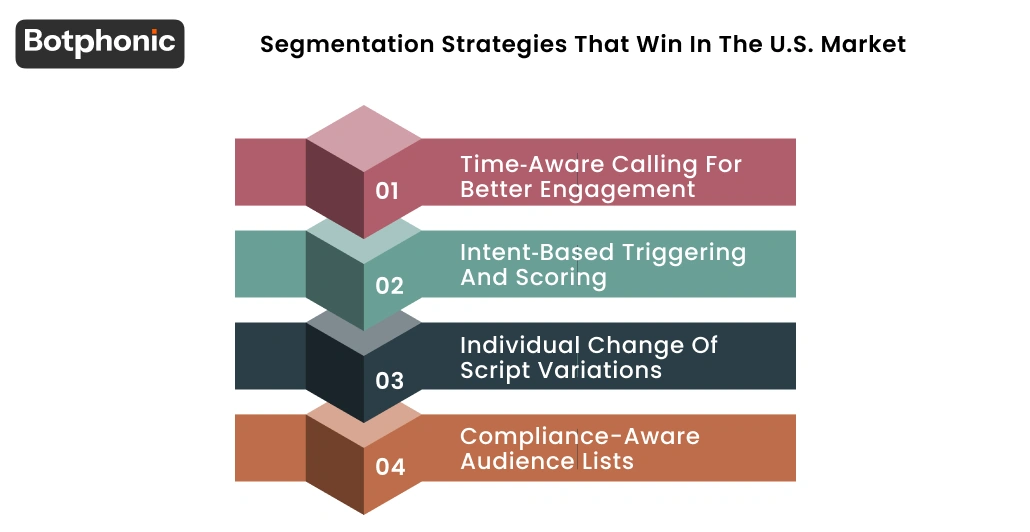
Case studies of winning call campaigns in the U.S. can showcase what it takes to succeed through the precise timing and relevance of such strategies. In the face of varying customer expectations and stringent compliance rules, you require segmentation that takes context, intent, and legal limits into account.
1. Time‑Aware Calling for Better Engagement
Reaching out to prospects at the right moment increases engagement significantly. AI‑driven solutions can effectively segment audiences by local time zones and typical availability windows.
For instance, morning calls can be more convenient for professional users, while evening calls suit consumers at home. This is where AI call assistant tools come into play, enabling campaigns to dynamically schedule calls for each segment, resulting in a lower number of unanswered calls and higher pickup rates.
2. Intent‑Based Triggering and Scoring
It’s called intent-based segmentation, which identifies prospects who are ready to take action. AI scans previous engagement, page visits, or product queries to grant intent scores. This means high-intent prospects can get follow-ups right away, while lower-intent leads enter nurturing sequences. With AI segmentation in the USA, campaigns can focus on meaningful signals rather than unintelligent dialing that converts poorly but costs dearly.
 NOTE
NOTE
3. Individual change of script variations.
Even within a segment, there are different prospects. The sales scripts can be dynamically personalized to include language and tone variations based on the demographic, behavioral, and intent data by AI tools, such as an AI call assistant.
This expands the personalization which enhances response rates, maintaining context. A tech-savvy millennial customer receives a clear message with benefits at its core, but on the other hand, you would provide a corporate decision-maker with detailed information about the solutions.
4. Compliance-Aware Audience Lists
In the US, automated call promotional campaigns must satisfy TCPA rules, do-not-call databases, and other limited local legislation. There is the option of automatically discarding contacts who did not want to be included in the campaign or are prohibited from campaign matters by AI-assisted segmentation.
Intelligence-based receptionist systems also direct calls to staff members who are within the company as needed. Compliance awareness segmentation practice can also assist you in minimizing legal risks and securing your brand image simultaneously.
This is significant since the possibilities of compliance in various segments will evolve in the course of time; e.g., compliance status (awareness of regulations) might become old. Audit your audience lists at an opportune time.
Measuring Success: Metrics That Matter
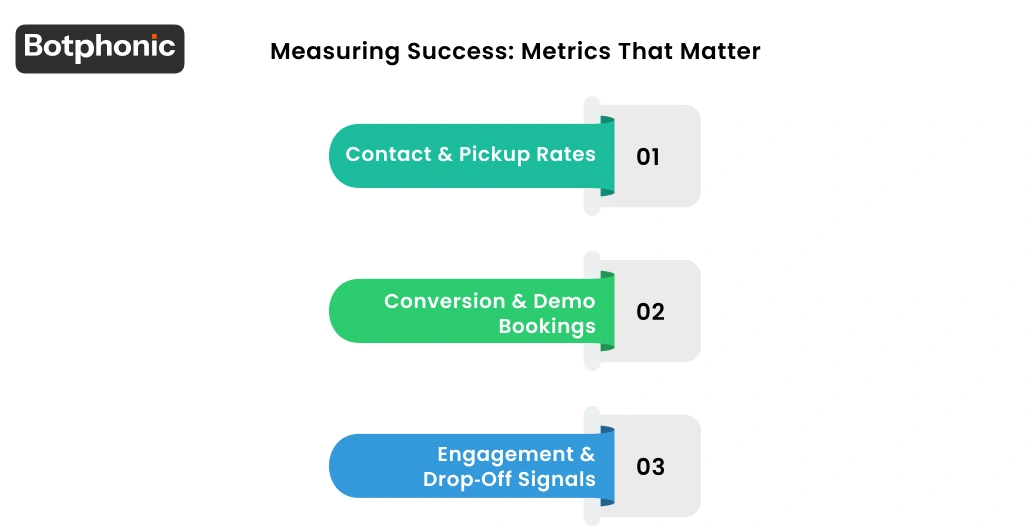
Your measurement framework makes or breaks segmented campaigns. U.S. squads require clear-scoring metrics to monitor performance, enhance segments, and warrant investment.
1. Contact & Pickup Rates
These metrics measure how many calls reach a real prospect and are answered. As with emailing my congressman, segmenting by engagement history, time zones, and demographics improves contact rates. Tools like an AI call assistant can automate follow-ups for missed calls and increase overall reach.
High contact rates show proper targeting, but low contact rates may reflect segment misalignment or a timing issue.
2. Conversion & Demo Bookings
Conversions are the final action you want users to take, or what the campaign is trying to achieve: a sale, a demo booking, a sign-up, etc. Segmentation ensures messages reach prospects who will take action. An AI-based receptionist can book demos in real-time and thus make scheduling frictionless and fast enough to convert more customers.
3. Engagement & Drop‑Off Signals
Having visibility into call engagement, like duration, questions asked, or drop-offs, gives you a sense for how segments are engaged in a call. These signals are logged by AI systems, which balance towards the scripts or segmentation criteria reactively, improving future campaigns.
Make sure to leverage drop-off metrics to spot weak points in your script or misaligned segments and improve them. Many advanced outreach platforms now bundle segmentation capabilities directly into AI call automation for U.S. businesses, helping marketing teams scale campaigns while maintaining personalized engagement.
Start smarter outreach with AI call automation for U.S. businesses and deliver personalized voice campaigns that drive real results.
Start Your AI Voice Campaign!Conclusion
The cornerstone of successful U.S. automated call campaigns is segmentation. Using a combination of demographic, behavioral, geographic, and CRM-driven approaches, complemented by insights from AI to ensure that messages are delivered to the right person at the right time. For many brands, this approach strengthens AI customer service strategies by aligning outreach campaigns with real support history and customer preferences.
Tools such as AI segmentation USA, AI call assistants, and AI receptionists are responsible for making a campaign smarter, more personal, and legally compliant. Constantly squeezing down on engagement and improving segments ensures that businesses can achieve the most conversions while respecting customers’ desires.