Summarise this article with
What You’ll Learn:
- The key metrics to benchmark your queue against, and why daily averages can hide peak-hour problems.
- How to tell which of three different problems is actually driving your hold time.
- 10 ways ranked from free to full headcount, with the exact change to make on each.
- Why the callback queue you already built is probably being ignored, and three things to change.
- Which call types you can safely remove from the queue, and which you never should.
- Why lowering AHT usually makes this worse and not better.
- How to prove the fix worked instead of just hoping it did.
Most call center hold-time advice is a flat list, which is why people read it but never use it. It’s also why four of the top 9 results for this exact search are people asking each other on Reddit, Quora, and Facebook instead of finding a real answer.
Before choosing a fix, identify where the customer is waiting: before an agent answers, during the interaction, or because the call is transferred. Each of those points to a different cause, and a different fix.
Here’s the real answer: 10 fixes ranked by cost, 4 of which need nothing but a configuration change. Two things below will probably surprise you: the callback queue you already built is likely firing too late to matter, and lowering average handle time won’t move this metric the way most advice claims.
Know Your Baseline Before You Change Anything
When people search for call center hold time standards or a call center wait time industry standard, they’re usually looking for a figure they can defend out loud. Before you use one, be clear about which kind of waiting it measures.
Queue wait is the time a caller waits before an agent picks up. Mid-call hold is the time a caller spends on hold after an agent has already connected. They have different causes and different fixes, and the figures below are not interchangeable.
| Metric | What it measures | 2026 benchmark | Source |
| Average speed of answer (ASA) | Queue wait: The average time callers wait before an agent answers. Does not include any hold after connecting. | 28 seconds globally | Lorikeet, 2026 |
| Call abandonment rate | The share of callers who hang up before reaching an agent. A queue-side outcome, not a measure of mid-call hold. | 2–5% target band | Lorikeet, 2026 |
| Average handle time (AHT) | The total time an agent spends on a call, typically talk time, mid-call hold, and after-call wrap-up. Does not include queue wait. | 4–7 minutes (voice) | Lorikeet, 2026 |
| Mean abandonment across all centers | Same as abandonment rate above, averaged across centers. | 8.9% mean vs. 5.0% median | Stealth Agents |
| Widely quoted average hold time, call center-wide | Time callers spend on hold: Confirm whether your platform counts queue wait, mid-call hold, or both before comparing. | 1 min 50 sec | Verint glossary |
Use the median to understand what is typical across call centers. Do not treat the 8.9% mean abandonment rate as an acceptable target, because unusually high abandonment rates at some centers can pull the mean upward. That is a queue-side figure, so compare it with your own abandonment rate, not your mid-call hold time. If your number is above that mean, you’re not “about average.”
 NOTE
NOTE
Diagnose Before You Fix
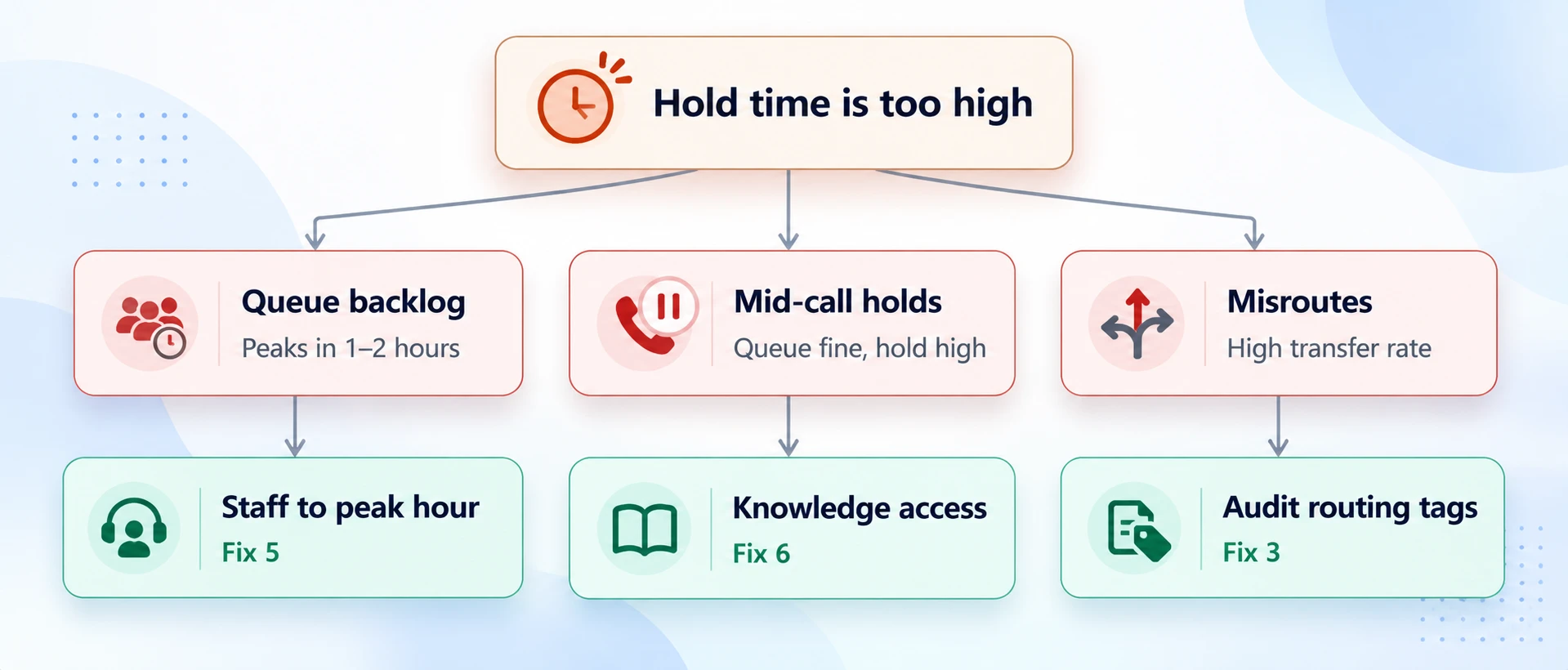
Good call queue management starts with identifying which of these 3 problems is actually causing the wait. You do not need to apply all 10 fixes at once. Some fixes may be irrelevant to the actual cause, while others may add unnecessary cost or require your team to adjust to several changes at once. Making one targeted change at a time also makes it easier to see which fix actually improves the queue.
The right solution depends on the diagnosis. For example, if queue wait is high during peak hours, review staffing and call volume. If queue wait is fine, but mid-call holds are high, investigate knowledge access or process issues instead. Adding more agents in that second case won’t shorten the wait.
Queue Backlog: Callers wait before anyone answers at all.
Check: Does the wait concentrate in one or two hours, or is it flat all day? A spike means a staffing and arrival-curve problem, not an agent problem.
Mid-call holds: Agents place callers on hold after connecting, usually to go find something.
Check: Is hold time high while queue time is fine? That’s a knowledge-access problem, not a headcount one.
Misroutes and transfers: The caller gets handled twice because the first agent wasn’t the right one.
Check: Your transfer rate points at routing, not staffing.
Hold time, on most platforms, is time on hold after connecting to an agent. Queue time is time spent waiting before an agent picks up. The fixes for each are different, even though your dashboard and your callers both just call it “waiting.”
One type of hold nobody publishing on this topic mentions: hold time runs in both directions. If you run a clinic or insurance agency, your own staff are frequently on hold too, to a payer, a lab, or a carrier, and that’s paid labor no customer-facing dashboard captures.
Reduce Call Hold Time Without Adding Headcount: 10 Fixes Ranked by Cost
1. Improve call routing (Free):
Review your IVR and routing rules to make sure callers are reaching an available agent or queue as quickly as possible. Remove unnecessary menu steps, outdated routing rules, or transfers that send callers through queues they do not need. This is a configuration change rather than a purchase, so it can reduce avoidable wait time without adding headcount.
2. Fix your callback trigger and wording (Free):
Offer a callback before callers reach the point where they are most likely to abandon, rather than waiting until they have already spent several minutes in the queue. Most abandonment happens in the first 60-120 seconds, so a callback option that appears earlier can move some callers out of the live queue and reduce the number of people waiting for an agent.
The wording matters as well. Instead of a generic message such as “Press 1 for a callback,” explain the benefit clearly: “Press 1 to keep your place in line and receive a callback without waiting on hold.” Clear wording improves callback acceptance, which can further reduce queue pressure during busy periods.
3. Audit your routing rules (Free):
Skills-based routing cuts hold time by cutting the number of transfers a call needs, and transfers are where hold time hides. Talkdesk’s own write-up makes this connection directly. The free part isn’t buying routing software; it’s auditing the skill tags on the system you already have. Most queues that “have” skills-based routing haven’t kept the tags current as staff and products changed.
 PRO TIP
4. Move after-call work off the line (Free):
If agents are finishing notes or tagging a case while the next caller is already queuing, that time inflates your numbers invisibly. Reduce, simplify, or automate unnecessary after-call work so agents become available for the next interaction sooner.
5. Staff to the peak hour, not the daily average (Paid):
Reschedule the shifts you already have around your real arrival curve before you ask to hire anyone. Most queues are overstaffed for 6 hours and underwater for two; fixing the shape of coverage often closes more of the gap than adding a seat would.
6. Give agents faster knowledge access (Paid):
Centralize or index what agents search mid-call. This is the direct fix for mid-call holds specifically; if your diagnosis above pointed here, this is the fix, not routing or staffing.
7. Deflect the calls that pass the test (Paid):
Route calls to an IVR, app, or web flow instead of a live agent, but only for the subset of calls that are simple enough to actually resolve that way.
8. Replace decision-tree IVR with intent-based routing (Paid):
A traditional IVR asks callers to choose from a menu. That works when the menu is short, and each request fits clearly under one of the available options. It becomes less effective when callers do not know which department handles their issue, so they choose the closest option and end up with the wrong team.
Intent-based routing lets callers describe what they need and uses that information to route the call to the appropriate team. This can reduce unnecessary transfers and prevent callers from waiting in one queue only to be moved into another. Botphonic can handle that initial conversation, identify the caller’s reason for calling, and pass the call to the relevant team.
Check your transfer logs before replacing your existing IVR. If callers are consistently choosing one confusing menu option, rewriting that option may be enough. If their requests regularly do not fit the menu structure, intent-based routing becomes a more useful alternative.
Try Botphonic to route callers based on what they actually need, not just the button they press.
Book A Demo9. Add an AI voice layer that answers at second zero (Paid):
For the deflectable call types, eliminate the queue by answering instantly rather than routing to a human queue at all. This is the fix that changes the arithmetic instead of tuning it.
AI voice is most suitable for repetitive, structured requests where the required information and escalation path are clear. It’s not a blanket replacement for the human queue, and calls outside that profile still need a clear, fast route to an agent.
10. Add seats (Highest cost):
The most reliable fix on this list, and the most expensive. It’s also almost certainly the one you’ve already been told no on, which is the entire reason the other 9 exist.
PRO TIP
The Calls You Can Actually Remove from the Queue
All the 3 tests are required:
- The answer is the same every time
- The caller already has what they need to identify themselves
- Getting it wrong is recoverable
Passes the test: Appointment or delivery status, hours and location, simple confirmations and reschedules.
Never deflect: A caller who’s already upset, or anything where a wrong answer causes real harm.
If your callers are patients, clinical questions never deflect, regardless of volume; the boundary sits at scheduling and administrative calls only. And recording or consent rules may apply differently in a healthcare setting.
The honest failure mode: deflection with no clear route back to a human turns a hold-time complaint into a worse one. Self-service is only a fix if the exit ramp to a live person is obvious.
AHT is the Wrong Metric to Target for Reducing Hold Times
Average Hold Time = Total Hold Time / Number of Calls Handled
AHT lumps together three things: talk time, hold time, and after-call work. But pressuring agents to lower it usually just makes them rush conversations, which hurts the part customers actually care about (feeling heard), without meaningfully fixing the queue problem.
That’s a real tension: Keep handle time down while also making callers feel heard, and agents resolve it by rushing. That’s a quality cost paid to fix a queue problem that was never a talk-time problem.
Measuring Call Center Fixes at the Peak Hour and Not the Average
Measure at the peak hour, not the daily average; the average is what hid the problem in the first place. Watch abandonment and ASA (Average Speed of Answer) alongside hold time, because hold time can fall simply because callers are giving up sooner, which looks like progress and isn’t.
Watch for one specific trap: a daily average that improves while the 11 a.m. peak gets worse. That’s how a fix gets declared a win and quietly reopened three months later.
Give each change a two-week review window and change one thing at a time so you can actually attribute the movement. For the rest of what belongs on the dashboard.
Conclusion
Start with the cause, choose the lowest-cost intervention that directly addresses it, measure the result, and escalate to a larger intervention only if the problem persists. You now have a target, a diagnosis, and a ranked plan: four fixes that cost nothing this week, five paid upgrades for when the free ones run out, and adding seats as the last resort. That’s the order to work in, and it’s the order that survives being questioned in a meeting.
Start with the 4 free fixes. If your abandonment and peak-hour hold time are still above target after two review cycles, move to the paid upgrades, starting with the one that matches your diagnosis, before you go back to asking for more headcount.