
Summarize Content With:
Summary
Customer churn continues to be one of the biggest headaches for U.S. businesses today, frequently resulting in billions lost in revenue. The AI-driven, personalized instant outreach is more effective than any previous strategy for keeping customers in the business by automating follow-up calls to companies.
Introduction
Imagine your business loses nearly one-in-five customers and you have no idea why. That’s not just a statistic, it’s an ongoing drain on growth, revenue, and momentum for American companies in virtually all industries.
American businesses lose an estimated 21 percent of their customers to churn, defined as when the customer stops buying or cancels a service completely. Even a tiny decrease in churn can have a monumental impact on profits and customer lifetime value.
This is where proactive strategies such as follow-up call automation can help. Rather than waiting for customers to fall silent, ai customer churn USA solutions such as Botphonic allow businesses to engage at the right time with the right message and retain more of their customers for longer. Modern outreach systems also rely on AI voice campaigns & marketing automation (USA) to maintain continuous engagement with customers.
The Current State of Customer Churn in the USA
Customer attrition seems insidious until it strikes like lightning. Across industries, businesses are watching profitable customers slip away, and old-school methods will no longer suffice to prevent it. The scope and pressure points of churn in the U.S. market need to be understood by leaders first before they can solve it.
1. How U.S. Companies Are Struggling With Retention
Retention is a broader struggle across competitive U.S. markets. In the telecommunications sector, high competition and a large number of plan changes increase churn rates. In SaaS, subscription churn eats into recurring revenue. In retail, brands watch customers leap to competitors over small pricing or experience differences.
These trends indicate that churn isn’t an isolated phenomenon; it’s rampant. With no proactive touchpoints, customers who have the slightest frustrations will abandon a brand for a competitor in seconds. And for many businesses, it’s not that they don’t have value to provide; the problem is often that when issues initially arise, they don’t close the engagement loop.
2. The Role of AI in Reducing Churn
The best-performing companies in the U.S. don’t sit idly by waiting for churn to strike; they pour efforts into preventing it with AI customer churn usa solutions. AI tools review customer behavior, main history, & engagement patterns to predict churn risk beforehand.
After a risk has been identified, AI-enabled tools can initiate appropriate follow-ups at the right moment, customized offers, or service touchpoints to ensure continued engagement with the customer. This all-in, proactive approach makes churn reduction a strategic weapon instead of a hurried firefight.
For instance, Verizon uses GenAI to forecast the reasons for the calls customers place and quickly direct them to appropriate support. The deeper insight helps them avoid dissatisfaction and churn among the up to 100,000 customers who use their service by being able to act faster and more accurately in determining needs. Many organizations also deploy an AI receptionist to ensure incoming customer concerns are captured and resolved quickly.
 NOTE
NOTE
Why Follow-Up Call Automation Works Better Than Manual Calls
Manual follow-up calls were the norm for customer care. But in today’s high-speed business environment, manual calls are slow, erratic, and difficult to scale. Automation technologies such as AI call automation for U.S. businesses help organizations respond instantly when churn signals appear.
Manual efforts cannot possibly compete. Here’s how AI customer churn USA follow-up call automation outperforms:
- Quick Action: Automation can prompt outreach the moment a churn sign also appears. Manual reps may be too late to respond by the time the customer has already become frustrated or disengaged.
- 100% Coverage: Every at-risk customer gets follow-up. Humans can get distracted or delay calls, whereas automation never misses a step.
- Support that scales: Automation can manage the volume of dozens or thousands of customers to contact no additional staff or overtime needed. Scalable support is also enabled by AI customer retention & support automation (USA) platforms that manage large volumes of customer interactions.
For businesses, automation means moving from being a slow-reacting organization to one that’s actively communicating before dissatisfaction turns into churn.
How Follow-Up Call Automation Reduces Customer Churn
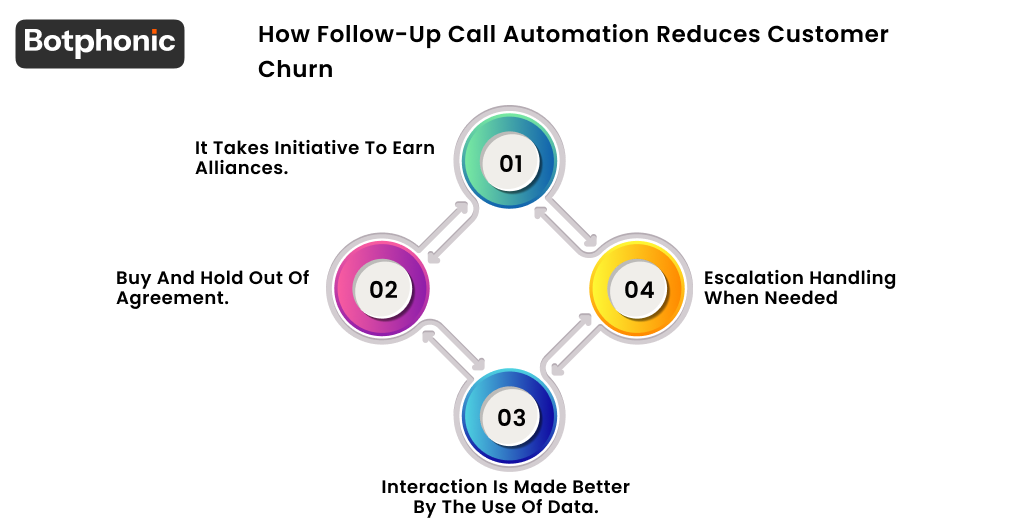
Automate your follow-up calls so that you stay in touch with customers at just the right time. And to prevent churn starting, companies implement AI customer churn usa systems instead of responding after the fact when a customer leaves. Companies often deploy an AI call assistant to guide conversations during automated follow-up interactions.
1. It Takes Initiative to Earn Alliances.
Follow-up calls are distributed automatically to customers, and this is hosted as soon as risk signals become apparent. These calls offer check-in, offer assistance, and solve issues prior to frustration developing. Second, customers like it when the brand takes the initiative to contact them since this will enhance trust and loyalty over time.
The proactive approach can reduce silence gaps. Customers do not get abandoned, and firms are the first ones in mind when it counts most across the customer journey.
2. Buy and Hold out of Agreement.
Manual follow-ups have a tendency of being made on the basis of recollection, time,e and availability of staff. Automation will remove these limits by ensuring that every customer receives an on-time check-in, a renewal notification, or an onboarding call.
It is the consistency that develops reliability. The thing is that customers understand that the brand will never do anything other than what it promises, which will result in increased trust and retention over the long term in all the touch points.
3. Interaction is made better by the use of data.
Based on the history of the customer and previous interactions, along with behavioral data, AI-enabled systems suggest directions in every follow-up call made. Customers listen to helpful and pertinent dialogue as opposed to boilerplate messages.
The individual calls are polite and efficient. There are no repeat customers, and context enables businesses to solve problems faster.
4. Escalation Handling When Needed
AI systems recognize signals of high-risk interactions and pass on calls to live agents only when necessary. This, on the other hand, saves agent time while also ensuring customers can still communicate with a human in their most critical moments.
Escalation occurs with a complete context, ensuring agents will step in aware and ready to help. The smoother handoff and speedier resolution are noticed by customers.
 PRO TIP
What Makes Botphonic’s Follow-Up Call Automation Different
Not all automation tools offer the same level of value. Botphonic AI receptionist emphasizes practical retention outcomes while remaining compliant, flexible, and easy to use.
1. Built for the U.S. Market
From day one, Botphonic builds its platform for U.S. businesses. It’s compliant with TCPA and FCC rules, built on a verified US calling infrastructure.
This focus allows companies to automate outreach without running into legal risks or delivery issues, which is significant when scaling follow-up calls across the nation.
2. How Botphonic Works Step-by-Step
It begins when a churn signal, like low engagement or an action not taken. Botphonic initiates calls at the right time using pre-defined workflows.
The AI handles dialogues, input responses,s and solves any issues that arise. It escalates cases to a human team with full context, if needed.
3. Natural & Friendly Sounding Bots
People are more receptive to chatbots that sound realistic and relaxed. Botphonic Designs conversations to feel friendly, clear, and easy to follow.
These calls skip robotic voices and instead prioritize a natural flow of conversation. This leads to customers behaving for longer, because the interaction becomes familiar and respectful. Natural speech is more trusted than robotic speech during automated calls.
4. Analytics in Real-Time Feedback and Risk Detection
On every call, AI analyzes responses, tone,e and sentiment to identify if a churn risk exists. The system recalibrates risk levels instantly based on each new input and adjusts next steps without delay.
Such real-time visibility enables businesses to react more quickly and direct their attention where it counts.
5. Integrations with Existing Systems
Botphonic seamlessly connects with CRMs, ticketing tools & internal databases. These integrations help keep data updated across platforms without any manual work. Integration workflows are often enhanced by an AI call assistant that synchronizes communication data across platforms.
Teams operate off a single source of truth, while outreach happens automatically in the background.
Most customers churn quietly. Botphonic can be utilized to activate relevant follow-up calls to possible customers before leaving the organization. AI customer churn USA automation helps you to be proactive instead of reactive.
Try Botphonic Today!Real-World Examples of Follow-Up Call Automation in Action
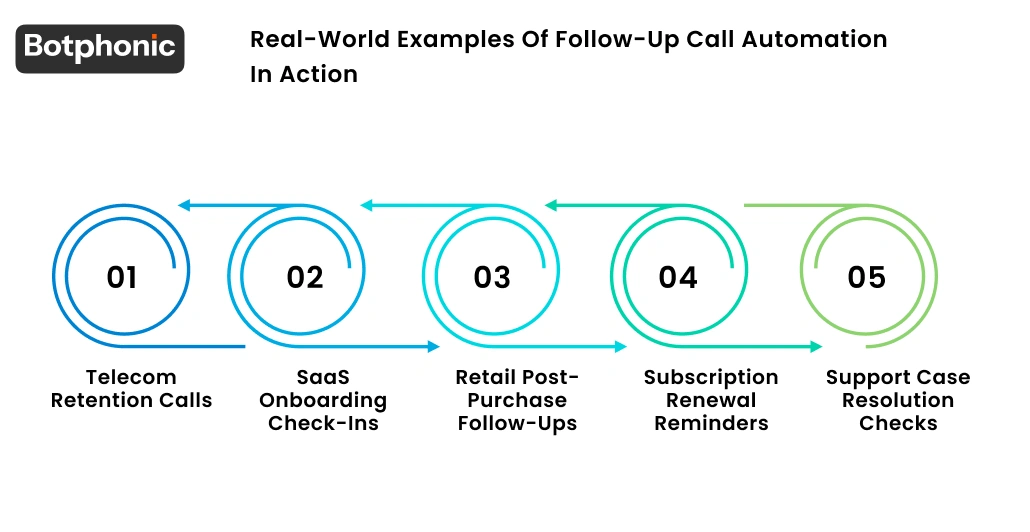
- Telecom Retention Calls: Automated follow-ups reach out to customers after service modifications or complaints. Such calls alleviate frustration and avoid provider switching.
- SaaS Onboarding Check-Ins: No user is left without a timely call when there are setup issues. When early support greases the wheels for product adoption, it reduces early churn.
- Retail Post-Purchase Follow-Ups: These automated calls verify satisfaction and field questions. This extends brand connection beyond the checkout.
- Subscription Renewal Reminders: AI-based dialing serves as a customer courtesy. It is used when elastically climbing the mountains of collection and leads staff to call customers before regular renewals, answer questions or concerns, etc. Meaning businesses decrease silent cancellations and missed renewals
- Support Case Resolution Checks: Follow-up calls confirm issue resolution. They come to feel heard, and complaints that are related to a recurring decrease over time.
These examples highlight how follow-up automation can adapt across industries while upholding customer churn strategies through AI.
Conclusion
Customer churn is still a major struggle for U.S. businesses, particularly in competitive markets with customers able to switch brands within seconds. AI customer retention & support automation (USA) with follow-up call automation provides the possibility for companies to be proactive, consistent, and personal at scale.
AI customer churn USA solutions like Botphonic allow businesses to drive down churn, safeguard revenue, and reinforce trusted partnerships without bottlenecking operational load.