Summarize Content With:
Summary
The call personalization through AI enables businesses in the U.S. to engage customers more naturally and relevantly. Companies can increase trust, engagement, and call results throughout the United States by personalizing automated calls using the data, behavior, and local circumstances of users.
Introduction
The U.S. has a high rate of most automated calls failing after a duration of less than five seconds. Individuals leave calls due to the message sounding generic, being in a hurry, or being irrelevant. Impatience does not cause that reaction. It comes from expectation.
The U.S. consumers want their brands to know them, appreciate time, and speak in clear language. Now, AI personalization can allow that to be done at scale.
Salesforce stated that 73 percent of customers want companies to know their personal needs and expectations.
Additionally, many companies now rely on AI voice campaings USA strategies to automate customer outreach while maintaining conversational quality.
The voice automation based on AI enables companies to fulfill these expectations without being robotic. Such solutions as Botphonic assist organizations in personalized automated calls and make the experience straightforward, transparent, and human.
Understanding AI Personalization for Automated Calls in the USA
Automated Calls AI personalization is aimed at personalizing a call to the individual listener. In the U.S., this strategy is more important since the listeners of callers need efficiency, clarity, and respect.
Rather than making one preset script, AI will modify the call flow, the timing of messages, and voice intonation with reference to actual user information. This makes automated outreach an interactive process instead of a message.
Many organizations adopt AI call automation for U.S. businesses to automate outreach without losing personalization. Similarly, businesses running AI voice campaigns in the USA can deliver targeted voice marketing campaigns while maintaining consistent customer engagement.
1. What AI Personalization Means in Voice Automation
Voice automation involves AI personalization, which is the act of using data and machine learning to modify the sound and behavior of an automated call. Depending on the listener, the system determines what to say, when to say it, and how to say it. For example, an AI call assistant might greet returning customers differently from new callers.
Indicatively, an AI-enabled system will have been programmed to address a regular client differently from a new caller. It is able to slow down the speed of older callers or complicate words to make sense. These changes are automatic in real time.
The method assists in making automated calls, not mechanical ones. The call reacts to the user rather than compelling the user to change.
2. How U.S. Customer Behavior Shapes Call Personalization Strategies
The U.S. customers appreciate transparency and efficiency when communicating over the phone. They want businesses to provide the reason why they want the call and fast. The AI personalization underlies this behavior by forming the opening message and the structure of the call.
A vast majority of U.S. callers make calls during working hours, during short breaks,s or during commute. This is explained by the use of AI systems that provide brief texts and give simple responses. The strategy helps to minimize frustration and maximize interactions.
The U.S. customers also like neutral and polite tones. Too excited or vigorous words decrease credibility. The personalization of AI assists in the balance process by normalizing tone on calls.
3. Why “AI Personalization USA” Matters for Modern Outreach
The search query “ai personalization usa” demonstrates that there is a change in the manner in which companies interact with US consumers. Automation is no longer generic on a large scale. Consumers would prefer contextualized experiences.
The AI personalization aids in adherence to the United States regulations, as it regulates the time of calls, consent policies, and opt-out processes. This feature secures companies and clients when reaching out to them through automated means.
Relevance, trust, and clarity are some of the pillars of modern outreach in the U.S. The elements are related to AI personalization.
Why Personalization Is Critical for Automated Calls in the U.S.
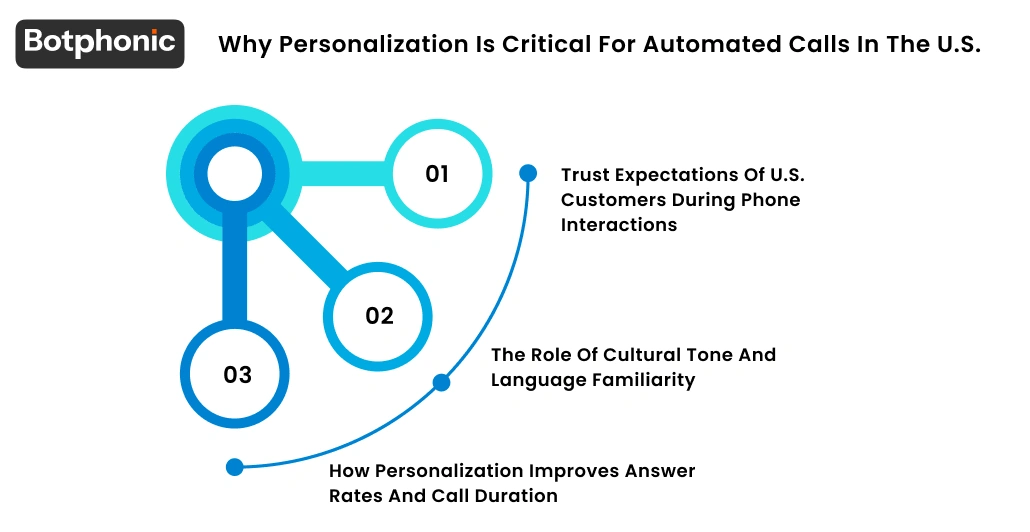
Millions of consumers in the United States are contacted through automated calls daily. Most of these calls do not succeed without their personalization. Automation is used to create a relationship through personalization.
Personalization with the support of AI contributes to making a business sound coherent and flexible at the same time. This balance is sensitive in the U.S., where the callers require non-inflexible professionalism.
1. Trust Expectations of U.S. Customers During Phone Interactions
According to the U.S. customers, trust determines the reaction to automated calls. Depending on the callers, they make decisions within seconds whether to proceed or not. Personalization fosters trust by exhibiting a relevant and understanding nature.
Properly using the name of the caller, mentioning a recent contact, and careful consideration of time settings are indicators of validity when an automated call is made. Such messages lower the mistrust and enhance collaboration.
When an AI receptionist addresses a caller by name or references past interactions, it builds credibility. Similarly, AI voice campaigns & marketing automation (USA) allow businesses to deliver messages that match customer preferences.
AI systems make these trust signals visible in all calls.
2. The Role of Cultural Tone and Language Familiarity
The cultural tone is significant in the personalization of the call in the U.S. Americans like friendly meetings, but in a business manner. Voice calls must be self-assured but not pushy.
Arbitrage AI personalization enables companies to match the language to the regional standards and expectations. This facilitates ease and understanding.
Simple language works best. Artificial intelligence systems, which do not use jargon and complicated language, will work better for a wide audience in the United States.
3. How Personalization Improves Answer Rates and Call Duration
One-on-one calls are more effective as they are relevant. When the message is matched to the needs or history of the U.S. customers, they respond more frequently to the calls.
The AI-personalization is used to extend the call time by steering the conversation in a logical manner. The system prevents the repetition of irrelevant information and is responsive.
Increased time on calls is not wasted time. It entails quality interaction.
Using Customer Data to Personalize Automated Calls
Automated calls are guided by customer data. Every call blends into the next and lacks context without having data. It matters a lot to U.S. audiences that, with the right data, calls feel relevant and purposeful.
Voice systems that fall under the umbrella of artificial intelligence leverage customer data to determine what the call’s going to say, when it’ll call, and how the conversation will progress. The Privacy Method™ can help businesses express themselves openly without breaking the silence of privacy. Respectful personalization keeps people on the line longer.
Tools like Botphonic allow conversations to be driven by customer data, not a series of scripted messages.
1. Personalizing Calls Using First-Party Customer Data
First-party data is data that’s sourced directly from customers. This data encompasses names, appointment history, past purchases, and previous support interactions. Due to the fact that customers willingly give up this information, it is tempting to utilise it during calls.
AI systems also personalize conversations by mentioning recent activity. The call to remind can refer to the scheduled visit rather than explaining services in general. A follow-up call can reference a recently placed order as opposed to rehashing sales messaging. Its relevance demonstrates respect for the customer’s time.
Using real relationships to make calls rather than a generic message winds up resonating better with U.S. customers. They feel recognized, not targeted.
2. Using Location and Time Zone Data for U.S. Audiences
The U.S. spans multiple time zones, work schedules, and daily rituals. When a call comes at an incorrect time, it erodes trust, no matter how important the message. AI personalization solves this problem by syncing calls with local time.
AI systems schedule a call from the closer one based on where the customer lives. They steer clear of early mornings, late evenings, and unholy hours. This timing also improves response rates and limits annoyance.
Regional relevance is also supported by location data. Without having to rewrite the headline, a company can tailor the messaging based on local offerings, office hours, or regional needs.
3. Segmenting U.S. Customers by Intent and Behavior
Not every customer wants the same call. Some want quick reminders. Others want detailed explanations. AI personalisation divides customers into segments according to intent and past action. For example, an AI receptionist might route repeat customers directly to support while guiding new callers to product information. Meanwhile, AI voice campaigns & marketing automation (USA) platforms segment audiences for different campaign types.
FaceTime, chatbots, and more are excellent ways to follow up based on lead status. A returning customer might get a brief confirmation call, while new leads could receive an overarching introduction. These segments are then used by the AI systems to also auto-adjust call flow.
This segmentation prevents over-explaining and avoids rushing to people who don’t need clarity. This brings harmony in automated conversations.
Voice Tone and Language That Resonate with U.S. Audiences
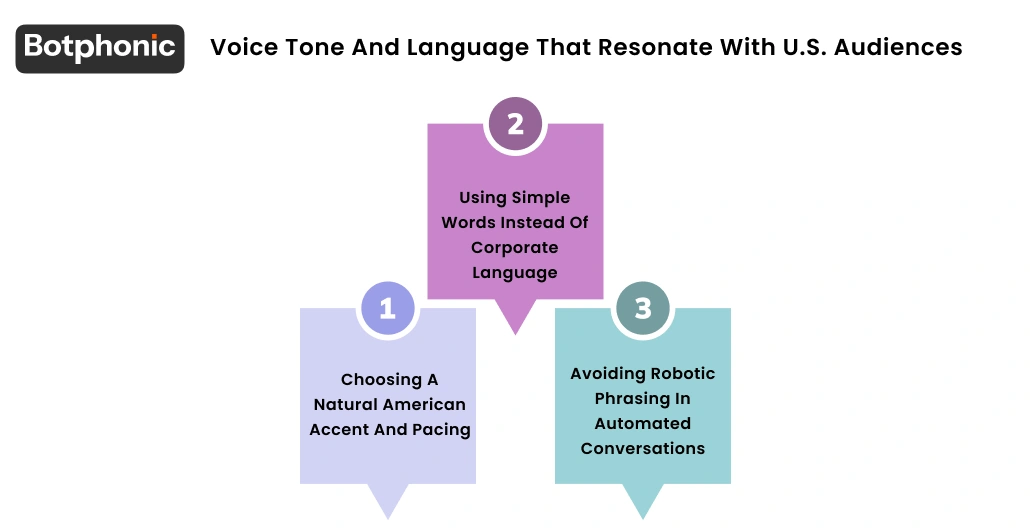
The tone of the voice affects how perceptive people are to automated calls. In the U.S., tone is as important as content. People expect calls to be polite, calm,m and easy to understand.
AI voice systems currently modulate tone, pacing,g and phrasing along lines familiar to Americans. This fix makes automated calls sound less robotic.
1. Choosing a Natural American Accent and Pacing
Listeners feel comfortable hearing a natural American accent. It creates clarity and instant trust. AI voice systems now provide accents that sound intelligible and neutral without overdoing it.
Pacing also matters. Calls that are too fast sound hurried. At the other extreme, calls that are too slow sound unnatural. AI systems toe the line to synchronize with prevailing U.S. listening habits.
 NOTE
NOTE
2. Using Simple Words Instead of Corporate Language
U.S. audiences prefer plain language. Corporate lingo introduces distance and misunderstanding. Automated calls are better when they include common words.
Content personalization with AI enables the replacement of formal phrases with clear alternatives. The system provides short, direct sentences rather than lengthy explanations. This clarity can enhance comprehension and lessen frustration.
Using simple language makes calls clearer and also more accessible.
3. Avoiding Robotic Phrasing in Automated Conversations
Robotic phrasing breaks trust instantly. Over-repetition of sentences and forced transitions betray automation. AI personalization solves this by changing up the phrasing and responding to user input.
Contemporary AI coders stop and start naturally, affirm responses, and even refine the wording mid-call. These behaviors establish a conversation flow that is more human-like.
Measuring Success of Personalized Automated Calls
Personalization is only relevant if it leads to better outcomes. American businesses need clear methods to understand if automated, personalized calls with an AI call assistant really do drive engagement and response from their customers. Artificial intelligence facilitates this measurement by monitoring how people respond to calls in real time.
Rather than having to guess at what the right move is, companies can now look to data to tell them where they were successful and where they should work on improved performance.
1. Key U.S. Call Metrics That Show Personalization Impact
There are several call metrics that tell us definitively whether U.S. audiences respond to personalization. If you are able to gain insights from your answer rate, check out whether the timing of your call and opening message feels relevant. Call length indicates whether people remain engaged once they pick up.
Completion rate and response rate are other useful metrics, too. Those metrics show whether callers listen all the way through a message and then take action. Personalized calls generally do better on all previous facets, as they match the customer context.
NOTE
2. Tracking Engagement Instead of Just Call Volume
While many businesses watch how many calls they place, not how the people respond. Just because call volume is generated does not equal success. Engagement tells the real story.
Engagement is how long people stay on the call, whether they press options, and if they fulfill actions. Tailored outreach that delivers a useful message often results in deeper engagement.
Engagement tracking enables businesses to eliminate wasteful calls and focus on the larger discussions involving interested candidates.
3. Improving Personalization Using Call Insights
AI systems obtain insights from each call. These insights show what’s effective, when people tune out, and how tone influences responses.
Businesses apply this data to optimize scripts, timing, and phrasing. With practice, calls become clearer and more effective. This ongoing improvement ensures that personalization remains relevant as consumer expectations evolve.
How AI Tools Simplify Call Personalization at Scale
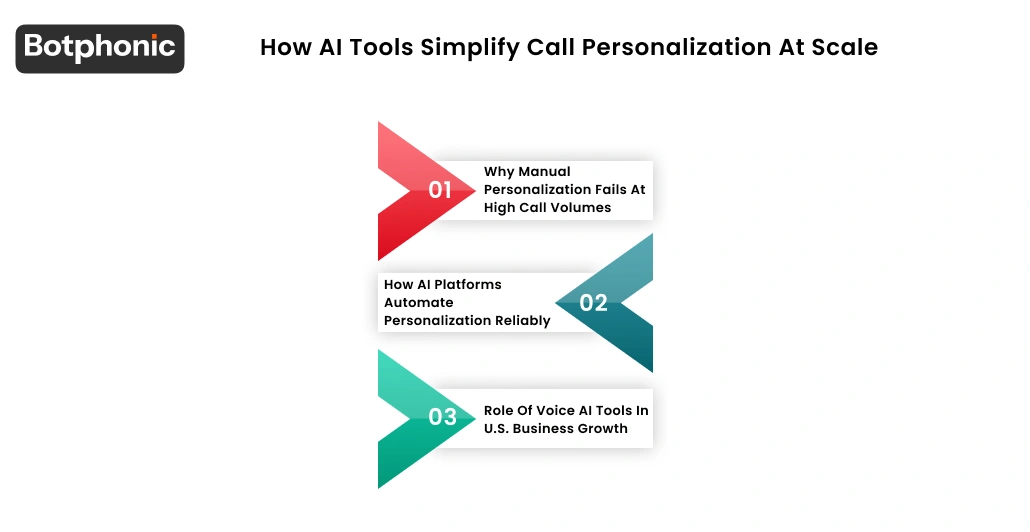
Personalization is great in small lots. This becomes challenging as the number of calls increases. AI tools address this challenge by consistently applying personalization rules across hundreds or thousands of calls.
These tools save manual work and ensure conversations stay relevant.
1. Why Manual Personalization Fails at High Call Volumes
Manual personalization relies on human input. When call volume increases, consistency decreases. Scripts are reused, context is shortened or missing, and accuracy suffers.
This strategy results in generic calls that annoy U.S. customers. Errors increase, and trust declines. Manual techniques are unable to respond quickly to data changes.
AI eliminates these constraints by enabling automatic personalization.
2. How AI Platforms Automate Personalization Reliably
Customer data, behavior patterns, and rules are used by AI-based platforms to personalize calls in real time. They modify greetings, message flow, and call timing with no human involvement.
The same logic is applied across all calls by these systems, which provides consistency. Companies can expand outreach but stay relevant and concise.
However, automation frees teams to concentrate on strategy, not rote tasks.
3. Role of Voice AI Tools in U.S. Business Growth
Voice AI tools scale rapidly because they process more calls without needing extra staff. They enable businesses to broaden outreach without compromising customer experience.
Voice AI is applied by U.S. companies for sales, support, reminders, and follow-ups. That personalization makes these calls feel like they could be helpful rather than intrusive, and helps foster long-term growth.
How Botphonic Helps Personalize Automateintrusive andd Calls
Botphonic simplifies how U.S. businesses automate calling personalization. The platform is designed with emphasis on clarity, flexibility, and scale.
- Intelligent Utilization of First-Party Customer Data: Botphonic personalizes greetings, references, and call flow with verified customer data. This method ensures that calls are relevant and accurate.
- Controlling Time and Timing of Calls: Botphonic also grows depending on U.S. time zones, and for this, they receive more calls. It helps businesses get in touch with customers at ideal times.
- Adaptive Call Scripts: Botphonic customizes scripts based on customer responses and behaviors. The paths that calls follow are not rigid; they evolve naturally.
- Natural Voice Delivery: Botphonic provides conversationally trained voice tones that are clear and neutral, just like U.S. donors prefer; calls sound smooth and easy to follow.
- Actionable Call Insights: Botphonic knows better over time, and so they draw insights that help businesses enhance personalization. Teams find out what works and adapt quickly.
Start capturing and qualifying prospects automatically with Botphonic’s AI call assistant and AI Call automation for U.S. businesses.
Request a Free DemoFinal Thoughts
Automated calls no longer function in a one-size-fits-all approach. Those differences in expectations for calls may be closely related to how contextualized, respectful, and easy-to-understand they feel to U.S. audiences. AI personalization enables that without the added complexity or manual effort.
Will businesses upgrade their operations and convert automated calls into productive conversations with the help of the responsible use of customer data, time adjustment for calls, voice tone updates, and call learnings? Why is Personalization so important? Personalized approaches increase trust, engagement, and long-term outcomes. In the U.S. market, automated calls are most effective when they feel deliberate and purposeful. AI introduces new workflows at scale.”
In conclusion, AI call automation for U.S. businesses enables companies to transform automated calls into personalized, data-driven conversations that improve trust, engagement, and long-term customer relationships.