Summarize Content With:
Quick Summary
Although AI call center software metrics include fulfillment of operational efficiencies, enhancing customer experiences, and cost reduction, the integrated AI call center software with CRM tools now makes it the better way to go in customer service.
Businesses are adopting solutions through smart AI innovations, such as predictive analytics, chatbots, etc., to design workflows, take on mechanized repetitive tasks, and advance greatly personalized service architectures at the enterprise scale.
In this feature post, we will be discussing the benefits, challenges, and best practices for better AI call center to CRM integration.
Introduction
Exceptional customer service in this very competitive business landscape is and has to be essential. Keeping pace with the demands of the customers, organizations are relying heavily on AI call center integrations which will boost efficiencies and lower costs and contribute to better customer satisfaction.
The integrations with AI are totally going to empower CRMs like Salesforce or HubSpot which themselves have been key in managing customer relationships. However, with AI integration, it becomes much sturdier and is capable of accomplishing much more than maintaining customer relationship management.
Integration of AI call centre software with CRM tools results in much quicker and sharper customer support service. This balance permits AI to take care of mundane jobs while the CM system is assisting in extensive understanding around customer behaviour and preferences, making sure every customer interaction is fully informed and efficient.
What Are Integrations With an AI Call Center?
AI call center integrations are simply the seamless integration of AI-powered tools with CRM systems. This allows AI to perform automated workflows and personalized interactions, improving customer service, as well as interfacing with customer data stored in the CRM.
Core Features of AI Call Center Integrations
- Chatbots: AI-driven bots are created to respond to simple questions. The capability of both generally minimizes volume calls but with significantly increased customer satisfaction from resolving inquiries.
- Natural Language Processing (NLP): NLP makes AI call assistants recognize the inquiry and articulate with consumers in a human manner.
- Predictive Analytics: With the information that AI gathers from the CRM on customers, it can administer expected necessities and serve call center agents by offering proactive solutions.
- Speech Recognition: AI is now able to transcribe customer calls and analyze them with sentiment, allowing agents to get a better understanding of the context in each interaction.
How Does CRM Reinforce AI Call Centres?
By integrating CRM tools with AI includes abilities by customer service teams:
- 360-degree, real-time customer profiles.
- Historical data giving context in interactions.
- Automating replies and workflows with funds of CRM data insights.
Vendor Selection Checklist (Practical Guidance)
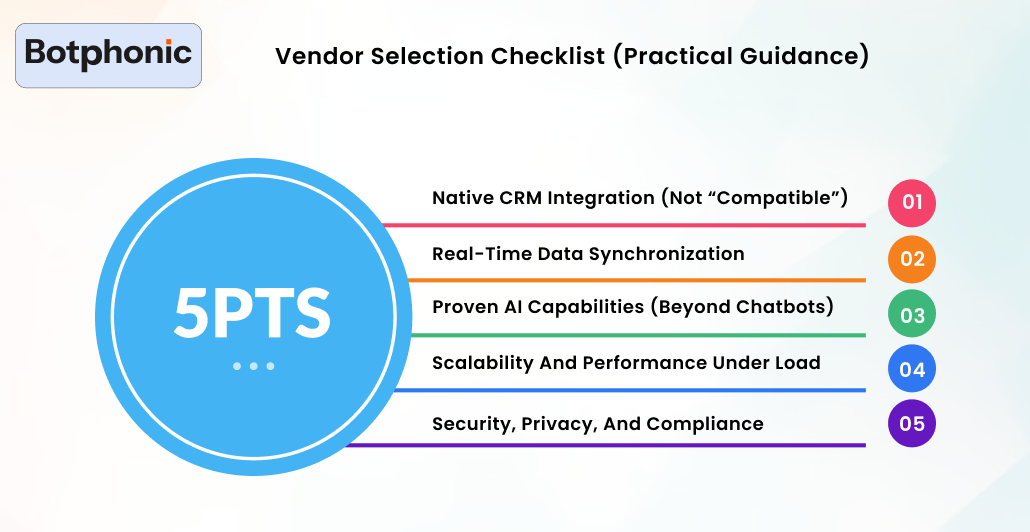
Choosing the wrong vendor isn’t just a slow down but it locks into your inferiority for years. You can use this checklist to separate serious platforms from other claimed ones:
1. Native CRM Integration (Not “Compatible”)
If a vendor is claiming their platform “integrates with Salesforce or HubSpot”, think harder. Ensure to verify:
- Out-of-the-box integration, not just third party connectors
- Bi-directional data sync in real time
- Full read or write access to CRM objects, such as contacts, cases, tickets, notes.
2. Real-Time Data Synchronization
AI is only as smart as the data it’s verifying, in real-time. Remember to verify:
- Real-time updates during live calls and chats
- No batch syncing for critical customer data
- Immediate CRM updates after each interaction
3. Proven AI Capabilities (Beyond Chatbots)
Every vendor has a chatbot, it’s not like they are offering anything new. You should what you have to verify:
- Live agent assist, such as suggested responses and next-based actions
- NLP accuracy across accents, languages, and noisy environments
4. Scalability and Performance Under Load
A system that effective works in a pilot might still fluctuate when deployed for full function, you should ensure to evaluate:
- Performance at peak call volume
- Proven enterprise-scale deployments
 NOTE
NOTE
5. Security, Privacy, and Compliance
This is one of the most important and non-negotiable aspects for any industry. You should check if the AI call assistant provides:
- End-to-end encryption, doesn’t matter if it’s in transit and at rest
- Compliance with GDPR, CCPA, HIPAA
- Role-based access controls and data masking
The right AI call center vendor won’t just “integrate” with your CRM but it will amplify it. Ensure to choose a partner that understands it, respects data, and delivers measurable outcomes.
How Does AI Call Center Integration Work with CRM Systems?
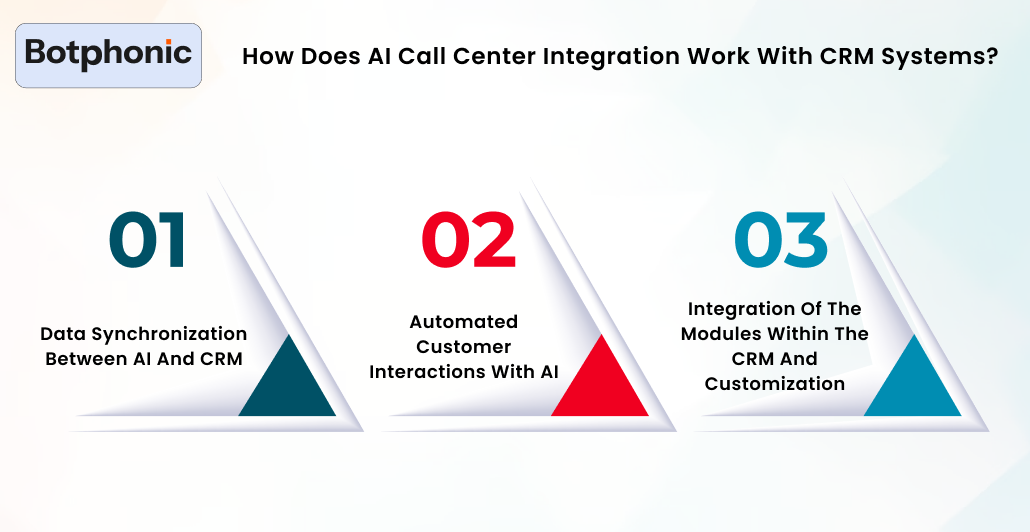
1. Data Synchronization Between AI and CRM
For full integration, the AI call center software is connected to a CRM system through an API, web hook, or middleware. It also can provide real-time data synchronization for customer interactions and updates.
- Profiles of Customers: AI has an active use of the CRM data in the construction of accurate customer profiles and uses this in the personalization of the interaction at every touchpoint.
2. Automated Customer Interactions with AI
With the full integration in place, AI call centers can automatically take all the calls relating to customer inquiries, using CRM data to give context and suggest appropriate solutions.
- Automated Responses: AI can respond to most frequently asked questions even providing steps to self-troubleshooting with no human intervention.
- Intelligent Call Routing: AI analyzes customer data in real-time, routing calls to the most suitable agent according to predetermined rules.
3. Integration of the modules within the CRM and customization
Several CRM systems provide modules powered by AI that will allow easy integration with AI call center software. And companies can customize workflows to trigger actions depending on customer interactions.
- Custom Workflows: For example, when customers raise a complaint about a product, AI can automatically log the issues, assign a priority level and notify the responsible agent to follow-up, all through the CRM.
Challenges to be Overcome in Integrating AI Call Center Software with CRM Systems
1. Data Quality and Standardization
AI call center statistics & insights data should be accurate, consistent, and up-to-date for CRM to function well with its AI counterpart. To the costliest inaccurate prediction failures or failed interaction is inconsistent or incomplete customer data.
- Data Cleansing: Regular data audits and cleaning activities would be necessary to maintain the quality of the data fed into both AI and CRM systems.
2. Cost and Complexity of Integration
Integration costs for AI applications and existing CRM systems could become significant to many companies using aged systems. The high costs associated with integration acquisition may require the use of specialized skills and resources.
- Implementation Time: Businesses need to plan ahead with phased implementations from small-scale AI initiatives to more extensive ones, as applicable.
3. Privacy and Security Concerns
When integrating AI with CRM, it must comply with data protection regulations such as GDPR and CCPA. Priority should also be given to the security of sensitive customer data in the process of integration.
- Compliance: Businesses must ensure that all data exchanged within the CRM and AI system is secure and that confidentiality is maintained.
 PRO TIP
Best Practices for Making Seamless AI and CRM Integration
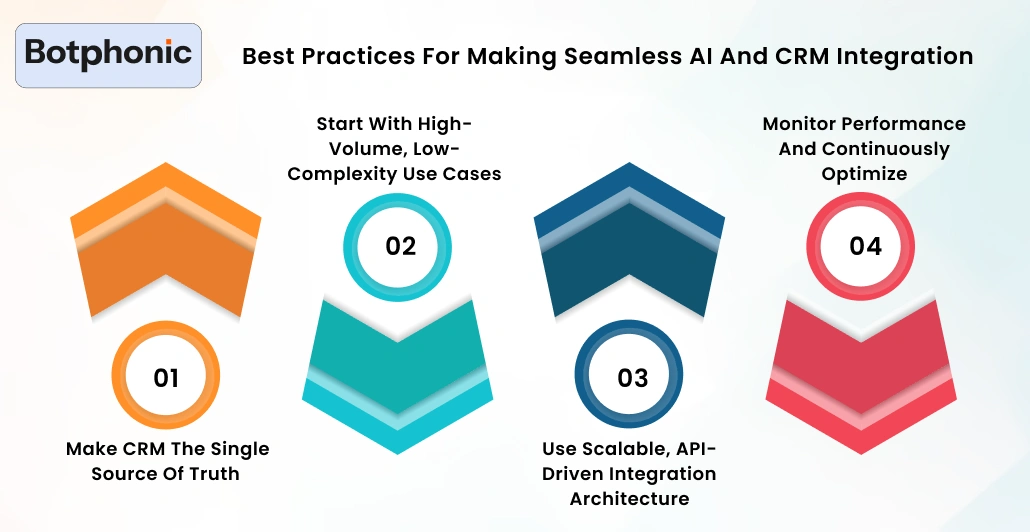
1. Make CRM the Single Source of Truth
For any successful AI call center integration, the CRM should remain an authoritative system for client data. AI tools should also read from and write back to the CRM in real time. Ensuring every interaction is accurate, traceable, and consistent as well. Fragmented data actively leads to poor AI decisions and also an inconsistent customer experience.
2. Start with High-Volume, Low-Complexity Use Cases
The smartest integrations usually begin with predictable workflows. For instance, order tracking, billing inquiries, appointment scheduling and more. Automating these tasks helps deliver quick ROI, reduces risk, and also validates performance before expanding the system into more complex customer interactions.
3. Use Scalable, API-Driven Integration Architecture
Seamless AI and CRM integration solely depends on robust architecture. Using APIs, webhooks, or middleware enables secure and real-time data exchange. While it ensures the system is able to scale with call volume and future capabilities.
4. Monitor Performance and Continuously Optimize
Integration doesn’t usually end at deployment. Ensure to track KPIs such as first contact resolution, average handle time, CSAT, and AI containment rates. Use CRM feedback loops to retrain your AI models and refine workflows continuously.
Try Botphonic Demo And See Results.
Request a Free DemoConclusion
Integrating AI call center software with CRM tools has already proven itself as a powerful strategy for businesses. It helps enhance customer service, optimize operational efficiency, and also reduce costs. The seamless connection between AI-powered systems and CRMs has enabled businesses to offer more customized experience to clients and drive overall customer satisfaction.
Meanwhile, with AI handling these tasks and using CRM data to create insightful and real-time customer profiles, businesses are able to focus on their human agents in more complex issues. This approach has smartly resulted in improved performance and better outcomes. Forrester research has also shown that AI initiatives will help in emerging a new age of creativity by enhancing productivity by 50% and will give more time for creative problem-solving.