
Summarize Content With:
Quick Summary
An AI call center effectively uses artificial intelligence to automate numerous voice-based customer interactions. It helps reduce operational expenses and improve response times. Businesses across industries are leveraging AI call centers to manage high call volumes effectively while managing service quality.
This AI call center setup guide is going to help you by providing a complete roadmap, from understanding what an AI call center is to implementing, optimizing, and also scaling it.
Introduction
Customer communication has proved itself as a major factor that helps in deciding the critical aspects of business success. Customers are rapidly expecting instant answers, personalized conversations, and also round-the-clock availability. The call centers that were present up to this date, have always struggled to meet expectations due to limited staffing, high costs, and also inconsistent service quality.
An AI-powered call center works by bridging this gap by using technologies like voice bots, natural language processing, and also machine learning. These systems can understand customer intent easily and respond to them in a most natural way. It helps resolve queries without any human intervention.
This AI call centre setup guide is designed especially for business owners, decision-makers, and teams who are going to modernize their customer communication strategy while improving efficiency and scalability.
What an AI Call Center Is?
An AI call center can be considered an assistant who is present virtually and uses artificial intelligence to manage outbound and inbound calls. Instead of relying on human representatives, AI systems actively manage conversations, answers queries, and routes calls intelligently.
AI call centers are built to engage clients in human-like conversations while maintaining consistency and speed. And they are especially effective for handling repetitive and high-volume interactions.
Key characteristics of an AI call center include:
- Voice bots capable of natural conversation
- Intent recognition using NLP
- Automated call routing and escalation
- Real-time data processing and analytics
A well-integrated system assures that customers are receiving fast, accurate, and context-aware responses through AI customer service that adapt in real time to each interaction.
Learn more: What Is an AI Call Center? A Beginner’s Guide
Benefits of Setting Up an AI Call Center
One of the most critical reasons for businesses to adopt AI call centers is their efficiency. AI systems can easily manage thousands of calls at once, while eliminating long wait time and improving customer satisfaction significantly.
Also another major benefit of adopting an AI call center can be counted as cost reduction. Businesses have seen significant lower expenses that are related to hiring, training, and managing even large customer support teams. AI also helps in minimizing human error and ensures that there’s a consistent service delivery.
Key Benefits Include:
- 24/7 Customer Support: AI call centers are operating continuously, while ensuring customers are receiving assistance at any time.
- Faster Call Resolution Rate: AI works by identifying customer intent and also provides instant and quick responses, shortening call durations.
- Lower Operational and Infrastructure Costs: Automation helps in reducing dependency on large teams and physical setups for call centers, which also leads to long-term cost savings.
- Easy Scalability: The systems are designed to scale up instantly whenever required, managing high call volumes even during busy periods without any service disruptions.
- Improved Customer Experience: AI analyzes all the customer data including interaction history to deliver a tailored response, making conversations relevant and engaging.
Along with these benefits, as time goes businesses also gain some of the smart valuable insights from call data, helping them refine processes and make better strategic decisions.
Key Components of an AI Call Center Setup
An effective AI call center software consists of multiple interconnected components working altogether to offer you seamless client interactions. Each component plays an essential role in making automation seamless intelligence.
At the core of these systems there is a voice bot that interacts directly with customers. Moreover, these bots rely on speech recognition and NLP to understand spoken language and respond to it naturally.
Core Components Include
- AI voice bots and conversational agents
- NLP and intent recognition models
- IVR systems and smart call routing
- Analytics and reporting dashboards
- Speech-to-text and text-to-speech engines
- CRM and third-party software integrations
A well-integrated system assures that customers are receiving fast, accurate, and context-aware responses.
Step-by-Step AI Call Center Setup Guide
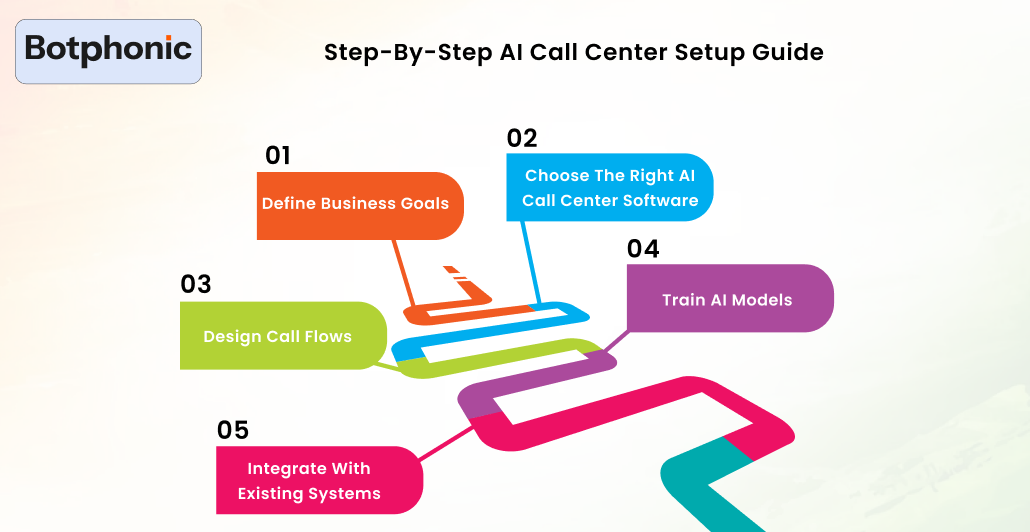
1: Define Business Goals
The first step in this AI call center guide is exactly what it should be, identifying business objectives. Without any clear idea of what you expect your system to offer the implementation can become inefficient or misaligned.
Evaluate first whether your AI call center will manage inbound support, outbound sales, or just a combination of both. Understanding customer pain points assists in prioritizing automation.
Questions to Consider:
- What types of calls have received the most?
- Which queries are time-consuming and repetitive.
- Do we need AI for support, sales, or just follow-ups?
Clear goals help assure that AI call centers are delivering a measurable value for you.
2: Choose the Right AI Call Center Software
Selecting the right platform is one of the major steps towards long-term success. The software you choose should align with your business budget, size, and also other technical requirements.
Cloud-based AI call center solutions are initially popular due to their scalability and ease of deployment. However, some enterprises might also prefer custom or on-premiere solutions for greater control.
Key Factors to Evaluate:
- Voice quality and language support
- Ease of customization
- Integration capabilities
- Security and compliance features
- Pricing and scalability
The right software forms the backbone of your AI call center.
3: Design Call Flows
Conversation design determines how natural and effective your AI interactions will be. Poorly designed call flows can even frustrate customers and reduce adoption. About 35% or companies have started using AI to improve customer service agents.
Remember to start mapping customer journeys and defining how the AI should respond at each step. And don;t use robotic phrasing, instead choose simple language.
Best Practices for Call Flow Design:
- Keep responses short and clear
- Anticipate multiple customer intents
- Include fallback responses
- And most importantly, always offer a human escalation option
Well-designed scripts help enhance customer experience and AI accuracy.
4: Train AI Models
Training is the foundation of AI performance, AI systems learn best from real customer interactions and historical call data.
Feeding diverse datasets effectively elevates speech recognition, intent detection, and contextual understanding. Continuous learning even helps AI to adapt to new customer behaviours.
Training Considerations Include:
- Monitoring misinterpretations
- Using real call recordings
- Updating intent libraries regularly
- Refining responses based on feedback received
A well-trained AI model leads to higher resolution rates and better customer satisfaction.
 NOTE
NOTE
5: Integrate with Existing Systems
Integrating AI call center software allows the systems to deliver personalized and informed responses. Without giving access to customer data, the interactions might remain limited.
By integrating CRM, ticketing systems, and other scheduling tools, AI offers context-aware assistance and reduces call transfers.
Common Integrations Include:
- Helpdesk and ticketing tools
- Payment systems
- CRM platforms
- Appointment scheduling software
Strong integration enables AI into a smart digital agent rather than just a basic voice bot.
6: Test, Optimize, and Deploy
Before full deployment, thorough evaluation of features is essential. Testing even helps identity gaps in call flow, system performance and also AI understanding.
A phased rollout of the systems allows businesses to gather feedback and refine the system before scaling.
Testing and Optimization Steps:
- Conduct internal test calls
- Measure response accuracy
- Monitor customer feedback
- Continuously improve scripts
Ongoing optimization ensures long-term efficiency and reliability.
Compliance, Security, and Data Privacy Considerations
AI call centers actively manage sensitive customer information, including personal details such as payment data, financial data, and even recorded conversations. As a result, security and regulatory compliance are non-negotiable factors for any industry.
Businesses should adhere to legal requirements that are related to call recording, data storage, and even customer consent to avoid legal penalties and reputational damage. Transparency plays an important role in building customer trust. Ensure to choose the software that helps you with this instead of the one who claims to be the best AI call center automation software.
Key Compliance Measures Include
- Secure Data Encryption: All call recordings and customer data should ensure to be encrypted, to prevent any unauthorized access.
- Clear Consent Notifications: Customers should be notified about the call recording and AI interactions, with consent captured in accordance with regional laws.
- Restricted Access to Call Data: Only authorized personnel should have access to all the sensitive call logs and recordings, it should be supported by role-based access controls.
- Ethical AI Usage Policies: AI systems should be designed in a way that avoids biases, ensures fairness and comply with ethical guidelines for responsible AI usage.
- Regular Audits and Monitoring: Continuous monitoring and periodic audits help in verifying vulnerabilities and ensuring ongoing compliance with regulations.
 PRO TIP
Future Trends in AI Call Centers
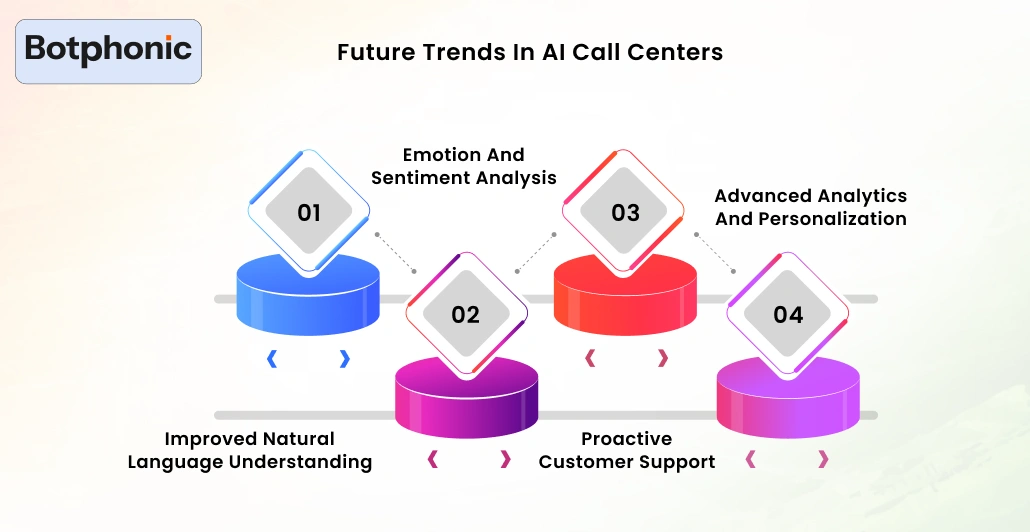
As AI technologies are still continuing to evolve, call centers have set themselves to undergo more transformation. These trends are not just going to redefine customer support operations but also deepen the strategic value AI is delivering to the business.
- Improved Natural Language Understanding: AI will now get better hold of contexts, accents, and even conversational nuances for more natural interactions.
- Emotion and Sentiment Analysis: Systems will be able to understand customer emotions in real time and will adjust the responses or might just escalate the calls to human agents when needed.
- Proactive Customer Support: AI will forecast customer needs by analyzing the past interactions, behaviour patterns and even the usage data.
- Advanced Analytics and Personalization: Deeper data analytics will allow AI to deliver highly personalized experiences on customer history, preferences, and also intent.
Staying updated with these trends are going to ensure you a long-term competitiveness, enabling organizations to deliver smarter and more engaging customer experiences.
Define Your Business Goals, Select The Right AI Platform, And Design Smart Call Flows
Try Botphonic Today!!Conclusion
Setting up an AI call center has become a necessity for companies who are looking for operational efficiency along with significant cost reductions. Businesses who are aiming to deliver fast, consistent, and personalized customer experiences at scale are actively adopting AI call assistant. Leveraging AI technologies such as voice bots, natural language processing, and even machine learning, organizations are overcoming the limitations of traditional call centers.
In this guide, we have outlined the complex roadmap, from understanding what an AI call center is to effectively defining business goals, choosing the right one AI call assistant for you, designing smart call flows, training AI models, and even ensuring a seamless integration with existing systems.