Summarize Content With:
Summary
In this blog, we shall explore the AI-changing experience of phone communication. You will learn how AI call assistants operate, explore some real-life examples, and discover how to get started simply, as well as the main advantages and issues of AI-powered calling systems.
Introduction
The phone is still the fastest way customers ask for help.
It’s also the fastest way businesses lose trust.
A customer calls. They expect an answer. Not a queue, not a looped message and Not silence. Just help. Immediately. And every time that expectation isn’t met, confidence drops. Quietly. Permanently.
That’s the reality of modern customer support.
Intent is simple. Customers want problems solved on the first call. Businesses want support that scales without inflating costs. Neither goal is possible with legacy call centers alone.
Human agents are capable. They are also finite. They can only answer one call at a time. Peak hours crush them. Repetitive questions drain focus. Burnout creeps in. Service quality becomes inconsistent. This isn’t a staffing issue. It’s a structural one.
This is why AI phone calling isn’t a trend. It’s a correction.
The solution isn’t removing humans. It’s removing bottlenecks. AI now handles the calls that don’t require judgment, nuance, or escalation. Booking. Follow-ups. FAQs. Status updates. Routing. The conversations that slow teams down but don’t need human reasoning.
This is the role of a modern Ai receptionist. Not a voice menu. Not a chatbot pretending to care. A system that answers instantly, understands intent, responds naturally, and knows when to hand off.
That shift alone changes everything.
Businesses testing this shift often start cautiously. They deploy a free ai call assistant to handle missed calls or after-hours support, they measure response time, resolution rate, and customer sentiment and they don’t guess.
And what they observe is consistent.
Calls get answered. Wait times disappear. Customers stop repeating themselves. Agents stop drowning in repetitive work. Support becomes predictable again.
Once that happens, the next step is inevitable. AI moves from an experiment to infrastructure.
But not all AI call systems are created equal.
Some sound robotic. Others respond quickly but miss context. A few can scale but fall apart when conversations drift off script. Real customer support is messy. Emotional. Unpredictable. Any system that can’t handle that creates friction instead of removing it.
Botphonic was built for real conversations, not demos.
Botphonic operates as an Ai receptionist that understands conversational flow. It answers inbound calls. Makes outbound ones. Detects intent. Tracks sentiment. Summarizes calls. Integrates with CRMs. And does it without latency that breaks the experience.
That’s why businesses don’t treat it as a gadget. They deploy it as an ai call assistant for business that becomes part of customer support operations.
And yes, many teams start with a free ai call assistant to prove value. But once AI consistently handles Tier-1 support without complaints or confusion, keeping humans on repetitive calls stops making sense.
The hybrid model takes over. AI handles volume. Humans handle complexity. Escalations feel intentional, not desperate.
This is why AI phone calling is changing customer support permanently. Not because it’s flashy. Because it works.
Imagine never missing a customer call again. It will get answered professionally 24/7, without the need for an additional hire. Sounds too unfair to be true? This has become possible through the use of AI phones and calling technology.
AI has the potential to transform your relationship with your customer base, whether you are a small-business owner or working in a large corporation. In this comprehensive guide to AI phone calling, we will clarify everything in simple terms so that you can learn about AI, discover, and act.
The economics are clear. Lower cost per call. Higher availability. Faster resolution. Consistent tone.
The second Ai receptionist goes live, silence disappears from customer support. Every call gets answered. Every customer feels acknowledged. Even at scale.
This isn’t about replacing people. It’s about letting them do what machines can’t. Judgment. Empathy. Creativity. Problem-solving.
Key Takeaways
- AI phone calling replaces an agent with virtual agents that sound natural to handle customers.
- It is convenient and time-saving, and it increases conversion and customer satisfaction without excessive installation.
- There is no necessity to develop your own AI model, as it can be developed with the help of such tools as Botphonic.
- The actual firms have accomplished more than 300% growth in sales with the help of AI voice assistants.
What Is AI Phone Calling, and Why Does It Matter?
So, where do we begin? What is calling using AI and the phone? So, in simple terms, it is when an intelligent machine places or takes phone calls on behalf of someone or a company. It speaks in human tones and hears in human tones. Still, it is a machine, and generative AI fuels its voice models. Probably, you have already encountered an AI call assistant without even noticing it.
Compared to old IVR, now AI prompting and AI in customer support allow conversational flow. This Comprehensive Guide to AI Phone Calling shows the power of generative AI in action.
Such AI agents are able to:
- Take bookings
- Follow-ups on leads
- Answer support calls
- Ever since, I’ve been feeling and acting up accordingly.
That’s why this isn’t just another tech trend; it’s a game-changer for AI in customer support and AI for small businesses.
Juniper Research projects that by 2024, around 8.4 billion voice assistant devices will be in use globally—a number that surpasses the entire human population.
Try Botphonic AI today and build your own AI call assistant.
Want to double your demo bookings? Set up your own voice assistant in under 10 minutes using Botphonic.
Request a Free DemoAI Voice Agents vs Traditional Call Centers
For years, traditional call centers have always been the backbone of customer communication. But with emerging trends of AI phone calls and conversational, businesses are rethinking how they can enhance their sales and support efficiency.
AI voice agents aren’t just an alternative but they also represent a fundamental shift in how companies scale their customer interactions.
1. Availability and Scalability: In traditional call centers the process of scaling operations requires organizations to hire additional staff members. AI voice agents provide organizations with the ability to scale operations immediately at any required moment.
2. Cost Efficiency: The operational expenses of traditional call centers include multiple components such as employee salaries, benefits, training costs, onboarding expenses, and additional items. The deployment of AI telephony systems begins their operation under various pricing structures which enable businesses to manage their customer interactions.
3. Consistency and Accuracy: Human agents help clients through their ability to understand their feelings while their work shows inconsistent results. AI voice bots deliver standardized interactions as they follow conversational workflows precisely.
4. Speed and Response Time: Traditional call centers face a major challenge because their customers experience long waiting periods which cannot be resolved. AI inbound call handling functions by eliminating queues entirely and answers each call almost instantly.
5. Personalization Capabilities: Humans can create personalized experiences but their capacity to do so remains limited because they lack the ability to manage large-scale operations. AI-powered conversations use CRM data and call analytics to create personalized experiences for every customer interaction.
6. Emotional Intelligence: Human empathy and judgment remain essential for handling difficult emotional situations which involve crisis support and sensitive customer complaints. AI technology has made progress in emotional intelligence but it still functions with restricted capabilities
Quick Comparison: AI Voice Agents vs Traditional Call Centers
| Feature | Traditional Call Centers | AI Voice Agents |
| Availability | Limited working hours | 24/7 AI phone calls |
| Scalability | Hiring required to grow | Instantly scalable AI call automation |
| Cost | High operational costs | Lower-cost AI telephony |
| Response Time | Wait times and queues | Instant AI inbound call handling |
| Consistency | Agent-dependent quality | Consistent conversational AI responses |
| Personalization | Limited at scale | CRM-driven AI customer support |
| Emotional Intelligence | Strong human empathy | Limited but improving AI voice agents |
.
Hybrid Call Centers: The Emerging Model
The future isn’t only AI versus humans but it’s more about AI plus humans. Modern AI call centers are increasingly optimizing a tiered approach, where AI manages Tier 1 questions like FAQs, routing, booking, and more, and humans manage escalations and complex cases.
Combining AI phone assistant’s efficiency and human agents empathy, this hybrid structure creates a balanced and scalable support system.
The Technology Behind AI Phone Calls
AI phone calls may feel conversational and effortless but it does have its own behind the scenes, they rely heavily on an orchestrated stack of technologies. Modern AI voice agents operate by combining advanced technologies like speech recognition, language intelligence, and even voice synthesis that helps in delivering natural and human-like interaction.
1. Speech Recognition (Speech-to-Text)
Every AI phone conversation is initiated with understanding the caller’s voice. It is majorly handled by a speech-to-text system that operates by conerting spoken audio into text within milliseconds.
Advanced speech recognition models are usually trained on different factors. For instance diverse accents, tones, and speaking speeds, it allows AI phone assistants to handle real-world conversations.
This real-time transcription also forms the foundation for intelligent AI call automation, which enables the system to understand what the caller is actually saying rather than relying solely on rigid menu inputs.
2. Natural Language Processing (NLP)
Once the speech is converted into text, natural language processing starts operating on the same. NLP enables AI agents to:
- Detect user intent
- Understand context across multiple turns
- Handle follow-up questions naturally
- Interpret sentiment and urgency
Unlike other traditional IVR systems, conversational AI doesn’t even rely on scripted paths. It operates by understanding meaning, that makes AI phone calls feel fluid rather than robotic.
3. The Decision Engine (AI Reasoning Layer)
After understandingit’s intent, the AI should decide how to respond. And this usually happens inside the reasoning layer, that is the logic engine that empowers real-time decision-making.
This layer combines:
- Conversational workflows
- Business rules
- CRM integrations
- Historical interaction data
For example, if a returning customer calls, the AI can just share the context from previous interactions and easily tailor the response accordingly. Moreover, this also changes AI-driven communication from generic automation into personalized conversations.
It’s also where call automation seems strong, it enables tasks like lead qualification, call routing, appointment booking, and even escalation to human agents when required.
4. Voice Generation (Text-to-Speech)
Once the AI decides what to say, the response is converted back into audio by using text-to-speech (TTS). Modern voice AI systems use neural voice synthesis that helps in generating speech including:
- Natural pacing
- Human-like intonation
- Micro-pauses
- Emotional tone variation
This is what enables AI voice agents to sound like a real person, that’s a critical factor in building customer interactions. Some advanced systems also support custom voice cloning, enabling vendors to create unique identities.
5. Real-Time Orchestrations
How fast a technology works defines AI’s real capabilities. In a typical conversation it feels various steps are considered, such as:
- Audio is captured
- Speech is transcribed instantly
- NLP detects intent
- The AI generates a response
- Reply is synthesized into speech
And all of this happens within a second, which enables real-time AI voice conversations that feel seamless to the caller.
6. Continuous Learning and Optimization
Unlike traditional call automation systems, AI voice agents improve over time. With every interaction, they can easily:
- Refine conversational workflows
- Improve intent detection accuracy
- Adapt to customer language patterns
- Optimize call analytics and outcomes
This feedback loop makes voice AI technology increasingly effective. And turns every call into training data to strengthen future performance.
Real-World Use Cases for AI in Customer Support
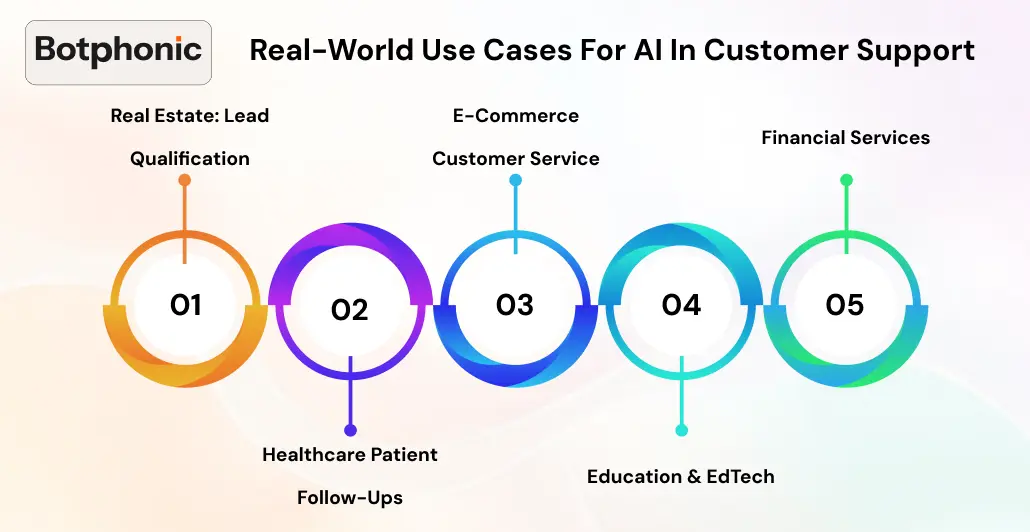
Artificial intelligence in customer support is developing at a rapid rate, and the reason is the following: people want answers quickly, they want ready access 24/7, and they want to be treated politely at all times. Firms with AI Call Assistant are addressing these problems in volume.
The following are some real-life applications:
1. Real Estate: Lead Qualification
Managers and salespeople also have AI phone calls that allow agents to pursue leads immediately. The AI inquires, remembers, and arranges visits.
2. Healthcare Patient Follow-Ups
Customer support AI in the form of hospital-related AI is being implemented to check on patients and remind them about medications or hospital appointments, and everything is handled for patients through an automatic process.
3. E-commerce Customer Service
AI automation assists brands in responding to FAQs, assisting with purchase orders, and decreasing support department workload.
4. Education & EdTech
Schools implement AI agents and course platforms to guide potential students, respond to questions, and remind students.
5. Financial Services
Through the AI IT support provided by banks and fintech companies, verifying their identification, updating, and guiding customers through processes is accomplished.
From small neighborhood stores to bigger businesses, the use of AI in business operations is having an enormous effect, as you can see.
How to Get Started Without Building Your AI Model
A question you would ask: “Can I use AI even though I am not a science-technology-mathematics person?”
Not. You do not need to build your own AI model to begin with.
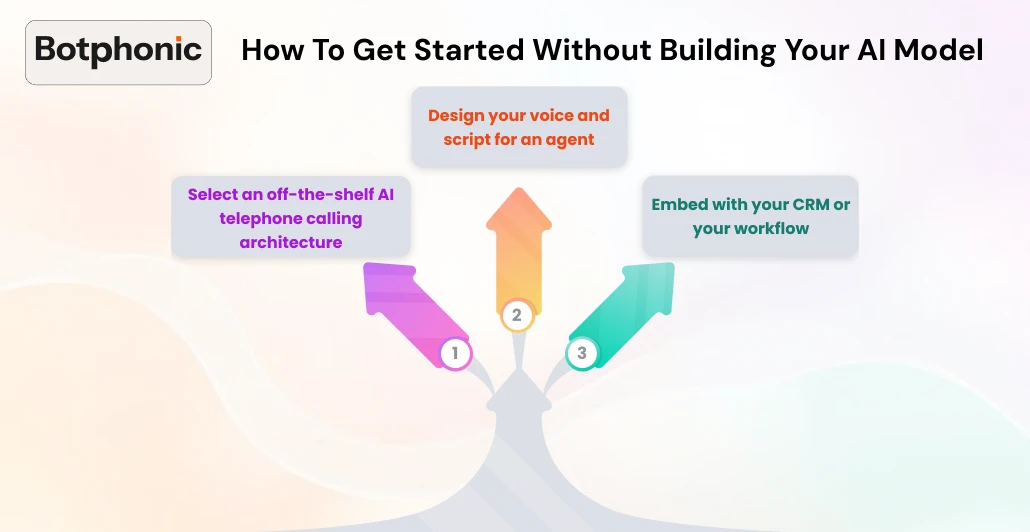
This is how you can start in 3 easy steps:
1. Select an off-the-shelf AI telephone calling architecture
With such tools as Botphonic AI, you can build your voice agents in a matter of minutes or setting up any technicalities.
2. Design your voice and script for an agent
Post your script or even talk about yourself! This assists in developing a tone for a personal brand.
3. Embed with your CRM or your workflow
The majority of the tools are integrated with other tools such as HubSpot, Salesforce, Google Sheets, or Zapier.
It is do-it-yourself AI—no more spending years developing the technology; just get it. This is mainly because most platforms are cloud-based, making it easy to scale as the needs increase.
 PRO TIP
Key Benefits of Phone Call AI for Businesses
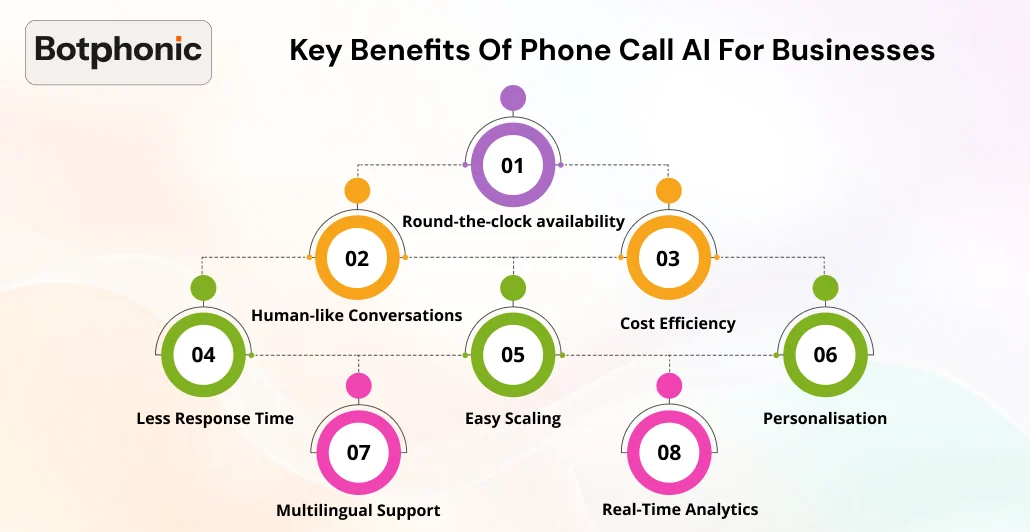
What stimulates a high number of companies to convert to AI phone calls? It is because the outcomes are self-explanatory.
So, what are the best reasons?
1. Round-the-clock availability
Your customers may call 24 hours a day, and the AI call assistant is online at all times. It will end these lost opportunities.
2. Human-like Conversations
AI prompting Day AI is even leading to modern prompting, where your callers will never even know they are talking to a bot. This develops professionalism and trust.
3. Cost Efficiency
It is costly to employ support reps. Customer service AI allows hundreds of frames to make calls at only a fraction of the cost.
4. Less Response Time
AI does not stop. It picks up faster, answers smartly, and the wait time is reduced drastically.
5. Easy Scaling
AI automation can grow with you; whether it be 100 calls or 10,000 calls, there is no pressure.
6. Personalisation
Under the AI models, every phone call can be customised according to the customer’s information and history.
7. Multilingual Support
Most AI agents speak 20 or more languages and have various accents, which is ideal for a global business.
8. Real-Time Analytics
Obtain live transcripts, sentiment scores, and call summaries that help your operations run more efficiently and improve your scripts.
| Feature | Human Agent | AI Phone Call Assistant |
| Available 24/7 | ❌ | ✅ |
| Cost per call | High | Low |
| Speaks multiple languages | Limited | Yes |
| Response time | Varies | Instant |
| Call transcription | Manual | Automatic |
Challenges and Solutions to AI Adoption in Voice
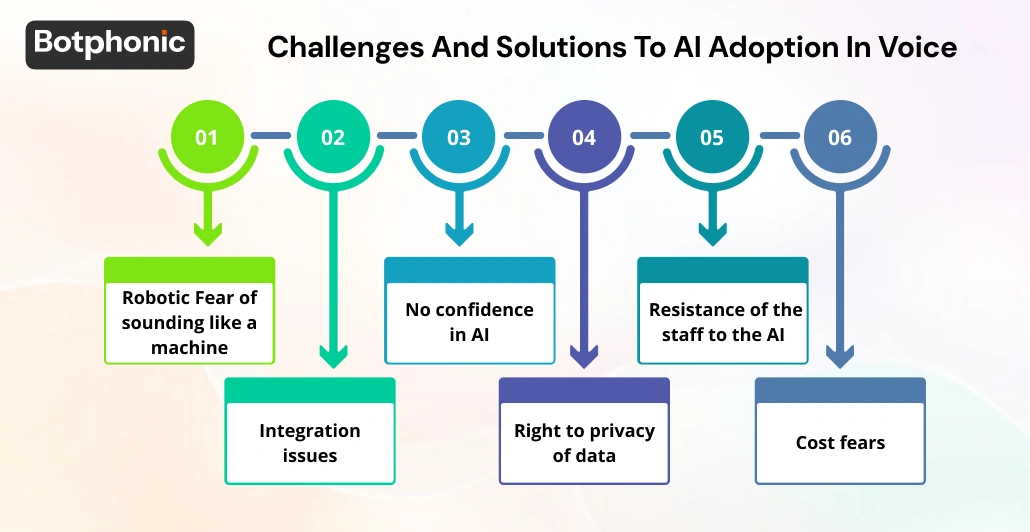
AI is very powerful, and there are some obstacles when implementing it. Now, let’s run through typical concerns about these problems and how to counteract them regarding AI:
1. Robotic Fear of sounding like a machine
Solution: Take advantage of generative AI and custom-voice assistive tools. Even your voice may be uploaded to sound natural.
2. Integration issues
Solution: Turn to such tools as Botphonic with more than 180 integrations. You will easily integrate with any current CRM or help desk.
3. No confidence in AI
Solution: Adequately train your AI agent using AI prompting. Make it current with new information and customer response.
4. Right to privacy of data
Solution: select AI vendors who abide by standards such as HIPAA and GDPR.
5. Resistance of the staff to the AI
Solution: Help improve thinking with AI, and not replace it. It takes care of menial jobs, allowing your human workforce to spend time on important conversations and planning.
6. Cost fears
Solution: Most contemporary trades offer flexible pay-as-you-go options. Botphonic, e.g., allows you to launch with the minimum investment, and you are only charged per use.
Conclusion
This is a customer experience world we are in. Out there, people are looking to receive immediate assistance, concise responses and a human approach to it. This is what assistants using AI now provide. They are no longer mere experimental instruments but a necessary business asset.
You can be a startup, a one-person team, or a huge enterprise. AI in customer support and AI automation will make you more efficient, reduce business expenses, and enable you to deliver five-star experiences with every customer.
And the best of it? You do not have to be a technology wizard. With tools like Botphonic AI, you get everything you need to have a great AI phone calling system up and running within minutes.