Summarize Content With:
Quick Summary
AI call center workflow automation is smartly changing how customer service operations are running. It’s helping cut costs, reduce friction, and also scaling without throwing any people at the problem. This article also breaks down what it actually means and which workflow AI automates today. Moreover, how AI is helping provide a measurable business impact.
Introduction
Let’s be honest and accept that the traditional call center model is asking for renovation. With rising calls, shrinking margins, burned out agents, and even customers with zero patience for inefficiency have created a perfect surrounding.
But with AI call centre, it has become a practical, operational lever. When implemented appropriately, AI call center workflow automation isn’t just reducing costs but restructuring how customer interactions are flowing from start to finish. It’s not just about replacing humans, but automating repetitive and predictable tasks.
What “AI Call Center Workflow Automation” Actually Means
Before the jargon overtakes the subject, let us lay some grounding.
AI call center workflow automation is all about the use of AI, conversational AI, natural language processing, machine learning, and voice recognition, to automate, optimize, and orchestrate customer service workflows across the entire call lifecycle.
This is way beyond the legacy IVRs or rule-based bots.
The key differentiators:
- IVR systems are working on a fixed set of scripts.
- Rule-based automation is reactive to a defined condition.
- AI is about intent understanding, real-time adaptation, and data-based improvement.
Simply put: AI does not just route calls but is also able to understand the reason behind a customer’s call and decide what happens next in that workflow with minimum human intervention.
 NOTE
NOTE
Core Call Center Workflows AI Automates Today
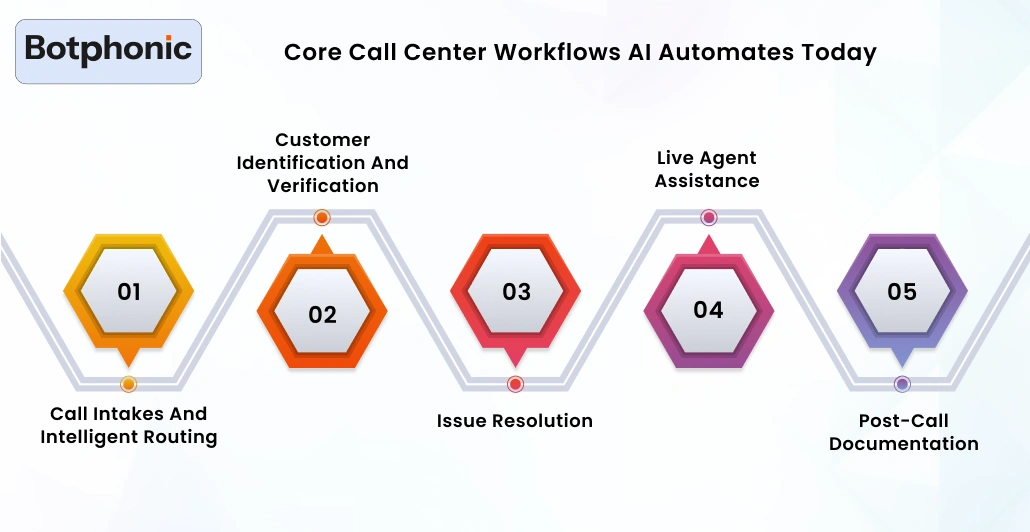
This is where theory meets practice. Presently, modern AI call center software automates high-impact workflows with measurable returns.
- Call Intakes and Intelligent Routing
AI analyzes spoken language in real time to identify customer intent, urgency, and sentiment. Call escalations occurs when query is complex.
The result: lower average handle time and less transfers.
- Customer Identification and Verification
Voice biometrics and contextual data replace manual security questions. Customers get verified during real time conversations.
Result: faster calls and better customer experience.
- Issue Resolution
Monotonous, repetitive, and yet high-volume inquiries are managed by AI. Automated tasks are as follows:
- Order status
- Account updates
- Billing inquiries
- Appointment setting
Result: humans are unshackled from work machines should have done away with years ago.
- Live Agent Assistance
With the need for human agents, AI is assisting them with:
- Real-time suggestions for responses
- Automated lookups to the knowledge base
- Dynamic prompts for next best actions
Result: better agent performance with less ramp-up time.
- Post-Call Documentation
The AI auto transcription of calls, summarizes outcomes, tags intent, and updates CRMs.
Result: Agents are free from having to type; data quality improves, and managers get clearer reporting.
A Complete View: How AI Takes Over The Complete Consumer Search Journey
AI call center workflow automation, however, has its best promise, not when the individual systems are treated as live linkages within one coherent engine but when it is tabs of tools. Ideally designed AI call center, every step in the customer journey is connected and contextual, measurable.
1. Customer Calls In
The very first moment the customer engages with the company via phone is immediately through AI interaction. No IVR menus, no long wait times, nothing: just natural speaking of the customers and with it, creating the frictionless experience from the very first second.
2. Intent And Sentiment Detect By AI
Everything the customer says and how he or she says it is analyzed via Conversational AI, and the intent, urgency, and emotional state are recognized. Integrating AI call center software helps with the interaction is routed, raised, and handled appropriately from the very beginning.
3. Identity Is Passively Authenticated
While in interaction, the customer is authenticated through voice biometric and contextual signals with no need for security questions while taking the right precautions against fraud.
4. Automatically Resolves Issues Or Intelligently Routes
AI can define whether the request can and should be fully automated or whether a human agent is necessary. Straightforward repetitive issues are solved in moments, whereas complex ones are routed to the best agent.
5. Agent Gets Complete Context If Relevant
The agent gets a complete picture of the customer’s history, intention, and previous interactions, eliminating the need for repetition and allowing them to dive right into resolution.
6. Automatically Sum Up And Record Calls
AI will maintain accurate documentation by generating call summaries, classifying them by outcome, and updating the CRM and ticketing systems without manual input from the humans involved.
 PRO TIP
The Transformational Benefits of AI Automating Call Center Workflows
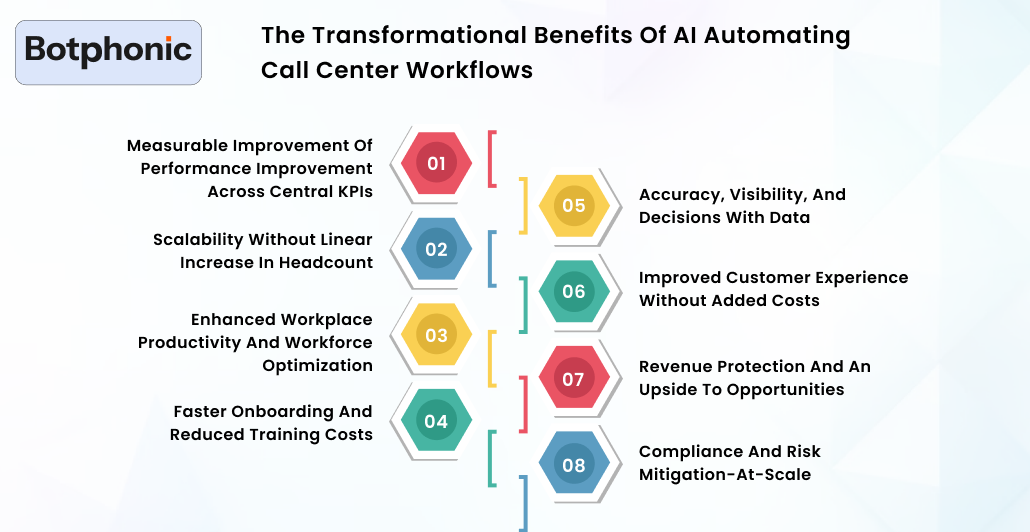
Call center workflow automation with AI is not a technology upgrade, but a transformation of operational models. Put into place with excellence, an AI call center for your business alters cost structures, performance metrics, scalability, and even workforce dynamics. The effects are immediate and compounding.
1. Measurable Improvement of Performance Improvement Across Central KPIs
Consistent improvement of AI-driven workflows in numerous industries, such as healthcare, real estate, and others have seen. over conventional call center processes in major operational indicators, Average Handle Time (AHT), reduces the time involved since intent is identified early and calls are delivered right first time. First Call Resolution (FCR) holds because of full context for agents or because issues have been automatically resolved before escalation.
Reduced abandonment rates due to customers bypassing the IVR hassle to quicker engagement. Increased Customer Satisfaction (CSAT) and Net Promoter Scores (NPS) not because interactions feel “high-tech”, but out of efficiency, accuracy, and that respect for the customer’s time.
Operational reality: AI improves execution discipline, which is what really moves KPIs.
2. Scalability without Linear Increase in Headcount
By hiring additional agents, traditional call centers scale. AI call centers are predefined to scale. Organizations will never panic-recruit or degrade services because of automated workflows beyond seasonal spikes, demand-driven from marketing, or unexpected surges in usage.
AI systems function at all times, and performance remains consistent; thus, it is economically feasible for global coverage and after-hours backing. These elasticities remove one of the biggest operational constraints in customer service.
Strategic advantage: Growth without proportional cost growth.
3. Enhanced Workplace Productivity and Workforce Optimization
AI Phone Call does not eliminate agents; it redefines them. Where their functions may be repetitive and continuous with their after-call work, agents are left with more interesting interactions and taking on more calls during their shifts. Real-time assistance from AI is brought about by parameters of accuracy, compliance, and confidence-enhancing effects.
This leads to better usage of skilled labor and most definitely less burn-out. Burnt-out agents are not treated like humans in IVRs, retention increases—retention is one of the most underrated cost savings in the business.
Workforce outcome: High productivity with lower attrition.
4. Faster Onboarding and Reduced Training Costs
Call centers have conventionally been very time-consuming, costly training. Ramp time is reduced with workflows using AI because they guide agents in real time, surface relevant information, and automatically enforce compliance.
New agents will now time to reach acceptable performance levels, while more experienced agents will maintain stability without constant manual coaching. Training goes from mere memorization to judgment and that is a much better use of human capability.
On the financial side: Less training costs to incur as well as faster time-to-value gains from every hire.
5. Accuracy, Visibility, and Decisions With Data
AI eliminates one of the biggest silent problems of call centers: poor data quality as all focuses are transcribed, summarized, and tagged automatedly so that any interaction is indexed in a uniform manner. From that moment on the manager will enjoy visibility into 100% of calls rather than relying on a limited number of samples of QA.
This will enhance forecasting, quality assurance, compliance monitoring, and performance management. Decisions will per force be governed by real data and not guesses.
Leadership benefit: Clearer gaining insight without the surprise.
6. Improved Customer Experience Without Added Costs
Customers require speed, they need accuracy, and they want not to repeat themselves. AI gives all three: faster resolution, intelligent routing, and contextual awareness improve customer experience without operational increase.
In addition, AI call assistant also enables proactive service, preempting customers from having to escalate issues or churn. This moves call center operations from purely reactive support to experience management.
CX reality: Better service doesn’t have to take more investment-the secret is smart workflows.
7. Revenue Protection and an Upside to Opportunities
AI can help prevent rodger by meaning that it will do what is called sentiment detection or churn prediction to hold a customer before he falls into churn or dissatisfaction. Some automated workflows such as upsell or cross-sell may also be revealed in such an opportunity where it is situationally matched without an aggressive script.
AI will transform the call center into a revenue-protecting entity and sometimes revenue-generated unit out of a simple cost center when responsible.
Commercial impact: Reduced churn and smarter growth opportunities.
8. Compliance and Risk Mitigation-at-Scale
AI monitors compliance in real-time over conversations during the conversations themselves and ensures that disclosures and policies are following requirements.
This scalability and non-fatigued nature put AI far ahead of humans as it lessens regulatory risk and opens up audit readiness for the millions of costs violating the set standards.
Risk perspective: Where machines can enforce consistency, humans cannot.
The business impact of AI call center workflow automation is structural, not incremental. Organizations that successfully adopt this reduce costs, create better outcomes, scale intelligently, and serve customers without increasing headcount.
Define Your Business Goals, Select The Right AI Platform, And Design Smart Call Flows
Try Botphonic Today!!Conclusion
That is to say, AI call center workflow automation has moved from the realm of “nice to have” for customer service operations to one of structural necessity. The old backward call centers, built on manual processes and linear growth of headcount, simply cannot keep up with today’s customers’ expectations or their economic pressures. AI changes the whole equation here, not by adding more people to patch an inefficiency but by redesigning the workflow itself.
Manual tasks can easily be handle with real time insights with the help of AI. Agents are now receiving real-time insights. And even every trading activity is traceable under one platform. Even in data capture, automation helps with 95% accuracy. This means lower operating costs for the organization, enhanced performance metrics, scaled-up capacity, and a consistently improved CX, all while keeping headcount static.
Organizations that succeed in AI are not entertaining novelty; they are somewhat disciplined in fixing workflows first before automating them, integrating systems appropriately, and keeping humans focused on what humans do best. Those who delay will only amplify their inefficiencies by higher costs.