Summarize Content With:
Introduction
It comes to a point that every Nashville practice manager can identify with. It is close to 40 minutes into the morning, not to mention that phones have not been stopped since the doors were opened. Two employees continue working on the calls that happened yesterday and a patient who called at 8:07 AM has yet to be contacted. Before one even calls back, he/she has already booked another place.
That’s not a staffing failure. It is a capacity issue – one that the traditional telephone systems never had to address. The unique divide that is bridged by a HIPAA-compliant, well-built AI call assistant is it.
The healthcare industry of Nashville is not deficient in ambition. The city has always been comfortable on the boundary of what can be operationally possible in the medical field. With over 500 health-oriented firms headquartered here. Still, the phone workflow of most individual practices, family medicine clinics, and more are still in a different decade.
The good news: that’s changing. And the processes that are undergoing transformation to AI call automation are not coming up with returns that are merely convenient.
Why Are Most Nashville Practices Struggling with Call Volume Right Now?
Let us tell it straight regarding what is really going in most of the practices in the peak periods. The disproportionate call volume is received in the average medical office between 8 AM and noon. Request for appointments, refills, insurance questions, follow-ups after the visit – they come under a narrow window and the front desk teams simply cannot accommodate them without something falling.
The data provided by the industry always indicates that somewhere between 20-35 percent of the calls coming in are not picked up during these times. In the case of a busy Nashville clinic with 60 to 80 patients a day, that is not a small inefficiency, but will be lost revenue, festering care, and patient dissatisfaction, which will eventually spread silently over time.
Even the calls that employees answer do not get the attention they should. Employees who handle high-volume, repetitive calls during refills, appointment booking, and inquiries about directions tend to feel overworked and therefore lack the time to give the truly challenging or urgent calls the attention those callers warrant.
It is not the issue of phones in healthcare that causes missed calls. It is regarding the imbalance between the demand and capacity of patients. AI call assistants are created to fill that gap specifically.
What HIPAA-Compliant Really Means of an AI Phone System
The compliance question must be answered ambiguously before any practice subjects call to an AI system of patient calls. There are also particular and consequential requirements of HIPAA in this respect: all phone interactions that involve Protected Health Information fall under the Privacy and Security Rules, whether it is a human or an AI working on this matter.
To be truly HIPAA-compliant, an AI voice assistant for healthcare should have all of the following, not as an optional addition, but as a minimum infrastructure:
- An actual Business Associate Agreement (BAA) between the vendor and your practice, signed.
- Encryption (AES-256) of all data during transit and rest.
- Role based access control of individuals who can access patient interaction records.
- Complete tracking of all system activities and access points.
- Retention and deletion policies set up under practice control.
- A written notification system of breach with specified action plans.
- Total disconnection with third party advertising and analytics pipelines.
Any vendor that is not ready to sign a BAA prior to a contract discussion has to be disqualified immediately. Any vendor that cannot articulate their encryption guidelines, audit documentation, or access regulations is informing you about something significant about their compliance infrastructure – or lack thereof.
What Kind of Calls AI Performs best and Why It Matters
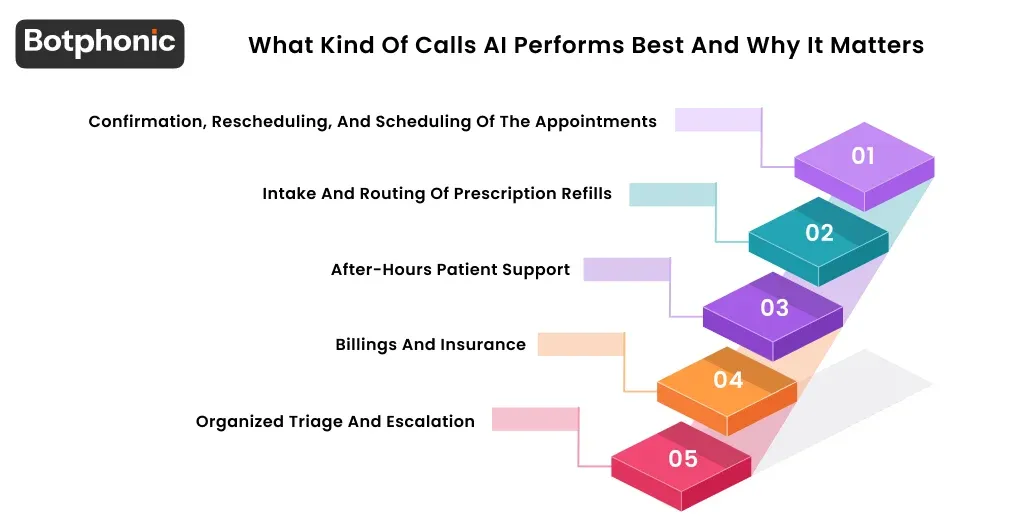
Inbound calls do not present equal complexity or clinical nature.An effectively deployed AI call-assistant does not attempt to substitute human judgment; it instead takes control over the structured, repeatable calls that it can handle without human intervention and allows your team to manage the interactions that require human involvement.
The areas in which AI call automation has had quantifiable effect on a regular basis:
1. Confirmation, Rescheduling, and Scheduling of the Appointments
When integrated into your appointment booking tool or EHR, an AI call center will verify your real-time availability. And process by scheduling appointments, confirming visits, and taking rescheduling requests without a hold-up time. Appointment management practices based on AI have been shown to reduce the rate of no-show. Since the reminder frequency is no longer influenced by staff bandwidth.
2. Intake and Routing of Prescription Refills
Refill calls are very or very frequent and are simple in structure. The information that is needed is predictable. The process of intake can be repeated. Even the process of routing the request does not need clinical judgment. This is neatly taken care of by AI receptionist. It will mark anything that needs a clinical look into and would not allow the queue to accumulate as the staff works elsewhere.
3. After-Hours Patient Support
The needs of patients do not keep office time. Having an AI call assistant that is 24/7 will ensure a patient who reschedules will receive a real answer. As opposed to a voicemail that the patient will have to call back the next day. To chronic care patients in particular, that after-hours access directly is of clinical value.
4. Billings and Insurance
Another category that is high-volume and low-complexity is inquiries of pre-visit coverage, co-pay questions, and routing of billing. AI processes the intake and responds to general queries without hold time. Meanwhile, it escalates any sensitive or complicated queries to the definite team member with the entire context.
5. Organized Triage and Escalation
In the case of practices, dealing with population management where the conditions are chronic. AI-guided triage walks lead the callers through facilitated check-ins. And, also escalates emergencies when necessary response is received. This is where the technology has taken a giant leap to the level of patient safety.
How Botphonic Healthcare HIPAA-Compliant Automation of AI Calls
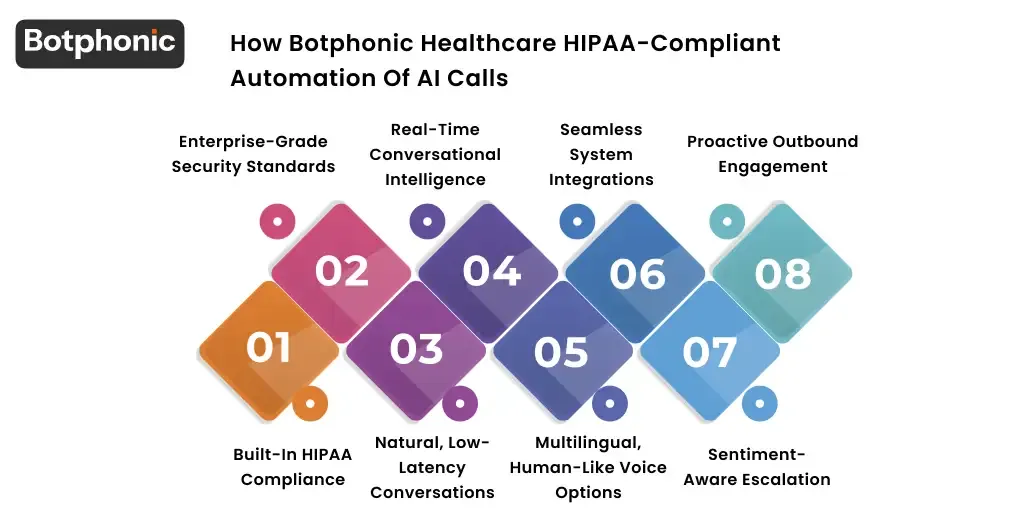
Healthcare serves as a primary context rather than a secondary vertical upon which Botphonic was constructed. That difference influences fundamental aspects like the manner in which the platform addresses PHI and the conditioning of its voice functions.
To Nashville practices that consider AI call solutions, Botphonic is bringing:
- Built-In HIPAA Compliance: Complete HIPAA compliance with BAA accessibility, end-to-end PHI encryption, and audit-friendly access rights integrated into the background, rather than an enterprise alternative.
- Enterprise-Grade Security Standards: Type II Compliance of SOC2 and PCI DSS that include security audit and documented incident response plans that are compliant to both the internal compliance teams and external accreditation reviewers.
- Natural, Low-Latency Conversations: Natural language processing at low latency that can drive conversation that patients can actually use- not scripted phone trees re-dressed up as AI.
- Real-Time Conversational Intelligence: Real-time natural language processing that can make conversations that patients can actually use, rather than programmed phone trees in disguise of AI.
- Multilingual, Human-Like Voice Options: It has 60+ voice options and is multilingual, which is topical in the context of the Nashville patient population that is becoming more diverse; communities, in which English is not the primary language.
- Seamless System Integrations: Single integration with 180+ EHR, CRM, and scheduling systems through API and SIP trunking, such that the system does not need to rebuild your infrastructure around it, but integrates into the existing infrastructure.
- Sentiment-Aware Escalation: Live sentiment analysis reading through change in tone of the patient and updating its response processing, including routing on escalation when the emotional context shows the patient is in urgent need
What Botphonic offers in the Nashville market that is not present in other systems is the depth of compliance, voice quality, and system integration, which makes healthcare-grade implementation actually a possibility without a months-long implementation initiative.
Will Patients Use It in Practice or Will they Resist?
The issue that stays the most in the minds of evaluation discussions is the patient experience issue and it is a justifiable one. No one would like to come up with a technology that would result into less attention given to the patients when they are calling at the critical point where they are calling about something that they are concerned with.
The difference to note is that the former way of automated phone systems were inflexible, frustrating, and created by having to force a caller into a predefined branch, whereas the newer models of AI call assistants are created based on supporting a modern natural language model. The latter will be able to conduct really natural conversations, deal with follow-up questions, respond to diverse phrasing and accents, answer with a suitable intonation.
When it works, patients do not challenge AI. They are resistant to waiting on hold in order to spend up to twelve minutes, leaving a voice mail that is not called back until the following day. A call assistant that picks up on the first ring, makes an appointment in less than two minutes, and sends truly difficult cases on to the appropriate individual is more likely to score higher on patient satisfaction than an overworked front desk, not due to its impersonality, but because it is always on time.
The right question is not whether patients will be willing to accept AI or not. It is either they would like a 45-second AI engagement that fixes their problem to a three-minute wait that does not.
Old Automated Systems vs. Modern AI Call Assistants
| Factor | Legacy IVR / Phone Trees | Modern AI Call Assistant |
| Conversation style | Press 1, Press 2 menus | Natural back-and-forth dialogue |
| Understanding intent | Keyword-only, rigid branches | NLP-powered contextual understanding |
| Accent / phrasing | Often fails non-standard speech | Handles varied accents & phrasing |
| Emotional sensitivity | None | Real-time sentiment analysis |
| After-hours support | Voicemail only | Full 24/7 live AI response |
| Escalation | Manual re-routing by caller | Intelligent automatic escalation |
 PRO TIP
The Real ROI: The Numbers behind the Numbers
Technology ROI claims are rightly questioned by healthcare providers. Here is where the financial component of an AI call assistant literally hits the ground – in more practical, less theoretical, terms.
The first category is recovered revenue on missed calls. Studies have even shown that 85% of callers who reach the voicemail do not even leave a message, and for any busy clinic it just means lost appointments. Reducing by half the same gap with any regular AI coverage would be equivalent to booked revenue of a quarter.
The second one is staff reallocation of time. At the largest majority of practices, the front desk teams waste two to four hours a day in calls that need no clinical judgment. A shift in that capacity to previous auth follow-ups, face-to-face patient experience, and proactive outreach can further increase throughput and staff satisfaction.
The third is the retention costs. It is very costly to hire and train front desk personnel in the present labor market of Nashville. An overnight, 24/7 call volume management system that is consistent, not turnover-induced, and requires no retraining has an ROI-clearing cost-per-interaction profile most practices identify with.
 NOTE
NOTE
Does AI in Your Call Workflow Replace the Human Side of Care or Strengthen It?
The fear that the automation of AI calls destroys the humanness of healthcare puts the relationship in reverse. When the front desk teams are not overwhelmed with call. They spend more time with the patients standing in front of them. When the on-call nurse is not distracted by calls to reschedule the appointments at 6 PM, he or she can provide more time for real clinical support.
Patient-focused, operationally sustainable, and staff-retention practices are becoming more common in Nashville. Which is all the more likely to reach the same conclusion: the HIPAA-compliant AI call assistant is not an experiment but it’s infrastructure. And the processes that do so address it in such a manner, selecting vendors with a real compliance thoroughness. Setting up the system in clinical reality, and holding a clear escalation route open are the ones that are seeing it do.
Try Botphonic to see how your team’s operational efficiency is enhanced.
Schedule a demoConclusion
The reason healthcare practices aren’t losing patients due to a lack of healthcare skills. They’re losing them because of a lack of access. When staff members don’t answer phone calls, voicemails accumulate. And the staff becomes overstretched, which causes the patient experience to suffer before the staff has ever treated the patient.
A HIPAA-compliant AI-powered phone assistant bridges the gap. It absorbs the high volume and ensures patient information remains safe. It frees up your front desk staff for the high-touch, high-value work. It’s not replacing human care; it’s optimizing it.
Products like Botphonic demonstrate that an HIPAA-compliant AI appointment scheduling can be conversational, and operationally viable without requiring your healthcare organization to change everything. This isn’t about keeping up with the latest trends. This is about reinforcing the front door of your healthcare organization with infrastructure that grows with the needs of your patients.
The AI absorbs the high volume, and your staff can focus on the high touch.