Summarise this article with
What You’ll Learn
- Why missed intake calls cost digital agencies high-value retainers
- What separates a real AI receptionist from outdated IVR systems
- The key features agencies should prioritise before choosing a platform
- How tools like Synthflow AI, CloudTalk AI, Smith.ai, Retell AI, and Botphonic compare
- The real ROI maths behind automating inbound call handling
- How to deploy an AI phone agent without damaging your agency’s brand voice
The best AI receptionist tools for digital agencies automate client intake calls 24/7. They’re built for agencies losing high-value new-business enquiries to voicemail. The cost isn’t the missed call, it’s the $35,000 retainer that went to your competitor.
Why Are Digital Agencies Still Losing New Business Enquiries to Voicemail?
Missed calls happen because agency teams are heads-down in delivery work. No one is monitoring the phone during a client sprint or a 2:00 PM internal sync.
The problem is structural, not accidental. Human receptionists handle one call at a time. They lack technical context. They transfer slowly. High-intent prospects, the kind who found you through a targeted Google search, do not leave voicemails. They call the next agency on the list.
Traditional IVR systems make this worse. A caller who hears “Press 1 for Sales, Press 2 for Support” after searching for a $5,000/month SEO retainer will hang up within eight seconds.
 NOTE
NOTE
What Should a Digital Agency Actually Look for in an AI Receptionist Tool?
An AI receptionist tool worth deploying at an agency must meet three non-negotiable criteria: low conversational latency, CRM synchronisation, and the ability to represent your brand without breaking character.
Here is what each criterion means in practice:
- Conversational latency is the gap between when a caller finishes speaking and when the AI responds. Anything above 600 milliseconds sounds robotic. Callers begin talking over the agent. The call collapses.
- Contextual handoffs mean the AI qualifies the lead, summarises the conversation, and pushes structured notes into HubSpot, GoHighLevel, or your CRM of choice, before transferring the call to an account executive.
- Brand representation means the tool must handle agency vocabulary without hallucinating. Words like “ROAS,” “headless CMS,” and “programmatic SEO” should not confuse it. If the AI stumbles on your service language, the caller loses confidence in your agency immediately.
 PRO TIP
Which AI Receptionist Tools Are Worth Deploying for Client-Facing Agency Work?
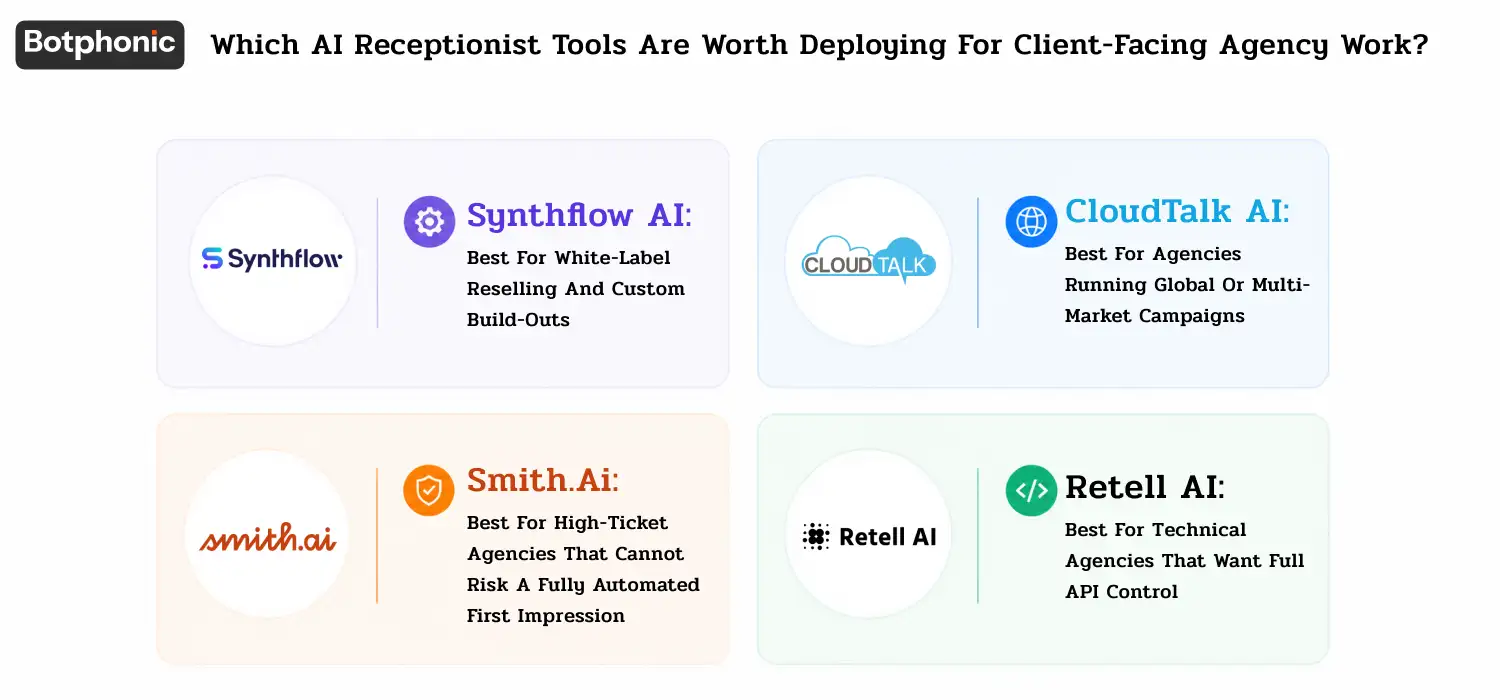
The tools below are the ones agencies are actively using for intake calls, not generic business phone use cases. Each is evaluated on client-facing polish, the factor most likely to affect whether a prospective client books a discovery call or goes back to Google.
Synthflow AI: Best for White-Label Reselling and Custom Build-Outs
Synthflow AI is purpose-built for agencies that want to deploy voice AI internally or resell it as a managed service to their own clients. Its drag-and-drop conversational builder requires no code for standard flows.
The white-label capability is the differentiator here. You can brand the entire experience under your agency’s identity. It maps natively to GoHighLevel and HubSpot, and connects to Zapier for everything else.
The honest limitation: complex multi-turn conversational scenarios require intentional prompt engineering. This is not a five-minute setup. Agencies with a dedicated ops or tech resource will get significantly more out of it than those expecting out-of-the-box deployment.
CloudTalk AI: Best for Agencies Running Global or Multi-Market Campaigns
CloudTalk AI is a VoIP platform with integrated AI conversation capabilities. It suits scaling agencies that need enterprise-grade call infrastructure alongside automated intake.
Its most practical feature for agencies: if an existing client calls from a recognised number, the AI surfaces their account history instantly. The caller is addressed by name and context before saying a word. It connects natively to Salesforce, Pipedrive, HubSpot, and Slack.
Smith.ai: Best for High-Ticket Agencies That Cannot Risk a Fully Automated First Impression
Smith.ai runs a hybrid model. The AI handles triage, data collection, and FAQ responses. If the caller becomes frustrated or presents an edge case the AI cannot handle cleanly, a North American live agent takes over, without the caller being told there was a transition.
For agencies pitching multi-million pound or dollar contracts, this backstop matters. The client-facing experience is flawless because there is always a human safety net behind it. It integrates with Calendly and most professional services CRMs for real-time booking.
Retell AI: Best for Technical Agencies That Want Full API Control
Retell AI is the tool for dev-heavy or technical marketing agencies. Its response latency runs at approximately 600ms, the threshold at which conversation feels natural rather than automated.
The standout capability is Streaming RAG (Retrieval-Augmented Generation). The agent can pull live data from your internal knowledge base, pricing sheets, or service documentation mid-call. Answers are accurate because they come from your own source of truth, not a static prompt. For effective AI receptionist scripts, you can check AI receptionist scripts that save time.
How Do These Tools Compare Side by Side?
| AI Tool | Best For | Client-Polish Score (1–10) | Key Integration | Starting Price Range |
| Synthflow AI | White-label reselling and custom builds | 8.5 | GoHighLevel, Zapier | ~$29/month |
| CloudTalk AI | Global scale and historical CRM matching | 9.0 | HubSpot, Salesforce | ~$25/user/month |
| Smith.ai | High-ticket hybrid AI + human backup | 9.5 | Calendly, Custom CRMs | ~$292/month |
| Retell AI | Technical agencies needing API control | 9.8 | Custom API, Twilio | Usage-based |
| Botphonic | Agencies wanting purpose-built AI call handling | 9.5 | CRM, calendar, custom flows | See Botphonic agency solution |
What Does the Math Actually Look Like on a Missed Intake Call?
The financial case for AI receptionist software intake handling is straightforward. Here arithmetic agencies rarely sit down to calculate.
Assume your agency receives five inbound discovery calls per month from organic or paid traffic. You miss two of them, one after hours, one during a busy delivery sprint. Your average close rate on qualified calls is 25%. Your average retainer is $3,500/month across a 10-month average client lifecycle.
That is $35,000 LTV per client. Missing two calls at a 25% close rate means an expected pipeline loss of $17,500 per month. Most AI receptionist platforms cost between $99 and $350 per month to run continuously.
The tool pays for itself the moment it saves one qualified lead.
What agencies actually experience in the first 30 days of deployment is not dramatic. The volume of inbound calls does not change. What changes is the conversion rate on after-hours and overflow traffic. Calls that previously went to a generic voicemail now receive a branded, coherent intake conversation. Discovery calls get booked. The pipeline line item moves.
This is also where pairing your front-of-funnel AI call handling with a capable AI sales assistant creates compounding returns, the intake converts, and the follow-up is handled without manual intervention.
How Do You Set Up an AI Phone Agent Without Damaging Your Agency’s Brand Voice?
Knowing why agencies use AI receptionists for lead capture and setting up AI call handling without brand risk requires three operational steps. Done correctly, callers will not know, or care that the first touch was automated.
Step 1: Connect your knowledge base first. Feed the platform your service descriptions, FAQ document, case study summaries, and pricing guardrails. The AI should know what you do and what it is not allowed to say. Never allow the agent to quote custom project pricing on a live call. Route pricing conversations to a calendar booking.
Step 2: Configure conditional call forwarding. Keep your primary agency number. Set it to ring your human team for 15 seconds first. If unanswered or busy, the call routes to your AI agent. The caller experiences no gap.
Step 3: Build the hot handoff. If a tier-one lead is identified during business hours, the AI should whisper-alert your sales team and transfer the live call immediately. This is available natively in Retell AI and Smith.ai, and configurable via Zapier in Synthflow AI.
You can see exactly how Botphonic structures this workflow in its AI call assistant documentation.
If your agency is getting inbound calls from paid or organic traffic and converting fewer than 40% of them to discovery sessions, the gap is almost certainly in the intake layer, not the pitch
Request a Free Demo