Summarize Content With:
Quick Summary
In this blog, we will demystify the AI phone call software for schools and explain why they have become a necessity for enhanced operational efficiency. We will be reading the reasons why traditional call centers are not able to keep up. And then we will explore the key features that define the best AI phone call software for educational institutions. Moreover, we will explore the three best considered AI call assistants for school and see which one tops the table.
- Botphonic is the clear frontrunner for schools that don’t have time for science projects. It plugs in, behaves, and delivers value without forcing IT to reinvent the wheel.
- Cloudtalk will be a good choice for large and multi-department institutions that require heavy routing, but require customization to fit academic use.
- Goodcall works fine as an AI add-on, but it leans heavily on whatever systems a school already has. If the backend is messy, the experience will follow suit.
Introduction
Every personnel of the education sector knows the drill: the phone rings nonstop, the number of voicemails is increasing, and at the same time, families are expecting instant answers. The conventional arrangement is under pressure, so temporary solutions are no longer sufficient.
At the same time, expectations have changed. Students and parents expect quick, personalized replies. Leadership teams want to gain data. Operations teams want to reduce manual workload. And throughout the organization, people are asking for more consistency and less chaos.
Here comes AI.
Over the past few years, AI call assistants have evolved far beyond pre-recorded scripts and monotonous voices. In fact, the best of today’s AI phone call software for schools manage intricate workflows, tailor-fit replies, connects with SIS and CRM systems, and handle thousands of conversations simultaneously, all with ease.
The educational field is slowly but surely catching up, and as a result, those who take the plunge into AI telephony first are reaping the rewards of increased productivity, improved enrollment rates, and happier customers.
However, not all solutions are of the same standard. Therefore, this article will help to discern the capable from the unworthy, to outline the essential functionalities, and to provide reasons why Botphonic is a practical option for educational institutions that aim to upgrade their system without the hassle of starting from scratch.
Why Do Schools Need AI Phone Call Software?
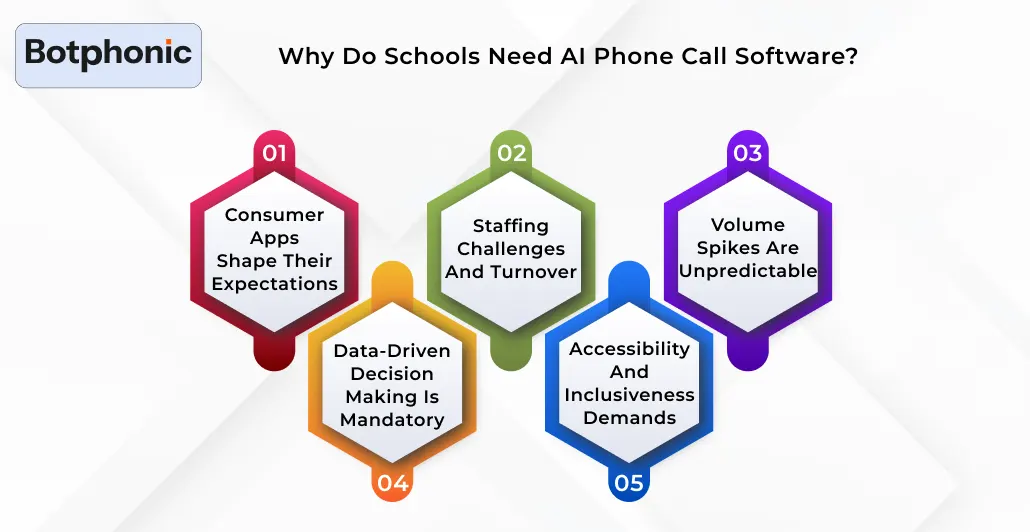
There was a greater transformation of the way families engage with the school than any of the institutional tech stacks. Emails and paper forms are no longer sufficient after this change; they want immediate, conversational answers. That particular paradigm shift has made the use of AI phone call software for schools is an urgent requirement, and consequently, institutions that do not embrace this technology risk losing applicants, distrust from parents, and burnout of their staff. What motivates the AI voice automation for colleges and K–12 schooling is followed by a practical breakdown of what these systems truly offer. AI phone calls help schools manage parent communication which makes them an important asset for schools.
Prospective students compare timings and would like instant clarification on deadlines, scholarships, and application status. Hence, a slow reply equals lost opportunity; an instant and correct reply could be the final nudge in either direction from deposit to “no thanks.”
1. Consumer Apps Shape Their Expectations
Parents and possible applicants expect this kind of responsiveness 24/7 from their retailers and banks. Thus, if they have to wait for any form of callback from your school, it will immediately brand any notion of technological advancement old in their minds, however good any of their best programs may be.
2. Staffing Challenges And Turnover
Enrollment offices and front desks run lean. It is hard to scale human teams rapidly, especially for temporary hires, due to the long hiring cycles and training overhead. Constant repetitive calls from students about frequently asked questions consume precious time. It could have been spent on higher-value counseling and conversion work by staff.
3. Volume Spikes Are Unpredictable
Be it a viral social post, changing financial-aid rules, or an unannounced deadline, anything can triple or double inbound calls overnight. Traditional call centers and manual processes fall apart under inconsistent volume. In contrast, the best AI phone call software for education institutions scales instantly.
4. Data-Driven Decision-Making Is Mandatory
Leadership wants evidence, call trends, top concerns, and impact conversion. Legacy phone systems present blind spots; whereas modern AI phone systems turn every interaction into actionable analytics.
5. Accessibility And Inclusiveness Demands
Multilingual callers, non-traditional schedules, and divergent communication requirements require a technology capable of responding in the language and style that families prefer, fairly, consistently, and without bias.
Why Traditional Call Centers Can’t Keep Up
Humans are costly and inflexible. Bringing temps on board for peak seasons is a costly and temporary solution, and furthermore, creates inconsistency in caller experiences. Hazy routing wastes time; call transfers, voice mails, or callback loops lead to frustration with many families, hence causing increased drop rates. Knowledge is not in-house; different staff members give different answers, which leads to a decline in accuracy.
No analytics have been found in legacy phone systems. That makes conversion-type insights or sentiment analysis known to inform strategic decisions.
Your institution benchmarks applicants right now with manual processes, and these applicants have already moved on. Let’ s just accept the uncomfortable truth:
- Call Volumes Have Gotten High: Applicants are ready, parents are also involved, and prospective students have started questioning more than ever.
- Budgets Are Tightening: Schools can no longer just throw these issues at staff.
- Families Are Expecting Instant Response: They are no longer interested in waiting, and not even a voicemail is enough to keep them calm.
- Staff Burnout Is Real: Putting everything onto staff makes them tired, and turnover in admissions and support hits really hard.
Meanwhile, schools are trying to squeeze more performance out of systems that are already outdated. Where do you think it leads? There’s longer wait times, missed inquiries, inconsistent messaging, and frustrated families who choose the institution who’s willing to communicate better.
How AI Phone Call Systems Bridge the Gap
Modern AI phone call assistants for admissions are neither toys of novelty nor glorified IVRs. For communication, there are dedicated channels. Integrating natural language understanding with existing systems of schools, and intelligent escalation for the real-world.
Immediate, point-in-time responses for high-volume questions. Application deadlines, required documents, and schedules for campus visits-these are the typical mundane issues that AI will absorb, while human resource staff will tend to more strategic work.
- 24/7 availability: Assistance is available outside business hours, and it reduces drop-off on the conversion funnel.
- Personalized conversion: AI would be able to customize responses based on status-“You’re missing X transcript” versus generic form instructions-such that the interaction becomes personalized and context-relevant.
- Smart escalation: AI understands which cases are more complicated or sensitive, and will thereby route them to the right human team member with context for having a more informed and efficient interaction going into the issue.
- Cross-lingual and accessible communication: AI covers several languages and accents, hence making your institution inclusive without increasing human capital.
- Scalable outreach and follow-up: From yield-enhancing reminders to some pressing campus alerts, artificial intelligence progresses towards making meaningful, large-scale mass personalized voice outreach measurable and consistent.
- Actionable: Due to understandable dashboards, FAQ trends, peak times, sentiment issues, and measurable impacts of voice automation on application progression become completely visible.
 NOTE
NOTE
Key Features Schools Should Look for in AI Phone Call Solutions
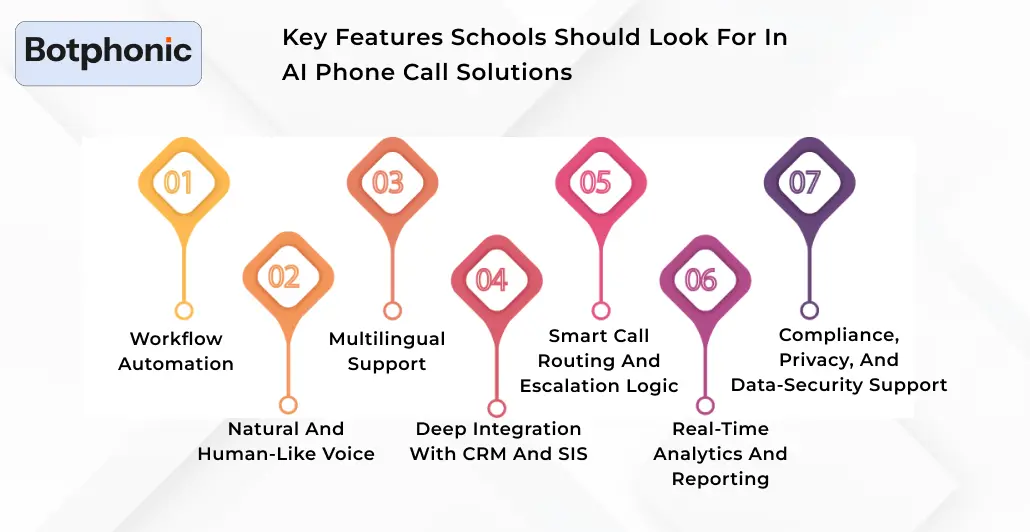
Any institution that is searching for an AI-powered communication upgrade needs something much more than just “good voice quality.” The right AI call assistant for education should align with your educational workflows, compliance standards, and operational realities. Let’s create a checklist for critical features that separates useful tools from superficial tools that click the checkboxes but are hollow.
- Workflow Automation: Automated responses to FAQs, built-in logic for follow-ups, and reminders to drive conversion.
- Natural and Human-Like Voice: A voice that isn’t robotic or stilted speech is important. As conversations should feel like speaking with a helpful admission rep.
- Multilingual Support: It’s one of the crucial components. As for international students, second-language families, or diverse communities, it helps them clear their queries in a language they are comfortable with.
- Deep Integration with CRM and SIS: Integration with the Student Information System or CRM platform is required. So, any conversation, status update, or query is automatically tied into existing records.
- Smart Call Routing and Escalation Logic: The system should be capable of handling routine calls and recognizing when a caller needs human intervention and route accordingly.
- Real-Time Analytics and Reporting: The systems should be equipped with a call-volume dashboard. That shows peak hour, day, or season, which allows staff to plan admission cycles or even outreach campaigns. Moreover, it also shows missed calls and callback logs with caller sentiment and satisfaction indicators.
- Compliance, Privacy, and Data-Security Support: The AI phone call system should comply with student privacy compliance. Such as FERPA, GDPR, and local regulations. It ensures phone interactions and other recorded data is secure, stored correctly, and are access-controlled.
Top AI Phone Systems for Education Reviewed
Botphonic: Best overall Purpose-Built for Education Contexts
Botphonic is a top-rated AI phone call assistant; designed to handle common “school-office” tasks. For instance, admissions questions, scheduling visits and bookings, multilingual parent-staff communication, and even after-hours call handling.
Let’s check out the features Botphonic offers:
- Purpose-built for education workflows
- An AI phone call assistant for admissions that understands enrollment cycles
- Unbelievably fast deployment, which saves the IT team’s involvement.
- CRM and SIS integrations that work out of the box
- Real-time analytics, tailored to admissions performance
- Human-like voice generation with multilingual support
- Reliable automation that even helps during peak season chaos
- Adaptive scripting for offering personalized information delivery
- Scalable structure that doesn’t even stop to breathe during high traffic
To put it simply, Botphonic is the best AI phone call software for educational institutions. It rapidly delivers results instead of excuses. Incorporating Botphonic AI phone call assistant provides higher admissions conversions. Also, better caller satisfaction and a major drop in repetitive call volume.
 PRO TIP
Cloudtalk: Best for High-Volume, Multi-Team Call Centers
Cloudtalk works in a large, multi-department environment where routing complexity and high call throughput rule the system. It’s essentially built for operational sprawl that is more than academic nuance, and offers a robust telephony infrastructure.
Where Cloudtalk stands out:
- Strong call infrastructure; designed for distributed teams
- Wide routing logic for institutions juggling several departments
- Large integration library; leaned toward business CRMs
- Solid analytics for workforce and queue management
Cloudtalk does deliver horsepower, but schools will need to make it into an education-ready workflow.
Goodcall: Best as an AI overlay
Goodcall effectively delivers an AI answering and assistant service. Designed to work on top of existing phone infrastructure, it aims to handle routine inbound calls, scheduling, and basic administration autonomously. Its real value lies in “AI-assisted augmentation”, which implies you don’t have to replace your existing system but gain automation benefits.
Goodcall’s value points:
- Easy AI call handling with minimal configuration
- Works better when the school already has strong internal tools
- Basic automation for FAQs and frontline triage
- Adequate analytics; offered for simple operational visibility
- Moderate deployment; without heavy infrastructure demands.
Goodcall is a respectable “AI assist” but clearly not a transformational engine. It’s not considered a foundation but an overlay.
Enhance Your Admission Teams ‘ Efficiency As They Deserve
Explore Botphonic Now!!Conclusion
When you take out all the jargon and just look at operational outcomes, the picture gets crystal clear. Institutions that embrace AI phone call automation win on speed, consistency, and even caller experience, but the institutions that wait fall behind. Even in a research, it was stated that with the help of AI deployment in the system they have noticed a 50% reduction in missed calls and administrative workload reduced by 30%.
Botphonic effectively delivers the strongest alignment with how school actually functions, such as admission cycles, multilingual needs, SIS/CRM handshakes, unpredictable volume spikes, and even the constant pressure to do more with fewer staff. It’s fast to deploy and built for the academic operations realities.
Whereas Cloudtalk is a strong fit for campuses with call structures but it requires customization before it behaves like an education-ready system. And lastly, Goodcall can be considered as a capable helper that can be paired with a solid phone backbone.