Summarize Content With:
Quick Summary
AI phone call software has become a strategic backbone for logistics operations. Moreover these systems also automate the routine communication, manage customer inquiries, support drivers with real-time updates. To ensure your operational workflows is enhanced, just know that you have integrated with the best AI phone call software for logistics providers.
In this article, we are going to uncover what AI phone call software is? Moreover, we will also check some of the best AI phone call software for logistic providers. We will also discuss how you can choose a right AI solution for your logistics companies.
Introduction
As the logistics industry is continuing to evolve, communication still remains a critical aspect of operations. AI phone call software is playing an essential role in transforming logistics companies by actively automating and optimizing voice-based interactions. From dispatch centers to customer-service, AI enables companies to improve efficiency, reduce costs, and even deliver a better experience. With this way of operation handling, companies are able to improve their decision-making as well and enable 24/7 communication that ultimately allows businesses to scale even while maintaining a high level of service.
AI phone call assistants aren’t just a simple tool but an essential for dispatch centers, warehousing, customer service, and fleet management as well. By optimizing voice interactions, these AI tools just free up valuable human resources for more complex tasks and allows businesses to focus on growth.
Understanding AI Phone Call Software for Logistics Companies
What is AI Phone Call Software?
AI phone call software is an artificial intelligence-powered system that effectively handles voice calls and automates communication processes in logistics operations. These systems usually integrate natural language processing (NLP), speech recognition, and machine learning. To detect and respond to customer queries, track orders, update delivery statuses, and even handle other logistics-related tasks, these are used.
AI systems like these can even act as a virtual assistant that can answer customer queries and provide real-time information about shipments. Moreover, also helps in processing dispatch orders and route calls to the appropriate department. All this happens when the system is still learning from each interaction to improve accuracy over time.
How AI Transforms Communication in Logistics
AI phone call software can significantly streamline communication between logistics, companies, customers, and internal teams. Here’s how:
- Automated Communication: Customers call whenever they find convenient to get answers. It can answer simple queries such as order status, delivery times, or tracking numbers, which frees up human agents to handle more complex cases.
- Route Optimization: AI-powered call assistants can easily interact with dispatch systems to provide drivers with optimized routes based on real-time data. For instance traffic, weather, and delivery windows.
- Scalability: Logistics companies can easily scale their operations more efficiently just by handling more calls with fewer resources. It is particularly more valuable during peak seasons or when they are expanding into new regions.
- Real-time Updates: AI systems actively help in enabling real-time communication about delays, changes in delivery schedules, or emergency dispatches. Ensuring both customers and internal teams are kept in loop, it reduces the risk of any miscommunication.
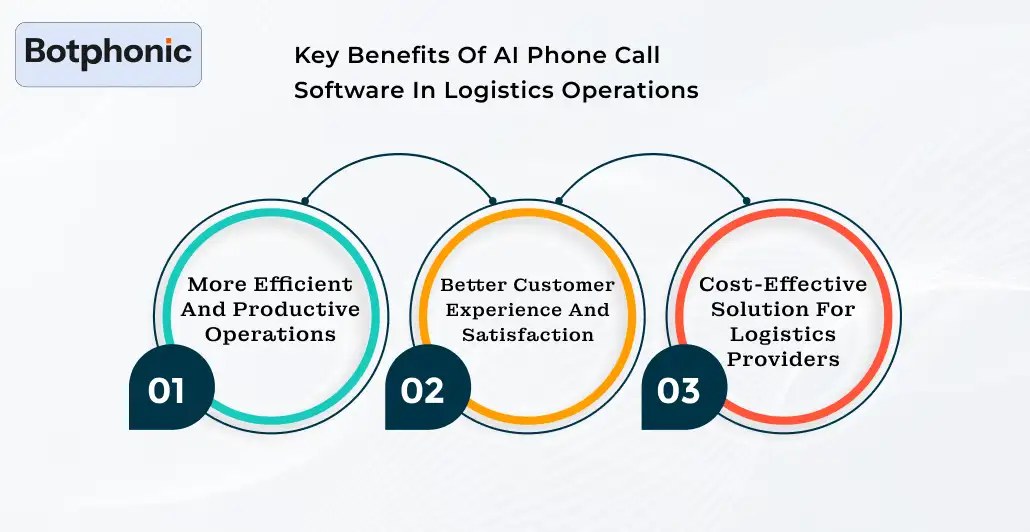
Key Benefits of AI Phone Call Software in Logistics Operations
1. More Efficient and Productive Operations
AI call software features in improving productivity as one of its ways. Routine activities can be automated, such as answering calls, confirming deliveries, or checking whether an order has shipped. This allows logistics companies to economize on time consumption when processing routine tasks. It frees human workers to concentrate on higher-value activities such as dispatchers and customer service agents.
- Faster Response Timings: AI phone call assistants help in reducing wait times (they are processed instantly) and in providing immediate responses.
- Multi-tasking: AI can manage a lot of calls simultaneously and also gives live updates at the same time.
2. Better Customer Experience and Satisfaction
AI-enabled Telephone lines can quickly give an immediate and personalized experience to the customer. For example:
- 24/7: AI assistants can take calls anywhere, anytime. This means that clients can use their flexibility to deliver their queries when they want. Even during off-business hours, they will be able to get their answers.
- Personalized Service: NLP-enabled AI can easily carry on ‘natural’ conversations with customers and personalize their responses. It will offer a tailor-made response based upon prior interactions, preferences, or account history.
- Immediate Resolution: AI conveys pack tracking, order confirmation, or change of route automatically, giving rise to speedier issue resolution and reducing customer irritation, once again, in briefs.
Driving better efficiencies in customer service and shortening wait times would allow increased customer satisfaction and customer retention in logistics companies.
3. Cost-Effective Solution for Logistics Providers
Operational costs can increase with the increasing need to hire large customer service teams or dispatch centers to handle minor phone calls. Integrating AI phone call software allows logistics providers to:
- Reduce Labour Costs: AI phone call for logistics companies readily handle a large volume of calls without even requiring additional staff. In fact, even at its peak season, the system can handle it on its own.
- Lower Operational Overheads: With AI managing all the repetitive and tedious tasks, human employees can be relaxed. Moreover, it allows them to focus on more specialized work, which makes the overall operation more cost-effective.
- Scalability: AI systems can smoothly scale with the business. Handling increased call volume without even a slight increase in expenses make them more preferred.
This cost-efficiency is one of the most valuable components for small and medium-sized logistics companies that are looking to compete with larger firms.
Key Features to Look for in AI Phone Call Software for Logistics Companies
1. Voice Recognition and Natural Language Processing (NLP)
Voice recognition technology and NLP are critical components that ensure AI assistants are able to understand and respond to complex customer requests. NLP allows the AI system to:
- Interpreting variations in speech patterns, accents, and terminologies related to logistics.
- Generate human-like responses, making interactions more smooth and efficient.
The more advanced the voice recognition and NLP features, the better AI can assist with specific tasks. Moreover, it works while reducing errors and improving customer satisfaction as well.
2. Intelligent Call Routing and Dispatching
AI phone call software are designed with the capability of smartly routing calls to the right department or person based on pre-defined criteria. For example location, urgency, or just the type of query.
- Call Routing to Appropriate Teams: For instance, if a customer needs a shipment update, the AI can effortlessly direct the call to the logistics department.
- Dispatch Optimization: AI can also assist in dispatching tasks, even by identifying the best resources available in real time. It automatically assigns job based on urgency, location, and availability.
It also helps ensure that calls are managed and improves operational flow effortlessly.
3. Reporting and Analytics Capabilities
AI-powered phone call software should ensure to include robust analytics tools which helps monitor performance and optimize workflows.
- Call Metrics: Helps track call volumes, wait times, call durations, and customer satisfaction as well.
- AI Insights: Ensure to use AI-generated insights that helps you identify bottlenecks in logistics operations, such as delays, frequent customer queries, or even inefficiency dispatch routing. About 10% of logistics companies have fully adopted generative AI to solve recurring issues and meet demanding customer expectations.
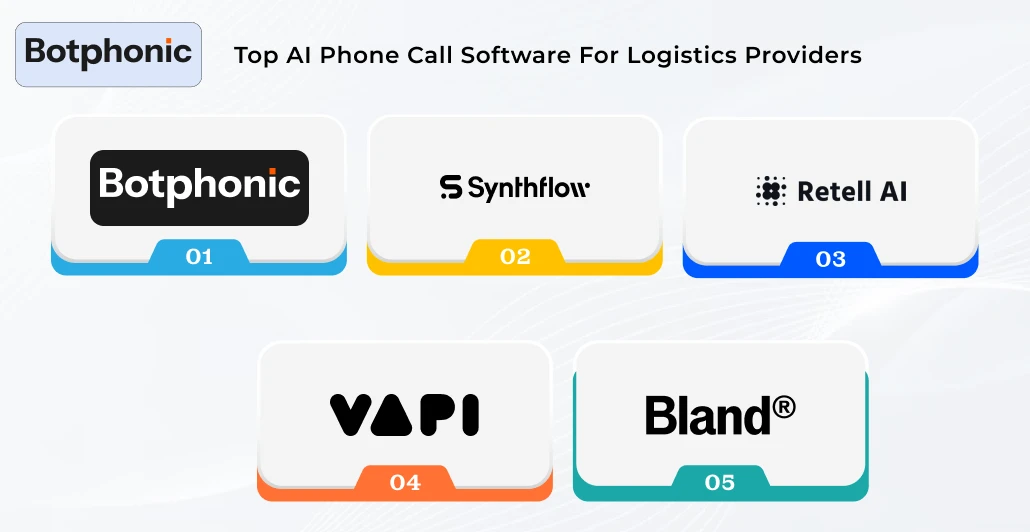
Top AI Phone Call Software for Logistics Providers
AI calling software is progressively transforming the previously manual communication systems for logistics companies, making operations simpler and even improving customer service. A fast-moving and customer-indifferent industry like this would find the most dynamic step in using an AI-powered voice assistant. This blog is going to focus on the benefits, features, and top software solutions-all aspects that can help logistics providers to identify the right kind of AI tool to remain competitive.
1. Botphonic
Advanced voice AI is an essential feature of Botphonic that is custom-built for the logistics operation of the company for smooth call handling and natural conversational flows. It is great for reducing call friction and boosting customer sentiment. The software also offers ERP integrations, multi-language support and intelligent call routing, elevating customer service and operational efficiency.
 NOTE
NOTE
2. Synthflow
Synthflow brings the latest and greatest AI voice technology to logistics firms, focusing on effectively improving the lines of communication between drivers and order tracking. The system is strong in environments where timing is everything. Moreover, it is also capable of being incorporated into existing logistics systems for smart routing, scheduling, and real-time updates.
3. Retell
Retell is an AI-powered customer care solution for inbound and outbound calls, particularly tailored for logistics companies. It is an excellent choice, when brand voice matters. Meanwhile it is focused on providing personalized services. Retell offers an interactive solution to enhance customer interaction and satisfaction levels.
4. Vapi
Vapi is built to handle large quantities of customer interactions related to logistics, managing automation for order confirmation, shipment update, and appropriate scheduling tasks. Moreover, it is designed for throughput over flair. Its integration capabilities make it the first option for companies looking to optimize their operations in logistics.
5. Bland
Bland presents AI communication tools. For medium and large-scale logistics companies that have voice assistants well versed in how the different operations within logistics are carried out. For instance, handling inquiries related to routing to deliveries and having users on the shortest hold times during a seamless call transfer.
Leading AI Software Solutions in the Logistics Industry
AI solutions for logistics companies come in more than one way. Each of them offer unique advantages based on business needs. In the market of numerous smart AI technologies, Botphonic is leading this pack with its smart AI call assistant. Moreover, providers like Synthflow, Vapi, Bland and Retell provide AI technology that easily integrates with logistics management systems. Offering customizable, scalable, and efficient solutions.
Comparing AI Solutions for Dispatch Centers
| Solution | Core Strength | Logistics-Focused Capabilities | Integration & Scalability | Languages & Voice Quality | Ideal Use Case |
| Botphonic | Natural, human-like voice AI | Smart call routing, multilingual support, optimized call flows | Plays well with legacy logistics stacks; stable scaling | High-quality conversational voice; broad language suite | Firms needing smoother inbound call handling |
| Synthflow | Cutting-edge voice tech for driver ops | Driver communication, order tracking sync, smart routing | Deep logistics-system embedding for scheduling + live updates | Crisp, modern voice tech | Operations focused on real-time driver coordination |
| Retell | Personalization-first call automation | Inbound + outbound care, tailored customer interactions | Integrates into standard CRM and TMS setups | Friendly, customer-centric tone | Customer-service heavy dispatch models |
| Vapi | High-volume interaction automation | Order confirmation, shipment updates, scheduling | Strong integration layer; highly scalable for enterprise | Efficient, utilitarian voice output | Businesses needing bulk automation |
| Bland | Logistics-savvy voice assistants | Call transfer, routing inquiries, delivery questions | Mid-to-large-scale operations; smooth escalation flows | Clear, practical voice handling | Teams needing fast triage calls |
How to Choose the Right AI Phone Call Software for Your Logistics Business
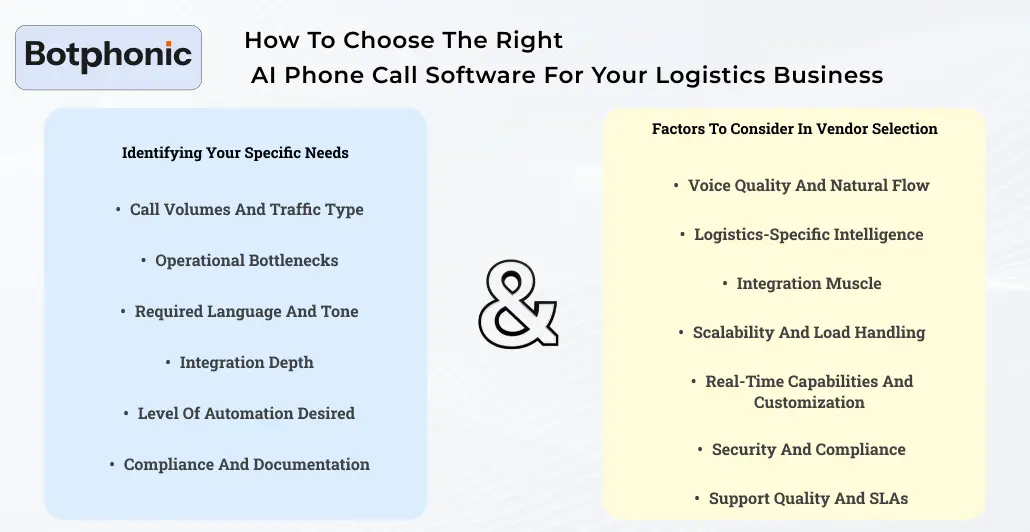
Identifying Your Specific Needs
Before you even start looking for vendors, ensure to know what’s actually driving the purchase, what is the reason you had to look for an AI? There are teams who always look at shiny tech and just forgets the basics. Let’s check out some of the key areas to clarify:
- Call Volumes and Traffic Type: Know what you are dealing with, whether its driver check-ins, customer ETA queries, B2B order confirmations, or a blend of both. Each pattern demands different AI strengths.
- Operational Bottlenecks: Are there any delays happening at dispatch? Customer service? Driver communication? Ensure to pinpoint your issue before you look.
- Required Language and Tone: Multilingual fleets and customers need voice tech that isn’t affecting accents or sounds too robotic.
- Integration Depth: Confirm with your team, if you need a surface-level data sync or heavy duty integration with TMS, WMS, CRM, or route-optimization tools.
- Level of Automation Desired: What do you want the level of automation to be? Is it going to be fully-automated, AI assisted, or hybrid with human escalation? Choose one that fits your issue.
- Compliance and Documentation: Some fleets require automated logs, call recordings, and audit-friendly transcripts.
 PRO TIP
Factors to Consider in Vendor Selection
Once you have got your information organized, evaluate providers who have clear and gets no-nonsense scorecards.
Let us make a checklist that’ll state what to look for:
- Voice Quality and Natural Flow: If your system is voicing like a toaster just with a voice, you customers might end up hanging the call. Ensure to prioritize clarity, tone, and response time.
- Logistics-Specific Intelligence: Generic call bots might not be able to understand dispatch complexity, search for tools that are trained on routing, delivery tips, exceptions, and multi-party coordination.
- Integration Muscle: There are vendors who just claim “easy integration.” before committing to test them. Ask for demos that are connected to your environment.
- Scalability and Load Handling: If your peak-season volume escalates to 200%, the software should be capable of surviving that situation without fluctuating.
- Real-Time Capabilities and Customization: ETS, traffic updates, driver location and load status should be updated instantly. Moreover, it should allow you to tweak scripts, route logic, and escalation paths.
- Security and Compliance: Ensure that you have opted for a system that offers solid data handling, encrypted call logs, and adherence to transport regulations.
- Support Quality and SLAs: Without any proper vendor support, the tech might not be able to help you promptly. SLAs, uptime guarantees, and response times matter more than you think.
Explore Botphonic Today and Enhance Your Operational Workflow.
Try Botphonic Demo Today!!Conclusion
AI phone call software is the new standard for staying competitive. The winners in this space are companies who have stopped filling communication gaps via manpower. Instead have started to deploy AI phone call assistants to handle the grind work. Whether you are smoothing out dispatch chaos, tightening customer response times, or just scaling without increasing headcount, these tools deliver real operational leverage.
With logistics becoming faster and more customer-driven, the right AI phone call assistants for dispatch won’t just streamline your workflow. But it will help you sharpen your decision-making, cuts costs, and boosts service quality across the board. Ensure to choose a platform that align with your needs today and can easily flex with your ambitions.