Summarize Content With:
Summary
This blog is about finding the best AI phone call solution for BPO providers in 2026. We cover the most impactful features, Botphonic’s position in the competition, and other competitors in the market. We also explore practical use cases, pricing, and strategic benefits.
Key Takeaways
- Without the right AI phone call technology, BPOs cannot enjoy the cost-saving and efficiency benefits of call handling.
- Botphonic is equipped with features such as natural conversation and sentiment analysis. Moreover, it helps in large-scale operation, which set it apart from the rest.
- In general, there are several similar products (Retell AI, CloudTalk, Uniphore, etc.) to choose from. Each has advantages in some areas and disadvantages in others.
- The decision on which software to buy should be based on the key metrics. Such as BPO’s call volume, spoken language, regulatory compliance, requirements, and the purpose of the integration.
Introduction
A phone rings in a BPO.
Then another.
Then fifty more.
Every call carries intent. A customer wants help. A lead wants answers. A client wants resolution. And none of them care about staffing shortages, time zones, or agent fatigue. They care about one thing. Whether someone answers. Fast. Clearly. Correctly.
Here’s the problem most BPO providers won’t say out loud. Traditional call handling does not scale. Humans max out. Queues grow. Costs explode. Quality slips. That’s not poor management. That’s reality.
By 2026, the BPO industry is no longer debating whether AI belongs in call operations. That conversation is over. The only question left is which platform actually works at volume without breaking trust.
Intent matters here. BPOs want predictable outcomes. Lower cost per call. Higher first-call resolution. Consistent service quality across thousands of interactions. And they want it without doubling headcount every time a new client signs.
The old approach tried to solve this with scripts, IVRs, and overtime. It failed. Not because people are incompetent, but because humans were never designed to handle infinite conversations simultaneously.
The solution is not more agents. It’s better infrastructure.
That’s why AI phone call software is now core infrastructure, not an experiment. In 2026, AI handles conversations the same way cloud systems handle data. Automatically. Reliably. At scale.
But let’s be clear. Not every AI qualifies.
A real AI call system is not a robotic voice that forwards calls. It’s a full conversational engine. It answers inbound calls. Places outbound ones. Understands context. Detects sentiment. Summarizes outcomes. Routes intelligently. And escalates only when human judgment is required.
This is the modern Ai receptionist. Not a front desk replacement. A front line upgrade.
And this is where most BPOs start cautiously. They test with a free ai call assistant to validate performance before rolling it out across operations. That’s rational. You don’t gamble production traffic on theory.
But once the data shows reduced average handle time, higher CSAT, and fewer missed calls, hesitation disappears. Because the numbers don’t lie.
The operational shift is brutal in its simplicity. AI does the repetitive, high-volume, low-variance calls. Humans handle the edge cases, escalations, and relationship-critical conversations. Everyone wins.
Still, not all platforms are built for BPO reality.
Some tools are optimized for startups with low call volume. Others focus on analytics but struggle with natural conversation. A few sound impressive in demos and collapse under real-world traffic.
Botphonic sits in a different category.
Botphonic was built for call density. High volume. Multilingual environments. Regulated industries. The stuff BPOs actually deal with every day. Natural speech. Low latency. Sentiment detection. Automated call summaries. Secure deployments. The fundamentals, executed properly.
This is why many providers treat Botphonic not as software, but as an ai call assistant for business that plugs directly into revenue operations. It doesn’t just answer calls. It resolves them.
And yes, many BPOs begin with a free ai call assistant pilot. But they don’t stop there. Because once automation handles 60 percent or more of routine calls without degrading customer experience, scaling becomes an operational decision, not a technical one.
The strategic advantage is obvious. Lower staffing pressure. Predictable costs. Consistent service quality. Twenty-four seven coverage without burning out teams.
This is what separates BPOs that survive from those that grow.
What if you could visualize a BPO workplace that can manage thousands of calls effortlessly. Even beyond their typical working hours, without the appearance of tiredness, without the requirement of a big workforce, and still achieve the highest level of customer satisfaction?
This is actually the near future. The phone call AI software of 2026 is an advanced technology that is no longer seen as merely an experimental turn of events in the future. It is an absolute win for BPO providers, offering tangible benefits such as cost reduction, standardized quality, and round-the-clock service provisioning.
In this blog, we demonstrate that top-notch AI phone call software is not only necessary but also a must-have tool for BPO providers in 2026. What we do is delve into the market and, from that, derive comparisons among key players. This, combined with your reasoning, leads to the conclusion that Botphonic.ai is the best choice for you. Besides that, our advice will be helpful if you are still unsure about the right decision to make, the criteria to consider, and the starting methodology.
The second AI receptionist is deployed, missed calls stop being “part of the business.” They become unacceptable.
By 2026, AI call handling is no longer a differentiator. It’s the baseline. The real differentiator is execution. And the BPOs that choose a true ai call assistant for business don’t just answer phones.
They control conversations.
What “Best AI Phone Call Software for BPO Providers” Means
When BPOs are in search of the best AI phone call software, their expectation is not merely a voice bot, but a comprehensive digital assistant capable of swiftly managing customer interactions that can be inbound or outbound, executing conversations organically, analyzing sentiment, giving a summary of the call, and even waiting for demand, duplicating it. By 2026, approximately 65% of customer calls in contact centers will be managed by AI-based technologies. These are the main features for which the users have to be satisfied:
- Natural, Human-like Voice: AI should be humanized as much as possible in a conversation, providing minimal robotic elements
- Low Latency: Any kind of delay in the conversation makes it inefficient and unpleasant for the parties involved. Good software answers without delay.
- Sentiment Analysis: When the AI recognizes emotions, the system can take appropriate steps, such as calming the customer, resolving the issue, or escalating it.
- Call Summaries & Analytics: Reports generated by the system post-call help BPO managers gain insights and coach staff.
- Multilingual Support: Many BPOs have global clients; hence, the AI must be able to speak different languages.
- Security & Compliance: BPOs take the security of the data they handle very seriously – the AI solution should meet GDPR, PCI, HIPAA requirements if necessary.
- Scalability: The AI should be able to accommodate more users or fewer users without compromising the service when call volumes rise or fall, respectively.
- Integrations: The software should be able to link with CRM systems, calendars, and call infrastructure.
Who Are the Top AI Phone Call Platforms in 2026?
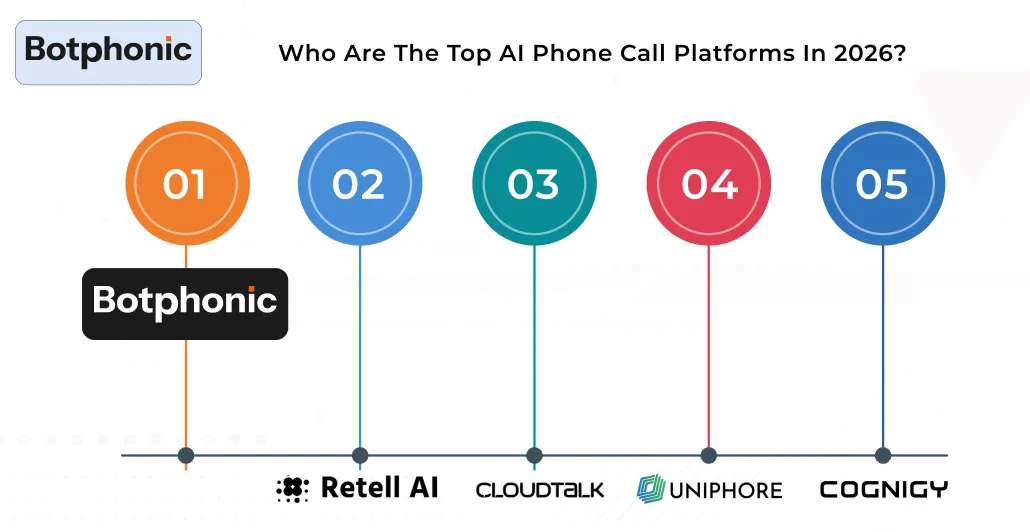
1. Botphonic – Human-Like Voice Automation Built for BPOs
Among all, Botphonic is the most exemplary. As it primarily emphasizes voice interaction, advanced sentiment analysis, and deep call automation features specifically targeted at the BPO sector. In fact, the technology makes the whole dialogue flow with customers very easy. It even humanizes the conversation to a very high level. In addition, it automatically generates call records, measures customer satisfaction, and provides communication in different languages.
Moreover, the Botphonic framework is compatible with over 180+ applications. Operationally, it can be extended as needed, and it can provide PCI DSS, GDPR, HIPAA security standards-certified environments. Due to these powerful capabilities, many BPOs treat Botphonic as an ultimate AI voice call assistant. Besides, a user-friendly pricing model and quick onboarding are among the platform’s strengths, facilitating daily use by teams.
To be precise, Botphonic is considered among the most potent and trustworthy AI-powered call agents in 2026.
Just botphonic, and it is estimated that your calls will be 65% handled automatically without any human. A 14-day trial is on us; start it now!
Try Today!2. Retell AI
Retell AI positions itself as a voice AI technology for the present, emphasizing acceleration and low latency. It can process speech on the go and convert text to speech in many languages.
The average latency is about 620 ms, according to reports, which enables a more coherent dialogue. Retell also includes a straightforward no-code builder that enables companies to develop voice AI rapidly flows. It is suitable for businesses that require quick implementation and simple automation without in-depth analytics.
On the other hand, Retell might not offer as comprehensive a sentiment analysis or emotionally human-like tone as the BPO sector demands for complex customer interactions.
3. CloudTalk (CeTe)
CloudTalk’s AI agent, CeTe, is a multilingual support system capable of over 60 languages and can be directly connected to popular CRM systems such as HubSpot, Pipedrive, and Salesforce. It is a great helper for BPO teams, not only for accepting but also for making phone calls. CeTe is a solution that aligns with CloudTalk’s long experience in the telephony industry; thus, it comes with a strong set of telephony features.
However, CloudTalk’s extensive language support notwithstanding, its AI model is more focused on automating tasks such as call routing and offering basic functions rather than leveraging deep conversational intelligence.
4. Uniphore
Uniphore has been, and remains, a major player in conversational AI. Their solution set includes automating dialogues with U-Self-Serve and U-Analyze, which deliver powerful speech analytics. They usually team up with large enterprises and can handle complex workflows such as emotion detection, real-time agent assistance, and voice biometrics.
While feature-rich, Uniphore can be costly and complex for a small or medium-sized BPO. Setting it up might also take more time, and therefore, the deployment will be slower.
5. Cognigy
Cognigy is all about enterprise-level automation and enabling connectivity between voice bots and chatbots, creating a single, unified customer support workflow. The company’s main feature is orchestration, which means it can perform complex tasks automatically across various communication channels. The BPO industry, which is seeking a comprehensive automation ecosystem, is where Cognigy is best known.
However, the BPO industry, especially those that only need a high-standard AI voice assistant, might consider Cognigy “too heavy” due to its requirement for more configuration and a technical team to manage updates.
Key Metrics BPOs Should Track When Implementing AI Calls
BPO teams implementing AI call workflows can significantly enhance these metrics through the use of a sophisticated AI call assistant, which is tailored for customer environments with a high volume of interactions and multiple languages.
- First Call Resolution (FCR): The percentage of queries that the AI solves without the intervention of a human.
- Average Handle Time (AHT): The total time of each call (which covers AI and handing over the call) if the quality is maintained, the shorter one is better.
- Customer Satisfaction (CSAT): Utilize post-call surveys to obtain direct feedback from customers.
- Cost per Call: Figure out what the price of each call is when carried out by AI vs a human.
- Call Volume Handled by AI: The proportion of calls has been completely handled by the artificial intelligence system.
- Feedback Response Rate: The rate at which callers engage in providing feedback at the conclusion of their call.
- Error Rate / Misunderstanding Rate: The frequency with which the AI wrongly interprets or fails to accomplish the target.
- Time Saved by Human Agents: The amount of time that the human agents get to take a break from their work due to the AI handling their routine calls.
How to Choose the Right AI Phone Call Software for Your BPO
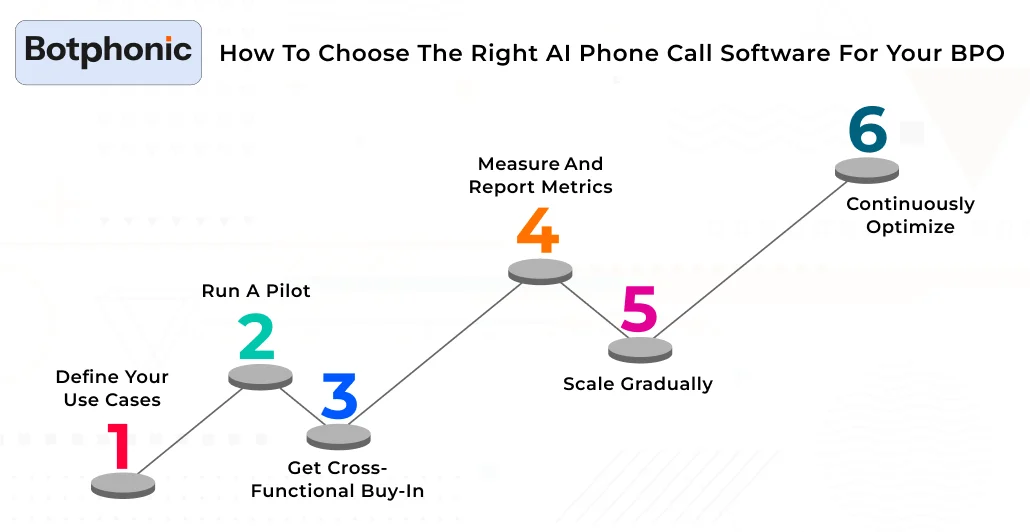
The following is a step-by-step guide for BPO providers on how to select the best AI phone call software for BPO providers in 2026:
- Define Your Use Cases – First, define which calls you want automated. Is it lead calls, support, feedback, or scheduling?
- Run a Pilot – You should select a small number of calls and install Botphonic (or other) for 1–2 weeks. During that period, you should measure different aspects such as resolution rate, CSAT, and cost.
- Get Cross-Functional Buy-In – At the same time, it would be a good idea to involve operations, IT, and agents from the very beginning. Their feedback can help you design your flows and scripts.
- Measure and Report Metrics – To evalaute the efficiency of the system employ the performance indicators. Look at the actual data from time to time and if necessary, make changes to your AI scripts and call flows.
- Scale Gradually – After the pilot program has achieved its objectives, you can extend it to more agents or different types of calls. Use Botphonic’s scalability and integrations to facilitate this increase.
- Continuously Optimize – Never cease to enhance your call flows, keep your sentiment models up to date, polish your templates, and carry out your performance reviews regularly.
 PRO TIP
Conclusion
By 2026, the use of an AI phone call assistant for multilingual support has become a necessity that companies have to follow to be able to provide to their customers all over the world a timely and context-aware service.
Business Process Outsourcing (BPO) companies must have in place by 2026. Some of the most advanced Artificial Intelligence (AI) calling tools if they are to maintain their positions in the market, make savings in their operations, and, at the same time, offer a better customer experience.
Botphonic.ai takes routine calls off the hands of agents by employing natural, humanlike voice assistants. Thus, agents are freed to engage in work of a higher-value nature. Customers are assured of getting quick, empathetic support.
Though there are other platforms, Botphonic’s potent combination of conversational AI, sentiment analysis, call summaries, and security features makes it a preferred choice, whether it is for inbound or outbound automation.
Initially, it is a good idea to start with a pilot, evaluate the outcome, and then proceed to scale with confidence.