Summarize Content With:
Summary
In this blog, we will explore when people launch an AI voice campaign; it is about being ready. This playbook offers a streamlined, pre-launch roadmap for U.S. businesses that encompasses compliance and data readiness; test-and-optimise by tracking performance.
By checking off each of these considerations before going live, businesses can minimise risk, increase customer engagement and feel comfortable with deploying AI voice-based campaigns. The result? And it’s that future that will demand smarter outreach, more meaningful conversations and campaigns that feel thoughtful rather than experimental.
Introduction
Imagine having the ability to go out to thousands of prospects with a voice that feels warm, natural and perfectly on-brand without having to hire an army of telemarketers or burning out your team. That’s the premise of AI voice campaigns. They’re available around the clock, scale effortlessly and can actually feel quite human when done right much like a modern AI answering service built for real-time conversations.
But there’s a catch: leaping into AI voice campaigns without preparation can go haywire quickly. Compliance shortcuts, bad call quality and ill-defined success metrics, many U.S. businesses bring the launch to market from a sprint and pay for it later, hobbled by poor sales teams or in various other ways.” The technology is powerful, but not if the underpinning is shaky.
This blog takes you through a simple, no-frills checklist to ensure that you’re creating for AI Voice campaigns in the best possible way. Whether you’re new to AI calling or optimising an already-existing strategy, these steps will help you steer clear of popular pitfalls, safeguard your brand and position your campaign for actual results, not guesswork.
Why You Need a Pre-Launch Checklist for AI Voice Campaigns
Too often, in the US, small and medium businesses (SMBs) rush into running an AI call campaign, believing that the mere fact of using artificial intelligence will automatically bring results.
In reality, performance depends on execution, data readiness, and setup accuracy—especially when comparing solutions in a voice AI IVR comparison USA market where platforms vary widely in call logic, compliance, and speech quality.
However, as many as 42% of AI voice campaigns in the U.S. do not perform to KPIs because of inefficient installation (Gartner, 2025). A well-organised pre-launch checklist allows you to cover compliance, accuracy of data, user experience and performance metrics before you spend a penny sending this out en masse.
By doing so, you can lower the chances of fines and bad customer experiences, as well as increase your campaign’s conversion rates. A checklist is your way from an idea to a successful and smooth automated AI voice interaction that accomplishes business goals.
 PRO TIP
Pre-Launch AI Voice Campaign Checklist
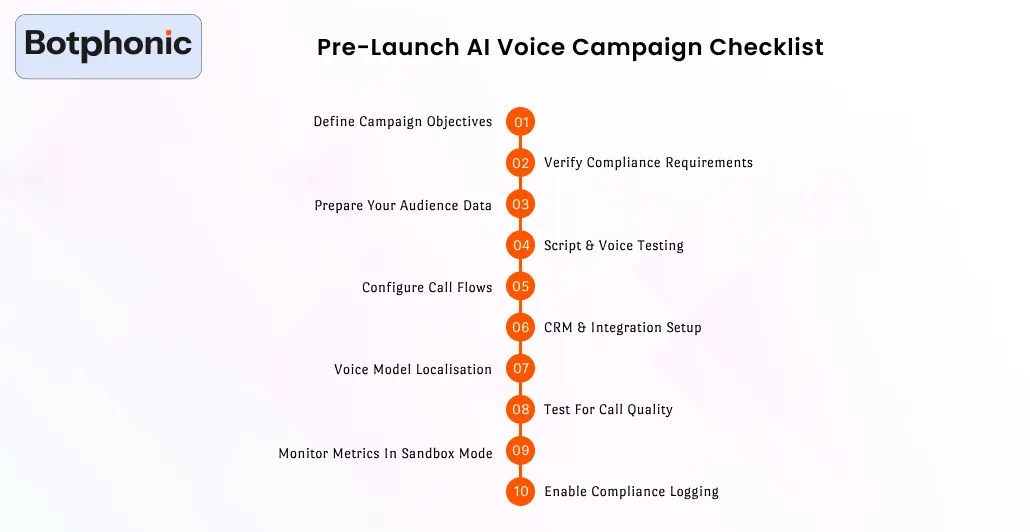
Here is a detailed US-based AI voice campaign checklist and plan for businesses, deconstructed into actionable steps with examples, best practices, and resources included.
1. Define Campaign Objectives
Begin with the end in mind by explicitly stating why you are running the AI voice campaign. Examples are appointment reminders, lead qualification, customer feedback collection or promotional offers.
Also decide why voice is the right channel. Many U.S. teams now benchmark performance using AI ROI voice vs sms USA metrics, discovering that voice often delivers higher engagement for time-sensitive or complex interactions.
Then establish concrete KPIs such as response rate, average time on calls or conversion percentage. E.g: If you’re studying lead quality, your KPI may be “Them >25% of qualified leads received a comprehensive response and were added to CRM”.
Tip: Do not generate calls without a clear set of goals for your AI call assistant to complete.
2. Verify Compliance Requirements
Automated calling is heavily regulated in the U.S. Make sure you have TCPA consent to reach the people, and calls happen (8 am to 9 pm) during the FCC-authorised time. Use HIPAA-compliant data practices for health care campaigns to ensure patient privacy.
Botphonic’s artificial intelligence compliance regulations guide can be a source for staying on top of internal resources.
Tip: Compliance isn’t optional. A violation can lead to thousands of dollars in fines per call.
3. Prepare Your Audience Data
Clean and verify your lists of contacts. Divide contacts by time zone, geography, and industry to stay relevant.
Review opt-out preferences, and confirm that your data is formatted correctly normally with commas. CSV or. JSON with verified consent tags. So, by using correct, well-organised data, the AI voice campaign USA will work better and reduce unnecessary mistakes.
Tip: The better the audience data, the higher the response rates and the lower the opt-outs.
4. Script & Voice Testing
Write a script that sounds human and instils personality, tailored to your audience, using personalisation tokens such as:
Test scripts the same way you would test a live AI answering service focusing on clarity, empathy, and how well the AI handles real customer responses.
“Hey {{FirstName}} its your AI assistant from {{CompanyName}}. I’m calling to…”
Test the tone warm, steady and conversational. Avoid robotic phrasing or jargon. Leverage Botphonic’s own AI voice preview to fake real calls before you go massive.
Tip: A little script tweak can have a huge impact on engagement. Always test variations in pilot runs.
5. Configure Call Flows
Carefully plan your call flow logic: greeting → AI response → decision logic → next, level up the emergency. Include fallback options like:
“Press 0 if you want to do your business with a human!”
Inner link → Call automation AI setup.
Tip: A well-designed call flow reduces the likelihood of customer confusion and can increase customer satisfaction, particularly if your AI-powered call assistant resolves more complex questions.
6. CRM & Integration Setup
Connect with platforms such as HubSpot, Salesforce or Zoho. Map call results to CRM fields and test for automation triggers (such as creation of a lead, updating a deal).
Outgoing Integration Pointers: HubSpot Workflow API.
Tip: If your sales team doesn’t have CRM integration, you’re either losing important data or not taking follow-up with hot leads.
7. Voice Model Localisation
For better reception, use other regional U.S. accents (Southern, Midwestern, West Coast). Allow for adaptive voice modulation (to accommodate various timezones).
Tip: People tend to respond more favorably to voices that are familiar and natural. One more thing: Engagement goes up when you have a local voice for the AI.
8. Test for Call Quality
Do 10–20 test calls among U.S. carriers (AT&T, Verizon and T-Mobile). Clarity, delay and accuracy of speech are to be evaluated.
Leverage Botphonic’s AI Quality Score dashboard to see our performance metrics and drill down voice settings.
Tip: Test your call quality in advance to avoid negative perceptions as well, and ensure that your AI voice campaign works at scale.
9. Monitor Metrics in Sandbox Mode
| Metric | Target | Tool |
| Response Rate | >80% | Botphonic Analytics |
| Opt-Out Rate | <5% | Consent Tracker |
| Conversion Rate | >25% | CRM Integration |
| Call Duration | 1.5–2 min | Dashboard Metrics |
10. Enable Compliance Logging
Automatic saving of consent timestamps for all call recipients. This gives you an immutable record for the event of TCPA disputes or HIPAA audits.
Safely save all audit trails in Botphonic’s U.S. compliance vault, which is on par with federal-level requirements and so ensures Buy 2 years cloud storage For each recording from AudBot you can safely store them for two years . This structure streamlines having to defend your business and offers you and your team peace of mind.
Tip: Think of compliance logging like a digital seatbelt required for safety purposes, barely noticed when it’s doing its job, but vital in times of trouble.
 NOTE
NOTE
Common Mistakes to Avoid Before Campaign Launch
Even veteran US team members commit unnecessary mistakes when starting an AI Voice Campaign USA. These oversight errors usually result in fines, low engagement or customer upset. Knowing that early empowers you to protect both revenue and reputation.
| Mistake | Risk | Solution |
| Launching without consent proof | $1,500 fine/call | Maintain opt-in logs |
| Using global (non-U.S.) data servers | HIPAA violation | Store locally |
| No human fallback option | Customer frustration | Add live-agent routing |
| Forgetting timezone alignment | FTC penalty | Use Botphonic smart scheduling |
In addition, launching without consents in place creates legal exposure which can compound at scale rapidly. Thousands of violations can be generated by a single campaign in the space of hours.
Using non-U. S. servers “leaves regulated data unacceptably vulnerable,” particularly in the healthcare and finance sectors. Localised data is required for U.S. businesses to comply with regulations.
Omitting human fallback is trust deprivation. Customers expect assistance when automation comes up short, particularly on delicate calls.
Failure to acknowledge time zones results in inconvenient calls that damage brand trust and elicit complaints.
PRO TIP
Final 24-Hour Pre-Launch Checklist (Quick Reference)
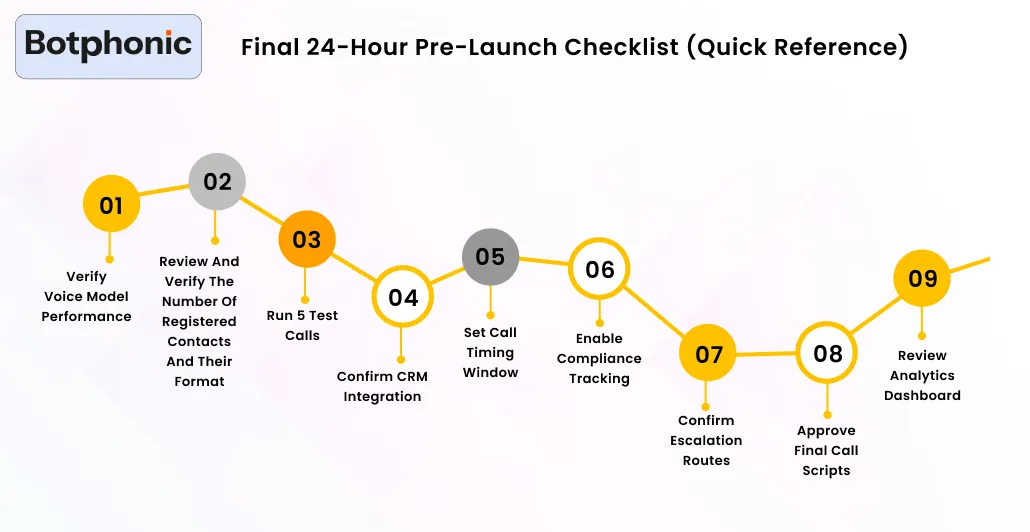
This handy checklist helps teams verify readiness before going live. It helps make sure your voice automation setup USA stays trained from the time of first call.
- Verify voice model performance: Get instantaneous previews and test for clarity, pace, and tone with your own ears. Make sure it sounds natural and your brand persona aligns.
- Review and verify the number of registered contacts and their format: Ensure the last version has no duplicates, consent tags and is in right file format such as csv or json. Accurate lists prevent wasted calls.
- Run 5 test calls: Make internal and external test calls to different U.S. carriers. Validate call flow logic, response and escalation steps.
- Confirm CRM integration: Make sure your CRM is recording call results properly. A gasification of our own brain Sweat equity, and Follow Up brackets Plus leads status notes all will dynamically update.
- Set call timing window: Verify the hours of FCC-approved call times and local time correspondence. This provides an adequate safeguard for your AI Voice Campaign USA against compliance risks.
- Enable compliance tracking: Enable automatic consent logging, opt-out tracing and audit storage. Here are some records that legally protect your small business.
- Confirm escalation routes: Test “press 0” and the other fallbacks. Ensure customer calls are answered promptly by human operators.
- Approve final call scripts: Audit the language, tokens and intent. Scripts should sound human and also remain tight.
- Review analytics dashboard: Before launch, verify that response rate, duration and conversion metrics look good.
Set up, test, and launch your AI voice campaign the right way with Botphonic.
Start your demo today.Conclusion
Planning, testing and compliance are necessary before launching a U.S. AI voice campaign. A clean list can help you reduce legal risks, increase call quality, and deliver better customer experiences.
You trust that your AI voice campaign is ready to go, because you’ve already prepared by testing scripts, perfecting data, and testing performance prior to launch. By integrating an AI call assistant into your strategy, you ensure smoother automation, smarter call handling, and consistent engagement at scale. With the right setup and tools like Botphonic, U.S. companies can even run AI voice campaigns that sound human, adhere to regulations, and produce quantifiable results powered by an advanced AI call assistant.