Summarize Content With:
Summary
U.S. telehealth companies are incorporating AI voice assistants in 2026 to cope with rising call numbers, offer patients better access, and take the load off staff without compromising care quality. Through secure, HIPAA-compliant voice AI, clinics automate scheduling of appointments, assist patients 24/7, and provide faster, more reliable communication for virtual healthcare services.
Introduction
Consider a patient who rings their telehealth clinic after office hours, and hears something like the following:
“Hey there, I’m here to help confirm or reschedule your appointment. What do you want to do today?”
No waiting. No voicemail. Just instant help powered by an AI voice assistant for healthcare.
It has everything to do with the magical combination of AI voice assistants and telehealth, and this is not a discussion about far-flung futuristic technology; it’s what we’re experiencing today. In fact, industry polls show that more than80% of patients prefer to receive digital/automated communication for routine healthcare issues today, a major shift in how people want to engage with care deliverers.
Telehealth is taking off across the United States, but older adults are not remote-health novices and already have systems in place that are buckling under high-volume calls. AI call automation adds clarity and speed to these challenges that make telemedicine scalable in a way that’s also friendly for the patient.
What Are AI Voice Assistants in Telehealth
AI voice assistants at telehealth are intelligent, automatic conversational agents who communicate with patients using natural language. They comprehend what patients are saying and respond in plain language, like a human volunteer receptionist. Acting as an AI receptionist it handles routine calls while staff focus on clinical work.
- They take calls, triage requests, and help patients handle routine tasks.
- They complement staff, rather than replace them, in handling a high volume of communication.
- They connect with backend systems, like scheduling or EHR, that retain accuracy and control of data flow.
How Telehealth Voice AI Works
Voice AI for Telehealth. It utilises advanced speech recognition and NLP technology. When a patient calls:
- The A.I. is listening and transcribing speech to text.
- It mines for meaning using machine learning.
- It answers in straightforward language, or if it performs a task (like reminding you of an appointment), the response is just another step down the line from its intelligence.
- It can be plugged into clinic systems to help push through this kind of record updating or alerting for follow-up.
By integrating with AI appointment booking software (USA), clinics ensure real-time accuracy while delivering dependable AI healthcare communication automation (USA).
 NOTE
NOTE
Difference Between AI Voice Assistants and IVR Systems
| Feature | AI Voice Assistant | Traditional IVR System |
| Interaction Style | Natural speech, conversational | Menu selections (press 1, 2, 3) |
| Flexibility | Understands varied questions | Follows rigid paths |
| Automation | Learns and adapts | Stays static |
| Use Case | Appointment booking, reminders, triage, support | Basic routing only |
The standard IVR is based on touch-tone input and fixed menus, but that’s not a nice way for your callers. AI voice assistants consider language conversation, not commands, which streamlines patient communication. Unlike IVR, an AI call assistant understands language naturally, improving patient trust and satisfaction.
Role of Conversational AI in Virtual Healthcare
Conversational AI describes voice or text systems that chat with patients. In virtual healthcare, this means:
- Answering common patient questions 24/7
- Aiding in appointment requests without human staff
- Navigating patients through symptom check or pre-visit instructions
- Follow-up and Medication Reminders
These materials give clinicians and support teams the room to do complex clinical work, not check in. They also create continuity in messages, which enhances patient experience.
Why Voice AI Fits Telemedicine Better Than Chatbots
Telemedicine already depends on human interaction, so apps with voice A.I. are more intuitive than text chatbots:
- A lot of patients would rather talk than type.
- Voice works for people who are more confident in their low-tech.
- Hands-free for the elderly and the visually impaired.
- Barriers such as apps or login screens are replaced by phone access.
Voice AI is one step closer to being personal and direct, even as it’s automated.
Key Communication Challenges Faced by U.S. Telehealth Providers
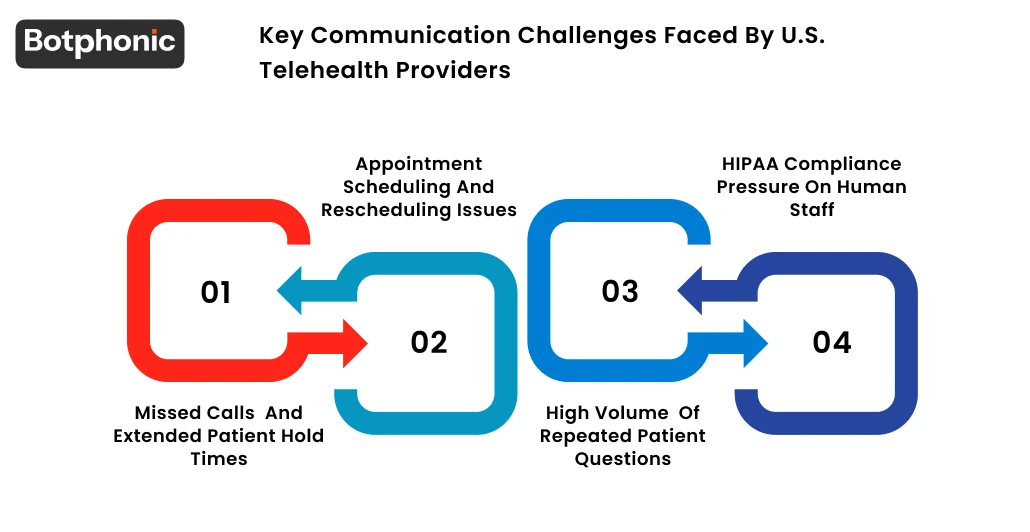
In the U.S., telehealth providers face numerous communication barriers that create delays in delivering care and consume resources. Patient satisfaction and clinic function are directly related to these factors.
1. Missed Calls and Extended Patient Hold Times
In many clinics, patients get stuck on hold or never get through to a staff member. It has an effect on patient confidence and contributes to callbacks. What’s worse, missed calls could lead to delays in important follow-ups or care instructions.
AI voice assistants pick up the phone instantly, so there’s no hold time, and patients never feel ignored.
2. Appointment Scheduling and Rescheduling Issues
It can also be time-consuming to book appointments over the phone. Staff may have to juggle numerous systems, and patients may give up if they don’t get quick answers. Further complicating matters are reschedules and cancellations.
On AI phone assistants, patients schedule appointments with a few words — no check-in, no listening to automated menus.
3. High Volume of Repeated Patient Questions
Pharma practices receive duplicate queries regarding office hours, insurance, or appointment reminders. These requests consume precious staff time.
AI voice systems take care of repetitive questions at scale, liberating teams to focus on higher-impact work.
4. HIPAA Compliance Pressure on Human Staff
In the U.S., patient communication is governed by HIPAA guidelines, which can put extra pressure on phone-call-managing staff. Human error is also likely to result in privacy and compliance failures.
HIPAA-compliant AI voice bots maintain patient data’s confidentiality, adhere to encryption and audit procedures, and minimise the probability of communication errors.
 PRO TIP
Why U.S. Telehealth Providers Are Switching to AI Voice Assistants in 2026
Telehealth providers in the United States, in 2026, now increasingly experience surging patient demand and call volumes. It’s the kind of old-school phone system that can’t keep up in today’s workplace. Consequently, many practices are now using AI-based voice assistants for telehealth in the USA, including advanced AI voice assistant for healthcare solutions, to handle calls, manage rising demand, and alleviate pressure on their staff while maintaining efficiency and compliance.
These resources enable rapid communications, more efficient data management, and standardised patient care on telemedicine platforms.
1. Rising Need for 24/7 Patient Accessibility
Let’s face it, patients want to see their providers when they want and not just during office hours. Telehealth is already flexible care, so communication needs to remain open, too.
A telemedicine voice assistant fields calls around the clock. Patients can book appointments, confirm appointments, or make basic inquiries without sitting by the phone waiting for staff.
2. Must Find a Way to Save on Costs Without Skimping on Patient Care
Telehealth providers are handling heavy call volume, but adding more employees would also mean extra costs. A lot of clinics need a more scaled way of reaching patients.
AI Call Automation for Telehealth reduces repetitive tasks, such as scheduling calls and reminders , from having to be done manually in clinics. Staff devote their time to focusing on patient care, while AI takes the mundane calls.
3. Increased Precision in Management of Patient Information
When people make your calls, slight errors often occur in names, dates, or the message. Those mistakes result in delays and frustration.
Healthcare voice assistant AI gives data voices. With an AI voice assistant for medical, patient information is accurately recorded and automated into the system. This cuts down on errors and callback work.
4. Improved Access for Remote and Rural Patients
For rural and remote patients, phone access can be more important than apps or portals. Textual applications are also less effective with poor connectivity.
Speech AI for telehealth lets patients talk normally and get assistance without having to figure out how a complex system works. This enhances access for marginalised communities.
5. Rapidly Increasing AI Penetration into U.S. Healthcare Systems
Health systems in the U.S. are now more confident in AI tools. These changes are prompted by regulations and security standards, as well as by increasing accuracy.
The net result is that AI telehealth solutions are being adopted faster and better integrated into clinics and virtual care platforms around the country.
NOTE
How Botphonic Supports AI Voice Automation for Telehealth Providers
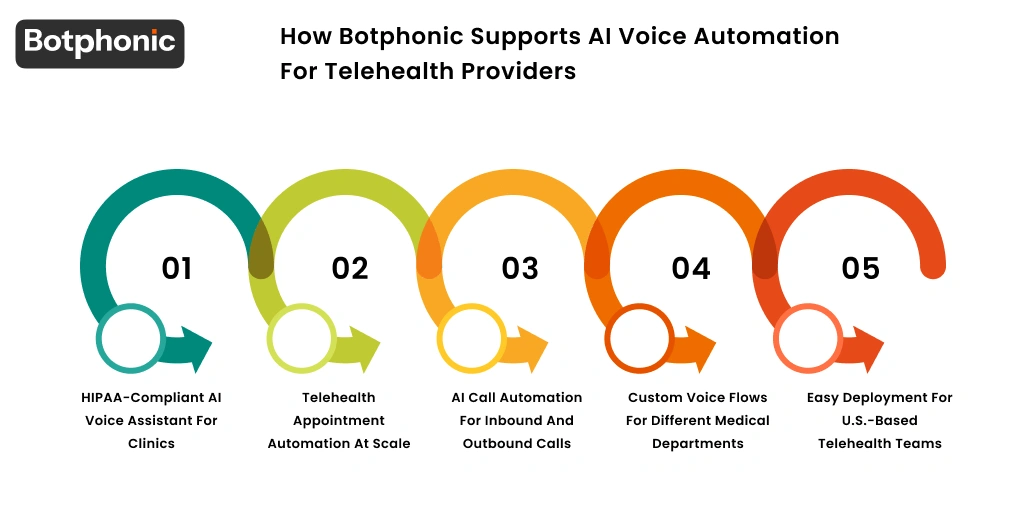
Botphonic is enabling U.S. telehealth providers to automate overnight patient calls securely and intelligently with voice automation powered by an advanced AI call assistant. The platform is based on real healthcare workflows rather than just general call handling, allowing the AI call assistant to manage patient interactions with accuracy and compliance in mind. Clinics are turning to Botphonic to improve access for their patients, minimize manual workload transfer, and ensure adherence with healthcare laws—all while leveraging an intelligent AI call assistant to streamline communication efficiently.
1. HIPAA-Compliant AI Voice Assistant for Clinics
Communicating about health care in the U.S. necessitates rigorous attention to data protection. – Botphonic provides a HIPAA-compliant AI voice assistant that safeguards patient discussions using secure infrastructure and managed data access.
Without patient privacy or compliance concerns, clinics can comfortably automate calls.
2. Telehealth Appointment Automation at Scale
Tabling appointments manually becomes impossible as telehealth expands. Botphonic provides access to telehealth appointments by managing bookings, confirmations, and text-based cancellations/ reminders through voice.
This enables clinics to handle high call volumes with no need for additional staff.
3. AI Call Automation for Inbound and Outbound Calls
Botphonic enables AI-powered call automation for telehealth on both incoming and outgoing calls. It responds to patients, confirms appointments, and issues reminders on its own.
This means that patients never wait for responses, even in busy hours.
4. Custom Voice Flows for Different Medical Departments
Different departments need different conversations. Botphonic enables clinics to design their own voice flows for billing, scheduling, follow-up, and clinical support.
You have patients getting to the right path pretty quickly without redundancy of information.
5. Easy Deployment for U.S.-Based Telehealth Teams
Botphonic offers quick deployment for U.S. telehealth providers. Voice AI can be onboarded in teams without heavy tech adjustments or lengthy onboarding periods.
This breaks down the barrier to adoption for clinics of any size.
Let Botphonic take over the discussion about it. Utilise AI voice assistants to cut down on wait times and help your patients with their queries 24 hours a day, seven days a week, with anything you want help with in your clinic.
Try it Today!Practical Use Cases of Voice AI in U.S. Telehealth
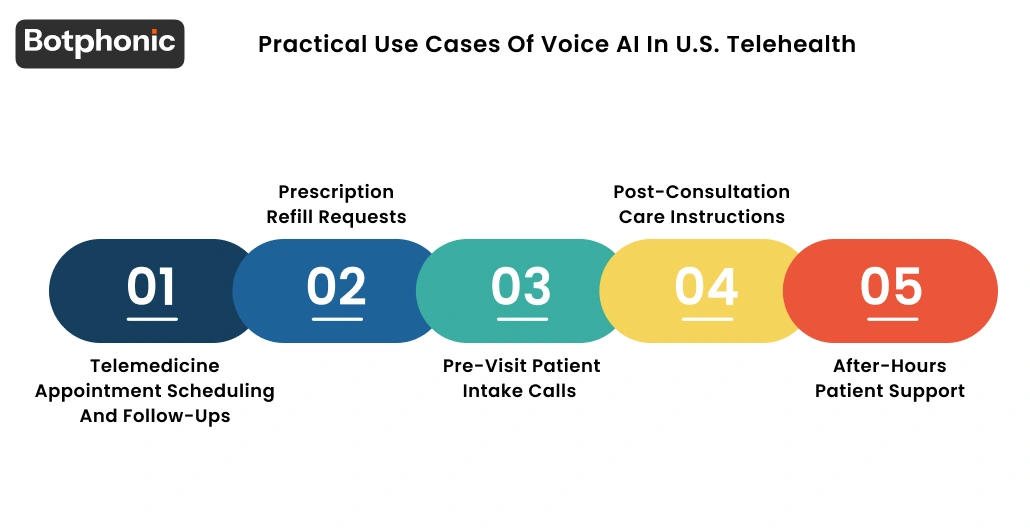
Voice AI can assist with many of the common telehealth workflows in practice. These are use cases that demonstrate that voice AI in healthcare attaches to our daily operations.
1. Telemedicine Appointment Scheduling and Follow-Ups
Patients create appointments with telemedicine voice assistants and receive follow-up reminders. This lowers the number of missed appointments and increases attendance.
Now, the staff doesn’t have to take every scheduling call by hand.
2. Prescription Refill Requests
Patients frequently phone in clinics for prescription refills. Voice AI captures necessary information and channels requests accurately.
This has the added benefit of saving staff time and accelerating response cycles.
3. Pre-Visit Patient Intake Calls
AI voice assistants gather symptoms, reasons for visit, and basic information before appointments. Providers receive that information in advance, which contributes to a higher-quality virtual visit. Follow-ups are automated through AI healthcare communication automation (USA).
4. Post-Consultation Care Instructions
Patients frequently forget care instructions after a visit. Voice AI can be used to provide reminders and next steps through voice calls. This leads to better compliance with and understanding by the patient.
5. After-Hours Patient Support
Clinics cannot staff phones 24/7. Voice AI makes sure patients get guidance after hours. Staff are not even available, but patients feel supported.
Conclusion
U.S. telehealth companies are moving to adopt AI voice assistants as the old way of receiving calls no longer meets the expectations of the modern patient. Voice AIVoice AI delivers better access, accuracy, efficiency, as well as compliance and employee satisfaction.
As telehealth grows in 2026, platforms like Botphonic will enable providers to scale high-quality and patient-friendly communication.