Summarize Content With:
Introduction
The conventional call centers are just not working as they were expected. In Phoenix, AZ, a mid-size BPO operation with two shifts consumes at least $6 to 25 per hour per agent, and this is not including the overhead of management, never-ending training cycles, and the revolving door of turnover which causes businesses to ought to backfill the seat to the tune of 20%/year. Indianapolis, IN is not an exception. Mathematics has never favored such companies where handling inbound calls in high volume is needed. It is only fair that no one was in the literal sense of the word given a choice.
The AI receptionist and the AI call assistant are not innovative products. They do not look like chatbots in a disguise with a telephone number. They are full-stack AI call centre software for BPO customer services, which respond to incoming calls in less than a second, comprehend what the people who are calling really want, actually do something in the live business systems and do it at a cost that is somewhere between $0.25 and $0.50. Compare it to an average of 3 to 6 per interaction of a human agent and you begin to see the reason why Phoenix and Indianapolis are becoming lightning fast companies.
The Problem Nobody Wants to Say Out Loud
Operating a BPO call center in 2025 is costly in a lot more than the salaries. You have:
- Shift premiums
- Overtime
- The QA staff listening and completing scorecards
- The constant churn handled by HR
- Instructors who redo the same onboarding deck to the fifteenth batch of new hires this year
And on the bottom of it, there is a hard ceiling: human agents are only able to manage one of the calls at one time.
The gist of the matter is that ceiling.
When thirty calls come in at the same time due to a lunch rush at a brokerage insurance firm in Phoenix or a spike hits a firm in Indianapolis in the middle of a logistics run on a Monday morning following a weekend crash, something breaks. Callers wait. Some hang up. Most won’t leave a voicemail. Zendesk CX research indicates that more than half of all callers who reach voicemail do not make another call. It is not merely an inconvenience that missed call. It’s a lost customer. Having a ten-line office with 200 calls each day, the costs of missing calls are estimated to be 450 per missed call, and the office is bleeding money daily.
An AI receptionist software for BPOs does not have a ceiling. It responds to call one and to call thirty simultaneously, with the same voice, with the same precision, and with the same tone.
What an AI Call Assistant Really Does
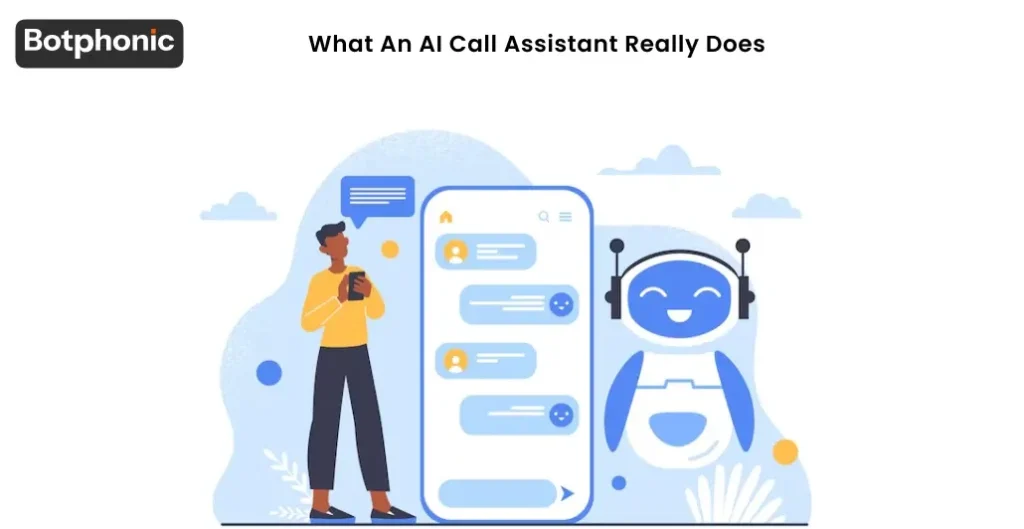
Individuals mix AI call assistants with the old IVR systems. At this stage that comparison is a disgrace. IVR says “press 1 for billing.” An artificial intelligence assistance responds by saying “Hey, I noticed you made a call regarding an invoice last Tuesday. Want me to pull that up?” There is no comparison.
The Real Call Flow
The real flow is as follows:
- A customer makes a call
- The AI receptionist answers within less than a second
- Speech-to-text translates voice into text in about 100ms
- A huge language model reads the intent, creates a contextually-suited answer, and directs or solves the call
- Text-to-speech changes the response back to voice
The whole cycle, including the steps of a caller talking to AI and the latter giving a reply, takes about 510 milliseconds. That is quicker than even the vast majority of human beings can reply.
What Happens Behind the Call
The AI call assistant is working even after the conversation, which is behind the call:
- It captures the interaction to your CRM
- It makes the appointment in your timetable
- It sends the follow-up SMS
- It notifies about the negative sentiment when it needs to be looked into
- It sends out a transcript to conform
All this occurs in the absence of a supervisor involved, in the absence of a checklist, and with no one missing a step.
In the case of the Phoenix-based medical clinics, this can be scheduling appointments, insurance questions, and calling patients 24/7 without the need to staff a night shift. To the Indianapolis manufacturing suppliers, it implies manufacturer inquiries, order status requests and shipment follow-ups handled before a human agent even shows up.
The Real Cost Comparison
Here is something to take your time.
One full-time inbound agent in Indianapolis would cost approximately 38000 to 50000 dollars in wages alone. Benefits, payroll taxes, PTO, training and management time add up and you have a full-bodied cost that is close to $55,000 to 65,000 per agent per year. In the case of the ten-member team, that equates to more than half a million dollars per year and they are yet to solve a single issue.
| Cost Factor | Human Agent (Annual) | AI Receptionist (Annual) |
| Base cost per agent/subscription | $38,000 – $50,000 | $588 – $36,000 |
| Fully loaded cost (benefits, training, mgmt) | $55,000 – $65,000 | No additional overhead |
| Cost per interaction | $3.00 – $6.00 | $0.25 – $0.50 |
| Concurrent call capacity | 1 | Unlimited |
| Overtime / surge cost | Yes | No |
| 10-agent team annual cost | $550,000 – $650,000 | Fraction of the above |
A subscription to an AI receptionist by a serious provider costs between $49 to 3000 per month based on the amount of calls, features and integrations. Even at the upper end, that would be $36,000 per annum to manage what would have otherwise taken a number of full-time agents. The math isn’t complicated. It is simply right that the majority of the businesses did not bother to run it.
This is what makes the figures even more unbalanced: the AI call assistant can be scaled without extra expenses. A single agent is capable of managing a single call at a time. A single AI receptionist will be able to accept a hundred simultaneous calls at the same price per month. When your franchise location of Phoenix runs a promotion and the sales calls are three times higher than usual in three days, the AI processes it, does not pay overtime, does not face burnout, and no one calls sickness.
Phoenix and Indianapolis Are Not Waiting
Phoenix is among the rapidly developing business markets in the country. Competition is also increasing by the healthcare networks, real estate companies, home services companies and the regional BPOs who are all competing with a very thin margin. The companies that are winning the race are not achieving it by having larger teams. They are doing it using smarter infrastructure.
One Phoenix dental group with 150 calls per day decreased the rate of missed calls by 40 percent to basically zero with the installation of an AI receptionist. They did not reduce the number of front desk employees at once, but they had ceased recruitment. The rest was done by natural attrition. They saved approximately 80,000 staffing expenses in over 18 months and redirected it to marketing and equipment.
Indianapolis narrates the same with a different industry perspective. The logistics and distribution business in the city operates on very thin margins and time-sensitive messages. Supplier telephone calls, shipment verification, claims. A call assistant based on AI is not bothered by volume. It does not make a call on the Monday that comes after the Super Bowl. It does not require a 15 minutes break after every two hours.
Why Botphonic Should Be in This Discussion
The market is full of AI receptionist tools. The majority of them are designed to serve a single purpose, single integration, and single business. Botphonic is constructed in a different way. It targets those businesses that have a real call volume and real operational complexity, between multi-location Phoenix healthcare providers and BPO firms in Indianapolis that require white-label capability to their own customers.
The Botphonic AI-based call assistant operates based on enterprise-grade speech pipeline that integrates STT, LLM reasoning and natural TTS to generate conversations which 72% of callers in blind tests thought were human in nature. That number matters. The customer acceptance is the largest obstacle to the adoption of AI call, and Botphonic has already overcome it.
What Botphonic Brings to the Table
- Native integrations: HubSpot, Salesforce, Zoho, Google Calendar, and Calendly
- Multilingual dialogue support out of the box
- Real-time analytics dashboard with sentiment analysis
- Call transcripts directly incorporated into performance reviews and compliance audits
- White-label architecture for agency and BPO models operate under your own brand without rebuilding anything
The setup doesn’t take weeks. Basic implementation can be made in minutes. Phoenix and Indianapolis businesses can move to zero and achieve a fully working AI receptionist that manages live calls in less than a business day.
What Becomes of the Human Agents
This is the question everybody steps about. Let’s not.
AI call assistants are used to manage the volume that does not involve judgment:
- Frequently asked questions
- Scheduling
- Status updates
- General troubleshooting
- Lead qualification
In most business settings, that is about 70 per cent to 80 per cent of the content of inbound calls. The remaining 20% to 30% then falls on human agents, which is precisely the work that actually needs a human: a complex complaint, emotionally charged situation, high revenue selling conversation, regulatory exception.
It does not bring about mass layoffs. It is in most instances, a smaller, better-paid group that is working on a higher-value work. Agents prevent their drowning in call centers and begin to work with the interaction where human judgment brings alive business results. Agent satisfaction goes up. Turnover drops. The scope of human responsibility becomes narrower to what really matters and hence training becomes more focused.
The BPO business worth billions, numbering 525 billion, is not heading to complete automation. It is heading towards the hybrid models where AI is doing the predictable volume and all the rest is done by the human. Phoenix and Indianapolis businesses that are now constructing this infrastructure are not simply making cost reductions. They are creating competitive moats
The Numbers Keep on Getting Better
The market of virtual receptionists reached 3.85 billion in 2024. It is estimated to attain 9 billion dollars in 2033. The already existing AI agents market of $5.4 billion is projected to be 50 billion by 2030. That’s not speculative. That is investment capital after proved ROI.
| Metric | Before AI | After AI |
| Cost per interaction | $3.00 – $6.00 | $0.25 – $0.50 |
| Customer satisfaction (positive) | Varies | 80% |
| First call resolution rate | Industry average | 69% |
| Average resolution time | 11 minutes | 2 minutes |
| Healthcare admin efficiency gain | Baseline | +30% |
| Law firm first-year ROI | N/A | 1,700%+ |
| Missed call rate (Phoenix dental case) | 40% | ~0% |
First-year ROI estimates in law firms that use AI receptionists are more than 1,700 percent. The five-people company that saves 45,000 on labor expenses compared to a 2400 annual subscription to AI does not need to have a spreadsheet to see the payback. The savings are timely, quantifiable and can be repeated on a monthly basis.
The adoption of AI is not hurting customer satisfaction measures. They’re improving. Firms that engage AI call assistants record 80 percent positive experiences by the customers. The first call resolution has an average of 69%. Mean time to resolution reduces to 2 minutes as compared to 11 minutes. These aren’t marginal gains. They are structural enhancements which get compounded with time. Menlo ventures have forecasted that by 2027. A multi-model system will dominate.
The administration efficiency of healthcare organizations is found to improve by 30 percent post AI receptionist implementation. The inbound call operations in Phoenix and Indianapolis, which are fully operated by humans in 2026 are not cautious. They’re falling behind.
The Shift Has Already Occurred
In 2024, 78% of organizations actively used AI in at least one business functionality, as compared to 55 percent in 2023. That’s not a trend. That’s a structural shift. Gartner estimates that 80 percent of customer service organizations will operate on generative AI by 2025. That is a projection that is almost up-to-date.
The price difference between AI receptionist systems and conventional manpower is not going to reduce. It’s going to widen:
- There is an increased accuracy in speech recognition
- LLM reasoning is improving
- Ecosystems of integration are on the rise
- The price per voice call of AI call assistants will be dropped whereas human labor will still remain increasing
The framing is important to businesses in Phoenix and Indianapolis that consider this decision at this time. This is not whether to implement AI call technology or not. Your competitors are already making that decision. The real question is whether you take action now, when the early adopters continue to have a structural advantage, or whether you can wait and take action later, when you have already fallen behind, not in front.
The AI receptionist is not coming. It’s already here. And it is already responding to those businesses that did not wait.
Conclusion
Companies in Phoenix and Indianapolis using an AI receptionist are spending less, missing fewer calls, and beating the competition still paying $55,000 per agent per year to manage volume that an AI call assistant handles for free at $0.25 per interaction.
This is not a technology trend to watch. It is a paradigm shift in progress. In 2024, 78% of companies are actively using AI in business operations. Gartner predicts 80% of customer service departments will be powered by generative AI by 2025. Law firms are seeing first-year ROI of over 1,700%.
Botphonic is right in the middle of this paradigm shift. It is not designed for pilots or proof of concepts. It is designed for companies that need an AI call assistant for business operations already in progress and working. Multi-location healthcare companies in Phoenix. BPO companies in Indianapolis. Agencies launching under their own brand name. Every single one of them is already in motion.