Summarize Content With:
The process of recruitment is evolving at a rate that is beyond the ability of most companies to handle. With the growth of business and increase in competition in the talent market, the customary hiring processes become painful due to high volumes of applications, missed calls by applicants and the administrative chokes. This is what smarter solutions will come in such as the AI receptionist to work on recruitment.
However, what is an AI receptionist in this context, and how does it turn recruiting into a cost center, rather than a strategic strength?
This article takes the hiring teams through everything on the nuts and bolts of how it works to the actual benefits, real world tips on how it can work and common misunderstandings. Let us unravel this with some sense and in a thinking perspective.
What Is an AI Receptionist for Recruitment?
In its most basic form, an AI receptionist is a computer-based friend that will automatically handle the initial steps between job seekers and your recruitment team. Imagine it to be the computerized first responder – responding to questions, vetting filters, arranging meetings, and data harvesting – without human bandwidth.
Front desk or HR coordinator performs these tasks in conventional recruiting settings. This is time consuming and usually inaccurate. The implementation of an AI receptionist scales, increases the reliability of work, and continuity of data on the tasks that previously were repetitive and prone to errors.
Suppose you take a funnel of hiring, the AI receptionist is at the summit of the funnel, the point of contact. And when it is set up well, then it does not merely react it acts.
Learn more: AI Phone Interviews vs Traditional Screening
Core Functions: How Does an AI Receptionist for Recruitment Work?
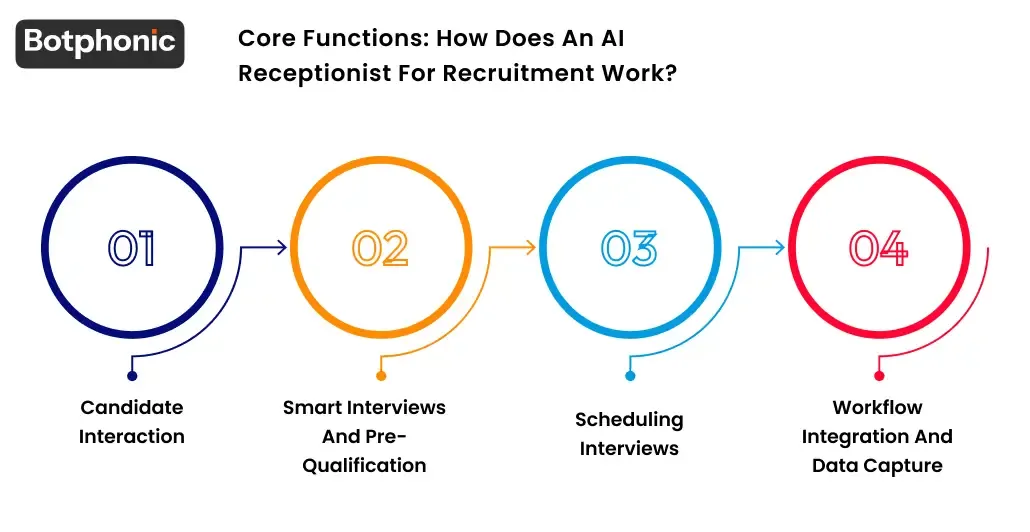
This is a critical point that needs to be understood to consider adoption. We shall discuss the major functions of an AI voice assistant for recruitment first.
1. Candidate Interaction
AI receptionists in the present day are not confined to the phone. They are able to interact with the candidates:
- Website chat widgets
- Text messaging (SMS)
- Email autoresponders
- Social media platforms
Natural language is used in every interaction. The candidate may raise questions on job requirements, company culture and scheduling of their interviews. The AI receptionist understands such questions and answers in real-time, removing the time lag and marking the conversation to be seen by the recruiter.
At this point, the system is not only responsive, but it is reactive. It modifies language according to the situation which enhances interaction and eliminates frustration.
2. Smart Interviews and Pre-qualification.
After a candidate elicits interest, the system has the capability of entering into a qualification mode. In this respect, the name AI receptionist of recruitment work gains a certain meaning.
Rather than a recruiter asking over the phone simple questions, such as:
- “What’s your availability?”
- “Do you have experience with X?”
- “Are you willing to relocate?”
These initial screens are done automatically by an AI receptionist. It applies organized reasoning and to a growing extent natural language understanding to rank candidates according to the criteria which hiring teams set.
This has a twofold effect:
- There are quicker responses to the candidates.
- Recruiters have a clearer candidate list of priority.
3. Scheduling Interviews
The scheduling is one of the most uncomfortable aspects of the recruitment process: it is difficult to find a time which suits both the candidate and the hiring team. The conventional coordination is usually connected with numerous emails, calendar clashes, and human error.
An intelligent receptionist can book appointments by:
- Integrating with calendar systems (Google Calendar, Outlook, etc.)
- Showing the openings to the applicant.
- Without back and forth confirmation of interviews.
- Automatically sending reminders and updates.
This will save hours per week to the recruiter alone.
4. Workflow Integration and Data Capture.
The quality of great recruiting systems is as good as the data they generate. An AI call assistant records information about interactions – the responses of a candidate, their availability hours, desired job positions – and inputs it into your Applicant Tracking System (ATS) or hiring database.
This implies that there will be no more lost emails or incomplete information. Hiring teams receive organized, searchable information that enhances improved decision-making at the downstream.
 PRO TIP
How Does an AI Receptionist for Recruitment Work in Real Time?
An example will help to be more specific.
Situation: High Volume Job Posting
You are recruiting 50 customer service representatives. You do the posting on the job boards and within 48 hours, hundreds of applications and inquiries come in.
An AI receptionist can manage it in the following way:
- Web site chat inbound candidate: AI meets them and requests their job application and contact information.
- Candidate shows interest: When the candidate shows interest and inquires about what is needed, AI provides the correct job description, remuneration package, and shift pattern.
- AI executes qualification questions: The system gives a screening score or tag to every candidate based on pre-determined criteria
- Scheduling logic kicks in: The system gives the candidates rated as qualified an interview slot depending on the availability of the recruiter.
- Integration into workflow: The system synchronizes any data obtained with the ATS. Recruiters see only pre-qualified, scheduled candidates—noiselessness.
This live orchestration ensures that all the candidates receive attention without engaging the human resources in redundant duties.
Why HR Leaders Are Turning to Solutions Like Botphonic
The market has a sufficient number of vendors, with one that can be easily and pragmatically implemented being Botphonic.
Botphonic has been explicitly oriented to the recruitment cases. It understands:
- Fast frequency of employment requests.
- Necessity to have configurable screening processes.
- Need for smooth scheduling.
- And reporting and audit trail value.
Instead of a generic chatbot, Botphonic is a specialized AI receptionist in recruitment work – that is created to work with real hiring processes.
Botphonic is also focus on configurability as to be a smart AI for talent acquisition. Recruiters are able to customize screening questions, messaging, and add information to existing tools without technical overhead.
The bottom line? When properly configured, an AI receptionist does not mean that professional people will not be hired, it just makes them more powerful.
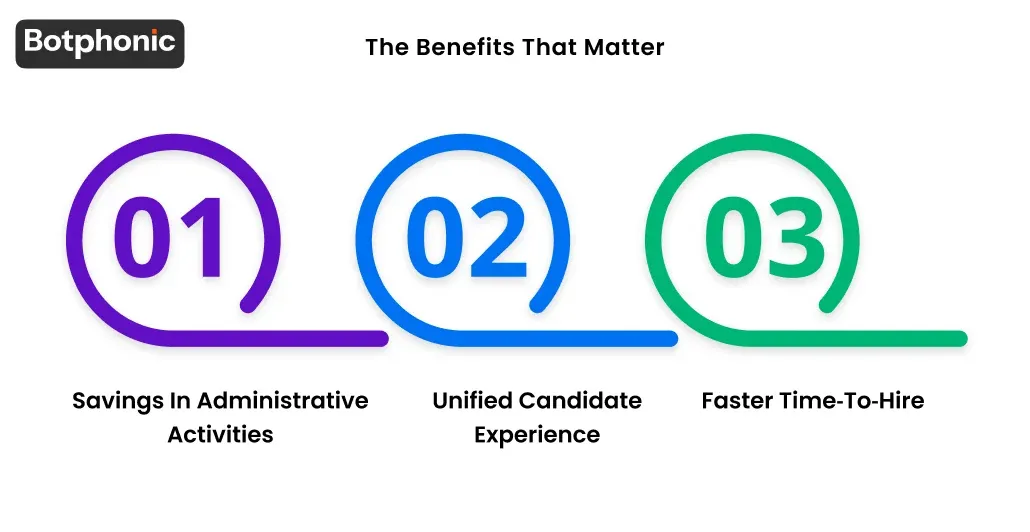
The Benefits That Matter
It is a good instinct of many recruiting officers to be suspicious. Reports have stated that about 67% of HR professionals have stated that AI enhances their recruitment efficiency. And, when you examine the results rather than the hype, the worth is apparent.
- Savings in Administrative Activities: One hour of time wasted in writing redundant e-mails or in scheduling interviews is an hour of talent that is not being considered or of managerial coaches who are not coaching, or of strategy that is not being laid out.
- Unified Candidate Experience: The candidates are now in a hurry. Top talent can be lost because of a slow or a disjointed first impression. AI receptionists will provide a clear and consistent reply to each candidate.
- Faster Time‑to‑Hire: Through funnelling of the early stages, qualified candidates are transferred to interview at a faster rate. This reduces time-to-hire and makes sure that you are competing well with in-demand profiles.
- Scalability: Regardless of whether it is five or fifty, the system scales without the need of extra costs or resource burden. This is a strategic benefit during the high hiring seasons.
 NOTE
NOTE
Common Misconceptions About How It Works
Myth 1. It Takes Jobs From Recruiters
Reality: It does not take jobs or people jobs; it takes tasks away to recruiters. The human judgment factor is also necessary – the AI is needed to handle quantity, the humans needed to handle subtlety.
Myth 2. It is Too Technical to Implement
Fact: Contemporary AI receptionists are meant to serve non technical groups. It generally plugs into calendars, ATS systems and candidate channels.
Myth 3. It Sounds Robotic
Fact; Good systems do not sound like robots. They apply the natural language patterns and contextual knowledge to provide a reaction that seems to be instinctive and supportive.
Key Components You Should Look For
When you are comparing tools, you want to make sure that your AI receptionist has:
- Natural language processing (NLP) which comprehends candidate questions.
- Job specific screening flows.
- Automated scheduling calendar.
- Support on multi-channel (chat, writing, voice).
- ATS integration or data export capabilities
- Dashboards of visibility about activity and ROI.
These are the features that guarantee that the AI receptionist is not a device, rather, it will be an essential component of your hiring system.
Getting Started: an Implementation Checklist
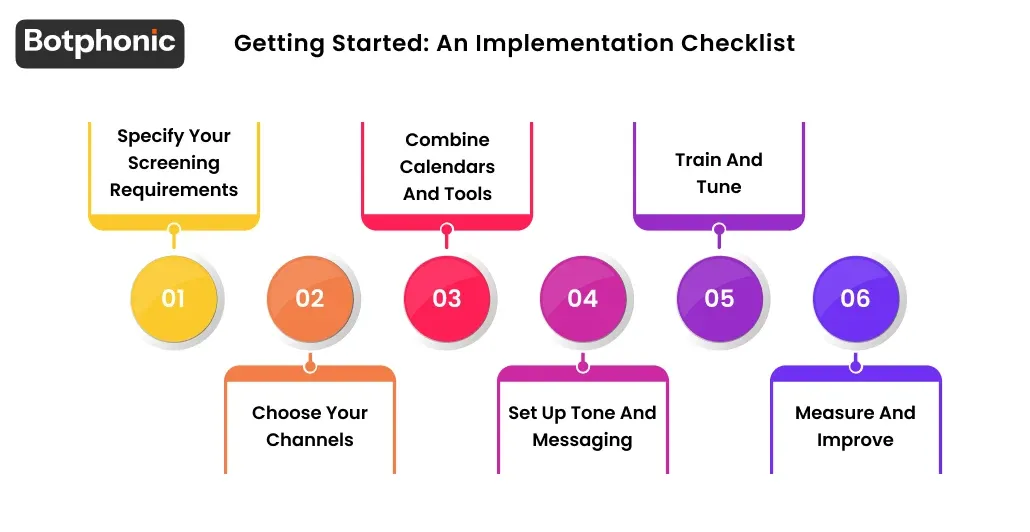
This is how to implement this without causing a hustle.
- Specify Your Screening Requirements: Determine which questions are important early on – level of experience, working hours of preference, work location of preference, wage rate expectations.
- Choose Your Channels: Will you begin with chat in the web sites? SMS? Both? Map of initial flows of candidate traffic.
- Combine Calendars and Tools: Link recruiter calendar, ATS and messaging system in advance.
- Set up Tone and Messaging: Ensure that the voice of the AI is similar to your employer brand, not too complicated, talkative and professional.
- Train and Tune: Test initial encounters to sharpen rationale, reactions and screening criterion.
- Measure and Improve: Monitor such metrics as response times, interview rates, and satisfaction of candidates.
Effective implementations are not set and forgotten. They are dynamic according to your need to hire.
Limitations and Mitigation of the same
As any other tool, AI receptionists are not flawless.
- Candidate Misunderstandings: A question might be misinterpreted by the AI sometimes. Mitigation: make sure fall back choices result in a human or provide clarifying answers.
- Data Integration Gaps: The information may be siloed in case your ATS does not sync. Mitigation: apply middleware/check tool compatibility prior to purchase.
- Resistance to Automation by Candidates: There are those candidates who like to have human contact. Mitigation: offer obvious possibilities to go to a human recruiter at any stage.
| CTAReady to transform your hiring process? Discover how Botphonic’s AI receptionist for recruitment can save your team hours, improve candidate experience, and scale recruitment effortlessly.Get Started with Botphonic Today. |
Discover how Botphonic’s AI receptionist for recruitment can save your team hours, improve candidate experience, and scale recruitment effortlessly.
Request a Free DemoConclusion
But what does an AI recruitment receptionist do? The concise response is that it will bring automation and intelligence, consistency, and speed to the front door of your hiring process. It responds to questions, stores candidate information, pre-employments, and schedules an interview and all the time spins structured data to your hiring team. Meanwhile, It is not some theoretical upgrade but an actual process of streamlining busywork. Also, in enhancing the candidate experience, and speeding up the hiring process.
With such applications as Botphonic, which is specifically designed to be used in the talent acquisition scenario, an AI receptionist becomes not as noteworthy as it is now an essential part of the competitive labor market.