Summarize Content With:
Introduction
Enter any independent insurance brokerage, almost any one, and you will observe the same thing. A small group of people handling a huge amount of telephone calls, emails, policy renewals, claims questions, new quote requests all concurrently. The phones are always on, and each time a call is missed, it is a possible client that went to the competition.
This form of pressure has always been a part of insurance brokers but a number of converging trends are making the communication issue more acute than ever. There has been an acute rise in client expectations on the response time. The complexity of regulations has been heightened. And the administrative and front-desk administrative workforce pipeline has been narrowed compared to how it was. The math of traditional staffing alone just does not work in a number of cases among the brokerages.
That is why AI personal assistant insurance has ceased being a curiosity to a working application which brokers actively implement – not to replace the staff, but to alter what the staff has to do.
The Response Time Problem in Insurance
1. Why Missed Calls Matter
Research about lead conversion in insurance also indicates that the likelihood of converting a prospect reduces drastically once the initial few minutes of the prospect interacting with one another are over. Any prospect making a call at 7pm on Friday and recording a voicemail is definitely likely to call another broker the following morning. It is the brokerage that picks up who receives the appointment or the system that picks up whoever receives the appointment.
2. Revenue Impact of Missed Calls
It is not a marketing issue on the abstraction. It’s a direct revenue impact. In the case of brokerages dealing in commercial lines, one missed opportunity call on prospective prospects might cost tens of thousands of dollars in yearly premium. With personal lines brokers who work in competition with direct-to-consumer insurance platforms, which are available 24/7, the capability to immediately respond is not only nice to have, but it is a competitive minimum.
3. How an AI Receptionist Closes the Gap
An AI receptionist does not think about the time. It:
- Responds instantly
- Collects the information and coverage requirements
- Sends first information
- Sets an appointment with the appropriate agent at any time, any day.
Handling Routine Inquiries & Claims Efficiently
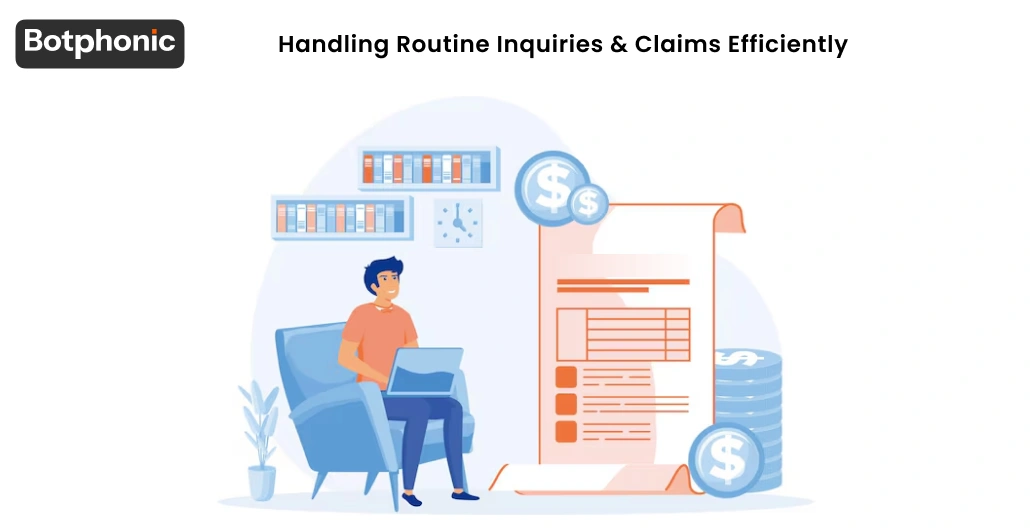
The front desk of an insurance brokerage is mostly doing something that is not complex. The common queries include:
- Policy holders making calls to confirm the date of their cover.
- Clients enquiring on the question of their deductible.
- The orders of certificate of insurance.
- Investigations into the process of filing a claim.
- Enquiries on high premiums.
The properly programmed AI receptionist can properly respond to these questions without the involvement of any human being in case the system has provided the brokerage’s policy management software.
In such a case, when a client calls to inquire about their renewal date, the AI can verify who they are, retrieve their policy information and confirm the information in less than two minutes.
This is important as these habitual calls are disrupting the work of the staff who need to be working on more intricate client demands, in new business or the policy service work which they actually need to be knowledgeable about. The AI attends to all the regular calls, saving time for a licensed producer or account manager.
AI-Assisted Claims Intake: First Notice of Loss
Arguments are emotive. When a client calls because his or her basement flooded, his or her car was wrecked, or his or her business was broken into, he or she usually feels angry and needs a clear sense of direction. Although the AI receptionist is not going to become the one providing empathy and working on the relationship based on a complicated claim, it can be instrumental in the first intake.
The properly designed system can:
- Receive first notice of loss data
- Verify the carrier that the policy is associated with
- Provide the carrier’s claims phone number or portal link
- Record the interaction in the management system of the brokerage
This implies that by the time the account manager takes over he or she has the first intake made and can concentrate on the relationship work and not to collect data.
 PRO TIP
Appointment Scheduling, Compliance & After-Hours Service
Eliminating Scheduling Phone Tag
Scheduling a new client at the calendar so as to have a review of the coverage or perhaps a new business consultation may need several rounds of callings or emailing between them as each attempts to find a common time slot. This is low value administration work which wastes time on both ends.
A single interaction with a broker can be used to schedule with an AI receptionist:
- The prospect or client makes the call a
- AI call assistant verifies the availability and makes the appointment directly
- Assures the caller and records it in the CRM
- No voicemails, no call backs, and even there’s no to and fro.
Since a significant share of the business of brokers who receive inbound calls will be switched to inbound calls, this eliminates a source of friction that was leading to unwarranted drop-off in the scheduling step.
 NOTE
NOTE
Compliance Considerations
Insurance is a regulated business and any technological solution that reaches client communication must be analyzed through the prism of compliance. Some essential points to understand:
- AI receptionists do not take the place of licensed producers.
- They do not deal with advice or recommendation of coverage, only administrative tasks and information collection.
- An AI insurance receptionist with proper settings will gather the information, only give factual policy-related information and direct accordingly.
- It will not give advice on coverage, explain the policy language to use in claim situations, and anything that qualifies as insurance advice.
Brokerages that implement these systems must ensure that they configure the escalation paths correctly so that any call needing licensed judgment receives prompt delegation.
The pleasant fact is that the callers at receptionist level do not request much that needs licensed knowledge.The licensed staff operate the professional layer and manage the administrative layer by means of the AI call assistant.
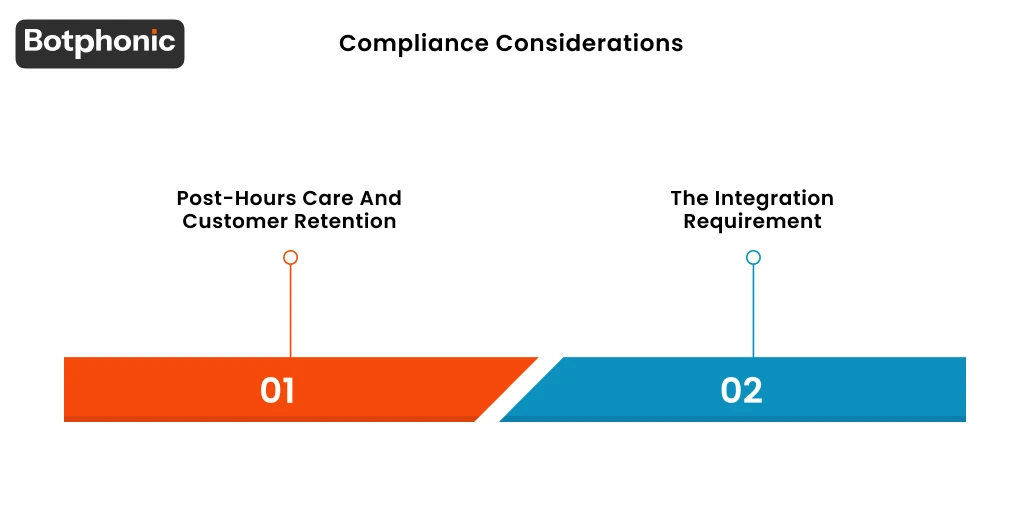
1. Post-Hours Care and Customer Retention
Ease of access greatly affects retention of clients within insurance. Clients who find it difficult to contact their broker when they have an inquiry. Particularly, during the renewal period. They are clients that are likely to proceed to market and do so with the possibility of switching. When compared to bigger airlines possessing 24/7 call centers. The late-night availability has long been a disadvantage to independent brokerages. As per research about 42% of enterprise-scale organizations have actively deployed AI in operations.
Independent brokerage firms can also provide this type of immediate response with botphonic and such platforms. Usually, before could have been offered to only large organizations with dedicated after-hours teams. A client who calls at 9pm and he/she receives a helpful response instead of a voicemail. It makes them feel better served and that service quality perception is a material factor in renewal retention.
2. The Integration Requirement
Even an AI receptionist with no connection to the agency management system of the brokerage can accomplish very little compared to one that is well connected.
The actual value will be achieved when the AI is able to:
- Retrieve policy data
- Verify client records
- Record interactions
- Update the CRM in real-time
Brokerages that are considering AI receptionist platforms need to focus on the ones that have native integrations. Or open an API that matches with their current management software. A system where agents have to manually input the information. That was gathered by the AI during a call is not what is termed as work removal.
And discove how AI can enhance your brokerage’s operational efficiency.
Try Botphonic Now!Conclusion
The need for an AI phone call assistant for insurance agencies does not stem from the desire to replace the expertise, but rather from the desire to eliminate the administrative burden that prevents agents from using their skills where they are truly valuable.
In a business where time to respond is a key factor in conversion, capacity is a limiting factor, and clients expect immediate access regardless of the hour. Businesses that use this technology are not simply being efficient. But they are building a service infrastructure that is competitive in the new world of insurance. While their peers are left scrambling to answer the phone.