Summarize Content With:
Introduction
Go to any administrative office in a university on Monday morning and you will encounter the same scenario; a queue of students stretching towards a front desk, a phone ringing with no one to pick up, and all the staff busy switching between three browsers as they seek to assist the individual standing right before them. This is not a failure in management. It is a structural one.
The number of queries received daily – financial aid deadlines, enrollment holds, housing applications, transcript requests, etc. – is much more than a human team is able to manage on a real-time basis. It is precisely there, where an AI receptionist in education comes and not to unseat people, but to take the repetitive burden away and leave people to what should actually be judged and empathized with.
This article transcends the simple argument that AI is saving time. Rather, it explores the particular bottlenecks in communication currently present on campuses, the reason why conventional solutions to the problem such as FAQ pages and email auto-responders do not work, and how properly implemented AI receptionist in the education sector alters the response-time equation on a structural level.
Why Does Campus Response Time Keep Getting Worse Despite More Staff?
This is what is hardly ever questioned. The addition of administrative headcount in institutions has been decades old. The administrators in American higher education increased by 221 percent in the years 1987-2012 as compared to 1 percent increase in the faculty. However, the student satisfaction with the responsiveness of the administration has not improved.
The problem is not headcount. It is a query distribution. In most institutions, about 70 to 80 percent of the questions posed by incoming students are variations of 40 to 60 questions that are asked invariably:
- What documents do I need to register?
- What is the date of financial aid disbursement?
- What is the way to take a hold off my account?
These questions possess familiar, consistent responses. Nevertheless, they still come in via all means possible phone, email, walk-in, portal chat and each one of them takes the same portion of the attention of a staff member as a truly complicated advising request.
The Real Bottleneck Is Query Triage, Not Staffing Levels
The literal bottle neck: It is not that employees are slow. It is that both simple and complex queries are in the same queue, and the front line does not have a triage system.
A learning assistant is a receptionist in the form of technology. It will automatically deal with the known-answer questions and send anything that needs a human to the appropriate individual, with the context already recorded.
| Without AI Triage | With AI Receptionist for Education |
| Simple and complex queries in same queue | Automatic separation of routine vs complex |
| Manual routing between offices | Intelligent real-time routing |
| Staff context rebuilding | Context transferred automatically |
| 2–4 day response time | Minutes to first resolution |
What Does a Campus Inquiry Actually Look Like Before It Gets Answered?
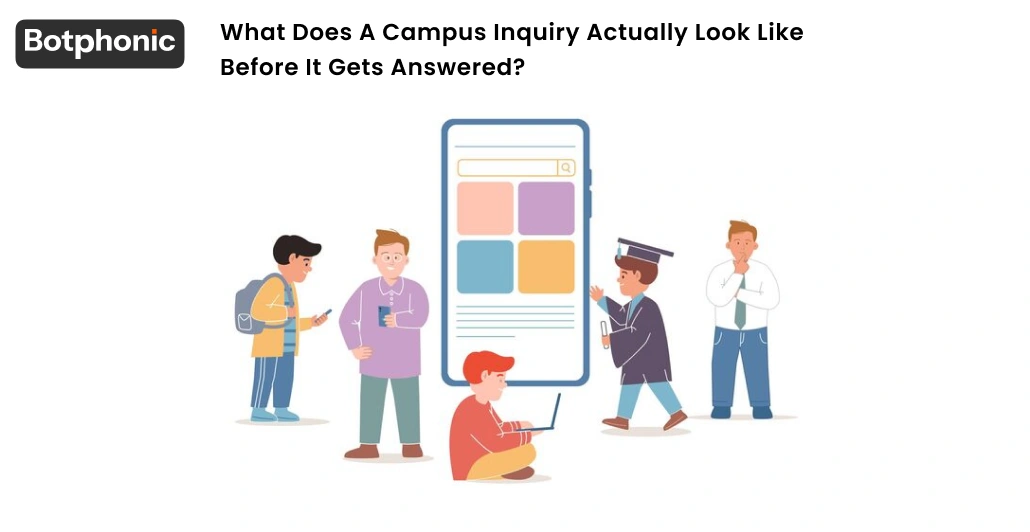
The general public not involved in the highest education administration would be amazed at the number of handoffs a mere student question causes before someone addresses it.
The Hidden Cost of Administrative Handoffs
A student sends an email to us seeking to know why his/her financial aid has not been posted.
- That email lands in a general inbox.
- Staff reads it.
- Staff determines that they should refer it to the financial aid office and sends it.
- The financial aid office notices it after a few days.
- Student has a verification hold.
- Staff ask students for documents by sending a reply requesting documents.
- The student also sends the documents via a portal.
- Another individual processes those documents.
- The student receives a response after four business days of the initial email.
Each of those steps involves a human doing something that, in most instances, a well-trained AI system could handle in less than thirty seconds: checking the account status, identifying the hold, drawing the document checklist corresponding to the type of aid provided to the student, and sending the reply with a direct upload link.
This is not hypothetical. The specific workflow that an AI phone call assistant for teaching and learning is designed to handle what actually is causing the problem. Such as, decreased response times to a matter of days to minutes to have their first point of interaction solved.
Isn’t This Just a Chatbot? What Makes an AI Receptionist Different?
Fair question. Chatbots in campuses are not a new thing, and the majority of them have been disappointing. When they match a keyword, they provide a scripted response, when a question even slightly deviates, they crash miserably, and annoy learners that have learned to mistrust them.
Three Structural Differences Between a Chatbot and an AI Receptionist for Education
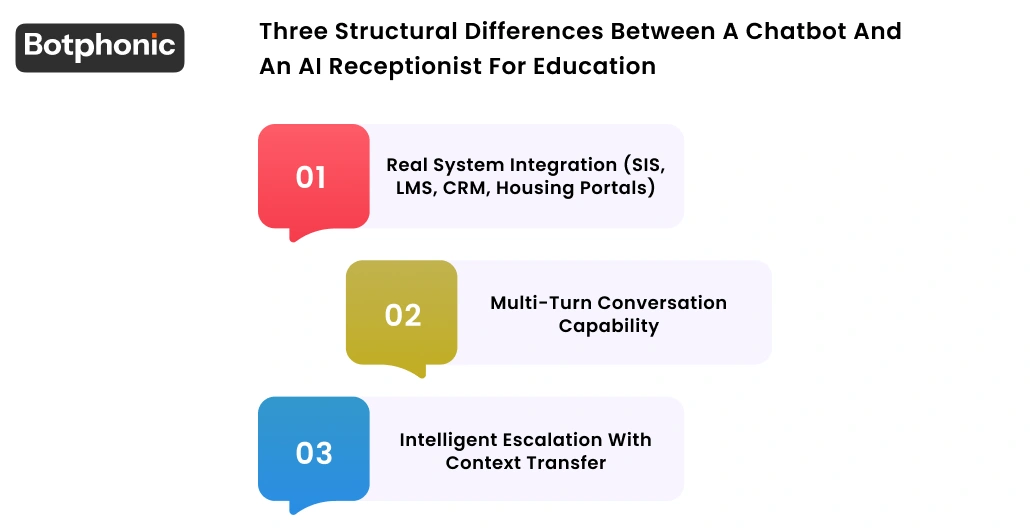
There are a number of ways that an AI receptionist in education is architecturally different.
1. Real system integration (SIS, LMS, CRM, housing portals)
First, it does not sit on top of a rigid body of knowledge but, on the contrary, connects to the real systems of the institution – SIS, LMS, CRM, housing portals. It may find out the enrollment, financial aid package, or room assignment of a chosen student in real time and respond to it in a personalized manner but not in a general way.
2. Multi-turn conversation capability
Second, the AI receptionist addresses multi-turn conversations. A student who begins by enquiring about any available options in terms of tuition payment then turns around and asks about a grade appeal does not get two unrelated replies to two different bot intents.
3. Intelligent escalation with context transfer
Third, most importantly, it knows how to stop. An adult AI receptionist in the education department is programmed to understand the distinction between administrative information (which he can give) and personal advising (which he must refer).
Academic probation students with mental health issues, or complicated financial situations are routed to a human at once, with the history of the conversation being transferred in such a way that the student does not need to repeat himself.
How Do After-Hours Inquiries Reveal the True Cost of Slow Response Times?
No one speaks of this extensively: a high percentage of anxiety among students with deadlines and administrative procedures reach its peak at 11 pm. That is when students are doing applications, reading financial aid notices, attempting to enroll in next semester courses, and getting stuck on a hold or error which they cannot resolve.
The conventional school of thought has been to make office hours known and wish that students make arrangements before hand. They do not – and they need not do it, arguably, well. The higher education deadlines often have no basis in the eyes of the student and the fact that the student with a registration block on a Sunday night is expected to just hang around until Monday morning is simply not only unrealistic but also a retention nightmare.
An intelligent AI receptionists in higher education admissions does not possess office hours. It takes care of the 11 pm hold enquiry and takes the student through uploading of the document. Meanwhile, it verifies that it has cleared the hold or when it cannot verify it, records the case with full context and tags it to be resolved first-thing-in-the-morning by employees. The student’s anxiety drops. The employee does not begin the day with an inbox of urgent and context-free emails but with a well-organized line.
 NOTE
NOTE
What Happens to Staff When Routine Queries Are Handled Automatically?
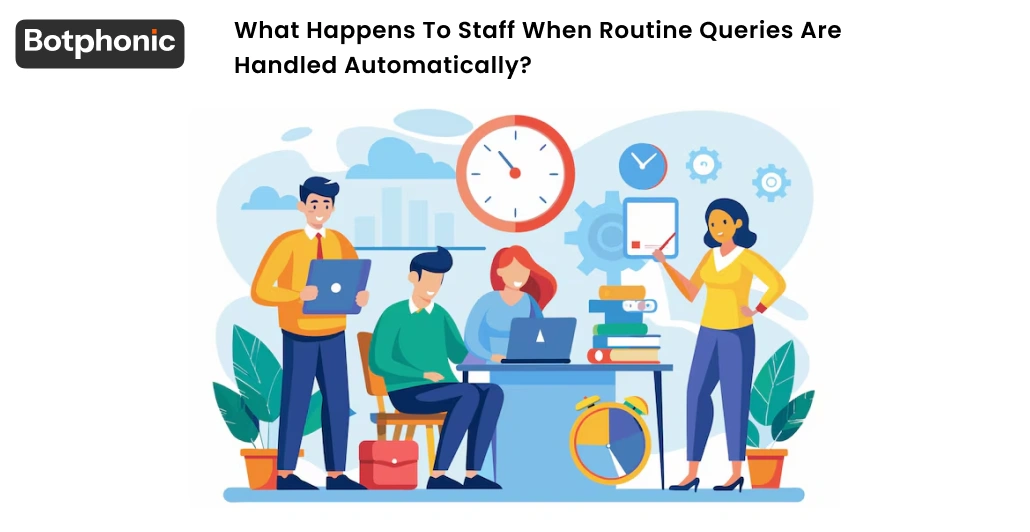
This is what is forgotten in the majority of AI-in-education discussions that either emphasize the student experience or the cost-savings. Even the staff experience is not an exception. And it is going to change in the most positive way, when an AI receptionist in education is introduced with a careful design in mind.
High rates of burnout are reported among administrative personnel working in the field of higher education. One of the significant factors in this case is thinking fatigue due to repetitive answers to the same question during eight hours. When an AI receptionist swallows that redundant veil of interruptions, employees dedicate more of their time to meaningful tasks. And informative conversations with students: the complicated advising call, the case that needs some out-of-the-box thought, the relationship-building with struggling students.
The organizations that have implemented AI reception systems report that their employees tend to be skeptical about the technology at first. It is understandable considering that they have a valid concern about their job security, but by the time they get a day where all questions they answer are indeed new and significant, they tend to become its proponents. This does not make the job less professional.
Can an AI Receptionist for Education Actually Handle Sensitive or Complex Situations?
The simple solution is: it does it better than a voice mail box or a three day email queue.
The more detailed answer is less obvious. An AI receptionist designed to work in the educational sector is not attempting to solve all the sensitive cases, it is simply attempting to make sure that sensitive cases are presented to a human being as fast as possible and as much context is preloaded as possible.
Think of a student that contacts the office claiming a financial crisis affecting his or her enrollment. The AI can automatically recognize the account of the student, verify their aid package and balance, ask some clarifying questions to screen urgency, and direct the conversation to an emergency aid counselor with a complete case history.
Two days of email back and forth would have been used what would have gone down the drain in terms of the student just dropping out would have escalated to the right person within the same day.
It is this point where the framing of AI versus human completely demolishes. The education AI receptionist is in no way competing with the human counselor. The preparation work is what is making the intervention of the human counselor more timely and effective.
 PRO TIP
What Should Institutions Actually Look for When Evaluating These Systems?
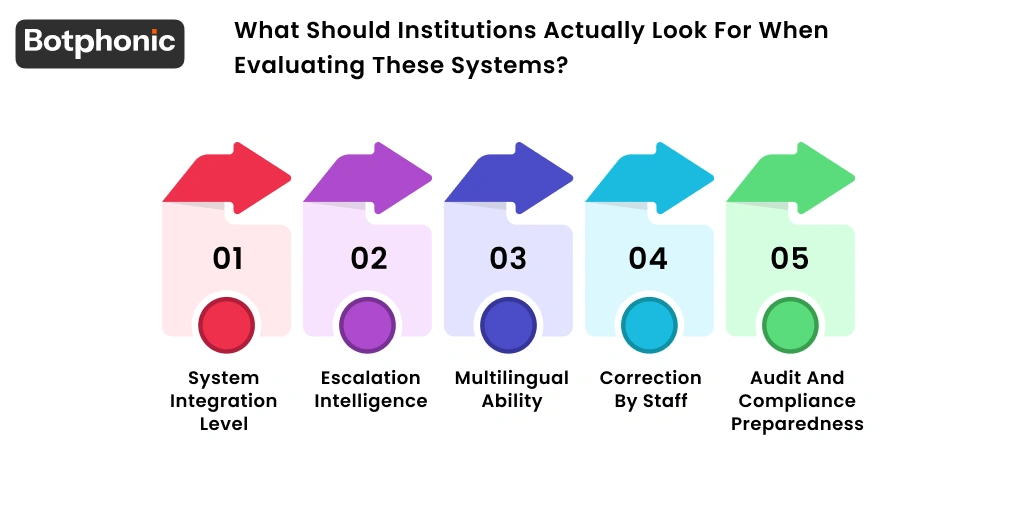
All AI receptionists in education products are not equal and the variations are important in their consequences. These are the elements that would indeed distinguish successful deployments and costly chatbot substitutes:
- System integration level: Does it support integration with your SIS, LMS and financial systems to get real-time, student-specific information? A system which is unable to access live data can only respond in a generic manner.
- Escalation intelligence: Does it have a principled structure to know when to hand off and does it hand off in full context? Systems that merely stop conversations at escalation points are a source of frustration in their own right.
- Multilingual ability: Numerous populations in campuses have a large proportion of international students and those who do not speak English. Not a full solution is having a receptionist who only speaks English.
- Correction by staff: Does the system get better when staff overrides the responses or tag the inaccurate responses? A fixed structure will also become less useful as the policies evolve; an adaptive one becomes more precise with time.
- Audit and compliance preparedness: The schools work by FERPA and other regulations. The system should be able to manage the student data with the relevant access control and logging.
| Basic Chatbot | Mature AI Receptionist for Education |
| Static FAQ database | Live system integration |
| Keyword-triggered replies | Context-aware conversation |
| Manual escalation | Intelligent routing |
| English-only | Multilingual |
| No compliance structure | FERPA-aligned logging & access control |
Is the Return on Investment Real, or Is This Another EdTech Promise?
There is a problem of credibility with EdTech, which is justified. Those platforms that promised change and brought confusion have burnt institutions. Doubt of an AI receptionist to education is good.
The advantage here, as opposed to most EdTech assertions, is that the ROI case is more concrete and not speculative. Assuming that your institution gets 3,000 student enquiries a week, and 70 percent of them can be answered without human intervention and 2,100 such inquiries times six minutes equals 210 hours per week that staff have lost out of administrative triage. The actual question in investment is what one does with those hours.
Schools that repurpose that capacity to proactive outreach – early alerts follow-up, registration nudges, financial aid renewal prompts, etc. – will always show a quantifiable effect on retention and completion rates. It is there that the ROI discussion becomes truly interesting and where the AI receptionist in education ceases to be a cost-cutting mechanism and becomes a student success infrastructure.
Explore How Botphonic AI Receptionist Works
Schedule A Demo!Conclusion
Campus response time is not a customer service measure. It is an indicator of the extent of seriousness with which an institution takes the student experience during its most transactional and stressful situations. The students create a long-term perception of how an institution takes care of them during a registration crisis at 10 pm and not during the orientation week.
The AI education receptionist does not make an institution more human or warmer. The thing that it does is to eliminate the structural bottlenecks that cause institutions to feel apathetic, the calls that are left unanswered, the three-day email lag, the voicemail of our office is currently closed, at the very time when the student is in need. Repair them with an AI call assistant, and the human operators of the system get to do the job that actually develops trust.