
Summarize Content With:
Quick Summary
The AI phone call assistant for financial advisors has already become an extremely important part of modern advisory firms; they are not only an experimental tool but also a fully developed operational asset. They directly deal with the communication bottlenecks experienced by advisors: the long calls, the lack of follow-ups, the logging done by hand, and the burden of administrative work. These assistants work wonders by communicating with clients. They transform an unorganized, inconsistent, and non-scalable communication system into a smooth, even, and large-scalable one by instantly answering calls, qualifying leads, scheduling appointments, summarizing conversations, and keeping compliance-ready documentation.
These systems are very efficient, and their use also benefits the client. They deliver company-wide effectiveness in wealth management, planning, and banking areas while improving client communication at the same time. They help the advisors by removing the busy work, accuracy improving, cost cutting, compliance enhancing, and making the firms quite much more scalable. In the middle of a competitive market with high expectations and low margins, AI call assistants are turning into the new standard for operational excellence.
Introduction
For many years, financial advisors and planners have always lived in a communication burnout environment. For instance, endless calls, jammed schedules, voicemail pileups, and administrative tasks that are just eating hours. This industry’s pain points have always been obvious, but the solution was never to be seen. But today, it’s changed.
There’s a new wave of intelligence, especially AI phone call assistants for financial advisors, that is just rewriting the whole journey. These assistants are designed to answer calls instantly, qualify leads, schedule appointments, handle administrative workflows, and maintain a consistent as well as professional tone 24/7. In industries like wealth management, financial planning, and banking, where client expectations have just skyrocketed, and margins are increasingly shrinking, AI phone call assistants are no longer just a tool but an operational pillar of modern advisory firms.
What an AI Call Assistant Really Is
Advisors and planners have usually built their reputation on attention to detail, such as effortless note-taking, organized scheduling, and consistent follow-up. These aren’t just simple tasks but these components are what makes client trust on them. This is something that’s quiet, but it keeps the client confident and relationships strong. AI phone call assistants don’t replace human touch but elevate it, digitizing these practices allows the system to capture every detail from the client conversation and automatically logs interactions into the management. Moreover, it also flags follow-ups and summarizes key points for quick review whenever required.
You can just stop worrying about misplacing a note or missing a subtle client cue; each call is actively documented and stored for easy retrieval. Providing a complete history to advisors at their fingertips. Reminders, task tracking, and automated call summaries mean there’s nothing that slips through the cracks.
Why Advisors, Planners, and Banks Are Adopting AI Call Assistants at Record Speed
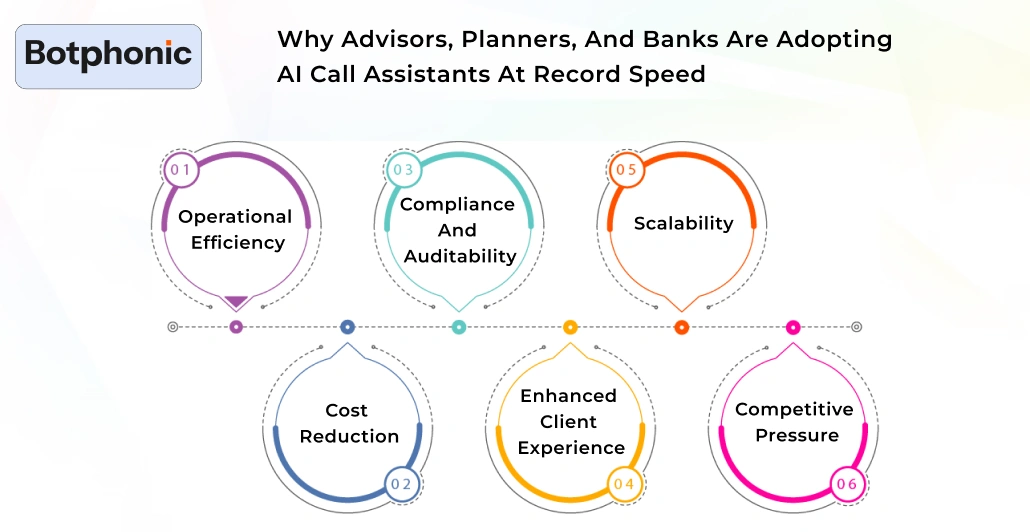
The financial industry is going through a serious transformation. Advisors, planners, and banks are effectively adopting AI phone call assistants faster than any industry. And it’s not just for one reason but several interconnected ones. On the contrary to any other software tools that just automates tasks, AI call assistants work as a intelligent partner, who are capable of understanding conversations, extracting actionable insights, and also integrating seamlessly into daily workflows.
Key Drivers of Adoption
Let’s check out some core components that drives the decision of adoption.
- Operational Efficiency: AI assistants takes over repetitive and low-value tasks such as call logging, transcription, and follow-ups. Moreover, it frees advisors to focus only on strategic decision-making and client engagement.
- Cost Reduction: Maintaining a large call center or receptionist can be expensive. Instead, AI assistants significantly reduce operational costs while scaling.
- Compliance and Auditability: Financial advisors and banks operate in heavily regulated environments. AI assistants are designed to capture every interaction and store it securely. Moreover, it ensures accurate records are added for audits and regulatory reporting.
- Enhanced Client Experience: AI assistants provide immediate responses to inquiries, schedule appointments, and also manage communications 24/7.
- Scalability: As the client base is growing, AI can easily scale without a proportional increase in staffing costs.
- Competitive Pressure: Challenger banks and fintechs are actively pushing the industry toward a digital-first, client-centered experience. AI adoption also allows traditional institutions to stay competitive.
To put it simply, the adoption of AI phone call assistants is a strategic move rather than just a trend. It allows industries to move towards operational excellence, manage risks, and, more importantly how to differentiate in a crowded market.
How AI Phone Call Assistants Integrate Into Daily Financial Workflows
An AI call assistant is not a tool that can work alone; it becomes a part of an advisor’s workflow, improving productivity at several touchpoints. Integration also allows the assistant to act like a reliable team member who is always available team member. A team member who can easily manage calls, track tasks, and provide insights that enable more effective client engagement.
Let’s check out some of its key integration points, which give it brownie points:
- CRM Integration: An AI phone call assistant for financial advisors helps by automatically logging call details, updating client records, and syncing notes across different channels. Besides, it ensures that all client information is current and accurate.
- Task and Calendar Management: Follow-ups, reminders, and meeting schedules, everything get automated. The system ensures that no important client call or deadline is missed.
- Call Summarization and Insights: Post-call, the assistant provides summaries highlighting actionable items and client concerns. It allows advisors to respond quickly and strategically.
- Client Communication Tracking: AI flags overdue communications and ensures proactive engagement while reducing the risk of neglected clients.
- Regulatory Compliance Monitoring: AI phone call assistants maintain detailed logs of calls for audit readiness and policy compliance. Moreover, it effectively reduces the chances of human error and supports risk management efforts.
Let’s look at an example workflow for enhanced understanding.
- The client calls the advisor.
- An AI phone call assistant will answer and confirm the client’s identity while capturing the conversation.
- Key points and action items are logged into CRM autonomously.
- Follow-up tasks are scheduled, followed by reminders, and any flagged concerns are highlighted for the advisors.
- The advisor then receives a concise and accurate summary before meeting the client, which enables them to be fully prepared to take action.
 NOTE
NOTE
Use Cases Across Wealth Management, Planning, and Banking
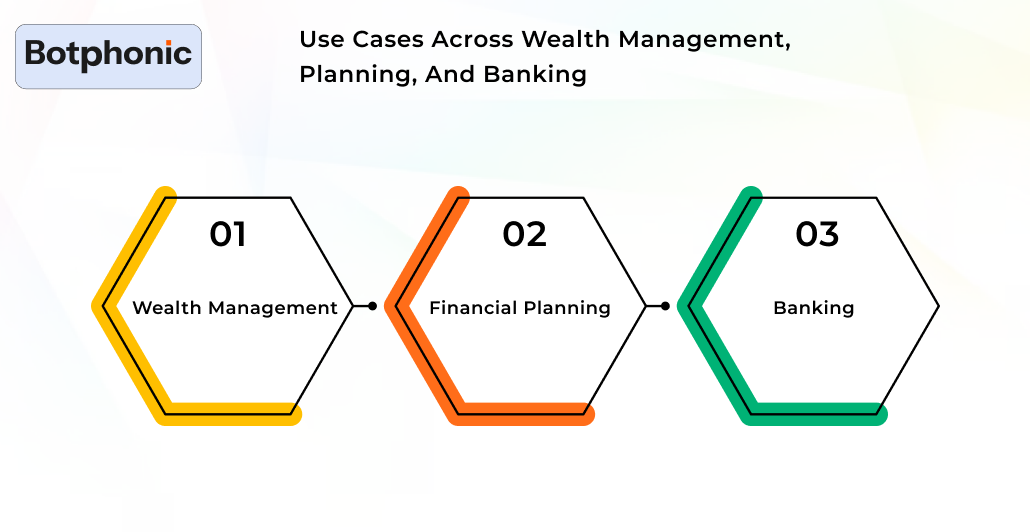
AI phone call assistants are versatile tools. They provide measurable benefits across multiple financial services sectors, for instance:
1. Wealth Management
Client Service and Relationship Support
- Proactive Appointment Outreach
AI calls clients to schedule portfolio reviews, RMD discussions, annuity check-ins, or annual planning meetings, without advisors losing their day to voicemail.
- Follow-up After Portfolio Changes
When there’s a rebalance trigger, the AI call assistant will call clients to notify them and offer to set a time with the advisor. Lastly, log the conversation back into the CRM.
Asset Management-Related Workflows
- Trade Confirmations
Automated post-trade calls ensure clients understand what happened, which makes it easier to avoid later questions regarding their finances.
- KYC Refresh Cycles
Firms running global compliance frameworks can easily offload the endless chase for updated information.
2. Financial Planning
Plan Maintenance and Accountability
- Plain Checkpoint Reminders
Clients seem to forget tasks, but the AI isn’t designed that way. Debt repayment milestones, saving updates, and estate tasks are made, confirmed, and logged into the system autonomously.
- Document Chasing
Tax returns, pay stubs, and insurance statements for these planners spend a large amount of time chasing paper. AI assistants can easily do that.
Annual and Quarterly Planning Cadence
- Meeting Scheduling and Preparation
The AI can call clients to set the next planning session and confirm pre-work details, such as budgets, updates, outside accounts, etc.
- Cash-Flow Check-ins
Instead of planners scrambling every time a client says, “My budget’s off,” the AI regularly checks in, gathers the facts, and delivers a concise summary.
3. Banking
Retail Banking Support
- Overdraft, Fraud, and Account Activity Alerts
Fast outbound voice notifications with clear instructions of next steps cut down on inbound call chaos.
- Loan Application Updates
An AI phone call assistant for financial advisors actively follows up on missing documents, clarifies status, and even nudges customers to complete applications.
Commercial Banking
- KYC, KYB, and Renewal Cycles
Commercial bankers usually spend too much time herding clients through compliance hoops. The AI can effectively manage the reminders and gather baseline info.
- Covenant Compliance Follow-Ups
Ensures clients are providing financial statements or data required under loan covenants on time, without any human nagging.
 PRO TIP
Feature Comparison: AI Call Assistant vs Human Receptionist vs Voicemail
| Capability | AI Call Assistant | Human Receptionist | Voicemail |
| Availability | 24/7 | Limited hours | Always available but non-responsive |
| Response Speed | Instant | Variable | Zero |
| Accuracy | High | Moderate | None |
| Lead Qualification | Yes | No | No |
| Documentation | Automatic | Manual | None |
| Scalability | Unlimited | Expensive and limited | Poor |
| Client Satisfaction | High | Variable | Low |
Analysis:
While a human receptionist is good at personalization and nuanced understanding, they can only offer limited resources in terms of time, cost, and scalability. Voicemail is a cheap option and is always-on, but it offers no intelligence or follow-up capability. AI assistants combine speed, efficiency, and insight.
Deep Dive Into the Benefits That Transform Advisory Firms
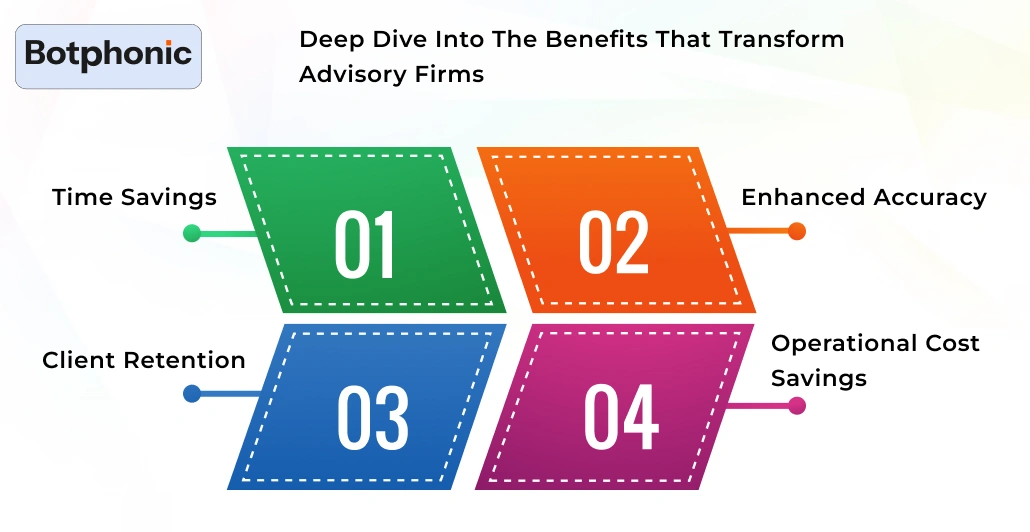
1. Time Savings
AI assistants effectively work on managing administrative work, reducing advisor workload by 30-40%. Advisors can spend their time more on analyzing portfolios, curating strategies, and most importantly, connecting with clients personally. The reclaimed time flows directly into the high-value activities that genuinely strengthen the business. Many banks have stated that about 60-80% of customer service inquires are now managed by AI phone call assistants or chatbots.
2. Enhanced Accuracy
Manual note-taking and follow-up processes are filled with many gaps. Whereas an AI phone call assistant for financial advisors eliminates those weak points by transcribing conversations and updating client files. It also generates precise follow-up tasks. Removing human error from the equation allows them to maintain clear records and ensure every client interaction is documented.
3. Client Retention
Clients like to be associated with firms that can communicate consistently and respond quickly. AI assistants can strengthen loyalty by providing proactive outreach and after-hours coverage. With immediate call responses that they are obviously expecting, you can be their favourite. Whether its about reminding clients for RMDs or confirming meeting prep, AI acts as a constant and attentive extension of the advisory team.
4. Operational Cost Savings
Traditional service models depend on large support teams or even expensive call centers to handle volume. AI cuts that overhead dramatically. Automating routine communications, firms can reduce staffing costs, trim training budgets, and even bypass the infrastructure needed to operate a full-scale phone support operation.
With 24/7 voice AI, your bank stays always on without hiring extra staff. Try Botphonic now with a risk-free trial and feel the difference.
Try a Demo Free!Conclusion
The world of financial advisory has always tried to meet two main demands: building relationships with clients and being precise in operations. Finally, AI phone call assistants make it possible to have both at once. They are able to bring the qualities of speed, accuracy, and scalability without losing the human part of advisory work. The communicative tasks that are repetitive, prone to error, and take up a lot of time are absorbed by these assistants, and in this way, the advisors can concentrate on what they do best, i.e., guiding clients, interpreting markets, shaping financial plans, and building trust.
This technology will not be just a temporary trend. It is a fundamental change that is altering how the advisory firms operate, compete and grow. The best AI phone call software for banks reveals the insights that pertain to client sentiment, needs and opportunities thus enabling the advisors to act quickly and smartly. The firms that start using AI call assistants now will not just have a smoother running operation; they will be running smarter, faster, and with a competitive edge that their rivals will not be able to match.