Summarize Content With:
Quick Summary
In this blog, we will read how AI is transforming travel and tour operations. It’s actively complementing businesses and enhancing the customer experience. Moreover, it also increases operational efficiency and empowers your team to deliver the best service possible.
Introduction
In the world of travel, time is the main essence of the industry. It could be about last minute booking, securing a spot on a guided tour, or even getting answers to urgent questions, it’s all about how fast you can answer, no matter the time. But in an industry that thrives on human interaction, managing these issues can be a little difficult.
And that’s where AI phone call assistants step in and offer help. For hospitality businesses, travel agencies, and tour operators, these AI call assistants are more than advanced tools. Just think of an assistant that answers calls 24/7, handles hotel reservations, and provides tour information, without even requiring any human intervention.
Why the Hospitality World is Waking Up to AI Phone Call Assistants
The hospitality industry always had one principle, that is exceptional service. Whether you are managing a luxury hotel or a cozy bed-and-breakfast the is usually the same, to deliver a seamless and personal experience to your guests. But, in today’s date it has become challenging, especially over the phone, it’s gotten more difficult than ever.
Let us tell you about an AI phone call assistant, it’s rapidly gaining popularity in hospitality. From answering calls at any time of the day to making bookings on the spot, AI call assistants are shaping how travel and tourism businesses function.
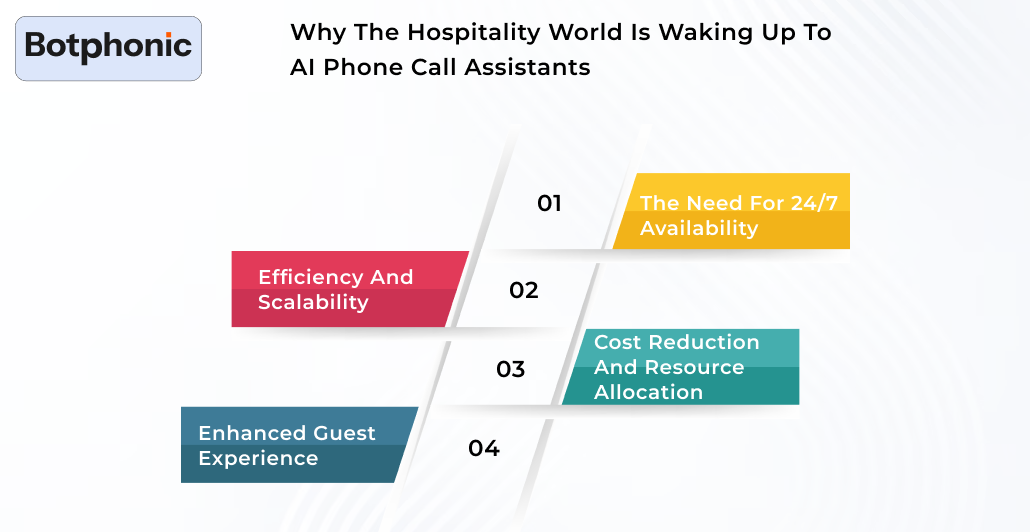
1. The Need for 24/7 Availability
Let’s be honest with each other, and accept that travelers don’t keep up with the 9-to-5 rule. Whether they are booking last-minute vacation or just reaching for assistance across time-zones, the reality is that almost all the calls happen outside business hours. A missed call or unanswered inquiry can be the difference between acquiring or missing the customer.
Let’s be honest with each other and accept that travelers don’t follow the traditional 9-to-5 rule. Whether they’re booking a last-minute vacation or reaching out for assistance across different time zones, most inquiries happen outside regular business hours. For popular experiences like a dune buggy Dubai tour, travelers often want instant answers about availability, pricing, and safety. A missed call or unanswered inquiry can be the difference between securing a booking or losing a potential customer.
AI phone call assistants offer a robust solution. They donn’t need breaks, sleep, or weekends off. Available 24/7, providing uninterrupted service, it ensures each call is answered and attended promptly. For hotels, travel agencies, and tour operators, it can boost conversions significantly.
2. Efficiency and Scalability
As business grows, handling it along with increasing the number of call volumes can be tough. During busy seasons or when promotions are in pipeline, the flood of inbound calls can vanquish human agents, leading to long wait times and frustrated customers.
But having an AI phone call software allows you to handle an unlimited number of simultaneous calls, without even breaking a sweat. They can easily triage inquiries, answer common questions, provide quotes and even process bookings.
3. Cost Reduction and Resource Allocation
Labor costs are one of the major expenses for any industry. With staffing always on thin ice, especially during high seasons. Having an AI receptionist can take care of heavy lifting for you and manage routine tasks such as booking confirmations, cancellations, and even answering FAQs.
AI assistants work around the clock, taking care of all the repetitive tasks and freeing up human teams to focus on strategic and high-value tasks. This is particularly important in travel and tourism, here personalized service and expert advice is what actually sets you apart from the competition.
4. Enhanced Guest Experience
In this advanced world where instant gratification has become a standard, guests are expecting quick responses, especially when its about booking accommodations. An AI phone assistant can easily deliver answers within seconds, even when agents are unavailable, it ensures guest experience is smooth and efficient throughout the process.
Not only does an AI call assistant simplifies the process but it also secures consistency in communication. With the AI assistant processing bookings and answering questions based on pre-programmed knowledge base, travelers can always expect to receive accurate and on-brand responses.
What AI Phone Call Assistants Can Do
In the world of hospita;ity and travel, AI phone call assistants have become indispensable tools. But what exactly do you think they help with? And more importantly, have you ever thought, if they can really deliver the experience guest want of service guests expect?
Let’s get into it and see what they can do.
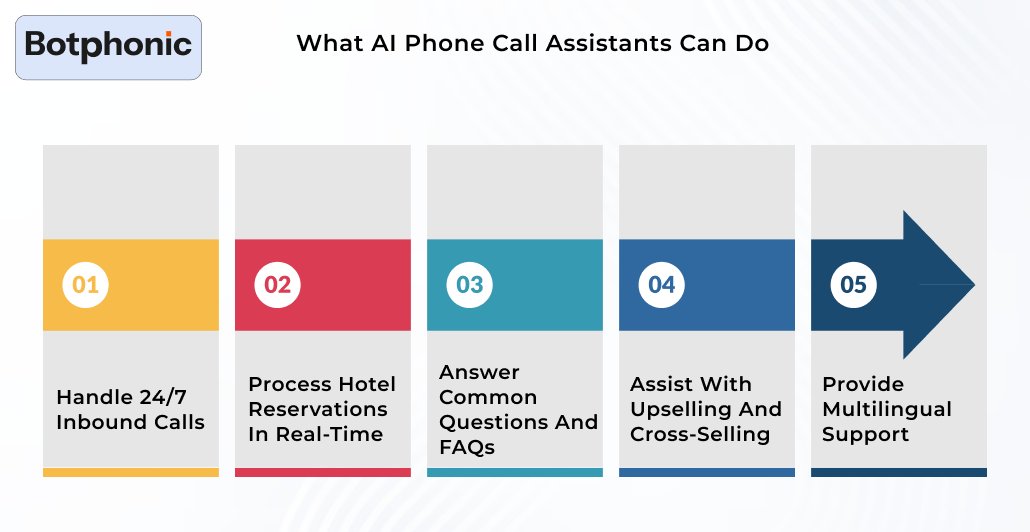
1. Handle 24/7 Inbound calls
One of the most recognizable features of AI phone calls for hotels is they offer round the clock availability. Travel agencies and hotels are usually busy during odd hours, and clients can even have questions of booking late into the evening.
What AI can do:
- Answer inbound calls at any time
- Take messages, share information, and even process bookings without any intervention
- Manage high call volumes during busy periods
2. Process Hotel Reservations in Real-Time
Booking a room should be as seamless and quick as possible. Guests even expect immediate confirmation, and waiting on hold for a human agent can lead to frustration and lost sales. Even AI phone call assistants excel in this department by automating reservation processes.
What AI can do:
- Access real-time availability information from your Property Management System (PMS)
- Add, Modify, or even cancel reservations instantly, based on live inventory.
- Confirm bookings and send follow-up notification via SMS or email automatically.
3. Answer Common Questions and FAQs
When a guest calls, they often have basic and repetitive questions about common issues, such as room availability, check-in times, amenities, or even pricing. Handling these questions manually can be pretty time-consuming for staff, but AI phone assistants can easily manage these because they are great at answering FAQs without even needing any human intervention.
What AI can do:
- Provides answer to common questions
- Offers detailed information on rates, promotions, or even policies
- Gives recommendations based on guest preferences.
4. Assist with Upselling and Cross-Selling
AI assistant can be used not only to answer questions and process bookings but they also assist in increasing revenue by offering upsell opportunities. They can even suggest upgrades, additional services, or other promotions based on client preferences or booking history.
What AI can do:
- Offers room upgrades, special packages, or add-ons
- Highlights current promotions or discounts
- Provides relevant suggestions based in previous guest behavior or preferences
5. Provide Multilingual Support
For international travelers, language barriers are one of the most frustrating factors. Especially when they are booking or making inquiries for the same. AI phone assistants can easily be programmed to support multiple languages, which makes it easier to serve a global clientele.
What AI can do:
- Communicate in several languages, which ensures clear understanding for non-native speakers.
- Translate and process inquiries in real-time, improving accessibility for international guests.
- Even maintaining a consistent tone and service quality across different languages.
AI call assistants are reshaping the way travel and hospitality businesses function. For instance, handling 24/7 reservations to upselling additional services, these intelligent systems are designed to improve both efficiency and customer satisfaction.
Pros and Cons: What You Gain, and What You Risk with AI Phone Call Assistants
As the hospitality and travel industries look for way to improve efficiency, reduce costs, and enhance customer service, AI phone call assistants have become an increasingly popular solution. But like any segment, everything have their own strengths and drawbacks. In this section, we will proceed with the pros and cons of adopting AI phone call assistants in your business.
Pros: What You Gain
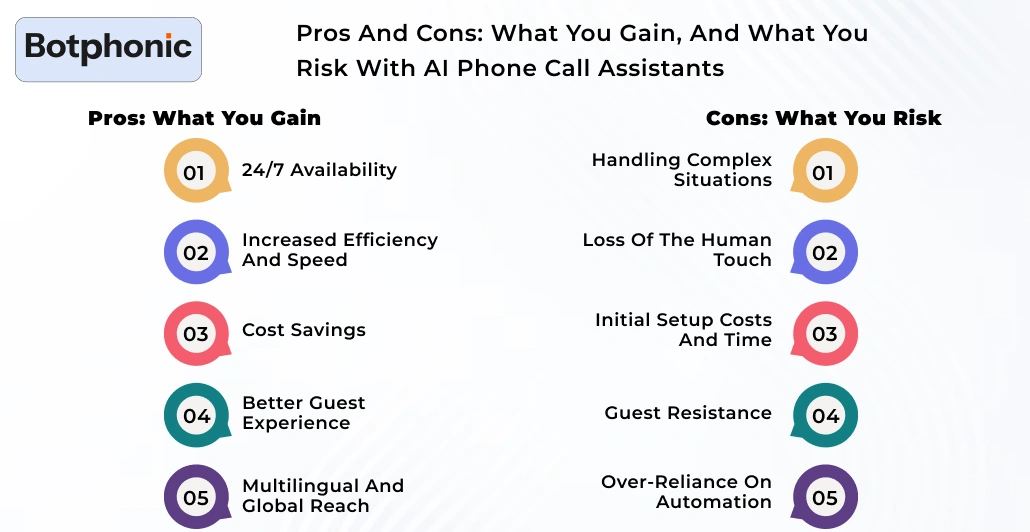
1. 24/7 Availability
Guests are not responsible to stick to your business hours, they might need assistance anytime of the day. So your AI phone assistant is always there for you and your customers, who provides aid without missing a single call.
2. Increased Efficiency and Speed
The AI phone call software for hotels & travel businesses can easily handle large volumes of calls at once without even sacrificing on quality. They are designed to automate routine enquiries, manage bookings, and even process cancellations or modifications in real-time.
3. Cost Savings
Hiring and maintaining a full customer support team, especially for seasonal spikes can really be expensive. Automating routine tasks, AI assistants help in reducing employment costs and eradicates the need for extra hires for peak times.
4. Better Guest Experience
Guests always want instant gratification and AI helps in providing that. With an AI assistant, you can always ensure that there’s no request that’s left on read or unanswered. Guests can easily reserve, alter, or cancel reservations without even waiting in line.
5. Multilingual and Global Reach
As travel and tourism is becoming global, businesses should also start catering to international clients. AI assistants can speak multiple languages, breaking down language barriers, and making it easier for guests to engage with your services.
Cons: What You Risk
1. Handling Complex Situations
While AI assistants are good for answering routine questions, they can still struggle with edge cases or complicated situations. When dealing with complex reservations, unique guests requests, or even special situation.
2. Loss of the Human Touch
Even though AI assistants can handle common repetitive tasks, they obviously can’t replicate the empathy, nuance, and personalization. Meanwhile, guests might prefer speaking to a real person for complicated or sensitive matters.
3. Initial Setup Costs and Time
Implementing an AI phone assistant is not plug-and-play solution. Undoubtedly, it requires integrations with existing systems, which trains the AI to understand your business’s nuances. And eventually lead to customizing the systems that fits your brand.
 NOTE
NOTE
4. Guest Resistance
There are guests who might actually be older or aren’t into technology, they may feel uncomfortable or just frustrated while interacting with a machine instead of a human. Moreover, guests’ resistance can actually become a barrier to adoption, especially in markets where customers expect personalized and face-to-face service.
5. Over-reliance on Automation
Even if AI is designed to solve problems, you should know it obviously can’t solve all of them. Moreover, relying heavily on automation can create gaps in your customer service. Escalation processes really need to be clearly defined and humans should always be available to step in when the system isn’t capable of handling the request.
Incorporating an AI phone call software into your travel or hospitality business offers multiple benefits. However, there are also risks tangled, including the loss of personal touch and resistance from guests.
To strike the right balance, ensure to consider implementing a hybrid model. Where AI is managing common time-consuming tasks and human agents are available for more complicated or sensitive interactions.
How to Decide If You Should Implement an AI Phone Call Assistant: A Mini Playbook
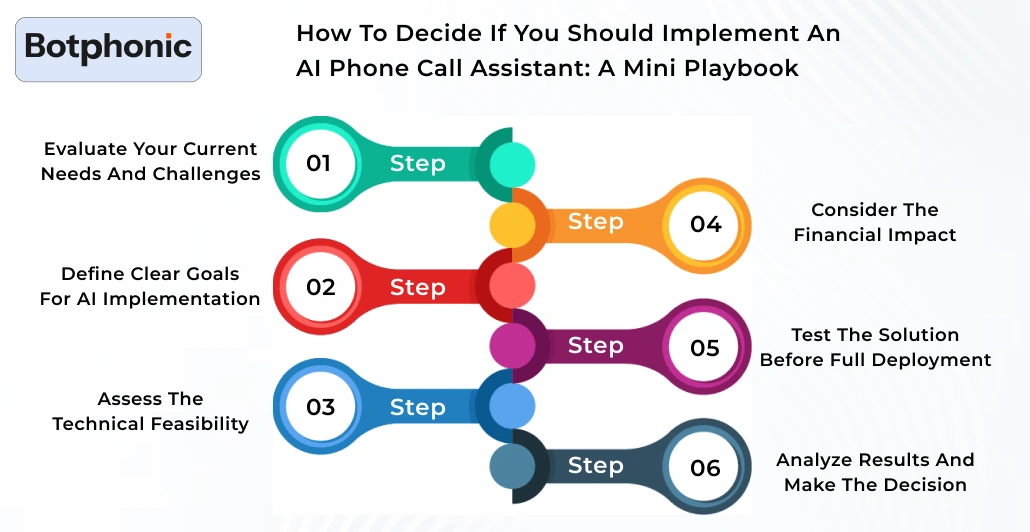
Adopting AI phone call assistants is one of the big decisions for any hospitality or travel business.
It promises a wide range of benefits but also requires an investment of time, money, and resources. So, how are you going to decide if it’s the right move for your business?
Let’s get into it:
Step 1: Evaluate Your Current Needs and Challenges
Before jumping directly into the world of technology, you need to assess where your business currently is and where it needs improvement. To do so, you are required to take a close look at current operational pain points and understand how an AI phone call assistant could address them.
Step 2: Define Clear Goals for AI Implementation
If your workflow needs to align with capabilities of AI, the next thing you are going to do is define what actually you want to achieve by implementing an AI phone assistant. Meanwhile, having clear, measurable goals will assist you in determining if the technology is worth it.
 PRO TIP
Step 3: Assess the Technical Feasibility
Even if AI sounds like a great fit, it is important to evaluate whether your current infrastructure and team is ready for integration. This also involves both technical readiness and a clear understanding of your existing systems.
Step 4: Consider the Financial Impact
AI phone call assistants require both initial investment and ongoing operational costs as well. While the long-term savings are considerable, it’s also important to know how it fits within your budget.
Step 5: Test the Solution Before Full Deployment
Before committing to full rollout, it’s better to pilot the AI phone assistant on a small scale. As we know, it will give you valuable insights into how the technology works in your environment and whether it’s meeting your standards.
Step 6: Analyze Results and Make the Decision
Once the pilot program is done, you should start with reviewing results. Compare the outcomes to your predefined objectives. If it shows positive results and aligns with your goals, then scaling up the implementations makes sense.
Mini Playbook
In this mini “playbook,” we will walk you through a structured approach for the same.
1: Assess Current Needs
- Identify your pain points, for instance call volume, missed bookings, and long wait times.
- Consider staff availability and capacity for peak seasons.
2: Set Clear Objectives
- Define measurable KPIs
- Ensure to align AI implementation with business goals.
3: Evaluate Feasibility
- Check technical compatibility with your existing systems.
- Ensure data is structured for AI integration.
- Assess your team’s willingness to accept AI tools.
4: Estimate Financial Impact
- Calculate your initial investments vs. expected savings.
- Include long-term costs like maintenance and training.
- Understand potential ROI in terms of time saved and guest satisfaction.
5: Run a Pilot Program
- Implement AI on a small scale first
- Monitor performance and customer feedback.
- Adjust the system based on pilot results before its full deployment.
Modernize Your Operations Today With Botphonic
Try Botphonic Demo Now!Conclusion
In the evolving world of travel and hospitality, staying ahead of the competition refers to embracing new technologies that can streamline operations, enhance customer experiences, and reduce costs. AI phone calls assistants are actively proving to be a game changer. It effectively offers solutions that ranges from 24/7 booking capabilities to personalized guest service. Even 76% of hotels executives have said AI is “fundamentally changing” the industry.
From understanding what AI phone assistants can do to evaluate pros and cons, and even implements these systems in your business, the potential benefits are significant. However, as we know it’s essential to address AI adoption with careful planning. Also, it ensures that the technology is aligning with your specific operational needs and business goals.