Summarize Content With:
Summary
We review the potential of an AI phone call assistant as an admissions tool to change student enrollment completely, features that make Botphonic a great fit, and a comparative analysis with other similar solutions. In addition, we discuss the practical use cases, implementation, and measurable benefits of the educational institutions.
Key Takeaways
- An AI phone call admissions assistant can achieve inhuman response times, reduce staff workload, and, at the same time, maintain an experience indistinguishable from a human interaction.
- Botphonic is equipped with such powerful features as multilingual support, sentiment analysis, call summarization, and scalable integration.
- On the one hand, Botphonic stands out for the quality of its calls, its flexibility, and its data security compared to competitors. On the other hand, implementing this solution can lead to increased enrollment conversion, higher student satisfaction, and lower operational costs.
Introduction
During admissions office peak season, just imagine phone lines ringing nonstop as students call with questions about programs, deadlines, campus tours, or scholarship criteria. Your staff attempts to respond, but many calls remain unanswered. As a result, some students decide to abandon the process and take their business elsewhere.
What if you could just add a helper who never slept, answered every call, understood students’ problems, and even helped schedule the next meetings? That is the promise of an AI phone call assistant for admissions. In this blog post, you will learn how Botphonic helps alleviate this pain, why it is a game-changer for student enrollment, and how to implement it efficiently.
Why Educational Institutions Need an AI Phone Call Assistant for Admissions
The Scale and Pressure of Admissions
Universities’ and colleges’ admissions departments are severe victims of communication overload. During application cycles, hundreds, or even thousands, of people call them for information. These callers are asking questions about courses, fees, financial aid, campus life, deadlines, and more. Staff members usually manually sort the calls. Therefore, there are long wait times, dropped calls, and disappointed callers who have no idea what is happening.
The problem has tangible results. Students might give up on their application process (a phenomenon called “summer melt” most of the time) if they do not obtain prompt answers. Georgia State University introduced an AI chatbot in a case study that led to a 21% reduction in summer melt.
Implementing an AI call assistant such as Botphonic helps handle call volume, answer FAQs, and route complex queries to humans, freeing staff for higher-value tasks. Your admissions team will then be able to utilise the time saved for other high-value tasks.
What is Botphonic: How it is Perfect for You
Botphonic is an AI-powered call assistant that helps companies automate both inbound and outbound phone calls.
The system uses natural language processing (NLP) to determine the caller’s purpose, sentiment, and situation, and even responds with a voice very similar to a human’s. In addition, Botphonic may schedule appointments, gather feedback, generate summaries of interactions, and integrate with CRMs or calendars.
Main Components of Botphonic:
Human-AI Conversation: One is hard-pressed to tell that Botphonic’s AI is not a real human as it interacts. It does not follow a typical robotic monotonous pattern.
- Sentiment Analysis: The machine identifies emotions in a conversation and adjusts its replies accordingly.
- Scheduling & Booking Automation: It could facilitate campus tour bookings, school counselor sessions, and subsequent meetings.
- Call Summaries & Analytics: After every conversation, Botphonic reviews the key points and records them.
- Multilingual Support: Botphonic understands several languages and answers in the language of the interlocutor.
- Templates: You can use pre-made templates to create conversation flows and edit them if necessary.
- Data Security: In addition to GDPR compliance, the system provides end-to-end encryption and several other features.
- Scalability: The helper can handle about 1000 calls per day.
How Botphonic’s AI Phone Call Assistant Boosts Student Enrollment
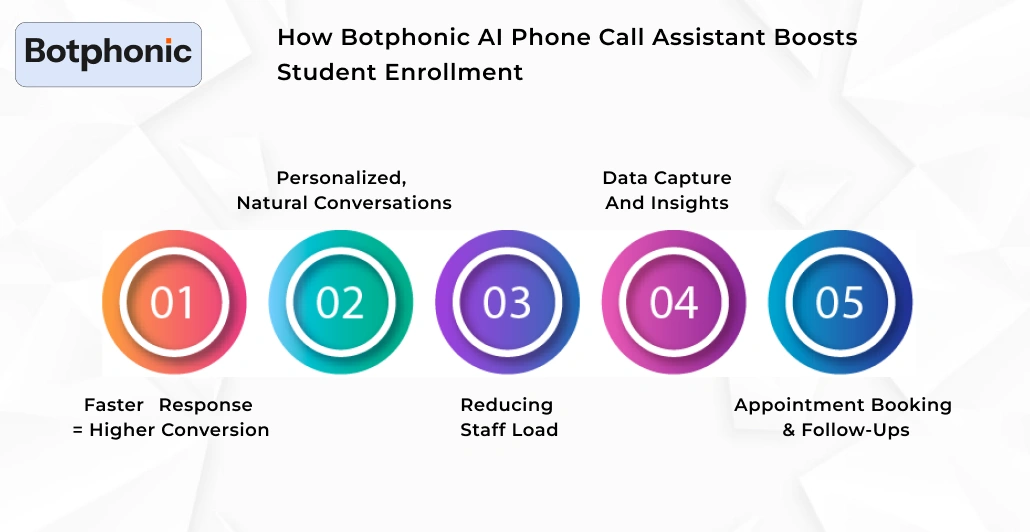
1. Faster Response = Higher Conversion
Speed to lead is very important in admissions. After filling out an inquiry form or visiting an open day, many prospective students make a call. If your team doesn’t respond quickly, these leads may go cold. Botphonic responds to calls immediately 24/7; hence, the waiting time is minimized, and the number of people willing to talk increases.
This AI phone call assistant for admissions ensures students receive immediate, accurate, and comprehensive information. Even beyond office hours, Botphonic is there, taking calls and planning follow-up tasks.
2. Personalized, Natural Conversations
Botphonic is not merely a medium for pre-written answers. It incorporates NLP and sentiment analysis, enabling it to detect the student’s emotional state and respond accordingly. When the student sounds happy, so does the assistant. If the student seems puzzled, the assistant tries to clarify or, if preferred, direct the student to a counsellor.
By creating more human interaction through personalization, trust is built, which ultimately helps students continue their journey.
3. Reducing Staff Load
Botphonic relieves admission officers by handling routine, repetitive calls that take up a considerable part of the staff’s working day. The staff can then dedicate their time to such tasks as require human judgment–processing applications, counseling prospective students, and planning.
Staff morale is positively affected by this, as they then function more strategically, rather than merely responding to queries reactively.
4. Data Capture and Insights
Botphonic handles everything without human intervention: it captures call records, summaries, and even sentiment data. Admissions teams can easily pinpoint the trends: Which programs generate the most queries? What concerns are students raising most frequently? Such insight is useful in perfecting marketing, outreach, and admission strategies.
5. Appointment Booking & Follow-Ups
The AI phone call assistant for campus tours can also manage other routine tasks, such as scheduling meetings with counselors and sending reminders. It is a great tool for both reducing the burden of manual scheduling and reducing no-shows.
If follow-up activities are not done automatically, they should be carried out only after the conclusion of a call, as per the assistant’s instructions: For example, providing a link to the application form and offering to take further questions.
Don’t let potential students slip away. Make sure every student inquiry is converted.
Just Botphonic’s AI Phone Call Assistant for Admissions along with your first-hand experience and see how the enrollment grows and the response gets faster!
Try it Now!Real-World Use Cases: Botphonic in Higher Education
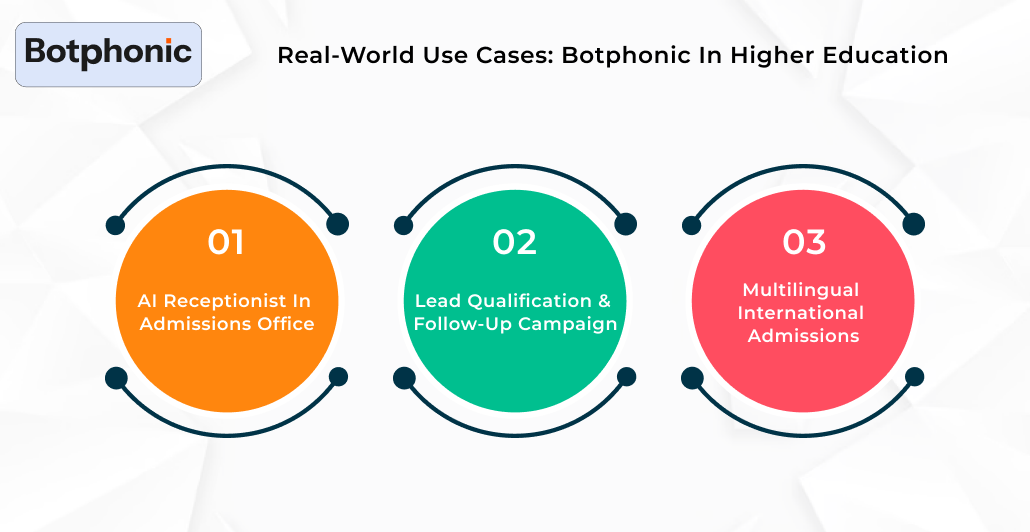
1. AI Receptionist in Admissions Office
It is clear from Botphonic’s website that an AI receptionist dedicated to higher education admissions greatly helps institutions when they are overwhelmed by peak call volume.
The assistant that can do so much on its own, most likely, is the one that first handles a large number of questions related to admissions.
The questions are rearranged after the assistant answers them, and the hard or complex ones are given to real employees to handle.
As a result:
- Missed calls decrease significantly during the busiest application periods.
- Students receive precise, consistent information about deadlines, courses, and events.
- Admission officers no longer have to be burdened by the repetition of standard questions, and they will thereby be freer to counsel students.
2. Lead Qualification & Follow-Up Campaign
Let us imagine a college that uses a digital campaign to collect inquiry forms. Many potential students would be calling after submitting a form. Botphonic might be the one to call them back, ask a few qualification questions, and measure their interest. Given the answers, it either arranges an appointment with a counselor or sends follow-up details.
This is an introduction to a web of transactions that ensures that no lead slips away. Moreover, it reduces the “speed-to-lead” period, which plays an essential role in turning inquiries into applications.
3. Multilingual International Admissions
The multilingual support offered by Botphonic is a valuable asset for institutions that are the first to attract foreign students. A student who speaks another language and is less proficient in English can speak in his mother tongue, understand a difficult topic, and also make an appointment for counseling. Thus, the loss of international students due to complex topics is reduced, and international enrollment is increased.
 NOTE
NOTE
Conclusion
To effectively handle large volumes of admission calls, provide uniform and accurate information, and truly involve prospective students are the must-do tasks for any educational institution.
With a solution like Botphonic, an AI phone call assistant for admissions, a critical communication function can be automated, scaled, and personalized. Besides, the assistant also eases pain points, reduces manual work, and opens up opportunities for data analysis, all without losing the human touch in the conversation.
Botphonic, an AI phone call assistant for admissions, maintains a human-like experience while automating conversation, enhancing response, and boosting enrollment growth.
Therefore, if one of your main concerns is to convert more inquiries into enrollments, and you also want to improve the student experience and increase the efficiency of your admissions team, then the integration of Botphonic is the right decision.
Try it, benchmark it with your existing real-world scenarios, and the result will probably be a radical change in not only the way your admissions staff works but also in how the students feel that their first interaction with your institution is valuable and supportive.