Summarize Content With:
Quick Summary
The comparison between an AI contact vs call center is not theoretical anymore but is a practical business decision driven discussion. The factors that impact this are cost pressure, customer expectations, and even operational scale.
A traditional call center effectively depends primarily on human agents and voice calls to manage client interactions. An AI contact center, might also be sometimes referred as an AI call centre, that uses automation, artificial intelligence, and even modern contact center technology.
Introduction
Customer service in earlier periods used to be simple. Clients called and agents answered them, which easily solved problems. But even that model worked only when call volumes were manageable and customer expectations were low. There was freedom to communicate via chat, messaging apps, email, or even voice, all in the same journey.
But this shift has now gradually forced businesses to rethink the role of the traditional call center and evaluate whether an AI call centre offers a more sustainable way forward. Knowing the difference is very critical before investing in new systems, expanding support teams, or even modernizing customer experience strategies.
What Is a Traditional Call Center?
A traditional call center is considered as a centralized operation where trained human agents effectively manage customer interactions. Initially, it was done through phone calls, by using standard call center software.
In this approach, customers usually have to wait in queues, speak to agents who follow pre-defined scripts, and rely heavily on individual agent’s knowledge and experience. And performance is usually measured through metrics like average handle time, first-call resolution, and call volume.
This workflow also has its clear strengths. Human agents can easily show empathy, adapt their tone, and even handle nuanced or emotional situations. For industries who have strict compliance requirements or other highly sensitive interactions, this human-led model still plays a major role.
However, traditional call centers have their own limitations. They are expensive to function with, difficult to scale instantly, and really vulnerable to staff turnover. Service quality can vary vastly, depending on agent skill and workload shared.
 PRO TIP
What Is an AI Contact Center?
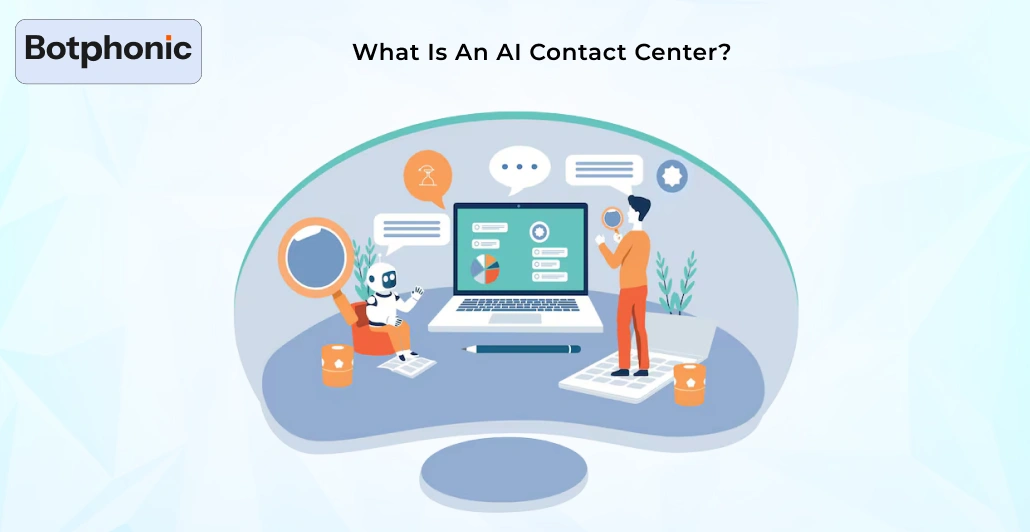
To answer your what is an AI call center? Let us tell you, an AI call center can be considered an evolution of the call center model. Effectively utilizing artificial intelligence to automate routine interactions, help human agents, and manage conversations across multiple channels such as messaging platforms, voice, and email.
At the core of an AI contact center, it’s a conversational AI that allows the system to understand customer’s intent, respond as naturally as possible and resolve common issues without any human involvement. And when required, interactions are smartly routed to human agents with full context, reducing repetition and client frustration.
Unlike traditional setups, AI contact centers are always present. They study from every interaction and get better over time. While providing real-time insights into client’s behaviour and operational performance. The goal is to never eliminate human agents but to ensure they are working on high-value tasks rather than repetitive tasks.
AI Contact Center vs Call Center: Smart Side-by-Side Comparison
| Query (What you might actually look for) | Traditional Call Center | AI Contact Center / AI Call Centre |
| What is the difference between an AI contact center vs call center? | Human agents handle most customer calls manually | AI automates routine interactions with human backup |
| Is an AI contact center better than a call center? | Works well for low volumes | Better for scale, speed, and consistency |
| Does AI replace human agents? | Humans do everything | No—AI handles repetitive tasks; agents handle complex issues |
| What channels are supported? | Mostly voice calls | Omnichannel support (voice, chat, email, messaging) |
| How does AI customer support improve experience? | Longer wait times | Faster responses with conversational AI |
| Which option is more cost-effective? | Higher cost per interaction | Lower cost through automated contact center workflows |
| Can it work as a virtual call center? | Limited | Designed for virtual call center operations |
| How does scalability work? | Hire more agents | Scale instantly with AI |
| Is this future-ready contact center technology? | Stable but dated | Built for AI in customer service |
 NOTE
NOTE
Factors That Actually Determine What’s Best
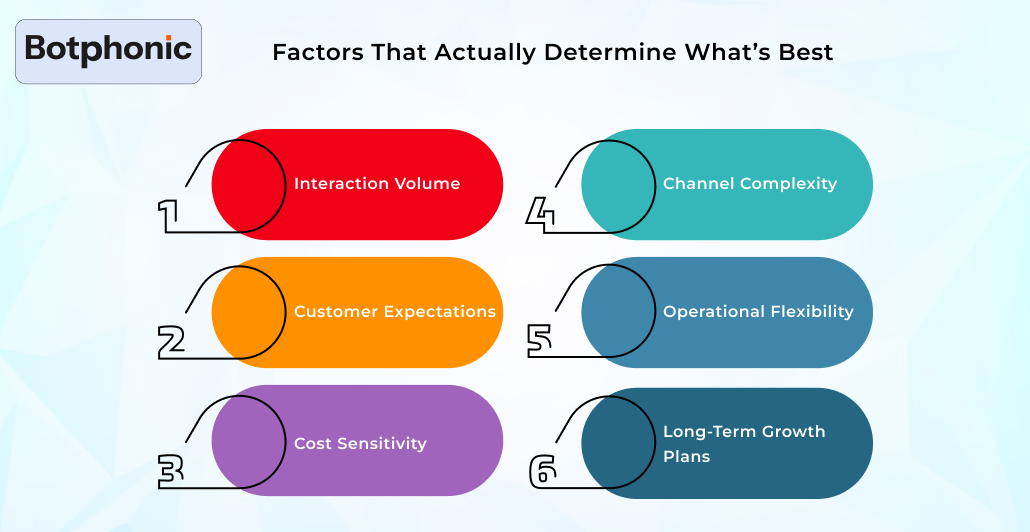
Choosing between a traditional and AI-driven model depends on operational realities that organizations have to face. Let’s check out the real determining factors:
- Interaction Volume: If your support team is handling a high number of repetitive queries, an AI contact center delivers immediate value through automation. Whereas, a traditional call center works better when there are low volumes and can be easily managed without long wait times.
- Customer Expectations: Today’s customers are expecting fast and always-on support across different channels. If speed and availability actually matters, AI customer service without a doubt outperforms human-only approach. When conversations are emotional or sensitive, human agents matter.
- Cost Sensitivity: Traditional call centers scale by adding headcount, whereas AI contact centers scale via automated contact center workflows. If you have cost control as priority, AI wins undoubtedly.
- Channel Complexity: Voice-only environments can easily survive with call centers, and omnichannel experiences demand modern contact center technology and conversational AI.
- Operational Flexibility: If you need a virtual call center, with remote agents and seasonal scaling, AI is the one who will help you without causing any chaos. Moreover, it also provides global coverage, making companies with diverse client bases serve them without any issue.
- Long-Term Growth Plans: A call center is meant to support stability but an AI contact center supports stability along with growth. Opt only based on where your business is heading.
The best option isn’t just about the hype or habit but volume, cost, speed, and scale. If your customer strategy won’t be able to grow without hiring faster than revenue, the approach you have chosen is the problem.
Learn more: 5 Real Examples of AI Call Centers in Action
Use Cases: When to Choose What
Choosing between an AI contact center and a traditional call center is not just about technology preferences but how your customers behave. Also how your business scales and how much operational friction you can tolerate. Both models have a place to be used where they serve very different purposes when applied correctly. Let’s start with AI call center real-world use cases:
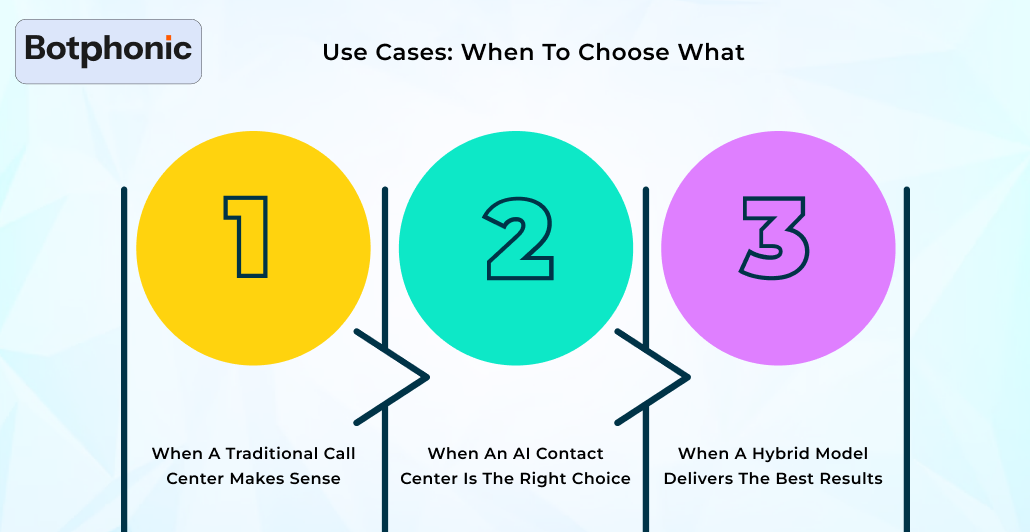
1. When a Traditional Call Center Makes Sense
A traditional call center is best suited for situations where conversations are complex and emotionally charged. In these types of environments, human judgement, tone, and discretion matters more than speed or automation.
Businesses who have lower interaction volumes often find that a call center supported by smart and reliable call center software is enough for them. When every customer interaction is unique and requires careful handling, automation just adds value to it but might also introduce risks along with it.
Typical use cases include:
- Sensitive customer complaints or dispute resolution
- High-touch B2B relationships
- Voice-only models
- Healthcare, finance or legal services with compliance requirements
In these types of cases, humans are not a cost burden but a real product.
2. When an AI Contact Center Is the Right Choice
An AI contact center excels when it’s about speed, scale, and consistency. If your customers are just confused about the same product or service, or even if they are expecting an immediate response outside of business hours, AI automation is the best option out there. It becomes a strategic asset rather than just a nice-to-have tool.
Using AI customer support that is powered by conversational AI, businesses can easily resolve common issues. This approach significantly reduces wait times and also improves overall customer satisfaction.
Ideal use cases include:
- Large volume of similar inquiries
- 24/7 support requirements
- Steadily growing businesses
- Omnichannel customer journeys
Here, the value of an automated contact center lies in its efficiency and predictability. As reported about 70% of contact centers have already implemented AI solutions to handle customer queries.
3. When a Hybrid Model Delivers the Best Results
For most organizations who are comparing AI contact center vs call center, the most effective solution is a hybrid model. This approach actively blends the efficiency of automation with the depth of human proficiency.
AI starts as the first point of contact, handling routine requests and gathering context. When escalation is required, conversations are directly transferred to human agents effortlessly, without even forcing customers to repeat themselves.
This model works best for:
- Enterprises who have diverse customer needs
- Companies transitioning to a virtual call center
- Organizations who are working towards modernizing
- Businesses functioning across diverse regions and time zones
This result is usually lower operational cost, faster resolution, and better use of human talent.
Check Whether An Ai Contact Center Is Able To Reduce Costs, Improve Response Times, And Scale Without Increasing Headcount.
Try Botphonic Demo Now!!Conclusion
The discussion revolving around AI contact center vs call center is not about choosing tradition over technology, but what makes your business scale. If the model is really able to face the problems businesses are facing or might face in the future.
A traditional call center has value where empathy, judgement, and compliance are critical components. It offers stability and familiarity. Especially in environments where they have to face lower volumes or sensitive interactions. But it was never designed to scale at the speed that modern customers are expecting.
On the other hand, an AI contact center or an AI call assistant brings efficiency, availability, and consistency into customer support. By using automation, modern contact center technology, and conversational AI, it allows businesses to handle growing volumes without even increasing costs or headcount. But still, for most organizations, it’s not about choosing one but a balanced hybrid model.