Summarize Content With:
Quick Summary
AI call centers are changing the way inbound supports are helping. They are automating high-volume, repetitive calls, while supporting human agents for complex issues. Using speech recognitions, natural language processing, and intelligent routing, AI systems provide faster resolutions and 24/7 availability.
Businesses adopting AI call centers have even reported significant cost savings, improving first-call resolution, fewer repeat calls, and an enhanced agent productivity. Contrary to those traditional call centers that scale people, AI scales outcomes, reduces labor costs while maintaining the quality.
Introduction
Inbound support has always been disguised as a customer experience function by cost center. Phone rings, queues form, agents scramble, and even leadership wishes that customers just don’t focus on these cracks. But it’s no longer going to be possible. Customers are expecting immediate and accurate response, while businesses can’t just afford this inefficiency as tradition.
The AI call centre for inbound calls now exists, and they facilitate while encouraging the whole customer experience. In this guide, we will break down how it actually works, where it delivers, and most importantly how to deploy it without learning the expensive lessons.
Why Are Businesses Replacing Traditional Inbound Call Centers with AI?
Traditional inbound call centers have failed because of one simple reason, they just scale people not outcomes. Every increase in call volume demands more agents, more training, more supervision, and even more budget, yet they are not actually able to improve the results equally.
Whereas AI call centers replace this fragile model with elastic intelligence. They absorb spikes in inbound calls, standardize responses, and even reduce dependency on overstaffing. More importantly, they are removing human staff from repetitive work to focus on actually revenue-driving tasks.
Primary business drivers behind the shift:
- Increasing inbound call volumes without impacting the revenue growth
- Escalating labor costs and agent attrition
- Inconsistent customer experience across agents and shifts
- Pressure to provide 24/7 inbound support without even offering 24/7 payroll
If your inbound strategy still depends on hiring faster than demand grows, the data will eventually break.
What Is an AI Call Center for Inbound Calls?
An AI call center for inbound calls is a system that uses artificial intelligence to manage incoming phone interactions, that ranges from fully automated call resolution to intelligent routing and agent assistance. Unlike those traditional IVR systems, AI call centers understand natural speech and context. Callers share their issue in their own words, and the system then determines the intent, urgency, and the best path to resolution.
How an AI Inbound Call Center Actually Works
When an inbound call hits the system, several technologies work simultaneously:
- Automatic Speech Recognition (ASR): Converts voice to text
- Natural Language Processing (NLP): Understands meaning and intent
- Conversational AI: Manages multi-turn dialogue
- Intent Detection Models: Classifies the reason for the call
- Decision Engines: Determine routing or resolution paths
All of this happens only in milliseconds, speed matters but the accuracy and precision matters more than it seems. A fast but wrong answer still creates a repeat call, and repeat calls are the boundaries where the margins die.
Core Components of an AI Call Center for Inbound Calls
An enterprise-grade AI inbound call center usually includes:
- AI Voice Agents: Handles common inbound requests end-to-end, like billing, scheduling, order status, etc.
- Intelligent Call Routing: Routes call based on intent, customer history, and sentiments.
- Real-Time Agent Assist: Offers live transcription, knowledge prompts, and compliance guidance during human-handles calls.
- Call Analytics & Insights: Identifies why customers are calling, recurring issues, and other operational blind spots.
How Do AI Call Centers Answer and Understand Inbound Calls in Real Time?
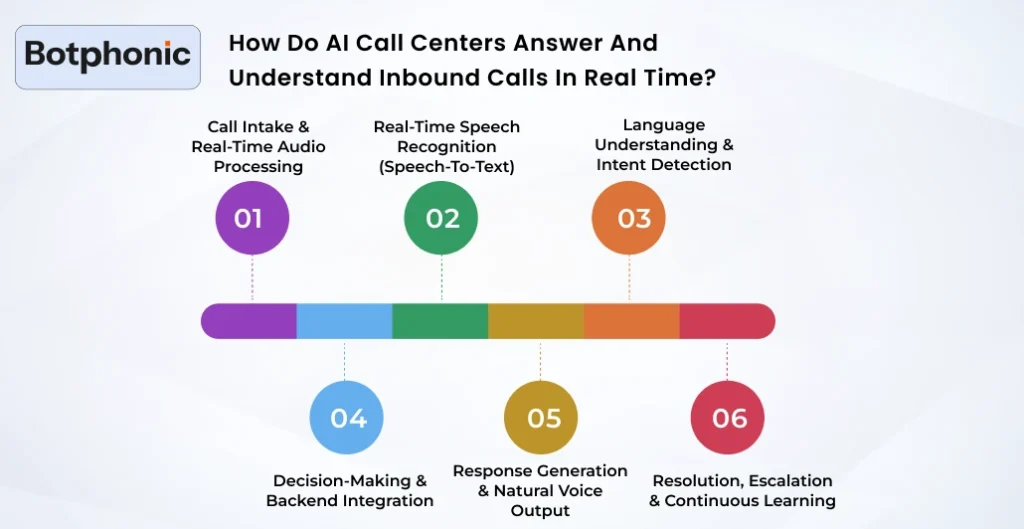
1. Call Intake & Real-Time Audio Processing
When an inbound call is made by a client, the AI call assistant receives and processes it via cloud telephony systems, such as VoIP or PSTN. The caller’s voice is then captured as a live audio stream and cleaned using noise suppression and echo cancellation, then splits them into small time slices so the system can easily process it without waiting for the caller to finish speaking.
2. Real-Time Speech Recognition (Speech-to-Text)
The processed audio is then converted into text using streaming speech recognition models. Moreover, these models help generate partial transcripts while the caller is still talking, and enables near instant understanding. They handle accents, pauses, fillers, and also background noise, ensuring only accurate transcription even in real-world call environments.
3. Language Understanding & Intent Detection
The transcribed text is analyzed using Natural Language Understanding, then AI proceeds to identify the caller’s intent such as billing, password reset, or just technical support. It extracts all the important details like account numbers or dates, and even evaluates those sentiments to detect frustration or urgency. Conversation context is maintained throughout the call.
4. Decision-Making & Backend Integration
A dialogue management engine works by determining the next best action, it proceeds by selecting the correct support workflow, checks business rules and also compliance requirements, while it also retrieves information from integrated systems such as CRMs, ticketing platforms, and also knowledge bases. Integration helps the system to work efficiently, and If authentication or verification is required, it guides the caller via those steps.
5. Response Generation & Natural Voice Output
Based on retrieved data, the AI works by generating a clear and empathetic response using natural language generation. The response is then converted into human-like speech using neural text-to-speech technology, with appropriate tone, pacing, and even pauses. The system also supports barge-in, which enables callers to interrupt naturally.
6. Resolution, Escalation & Continuous Learning
The AI tries to solve the query entirely on its own, but if the request seems complex or the caller asks for a human, the call is escalated seamlessly to the agent along with context, transcripts, and recommendations.
 PRO TIP
How Much Money Can an AI Call Center Save on Inbound Support?
AI call centers are not just a tool for customer experience upgrade, but they are helping in a major cost-reduction engine for inbound support teams. By automating routine calls and augmenting human agents, organizations can easily lower operational expenses significantly while improving the service quality.
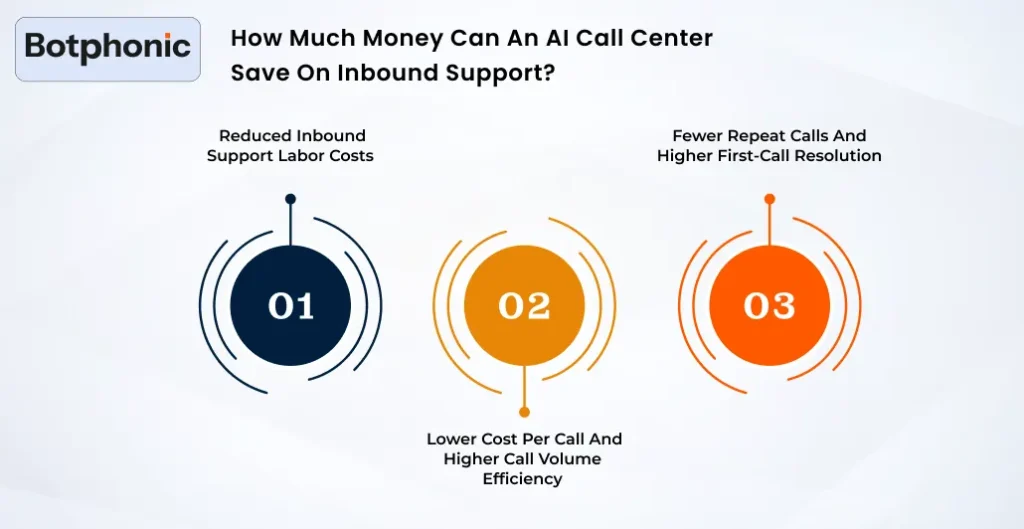
1. Reduced Inbound Support Labor Costs
One of the largest expenses in traditional call centers is human labor, and AI call centers help you manage a high percentage of repetitive inbound queries. For instance, password resets, order tracking, appointment scheduling, and also billing questions.
On average companies can easily automate 50-70% of inbound support calls, it reduces the dependency on large agent teams. While a human-handled inbound call usually costs $4-$7 per interaction. Whereas AI handled calls often costs about less than $1 per interaction, resulting in substantial labor savings at scale.
2. Lower Cost per Call and Higher Call Volume Efficiency
AI call center automation assists dramatically in reducing the cost per resolved call. Unlike human agents, AI systems can easily handle thousands of inbound calls simultaneously without adding overtime, shift constraints, or burnout.
Organizations commonly see a 60-70% reduction in cost per call after deploying AI voice agents. For high-volume inbound support teams, this can easily translate into hundreds of thousands of dollars in annual savings, even for mid-sized operations.
3. Fewer Repeat Calls and Higher First-Call Resolution
AI systems consistently follow best-practice workflows and pull real-time data from CRMs and knowledge bases. This improves first-call resolution rates, effectively reducing repeat inbound calls that inflate support costs.
Even a 10-15% reduction in repeat calls can generate meaningful savings, and fewer inbound interactions are required to resolve the same customer issues.
 NOTE
NOTE
AI Call Centers vs. Traditional Inbound Call Centers: What’s The Real Difference?
As customer expectations change and support costs keep rising, businesses are beginning to rethink how inbound calls are handled. Traditional call centers depend heavily on human agents, while AI call center software use intelligent automation to resolve customer queries faster and at a lower cost. The variation goes beyond technology.
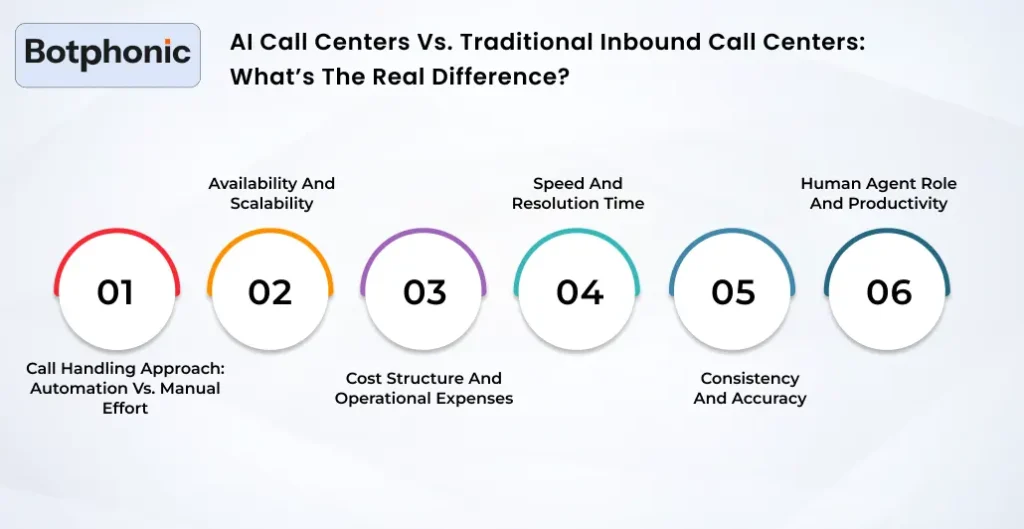
1. Call Handling Approach: Automation vs. Manual Effort
Human agents entirely answer, comprehend, and solve calls in traditional inbound call centers. This leads to longer wait times, inconsistent answers, and even poor availability on peak hours.
On the other hand, this call center relies on AI voice agents to automatically handle the bulk of inbound calls. These systems understand natural speech, identify intent and resolve common issues without any human intervention instantly and consistently.
2. Availability and Scalability
During times of high volumes of calls, all customers will clear a Talk-sure, but rancor would have drowned the instructions spoken by call agents.
Since traditional call centers ramp up usually by hiring more agents, this naturally means higher costs with time being consumed for training and onboarding as well. Hence, during times of high volumes of calls, customers might have to endure long queue times or even dropped calls.
AI call centers yet without losing productivity, want to replicate thousands of simultaneous inbound calls while being online 24/7 and undeterred by the influx of calls in which are recorded, all these at the maintainable cost.
3. Cost Structure and Operational Expenses
Due to salaries, benefits, training, attrition, and infrastructure, inbound support costs are all traditionally higher than the calls received. Any given additional incoming call simply increases operational expense.
AI call centers tend to push down costs per call via the automation of routine interactions. Post-AI implementation, most enterprises report 30-70% reductions in inbound support costs and cost per interaction.
4. Speed and Resolution Time
Human representatives usually require time to search for information, verify customer details, or escalate issues. It even increases average handle time (AHT) and reduces first-call resolution rates.
AI call centers usually retrieve data from CRMs, knowledge bases, and also backend systems. They even follow optimized workflows, leading to faster resolutions and fewer repeat calls.
5. Consistency and Accuracy
Variation in quality of responses and/or service will depend on agent skill level, training, and even fatigue in traditional inbound call centers. This leads to varied customer experience and a risk for compliance.
Conversational AI in call centers provide standardized, compliant, and repeatable responses whatsoever. It confines itself to obey pre-determined rules, policies, and brand guidelines across all inbound calls with utmost consistency.
6. Human Agent Role and Productivity
Historically, traditional telephony would require agents to handle almost every aspect of a customer call, even those that are often repetitive, low-value tasks. This less obviously leads to burnout and turnover.
AI call centers allow human agents to proceed with complex, emotionally charged, or otherwise high-value interaction. Rather than being just call handlers, agents become real problem solvers, resulting in improved productivity and job satisfaction.
Try Botphonic, Start Small and Automated What’s Predictable
Book Your Demo Now!!Conclusion
Inbound support is not actually capable of adding people on its own. Traditional call centers increase costs without even improving speed, consistency, or any outcomes. AI call centers can even solve this issue by automating high-volume inbound calls, reducing costs, and delivering faster as well as more reliable customer experiences.
By handling routine interactions, analyzing customer intent, and actively supporting agents with real-time intelligence, AI call centers turn inbound support from a cost burden into efficient and scalable operations. Moreover, it also helps in reducing average handling time by about 20%. Businesses who actively adopt this model gain lower operational costs, higher resolution rates, and also 24/7 availability, without sacrificing the quality.