Summarize Content With:
Quick Summary
By 2026, AI will change the operations of the U.S. call center industry. AI call center trends 2026 will move beyond basic automation to deliver hyper-personalized customer interactions, intelligent voice automation, predictive support, cloud-based scalability, and enterprise-grade compliance.
U.S. call centers are actively embracing AI-driven automation, voice AI, predictive analytics, and much more. Offering these features is making cloud infrastructure gain a decisive edge in efficiency, customer satisfaction, and even cost control.
Introduction
The U.S. call center industry is shifting towards major transformation, and these AI call centre trends 2026 transformation will get smarter and better. Artificial intelligence is no longer just going to be a supporting tool. Instead, it will redefine how customer service is going to be delivered, and how it will help drive measurable gains in efficiency, personalization, scalability, and compliance.
From Intelligent automation to cloud-based call center platforms, the future of innovation is effectively enhancing both customer experiences and internal operations. AI is empowering call centers to know customer needs, resolve issues faster, and reduce churn while also operating with flexibility.
In this feature, we have explored the most impactful AI call center trends, while also highlighting practical strategies, and business benefits as well. Organizations who are looking to stay relevant and competitive in an increasingly AI-driven customer service landscape can get ideas and start working on it.
How AI-Powered Automation Will Dominate U.S. Call Centers
Automation is the core of the future call center. AI call centers in the USA are effectively leveraging intelligent virtual agents, chatbots, and predictive call routing to handle inquiries efficiently. Companies that fail to integrate with AI call center trends 2026 are risking falling behind competitors who can respond faster and more accurately.
Intelligent Virtual Agents and Chatbots
Virtual agents will get smart enough to even manage complex conversations, reducing all the burden on human agents. In the U.S., businesses have started adopting chatbots to:
- Manage high-volume queries 24/7
- Offer consistent responses across all the channels
- Integrate effortlessly with CRM systems.
Predictive Call Routing for Efficiency
Predictive routing ensures that calls are reaching the most suitable agent. Effectively improving first-call resolution rates. Moreover, AI analyzes other customer behavior, call history, and sentiment, allowing U.S. call centers to reduce wait times and improve satisfaction. AI call assistant effectively analyzes:
- Customers’ history and past interactions
- Sentiment and urgency of the inquiry
- Agent expertise and availability
U.S. call centers who have adopted predictive routing have already reported up to a 25% increase in first-call resolution rates and a significant reduction in customer churn.
Learn more: 10 Benefits of AI Call Center Automation
Hyper-Personalization of Customer Interactions

Generic customer service is no longer enough to satisfy client’s demands. By analyzing client behaviour and purchase history, the system enables hyper-personalized customer experiences. From tailored recommendations to proactive engagement, personalization has become a differentiator for U.S. call centers.
Real-Time Data-Driven Support
Modern AI platforms analyze customer data in real time while a call or chat is happening. AI platforms are effectively providing agents with real-time insights, which allows them to:
- Predict their customer needs even during live interactions
- Suggest relevant products or services
- Resolve issues as quickly as possible
CRM Integration and Dynamic Recommendations
Integrating AI with CRM platforms ensures a seamless customer journey. Moreover, it also allows U.S. call centers to deliver tailored solutions, which also increases conversion rates and overall satisfaction scores. When AI connects CRM data with real-time analytics, call centers can:
- Adjust scripts and prompts
- Triggers proactive follow-ups
- Recommends next-best actions
- Offers personalized retention incentives
 NOTE
NOTE
Integration of Voice AI and Natural Language Processing (NLP)
Advanced voice AI and NLP are effectively helping reshape the U.S. call centers are communicating with customers. Customers are no longer interested in pressing 1 for sales anymore, but they want to speak naturally and be understood. With the help of smart integrations, AI will start understanding tone, sentiment, and even intent while making interactions more natural by 2026.
Sentiment Analysis and Speech Recognition
The most valuable applications of voice AI in U.S. call centers is real-time sentiment analysis. AI works by analyzing:
- Tone of voice, pitch, and even pacing that helps in detecting frustration or urgency.
- Call content shared by clients to identify escalation points autonomously.
- Language patterns that help anticipate needs and provide tailored responses.
U.S. companies who are using sentiment analysis have reported reduced escalations by up to 30% and improved customer satisfaction scores (CSAT).
Multilingual and Conversational AI
In accordance with U.S. market’s linguistic diversity, AI-powered multilingual support actively allows companies to cater to wide audiences. Conversational AI even ensures that interactions are natural and human-like, which also makes it easier for customers to resolve issues without human intervention. Benefits include:
- Serving diverse customer populations more effectively
- Expanding reach without proportional cost increases
- Supporting accessibility needs such as speech impairments, accents, etc
Predictive Analytics and Proactive Customer Support
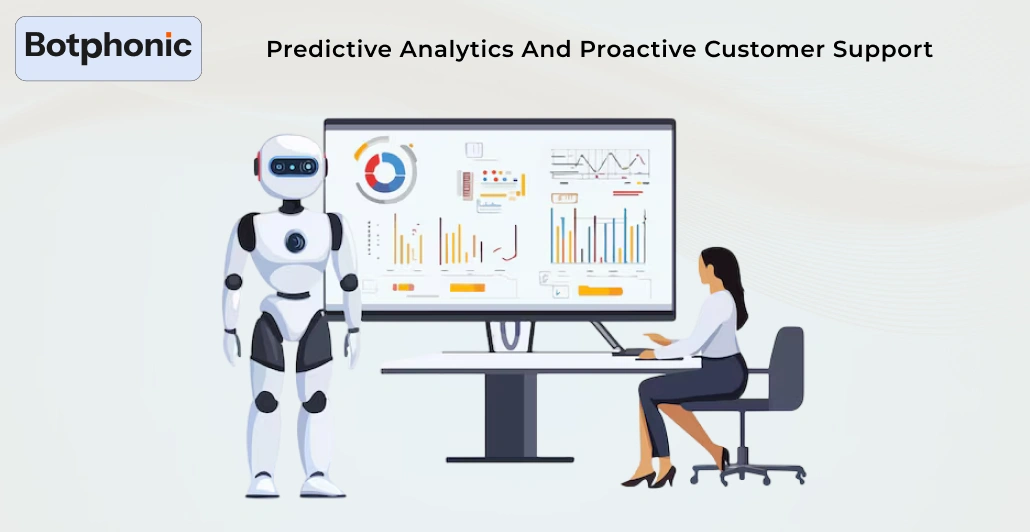
Proactive service is a new competitive advantage. And predictive analytics actively allows U.S. call centers to anticipate customer needs, and reduce churn while increasing loyalty. Predictive analytics actively utilizes AI too analyze large datasets, which includes customer interaction history, purchasing patterns, support tickets, and even social media activity. Furthermore, this allows call centers to anticipate problems, forecast demand, and even personalize interactions at scale.
Anticipating Customer Needs
AI algorithms operates by identifying trends and behaviors that indicates potential issues. For instance:
- A telecommunication provider can detect early signs of service disruption, based on usage patterns and network reports as well.
- Banks can easily flag unusual transaction patterns, alerting customers before potential fraud occurs.
- Retailers can identify customers likely to return products or abandon carts.
 PRO TIP
Reducing Churn and Improving Retention
Predictive analytics also helps in lowering churn, which is a major challenge for U.S. companies. By identifying clients at risk of abandoning, AI can trigger personalized retention strategies:
- Tailored promotions or loyalty incentives for high-value clients
- Early intervention for customers experiencing repeated issues
- Targeted communication strategies to improve engagement
A U.S. insurance company have also implemented predictive AI to identify clients at risk of policy cancellation. Personalized outreach also helped in reducing churn by 28% and increasing policy renewals significantly.
Implementation Best Practices
- Integrate with CRM: Centralize all customer data to provide a 360-degree view for predictive insights.
- Leverage real-time data: Ensure AI models use current information to improve accuracy and responsiveness.
- Combine human expertise: While AI predicts and suggests actions, human agents provide empathy and contextual judgment.
- Monitor and iterate: Continuously refine AI models based on feedback and evolving customer behavior.
Learn more: 5 Real Examples of AI Call Centers in Action
Cloud-Based and Remote AI Call Center Solutions
The U.S. call center landscape has been moving drastically towards cloud-based and remote operations. By 2026, most AI-enabled call centers will start operating on cloud-infrastructure, offering scalability, flexibility, and even enhanced security. Remote AI solutions are not just a pandemic-driven necessity, but have become a strategic asset for businesses.
Scalable Cloud Telephony
Cloud-based telephony allows call centers to:
- Scale operations quickly during peak demand, like holiday seasons or product launches.
- Integrate AI tools effortlessly, including chatbots, predictive analytics, and sentiment analysis.
- Maintain high uptime and reliability with geographically distributed servers.
A U.S. financial services call center had implemented a hybrid model with remote AI support. Agents actively received AI-driven prompts even during live calls, reducing handling times by 30% while maintaining regulatory compliance.
Secure Remote Operations
Operating in the cloud does not mean they are compromising security. AI-enabled cloud solutions help U.S. call centers to comply with regulations. Such as CCPA and TCPA by:
- Encrypting sensitive customer data
- Monitoring access logs to prevent unauthorized activity
- Automating compliance reporting for regulatory audits
NOTE
Compliance, Data Security, and AI Governance
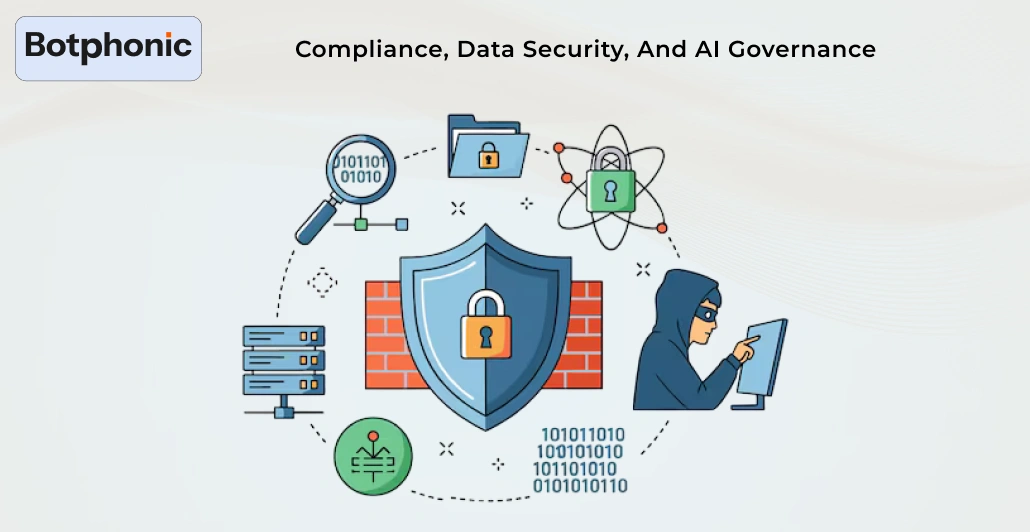
AI may be transforming U.S. call centers, but regulators aren’t really impressed by innovation without any discipline. By 2026, compliance, data security, and AI governance will be non-negotiable for any AI-powered call center operating in the USA.
CCPA and TCPA Compliance
AI call centers in the USA operate with a complex regulatory environment. Key regulations shaping AI adoption include:
- CCPA (California Consumer Privacy Act): Governs how customer data is gathered, stored, and shared.
- TCPA (Telephone Consumer Protection Act): Regulates all the outbound calls, consent, and even automated dialing.
- State-level Privacy laws: Increasingly divided and even stricter than federal guidance
AI systems should be designed to respect consent, minimize data exposure, and even helps maintain full auditability.
Ethical AI and Secure Customer Data
AI governance is not just theoretical but operational. U.S. call centers should ensure AI systems are:
- Transparent: Decisions should be able to traced and explained
- Fair: There are no biases in routing, prioritizations, or customer treatment
- Accountable: Humans are held responsible for AI-driven outcomes
This is especially critical for industries like finance, healthcare, and insurance, where AI-driven decisions can impact customers.
Future Outlook: Human-AI Collaboration
The future of AI call centers is never going to replace humans but it’s AI augmenting human capability. It’s assisting to create a more efficient, personalized, and adaptable customer experience. By 2026, the focus will shift from AI as a standalone tool to an integral part of the service team. Actively providing a harmonious blend of technology and empathy.
Workforce Upskilling and Hybrid Teams
For making this collaboration more effective, workforce upskilling is going to become a strategic imperative. Call centers are only going to invest in training programs that teaches employees about how to use AI tools effectively. Instead of fearing obsolescence, workers will effectively optimize AI to streamline their workflows.
- AI Literacy: Train your agents to use AI tools effectively, while enhancing automation and predictive analytics for smart and data-driven decisions.
- Emotional Intelligence: Boost agents’ EQ to handle sensitive queries with empathy and personalization, that also compliments AI’s efficiency.
- Hybrid Roles: Start shifting your agents to strategic roles such as AI to handle routine tasks, while humans for complex problem-solving and relationship building.
PRO TIP
Maximizing AI-Human Synergy
AI excels at data processing, pattern recognition, and even automation. While humans are good at problem-solving, creativity, and empathy. The most effective call centers of 2026 are only going to be those who harness both the strengths together.
- AI’s Strengths: Speed, accuracy, 24/7 support, predictive capabilities, handling high volumes, and even real-time sentiment analysis while offering instant scalability.
- Humans’ Strengths: Complex decision-making, context understanding, Empathy, emotional intelligence, creativity, and trust-building.
Best Practices:
- Clear AI Strategy: Align AI tools with business goals.
- Scalable Training: Ongoing development to match AI evolution.
- Customer-Centric Approach: Balance AI efficiency with human empathy.
Botphonic AI-powered call center helps you deliver lower costs, better customer experience, and scalable growth.
Book Your Demo Now!!Conclusion
By 2026, AI call center trends in call centers will get acknowledged. Knowing what Is an AI call center is and how AI-powered call centers in the USA are managed is important. In the near future, these will get recognized not by how many calls they manage but how intelligently they are engaging customers. Integrating automation, hyper-personalization, voice AI, predictive analytics, and even cloud infrastructure will become standard opening requirements.
Organizations who have started early investment in AI driven customer experience, secure data governance, and also human-AI collaboration will obviously achieve lower operational costs. Moreover, they will also get higher customer satisfaction and even stronger long-term loyalty.
The future of U.S. call centers is not human vs AI, but it is human empowered by AI.