Summarize Content With:
Quick Summary
The guide also contains very vital details on pricing models that involve standard costs, hidden costs and the value of a given plan on the basis of a return on investment which will enable you to settle on a plan that is of the greatest value to you, but with limited financial capability.
Introduction
The old fashioned call centers are no longer adequate to meet the rising demand of immediate customer services. AI call center software applies the implementation of automated systems along with intelligent call allocation and real-time data analysis in order to attain the optimum call processing and reduction in the operational costs and enhancement of the levels of customer satisfaction.
The AI solutions have businesses investigate their pricing system leading to a complicated pricing environment. The vendors offer their pricing models in various ways that encompass per-minute usage fees, per agent subscription fees, tiered pricing models, and hybrid pricing model. Companies have to understand the operations of these pricing models along with the factors that affect them since it will help them to reach the budget constraints without compromising the efficiency of their operations.
What is AI Call center Software?
The AI call center software will be an intelligent customer service system that offers more than its superior telephone features. The platforms embrace artificial intelligence and natural language processing and automation to handle routine tasks. Whereas AI call assistant smartly routes the incoming calls and provides real-time operational information that boosts agent performance.
Core capabilities include
- AI Voice Agents: They respond to customer questions without the intervention of a human.
- Conversational IVR: This type of system has interactive menus that enable the user to speak out their requests rather than use buttons.
- Intelligent Call Routing: The system directs the callers to the right agent or department based on the evidence provided in the background of the call.
- Omnichannel Support: The system will integrate voice communication with chat and email and messaging skills into a single platform.
- Analytics and Reporting: The system tracks the performance indicators along with customer feedback, and finds the areas of operation that are delayed.
The AI call center software is interactive and enhances all interactions using its research-based system, whereas traditional VoIP systems only offer connection of calls. Businesses need such solutions to meet its customer-oriented objectives with customer support, which must have reduced costs and improved service outcomes, reduced waiting times.
The AI Call Center Pricing Process
AI software to call centers is priced differently as different developers develop their own pricing formula on many variables that should be known before committing to a contract. Unlike the conventional call centers, which charge users the cost of labor and the required infrastructure, AI call assistant charge users depending on the capacity of their systems and the actual cost of operation.
There are four key factors that are used to determine pricing and this includes the items as follows:
- Call Volume & Interaction Minutes: The majority of AI solutions cost per minute or per interaction. The large call volumes can drive up the costs, and smaller companies can pay only the amount they use.
- Agents or Seats: Although most interactions might be done by AI, there will still be more complicated queries that require human agents. The pricing structure is dependent on the number of live agents in the system and goes up with an addition of an agent.
- Functions & Enablements: Basic plans include basic voice AI and routing. A high level of analytics, CRM connections, multilingual services, and bespoke processes tend to be additional.
- Deployment Model: Cloud based solutions save upfront infrastructure expenses but could incorporate usage fees. On-premise systems can be less expensive to install, but generally more certain with regard to maintenance costs.
- Storage and Compliance: AI platforms that hold sensitive customer data will bill the businesses the three services which are data storage and encryption and compliance certification.
The amount of money you will spend every month will depend on your choices regarding the amount of usage, the amount of features to add and the amount of work to automate. The more you map out your plan to enable AI capabilities to meet your realistic requirements, the higher your ROI.
Learn more: AI Call Center Cost in 2026: Pricing Breakdown
Primary Pricing Models Expressed
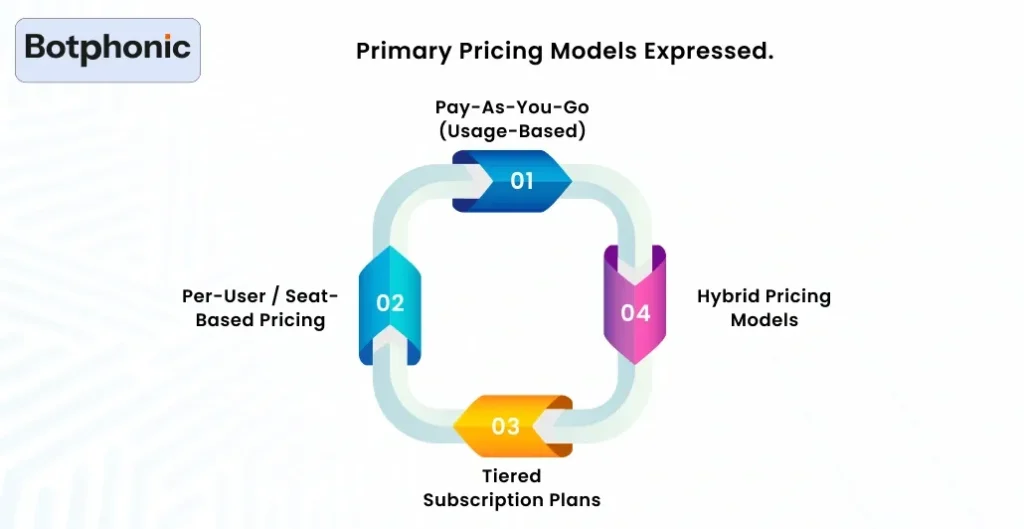
The AI call center software pricing model demands half knowledge to allow an individual to continue with the process of evaluation. Vendors usually base their pricing strategies on four various models that offer various strengths and weaknesses based on your business size and future development needs and objectives.
1. Pay-As-You-Go (Usage-Based)
The payment plan dictates that you have to pay per minute of time use or a call made or interaction exercise. This can be used by businesses that have fluctuating call volumes and also by partners and businesses that are seasonal in operation or have start-up status.
Advantages: Low initial expenses, scalability.
The cost is higher in the times when demand is at the peak.
2. Per-User / Seat-Based Pricing
The service will charge monthly fees to any user per agent or seat that uses the software. It fits into companies that have unending employee demands to its staffing needs.
Advantages: foreseeable budgets, simple budgeting.
The system also involves additional expenses among the users of the system in order to access AI minutes and other features and integration options.
3. Tiered Subscription Plans
The sellers offer three subscription variants that consist of basic and pro and enterprise plans that offer additional capabilities in their higher packages. This solution should be used by companies that require standard and advanced capabilities.
Advantages: Features can be easily compared at various prices.
The upper levels come with fees that can be charged on the features that the users will not be using.
4. Hybrid Pricing Models
The AI call assistant is powered with a simple subscription model that bills customers with the selection of seats or tiers plus the use charges. The service is appropriate to medium-sized or large businesses that need flexible operations along with constant basic costs.
Advantages: Scalability and predictability of cost.
The system is hard to handle since the user would be forced to come up with an elaborate plan to prevent unforeseen occurrences. The right choice of pricing model will demand that you consider operational needs and volume of calls and business perspective in the future.
Cost Breakdown in terms of features
The cost of AI call center automation software is based on their unique needs that consist of the number of seats and the number of minutes but their overall costs increase based on the features they choose. To know what you will get and what you will need to pay in terms of the features, you need to know what is offered in your plan. The next section is a detailed analysis of the topic:
1. AI Voice Agents
Pricing model: Most services charge customers based on either their total call time or their number of customer interactions.
Factors impacting: These costs are affected by three factors including multilingual support, voice quality, and also natural level processings.
 PRO TIP
2. Automation & Workflows
Included vs premium: Basic automation like call routing an IVR menus) is usually standard; advanced workflows like auto-resolution, sentiment detection, or task orchestration may cost extra.
Impact: Companies experience reduced human resource needs because they implement advanced automation which results in higher operational costs.
3. Integrations
CRM & third-party software: The system requires additional payment to establish connections with Salesforce and HubSpot and other platforms.
Custom API integrations: The service requires additional payment for custom API integrations which also needs customers to pay for setup costs.
 NOTE
NOTE4. Analytics & Reporting
Basic dashboards: The basic dashboard exists as a standard feature which comes with all basic plans.
Enterprise clients receive access to advanced AI insights which include predictive analytics and churn forecasting and call sentiment scoring.
Consideration: The use of advanced reporting systems enables organizations to make better decisions however these systems require additional payment to access their specific features which should match the requirements of the organization.
The focus of your vendor comparison should center on features which you receive instead of their associated costs. Businesses frequently fall into the trap of paying for premium services which they do not use.
Your planning should center on your current operational needs and your future growth predictions instead of focusing on trendy features.
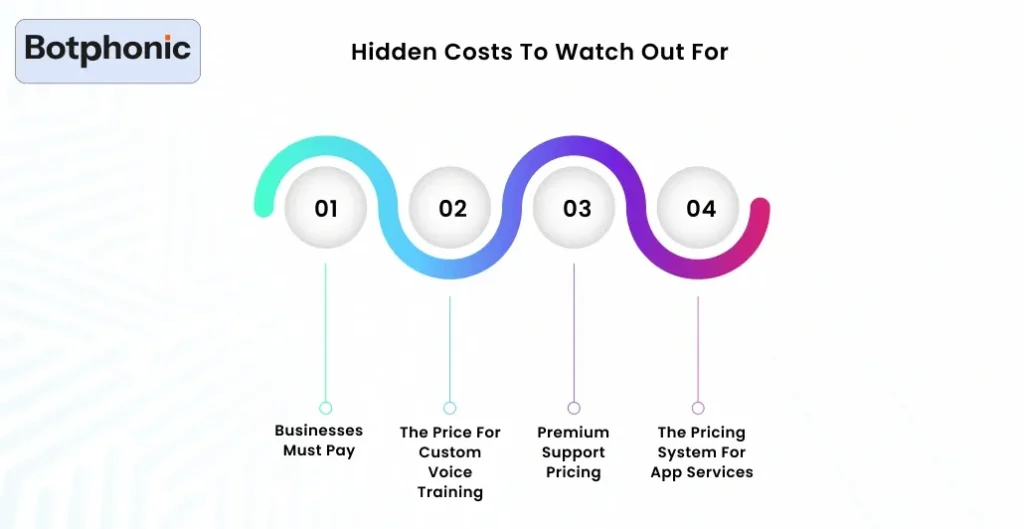
AI call center software can seem straightforward until the fine print hits your budget. Many businesses underestimate these hidden costs, which can quickly add up if you’re not careful. Here’s what to watch for:
1. Businesses Must Pay
Business operations require payment of all associated expenses. The initial setup requires three essential steps which need extra payment. Some vendors charge thousands just to get your system live.
2. The Price For Custom Voice Training
Training costs apply when you want AI agents to learn your specific brand language and special terms and distinct accents. The monthly expense for secure storage that meets GDPR and HIPAA and PCI requirements will increase because of additional costs. The expense of storage will increase with the amount of incoming calls.
3. Premium Support Pricing
Basic support is usually included, but 24/7 assistance, dedicated account managers, or faster response SLAs come at a premium. The foundational support system provides basic assistance but extends beyond that through premium support services which include round-the-clock help and dedicated account management and expedited support response times.
4. The Pricing System For App Services
Usage-based plans often have caps on minutes or interactions. After surpassing those boundaries, customers will incur significant overage fees.
Always request a full cost breakdown upfront. The initial budget-friendly appearance of a plan will become costly when you overlook the hidden expenses.
AI Call Center Pricing Comparison Table
| Vendor | Starting Price | Pricing Model | Best For | Key Strengths |
| Botphonic | ~$22/month starter | Tiered monthly (minutes‑based tiers) | Small businesses / rapid deploy | Very low entry price, scalable tiers, voice AI + analytics |
| Vapi AI | ~$0.05/min base | Modular usage‑based | Dev teams / custom voice workflows | Full control over stack, pay only for what you use |
| Retell AI | ~$0.07/min+ components | Per‑minute with component costs | Medium teams / compliance use | Clear per‑min pricing, real‑time speech and analytics |
| Cognigy | ~$2,500/month (entry) | Subscription | Large enterprises & structured IVR | Enterprise NLU, multi‑channel orchestration |
| Voiceflow | ~$60/month Pro | Tiered subscriptions | Growing teams / builders | Includes agents, concurrent calls, collaboration |
How to Choose the Right Pricing Plan
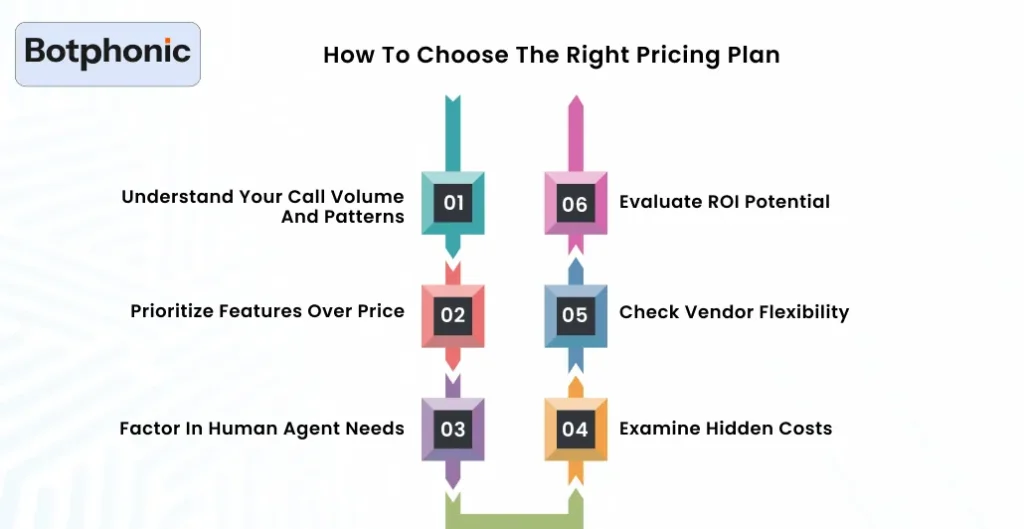
The process of selecting an AI call center pricing plan requires more than selecting the least expensive option because it requires finding an appropriate financial and operational match to meet future demands. As per Zylo survey, about 78% of IT leaders have received unexpected charges from usage-based AI pricing models. Here’s a no-nonsense approach to make the right choice:
1. Understand Your Call Volume and Patterns
You should estimate your monthly interactions together with your peak call times.
Usage-based or hybrid plans function better at high volume situations while per-seat subscriptions work better for predictable workload situations.
2. Prioritize Features Over Price
You need to create a list of essential features which should include AI agents and analytics and integrations and multilingual support.
You should not spend money on attractive features which you will never utilize because feature creep functions as a concealed expense which destroys your budget.
3. Factor in Human Agent Needs
The best AI systems cannot resolve every customer inquiry. You need to determine your required number of live agents and which plan will charge you per seat.
4. Examine Hidden Costs
The total costs include setup fees, onboarding costs, custom voice training expenses, storage costs and premium support services. A complete cost breakdown should be requested before you make any signing decision.
5. Check Vendor Flexibility
Ensure to know if you are able to:
- Upgrade or downgrade tiers easily?
- Are overage rates reasonable?
The system must allow users to easily add extra minutes and seats and features whenever their needs increase.
6. Evaluate ROI Potential
The plan cost should be evaluated against potential savings which result from fewer agent hours and decreased churn and quicker resolution times.
The company should accept a slightly higher upfront cost because it will provide efficiency improvements which lead to better customer satisfaction results.
The business should start with its present requirements and make accurate growth predictions while selecting a plan that will support future expansion. The company should focus on finding its most valuable products instead of selecting the least expensive options.
Try Botphonic Demo And See How AI Can Help You Grow?
Try Now!!Conclusion
AI call center software exists as a budget item but actually serves as a vital investment for your business. The ideal plan establishes a balance between cost-effectiveness and product capabilities while actual expenses differ between vendors and product functions and user requirements. Knowing AI call center statistics helps businesses work on their strategic plan and make it better.
Your business should concentrate on its actual requirements while planning for growth and acknowledging all undisclosed expenses. Select the plan which provides maximum worth instead of choosing the most economical option. Implemented correctly, AI call centers achieve financial self-sufficiency through their role in decreasing human tasks while enhancing customer satisfaction and building future-ready support systems.