
Summarize Content With:
Quick Summary
At its core, AI in call centers is a cost play, an efficiency play. It’s not a vanity project. And knowing AI call center ROI is critical. Traditional models don’t scale. They don’t scale because they’re based on a model of hiring more people to solve a problem. And what happens when you hire more people? You get a cycle of inefficiency, waste, and high costs.
AI turns this model on its head. You use technology to increase agent efficiency, to increase your ability to serve customers 24/7/365 without hiring more people. And what’s the biggest benefit? Labor dependency, call time, waste.
The problem? You need to have a solid foundation for determining your ROI. You need to know what you require for your metrics. Cost per contact, containment rate, first call resolution. When you get it right, you turn a cost center into a scalable model.
Introduction
The use of AI in the call center is all about solving a fundamentally broken cost model. The old way of running a call center is based on a very simple model: if you need more calls handled, you need more people. While this may have been true in the past, today this approach has created a vicious cycle of costs that are driven by labor costs, inefficiency, and a lack of scalability.
On the other hand, customer demands are higher, and patience is lower. Businesses today are faced with a choice: increasing operational costs and the need for faster and better customer service. This is where AI enters the scene, not as a luxury but as a way to solve a critical business need to manage costs and deliver customer service at scale. Even ROI of AI in the public sector report, backed by Google Cloud and conducted with the National Research Group, has found that AI agents are actively delivering value to organizations.
What Is the Business Case for AI in the Call Center?
Let’s get real and accept that businesses are no longer about AI transformation but fixing an expensive issue that might be labor heavy and doesn’t actually scale. At its core, AI call assistant is playing a margin with a side of customer experience.
To answer one of the most asked questions, “why are traditional call centers financially inefficient?” We should let you know call centers have always followed the same formula, that is more demand = hire more people. It might have worked in earlier times but today it has become a cost spiral.
- Labor usually makes up the majority of operating costs
- High turnover represents constant recruiting and training expenses.
- Peak demand drives overstaffing while slow periods waste those capacities.
- Repetitive calls usually consume skilled agents who should be focusing on higher-value work.
Put simply, you are paying premium human wages to answer the same five questions the whole day.
How Does AI Change the Cost Structure?
AI changes the whole model from being linear scaling to leverages scaling, that is automate more,
- Automation absorbs volume: Routine inquiries get managed instantly without even adding any headcount.
- Agents become multipliers: With AI assistance, agents are able to handle more interactions each hour
- 24/7 coverage without any shift premiums: There won’t be any overtime, no night differential so no burnout
- Lower cost per contact over time: Once deployed, the incremental interactions are cheap
The shift is rather simple but much more powerful.
Learn more: AI Call Center Architecture: Technical Overview
What Is Our Current Performance Baseline?
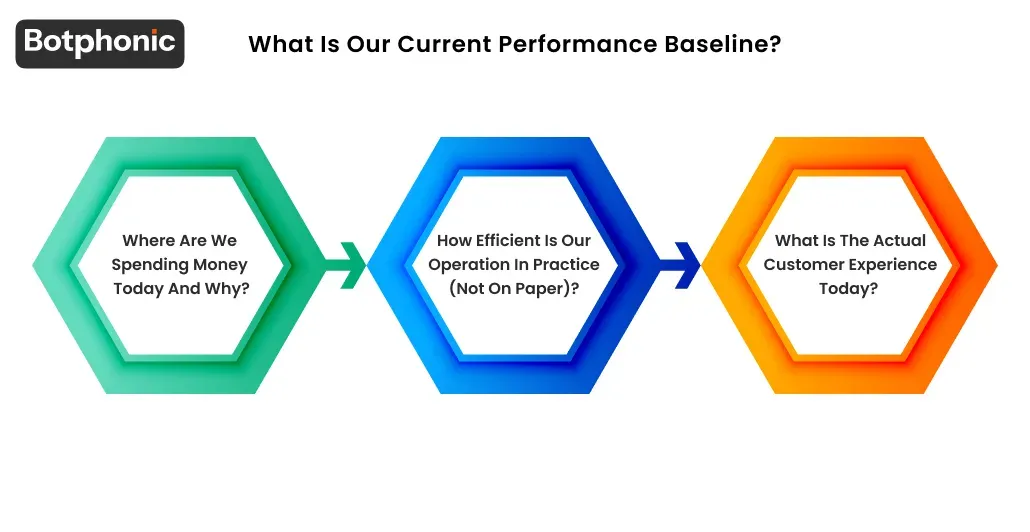
Before you even start thinking about saying “ROI,” you need an honest fact of today’s operation. Many organizations think they know their numbers until they actually calculate them. And it’s where reality actually gets expensive.
1. Where Are We Spending Money Today and Why?
This is your financial ground truth. They are not estimates, not averages but real costs. You should start with cost per contact, but don’t entertain yourself by looking at wages alone. You need to factor:
- Salaries, benefits, and overtime
- Technology stack (telephony, CRM, licensing)
- Facilities or remote infrastructure
- Training and onboarding costs
- Attrition and rehiring expenses
Then pressure-test it:
Are you overstaffed during slow periods? Understaffed during spikes? Paying experienced agents to manage basic inquiries.
Many call centers discover that they are not inefficient because of one problem but several small ones that come at once.
2. How Efficient Is Our Operation in Practice (Not on Paper)?
This is where operational myths don’t really work. Ensure to look closely at these metrics of your AI appointment booking software:
- Average Handle Time (AHT): If the calls are taking longer to get completed and why?
- First Call Resolution (FCR): Are customers calling back cause their issues aren’t getting truly solved.
- Agent Utilization: If agents are really busy or they are just available.
- After-call work: How much time is actually getting wasted on admin tasks?
Many times are optimizing AI for wrong things that might not actually matter. For example, chasing lower AHT might just destroy FCR and customer satisfaction.
3. What Is the Actual Customer Experience Today?
If you are not actually getting this, every other factor is just internal theater. Some key questions include:
- How long are customers waiting before they reach someone?
- How often are they transferred or forced to repeat themselves?
- Are answers consistent across agents?
- What are your CSAT or NPS trends actually telling you?
And now go one step further, start looking at behaviour and not just survey scores:
- Repeat call rates
- Escalations
- Drop-offs in the queue
Because there’s only one blunt truth and that’s that customers don’t actually complain about your metrics but they react to friction. And frictions show up in behavior much earlier than in dashboards.
Which AI Use Cases Actually Drive ROI?
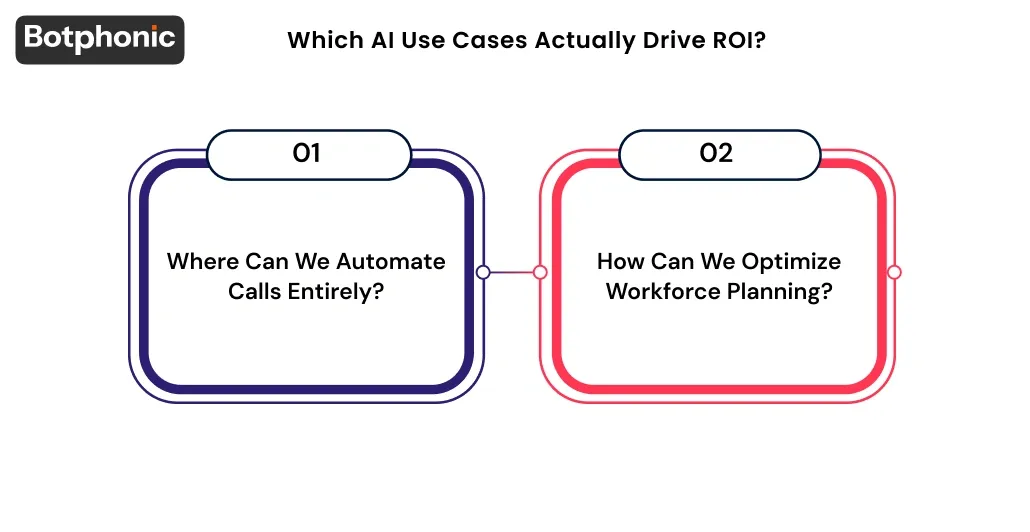
Let’s just be honest with each other, not all AI use cases are worth your time but some look impressive in demos and just fall apart in production. The ones that actually drive ROI are the ones that are directly tied to volume, time, and labor.
1. Where Can We Automate Calls Entirely?
This is one of the fastest path to ROI, where you have to focus on high-volume but low-complexity interactions:
- Billing inquiries
- Password resets
- Order status and tracking
- Appointment scheduling
- Basic troubleshooting
These are some of the basic calls that clog the call management and actively drains the budget.
A smart and well-employed AI voice or chat system can easily manage queries instantly 24/7, eliminate queue times for simple issues, and frees up agents for work that actually needs them.
The actual key metric for this is containment rate and how many interactions don’t need human intervention.
 NOTE
NOTE
2. How Can We Optimize Workforce Planning?
Many AI call centers are just understaffed but they are mismanaged. AI tools work in favor of organizations and reduce guesswork. It:
- Predicts call volumes with higher accuracy
- Aligns staffing with real demand patterns
- Reduces idle time and overstaffing
Instead of just working for appointment scheduling, you get precision:
- Fewer wasted labor hours
- Better service levels during peak times
- Less burnout from chaotic workloads
Where Do the Hard Cost Savings Come From?
Let’s not beat around the bush here; hard savings means dollars and cents that you can point to in a budget review without being side-eyed by the finance folks. This is not about fuzzy concepts like productivity improvements. This is about actual and factual cost savings of an AI call assistant.
1. How Much Labor Can We Eliminate or Reallocate?
Labor is the thing that actually affects 60-80% of total call center costs. If you move this lever, you are moving everything that’s going to enhance your productivity.
AI doesn’t usually trigger the layoffs, even if there’s headlines. The factor that makes it smart is:
- Slowing or freezing hiring as demand actually grows
- Reallocating agents to higher value tasks
- Reducing overtime and contractor reliance
And then there’s automation:
- Every call fully handled by AI = one less call an agent needs to touch
- High-volume interactions compound savings quickly
The practical outcome is that AI call center software enables you to offer more customer support without scaling headcount at the same rate.
2. How Much Efficiency Can We Unlock?
This is one of the quieter levers, but it adds up fast and works smartly. When AI reduces the friction in the workflow.
- Calls get shorter (lower AHT)
- After-call admin shrinks or disappears (ACW reduction)
- Agents handle more interactions per hour
Even if you have some modest gain, it matters. A 15% improvement across a 200 person team isn’t just nice but it’s equivalent to adding dozens of agents without actually paying for them.
3. What Infrastructure Costs Can We Reduce?
Most call centers are just bloated in ways that nobody even asks about them, it has become just about how things are actually getting done.
AI exposes and eliminates that waste significantly:
- Overstaffing during low-demand periods
- Underutilized agents sitting idle
- Inefficient call routing leading to transfers and repeats
- Training inefficiencies that drag out ramp time
Fixing even these issues doesn’t help you in making headlines but it quietly removes unnecessary spending month after month.
Which Metrics Actually Prove ROI?
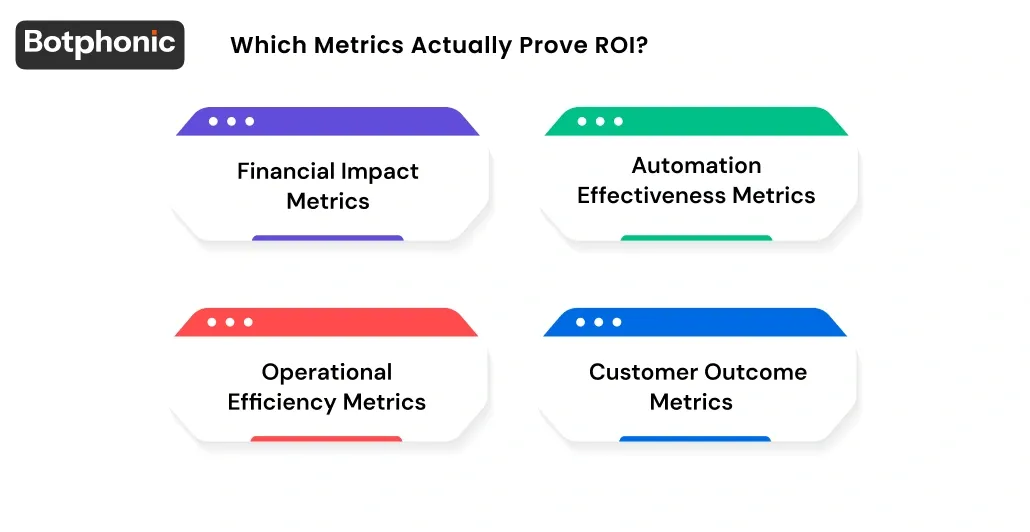
The reality is that the majority of the teams are drowning in metrics, which is unable to demonstrate any ROI. Why? Since they are following what is easy to follow and not what moves the money.
Rather, concentrate on a few measures that all people in finance, operations and leadership consider important.
1. Financial Impact Metrics
Cost per Contact (Your North Star)
That is what this metric is all about. Unless this figure is declining, then you are not making money on your AI investment.
- Preimplemental and postimplemental tracking.
- Channel by channel (voice, chat, etc.).
- Reduction of tracks to estimate the benefits of automation and efficiency.
Call Volume Reduction (Demand Shift Indicator)
In case AI is successful, the amount of calls per call should reduce.
- Especially in the context of the self-service and automation applications.
- Assists in justifying the possible cost cutting benefits.
Payback Period (Executive Litmus Test)
The payback time of the investment.
- Measures in months.
- When this is a high figure there should be executive-level scrutiny.
2. Automation Effectiveness Metrics
Containment Rate
Measures the percent of interactions that AI automatically solves.
- Increased keeping costs = short-term saving of labor costs.
- Have you concentrated on deflection? Poor automation may be a bigger problem than a solution.
3. Operational Efficiency Metrics
Average Handle Time (AHT) (Efficiency Lever)
Fewer calls are made by the staff as they are shorter.
- Monitor long-term improvements in time of calls.
- Do not consider only reductions. Combine with quality measures to prevent rush and fail.
After-Call Work (ACW) (Hidden Time Drain)
This is where AI can create massive advantages to your contact centers.
- Observe decreases in ACW time.
- There is a direct relationship between ACW and increases in available capacity of agents.
Output per headcount (Productivity of Agents)
Measures the degree of getting something done by agents.
- Calls managed within an hour/day.
- Compare to pre-AI levels
Here, the benefits of efficiency become real.
4. Customer Outcome Metrics
First Call Resolution (FCR) (Effectiveness Check)
In case the customer will be forced to make a call back, it will be costly. Period.
- AI is expected to assist in enhancing FCR by providing agents with additional information.
- When FCR declines it is an indication that AI is effecting a net-negative influence.
Customer Satisfaction (CSAT/NPS) (Guardrail Metric)
When the cost is reduced and the satisfaction reduces further then it is futile.
- See whether there is stability or improvement in CSAT/NPS.
- Integrate with behavioral measures like repeated calls.
 PRO TIP
How Do We Calculate ROI Without Fooling Ourselves?
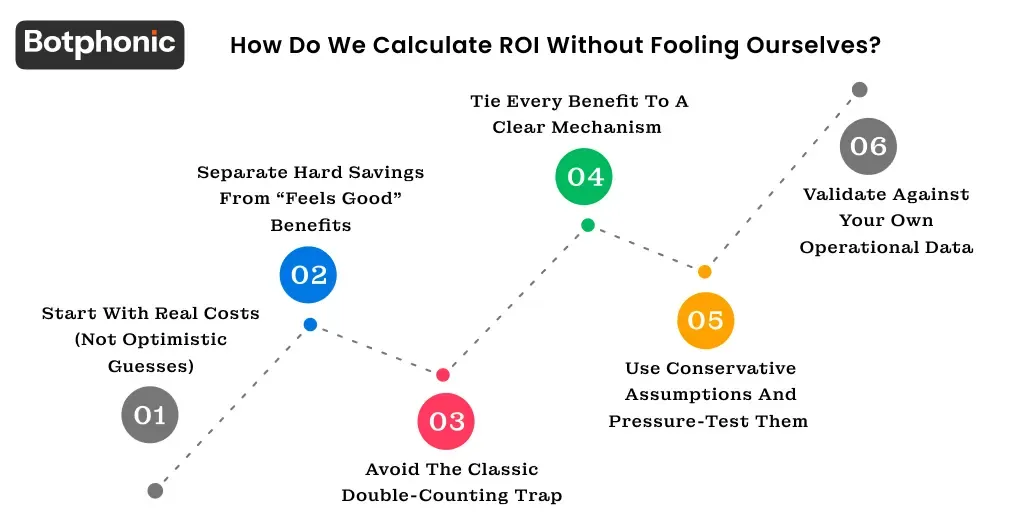
This is where the majority of AI receptionist projects lose their credibility without hue and cry. Not that the technology performs poorly, but because the figures are being painted in a better way than they are. A good ROI model is not about hopefulness, it is about discipline. When finance can find holes to its contents in five minutes, you are not creating a business case, you are creating a slide.
1. Start With Real Costs (Not Optimistic Guesses)
The failure of most of the ROI models is due to the cost side being considered as an afterthought. As a matter of fact, it is at this point that you must be most rigorous. Not only is it the platform fee, but it is the implementation, integration headaches, time within the company, training, and the ongoing effort to maintain the system doing well.
These are grossly underestimated in the same way by organizations, particularly internal lift. When your model of costs looks clean and trim, then it is most likely incomplete. An authoritative style presupposes friction, delays, and some overrun- because that is the nature of real operations.
2. Separate Hard Savings From “Feels Good” Benefits
Not every benefit is beneficial and it is in their combination that one gets lost. Hard savings refer to those that cut the amount spent or eliminate future expenses such as hires that are not necessary or reducing overtime. These are defensible.
Softer benefits such as enhanced experience or knowledge on the other hand might be actual, but they cannot be placed in the limelight unless you can attribute them to revenue or cost effect. When all that is called value, then nothing is. Models of strong ROI create a distinct line between something that can be measured and something that is just directional.
3. Avoid the Classic Double-Counting Trap
This is among the most prevalent-and least evident mistakes. The identical enhancement is enumerated several times by various titles. As an example, a lowering of handle time could also translate into higher productivity or staffing efficiency.
All that might be the case on an operational account, but on the financial front it is the identical gain. Reporting it twice is inflationary of ROI and undermining trust. The simplicity of the discipline here is that all benefits must have a single financial path in it and only be found once in the model. When it appears on several occasions, then you are exaggerating influence.
4. Tie Every Benefit to a Clear Mechanism
General improvements are not durable. It is not sufficient to state the fact that efficiency is increased but only to clarify how it is converted into dollars. It is a process of relating operational changes with financial results in a sequential manner. As an illustration, when call times go down, there should be an automatic increase in capacity which subsequently lowers the necessity of extra staffing. Whenever every link in that chain is transparent, then the model becomes believable. In the absence of that explicitness, it appears to be assumption upon assumption, which is precisely what finance teams are supposed to question.
5. Use Conservative Assumptions and Pressure-Test Them
The best ROI model is not one that is based on best-case scenarios. Actually, it supposes that everything will not be well. The adoption process is slow and performance is slow and does not give back all the use cases equally. Here you construct an assumption that is conservative – and then see whether your ROI can withstand changes – you have a model that is sustainable.
When this is just a business when things are going well, then it is a weak business case. When it continues to perform in less-than-optimal conditions, then this is the time that leadership begins to take note.
6. Validate Against Your Own Operational Data
Generic benchmarks are hardly ever representative of your reality. Each call center comprises a combination of types of calls, cost structures and inefficiencies. It can be based on your personal historical data in order to make the model grounded.
It also makes teams to be on the same page as everybody is working with the same source of truth. Once built on internal data as opposed to external averages, ROI is much harder to dispute and is much more useful in decision-making.
Start with measurable wins and expand easily with Botphonic
Schedule a DemoConclusion
With an intelligent AI call center software the benefits can actually be measured and tracked. This is where the discipline of tracking cost per contact, containment rate, and resolution quality comes in. If the customer experience does not improve or degrade at a slower rate than before, the benefits will soon disappear. When implemented correctly and with realistic assumptions, AI is not just a tool; it is a structural advantage for the call center to grow while still maintaining control over cost and performance.