Summarize Content With:
Quick Summary
AI call center contracts are associated with risks that the typical software agreements were not designed to handle. The grey data ownership terms to the definition of SLAs that do not consider the actual failure of the AI systems, the details here are more critical than nearly any other part of enterprise tech. That is why you will follow this guide of AI call center contracts step-by-step through the five areas that require your utmost attention and the exact questions you should have answered before signing it.
Introduction
The contract of an AI call center solution is not comparable to a regular SaaS subscription. It exists at the cross point of business software, customer data management, labor-near automation, and fast-evolving technology, a mix which renders boilerplate accords a real hazard to the business that embraces them blindly.
Call centers process massive amounts of sensitive dialogues on a daily basis. grievances of the customers, payment information, personal information, health questions everything passes through them. When artificial intelligence intervenes in that area to do routing, summarization, quality scoring, or live agent support, stakes in the contract become significantly higher. Even advancing methods in AI innovation is an essential component for buyers.
Both well-established cloud giants and venture-backed startups sell these platforms. Moreover, they initially design their standard contracts to serve their own interests. Negotiation teams accustomed to traditional software acquisitions usually lack the preparation for the complexity an AI system brings.
This is not a guide that will instruct you to abandon the AI call center technology. The operational benefits include the decreased handle time, improved first-call resolution, 24/7 operations with no proportional increase in headcount are actual. What it will inform you is what the business signing the contract needs to look into, what to enquire upon, and what to move back on, to make the contract that you will sign, work to the advantage of the business that signs the contract.
AI Call Center Contracts vs Traditional Software Agreements
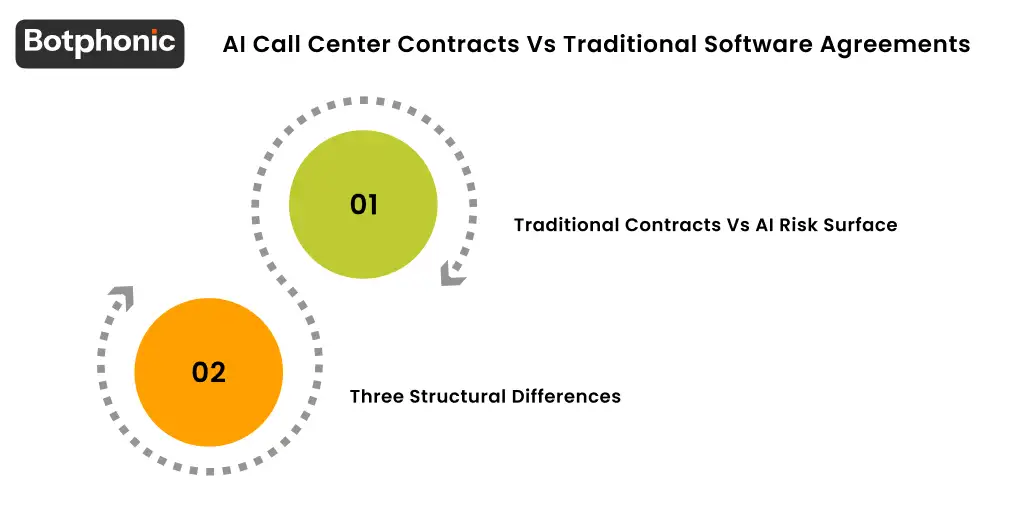
1. Traditional Contracts vs AI Risk Surface
Conventional call center software contracts were mostly concerned with uptime, feature accessibility and seat cost. The danger surface was controllable. In case of a failure of the system, phone calls were not made. The damage could be calculated and the repair was normally a service credit. They usually focus on:
- System uptime
- Feature access
- Pricing models
The category of failure that is presented by AI systems is completely new. It may also take weeks before a routing algorithm misclassifies customers before the pattern shows in data. A voice bot may answer neighboring case queries in a manner that puts the company at regulatory risk. Training data could bias a sentiment scoring model. None of these failures resemble traditional downtime, though they all carry actual business and legal implications.
2. Three Structural Differences
The three structural divergences between AI call center contracts and traditional enterprise contracts can be outlined.
Why Do AI Systems Introduce Probabilistic Risk in Call Center Contracts?
To begin with, the behavior of the system is not deterministic, but probabilistic. The AI model makes statistically informed guesses as opposed to a traditional IVR which routes based on explicit rules. What that involves is that one cannot specify expected behavior in advance exhaustively, nor can failure modes be listed exhaustively. Contracts should take this vagueness into consideration.
How Does Continuous Model Training Impact AI Call Center Contracts?
Second, the system evolves and transforms. Most AI systems are still being trained using production data, indicating that the system that your team will approve of in the first month will not act the same way in the twelfth month. In the absence of contractual commitments with regard to updates of models, you have few details of that drift or control.
To put it simply, its implications are:
- System behavior changes over time
- Performance drift may occur
- Lack of transparency in updates increases risk
How Do Changing AI Regulations Affect Call Center Contract Terms?
Third, there is dynamic regulation environment. Legislation on data protection, consumer communication regulations and new regulations relating to AI are all on the move. A contract made today must explicitly assign responsibility of keeping up with that landscape which changes.
Learn more: AI Call Center Software: Overview & Features
What Should Be Included in an AI Call Center Contract? (5 Essential Components)
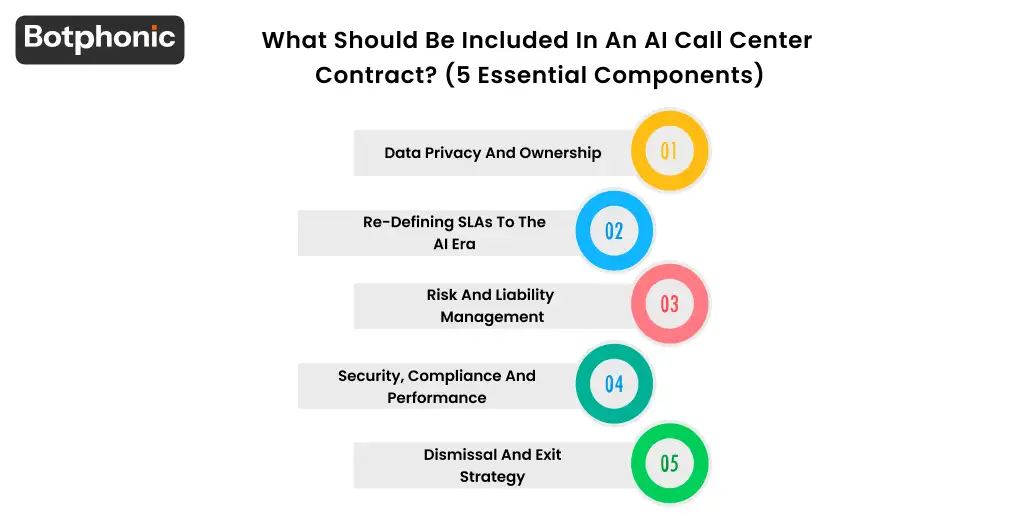
It is beneficial to have a structure of what a complete AI call center contracts should include before breaking down each part of it as a separate entity. The five categories below are the least viable contracts in this space. Any lapse in any of these areas forms a point of vulnerability that is bound to come out at the most inopportune time.
1. Data Privacy and Ownership
How Is Data Ownership Defined in AI Vendor Contracts?
Data powers all AI systems. Call center recordings, transcripts, interaction metadata, customer sentiment scores, and agent metrics continually generate this input. The most significant question in the whole contract negotiation remains: what does the vendor do with that data after you upload it to their platform?
Statements that vendors can use “aggregated and anonymized information.” They might use it to “provide better services.” Also, it might seem harmless until you realize the vendor defines “anonymized” however they wish. Furthermore, the vendor trains their system on your specific customer interaction patterns to sell those data points to your rivals.
The agreement must specifically indicate the raw call information. Such as all transcriptions, and all the inferred metadata are the sole proprietary belongings of your organization. The use of such data by a vendor to train models must have a written affirmative. Meanwhile, It should also include specific consent not an obfuscated term of service amendment.
What Are the Best Practices for Data Retention and Deletion in AI Call Center Contracts?
Specify dates of data retention. The contract must also state the retention period of raw data, derived data and any model weights or embeddings that include your data. It must contain a documented deletion process that is verified and not just a guarantee by a vendor that deletion shall be done.
How Do Regulations Like GDPR and HIPAA Impact AI Call Center Data Contracts?
Major privacy laws, including GDPR in Europe, and CCPA, CPRA, and HIPAA in the United States, designate you as the data controller and the vendor as the data processor. Your contract of AI call assistant must capture this structure by mandating sub-processor disclosures, a breach notification schedule, and cooperation requirements for data access requests.
Inquire with each vendor directly: Does any part of our interaction information feed shared models that are used with other customers? In case of ambiguity in the answer, it would most definitely be possible under the contract language.
2. Re-defining SLAs to the AI Era
Why Are Traditional SLA Metrics Inadequate for AI Call Center Systems?
The traditional call center contracts had a set of very specific metrics that Service Level Agreements dealt with: system uptime, API response time, and support ticket response time. These measurements are still applicable, yet it is far in-between what an AI-powered environment needs.
A fully functioning AI system cannot go without failures, no mistakes, and at the same time, it acts in a way that is actively detrimental to your business. A live bot that is generating incorrect responses, a routing model that is also functional and making systematic error in classifying the intent of calls, a quality scoring model that is available and producing misleading agent scores none of this will instate uptime-based solutions.
SLA Comparison Table
| Metric Type | Traditional Contracts | AI Contracts |
| Focus | Availability | Performance outcomes |
| Measurement | Uptime | Accuracy, resolution rates |
| Failure Detection | Immediate | Delayed |
| Impact | Service interruption | Business risk |
The performance SLA should be in terms of results, rather than being an availability one. This will involve establishing reasonable levels of such measures as intent classification accuracy, transcription accuracy, first-call resolution rate attribution, and escalation rate and binding contractual remedies to persistent non-conformance against such levels.
What SLA Metrics Should Be Used for AI Model Accuracy in Call Centers?
Requests push vendors to make promises on precision standards of core AI call center architecture. These standards are expected to be compared to a representative sample of your real types of calls as opposed to an industry generic standard that may not be representative of your customers or level of use case complexity.
Important as well: specify what occurs when the accuracy is reduced. The agreement must create a monitoring mechanism, a requirement to investigate on the vendor side and timeline of remediation. In case the accuracy of agreed targets cannot be restored within a given time, a customer should be allowed to leave without penalty.
How Should AI Model Updates and Drift Be Handled in Contracts?
When the vendor does an update on the underlying models be it to enhance their overall performance or to re-train on new data, the update can alter the behavior of the system in such a way that it impacts on your operation. Your contract must make prior notice of material changes to the model, and establish what is and is not material, and must not preclude your right to withhold giving prompt notice of changes that would interfere with active deployments whilst you test them and sign off.
 PRO TIP
3. Risk and Liability Management
Why Do Standard Liability Caps Fail in AI Vendor Contracts?
The AI contract liability clauses are the most delicate to read as compared to almost any other contract clause. In vendor-written contracts, there are usually limits that essentially restrict the liability to a small part of the yearly contract fee, usually the fees paid during the last three to twelve months without regard to the actual damages incurred.
Based on realistic failure, assume that an AI system fails to handle regulatory disclosures on collections calls over six months before being found out. Downstream exposure regulatory fines, remediation costs, possible class action might result in tens of millions of dollars. There is a liability cap of fees paid in the previous three months which barely covers that.
The exception of normal liability carve-outs to the caps to be applicable in situations of gross negligence, fraud or a willful act is not a ceiling but a floor. Demand certain carve-out that relates to data breaches, regulatory non-compliance brought about by failure of vendor system, and AI outputs that result in reported harm to end customers.
What Indemnification Clauses Should Be Included in AI Contracts?
The indemnity clauses define the parties who pay in cases of injury by the system. Make sure the vendor offers general indemnification in the event of intellectual property infringement action associated with the AI system such as the training data of the model used third-party material without permission. It is a hot litigation field and the exposure is actual.
What Insurance Coverage Is Required for AI Call Center Vendors?
Minimal requirements of insurance coverage: technology errors and omissions, cyber liability (including first-party and third-party coverage), and general commercial liability. Ask that where possible the vendor name your organization as an additional insured, and take certificates of insurance before commencement of deployment.
4. Security, Compliance and Performance
How Should AI Call Center Contracts Address Scalability and Infrastructure?
The reliability of the operational processes of an AI call center system is based on long-term architectural decisions, which are reflected in technical requirements and compliance obligations that are outlined in the contract.
The demand in contact centers does not experience uniformity. The peaks of demand can cause issues with platform capacity due to seasonal spikes, product launch surges, service incident storms etc. Capacity promises should be outlined in the contract, AI call center ROI and even scaling needs to be spelt out during peak times and performance standards should be set in both base load and peak load states, not in the average traffic.
What Security Certifications Should AI Call Center Vendors Have?
Make documentation of relevant security certifications: SOC 2 Type II: is the bare minimum expectation of enterprise SaaS; ISO 27001: is becoming common among vendors with international customer bases; PCI DSS compliance: is mandatory where payment conversations flow over the system; HIPAA Business Associate Agreement coverage: is mandatory to any use case involving healthcare adjacency.
In addition to the certifications, the contract ought to provide penetration testing schedules, timelines of disclosure of vulnerabilities and whether the vendor is expected to patch critical vulnerabilities within specific windows or not. It must also outline your rights to make or perform independent security examinations of the platform.
Learn more: Ensure to ask your vendor about their security framework, if they aren’t able to do so that’s just wrong.
Who Is Responsible for Regulatory Compliance in AI Call Center Contracts?
AI specific regulation is coming. The EU AI Act categorizes some of the call center AI applications as high risks. The state-level AI transparency legislation is proliferating in the US. The automated communication systems are also under scrutiny by federal consumer protection agencies.
Contract must explicitly specify who will oversee the changes in regulations. Including, who will be obliged to bear the compliance burden under each category of requirements. Also, what is necessary in case new regulation may lead to changes in the system. Blanket customer has responsibility of its own compliance LLP is not permissible where the system design is what defines the ability of compliance on the part of the vendor.
In compliance, the responsibility is negotiable. Demand collaboration review processes and explicit vendor responsibility. Ensure to know the instance of regulatory modifications that entail platform-wide remodeling not merely that you must work it out on your own.
5. Dismissal and Exit Strategy
What Is the Difference Between Termination for Cause and Convenience in AI Contracts?
The exit provisions of a contract should receive as much attention in the contract negotiation process as the performance provisions does sometimes more. You lose your bargaining power to negotiate exit conditions once you sign the contract, though you typically only realize the necessity of these conditions years later as situations change.
Parties conventionally allow termination for material breach, protracted service interference, or breach of law. But these clauses often trigger high penalties compared to termination for convenience. The definition of cause in the AI contract must be extended to cover degraded performance over prolonged periods. The periods might fall below the contracted levels, security breaches that have not yet been adequately addressed over specified periods. Meanwhile, significant changes in the data processing methods of the vendor without agreement might have been made.
| Termination Type | Trigger | Risk |
| Cause | Breach or failure | Limited flexibility |
| Convenience | Business decision | May include fees |
Convenience termination options, with or without a fee. Ensure you do not bind your company to a platform that fails your operational requirements or falls behind competitors. A 60-90 day notice at a well-defined fee structure is a realistic goal.
How Should Data Portability Be Handled in AI Call Center Contracts?
When you terminate, you want your data available in a format that is useful. The contract must specify which data the vendor returns, in what form, within what period, and at what expense. You must define the format, such as JSON, CSV, or a vendor-documented schema. Instead of accepting a “standard export format,” ensure the vendor exports all metadata along with raw call recordings.
The agreement must further indicate the period within which the vendor-side data is to be deleted after successful export. That also includes how to ascertain that such data has been deleted.
What Transition Support Should AI Vendors Provide After Contract Termination?
It is not easy to migrate out of an AI receptionist. The interaction of the vendor throughout the transition period. Including documentation, documentation of API access continuity, integration support has a material impact. It might have effect on the disruption of your operation. Agree on transition assistance terms to ensure terms. Such as features are available at an agreed price even within a specified period after termination notice. The vendor might come to offer a specified amount of migration assistance.
Book a consultation today and make it work for you.
Schedule a demoConclusion
AI call center contracts are not agreements you can afford to take a standard term with a fine attitude towards. The technology is robust, the operational advantages are real and risks contractual, regulatory, operational are proportionately high.
The five topics in this guide of AI call center contracts are data privacy and ownership, redefined SLAs, liability and risk allocation, performance and security specifications, regulatory compliance responsibility, and exit strategy make up a whole negotiation framework. You must question and, most often, revise every one of these sections rather than accepting the vendor’s default language.
Before an AI call center contract reaches the signature phase. Ensure procurement, the office of the technology contract-expert legal counsel and the information security unit. Hopefully a regulatory compliance expert must review it. The cost of this review is a thousand times less than the cost of a contract that fails to protect you.
The developers of these systems are not competitors. Most of them will bargain honestly with customers who come to the table with knowledge and demands. This manual provides you with the details you require. Use it.