Summarize Content With:
Quick Summary
AI call center analytics has moved up from being nice to having a smart assistant. Applying artificial intelligence to customer interactions has made organizations extract actionable insights that materially improve the customer experience, agent performance, and even operational efficiency. This article also breaks down what AI call center analytic really is and how it actually works
Introduction
The modern AI call center has an image problem. For years it’s not just screen as call center but cost center, that is necessary but not actually favored. And meanwhile the customers are judging the whole brand based on the single interaction it has made. And the disconnect it makes is actually very expensive.
Let’s now think of this situation with AI call center analytics. You can think of it as a practical and data-driven mechanism for turning numbers of daily conversations into an organized intelligence when designed correctly, AI analytics doesn’t just have to report on CX but it actually improves it.
Let’s just be honest, many organizations have already gathered vast amount of data, including call records, chat logs, IVR transcripts, and even CRM notes.
What Is AI Call Center Analytics? A Technical Definition
AI call center analytics is the application of artificial intelligence technologies that helps contact center interactions data in order to extract insights, predict outcomes, and optimize both customer and agent behaviour.
Let’s get into this more:
Traditionally call center analytics used to rely on:
- Manual call sampling
- Static reports
- Lagging indicators that are reviewed weeks after the fact
- Subjective quality assurance scoring
This approach was also slow, biased, and dangerously incomplete. It did mentioned what has happened but when the client was long gone.
And in this new generation, the real upgrades happens with AI call center analytics, AI call center automation replaces the guesswork with scale and precision by leveraging:
- Speech-to-text engines helps in transcribing the calls
- Natural language processing assists in understanding the meaning, intent, and sentiment of the user
- Machine learning models aids in identifying patterns and anomalies
How AI Transforms Raw Call Data into CX Intelligence
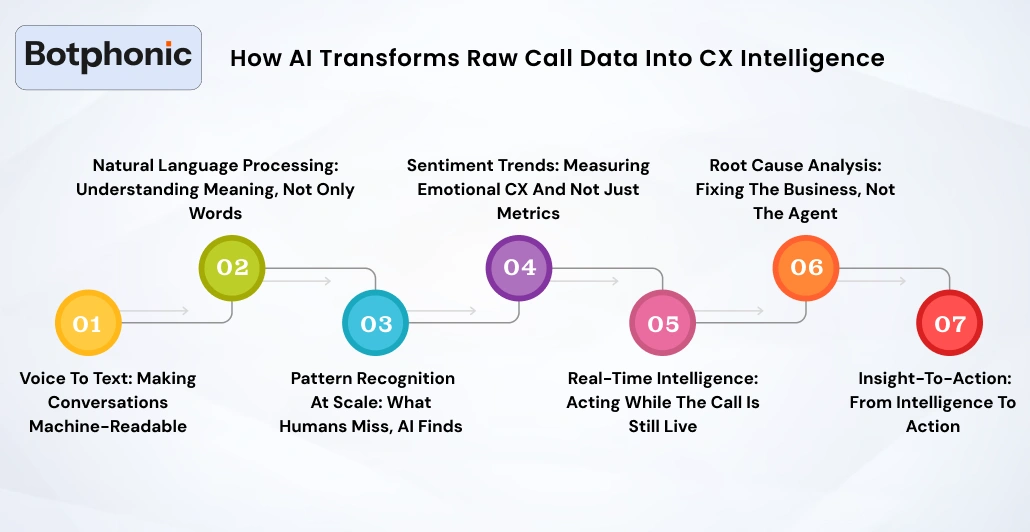
Let us be blunt: raw call data is operational exhaust. It’s noisy, unstructured, and borderline useless as it exists in nature. Thousands of hours of conversations build up each week, and without AI, most organizations do exactly what they’ve done already—ignore 97% of it and hope the other 3% tells a good story.
AI changes the operating model. It takes the everyday talk of customers into decision-grade knowledge that directs what leadership will act on.
Here’s how that whole transformation goes.
1. Voice to Text: Making Conversations Machine-Readable
AI’s first work is translation: quite literally.
Advanced speech-to-text engines transcribing calls at scale—the voice becomes structured text, differ from legacy transcription facilities in terms of:
- Accents and dialects
- Overlapping speech
- Proprietary terms
That’s the first step. Weak transcription means weakness downstream. Strong AI analytics platforms see transcription accuracy as a non-negotiable rather than a “version two” feature.
2. Natural Language Processing: Understanding Meaning, Not Only Words
After the transcription of conversations, natural language processing (NLP) is what comes next. This is the point where raw text makes a turn into insights.
NLP models analyze:
- Intent: Why the customer is calling
- Context: What happened in this interaction before
- Sentiment: Emotional tone (levels of frustration and satisfaction signals)
- Entity identification: Products, competitors, pricing, policies
This essentially moves analytics away from keyword spotting. The system understands that, ‘I’ve called three times already,’ is a churn signal, not just a sentence.
3. Pattern Recognition at Scale: What Humans Miss, AI Finds
People telling cool anecdotes are far better at it than any machine learning process researching patterns.
Machine learning models look at millions of interactions, discovering:
- Emerging call drivers
- Repeated friction points
- Escalation triggers
Language patterns tied to successful resolution
No QA team, however hawk-eyed, can spot these patterns manually. AI does it continuously, objectively, and without fatigue.
That’s what we call translated for leadership: no surprises; early warnings.
4. Sentiment Trends: Measuring Emotional CX and Not Just Metrics
Traditional CX metrics measure efficiency, whereas AI Answering Service measures experience. Sentiment has been tracked by AI:
- Before, during, and after calls
- Across agents, queues, and customer segments
- Approximately over days, weeks, and months
- This answers things organizations had never even thought to ask:
- Where does frustration actually start?
- Which policies generate the most emotional friction?
- Which agents have recurrent de-escalation of high-tension calls?
If CX is how customers feel, sentiment intelligence must be the closest thing to experience balance sheets.
5. Real-Time Intelligence: Acting While the Call Is Still Live
This is the point where AI stops being analytical and operationalized.
In the most advanced deployments, AI offers:
- Real-time guidance to agents
- Live escalation alerts for high-risk calls
- Compliance warnings before infringements happen
Instead of reviewing mistakes after the fact, organizations prevent them in the moment. That is a structural upgrade, not an incremental improvement.
6. Root Cause Analysis: Fixing the Business, Not the Agent
Here’s the ugly truth: most of the call volumes are self-inflicted.
AI does correlate the interaction data with:
- Releases of products
- Billing changes
- Updates of policies
- Outages of systems
This allows leaders to find root-causes and not only symptoms. When such spikes in calls happen, AI does not shrug-it explains.
This is how call centers evolve from complaint handlers into early warning systems for the entire business.
7. Insight-to-Action: from Intelligence to Action
Inaction renders insights not actionable but rather corporate theater.
Such AI analytics solutions would drive the insights directly through:
- Coaching workflows;
- Process improvement initiatives;
- Knowledge base updates;
- Executive dashboards tied to KPIs;
Better reports are not the end game. Rather, it is fewer repeat calls, higher resolution rates, and customers do not dread picking up the phone.
 NOTE
NOTE
Key AI Call Center Analytics Capabilities That Drive CX
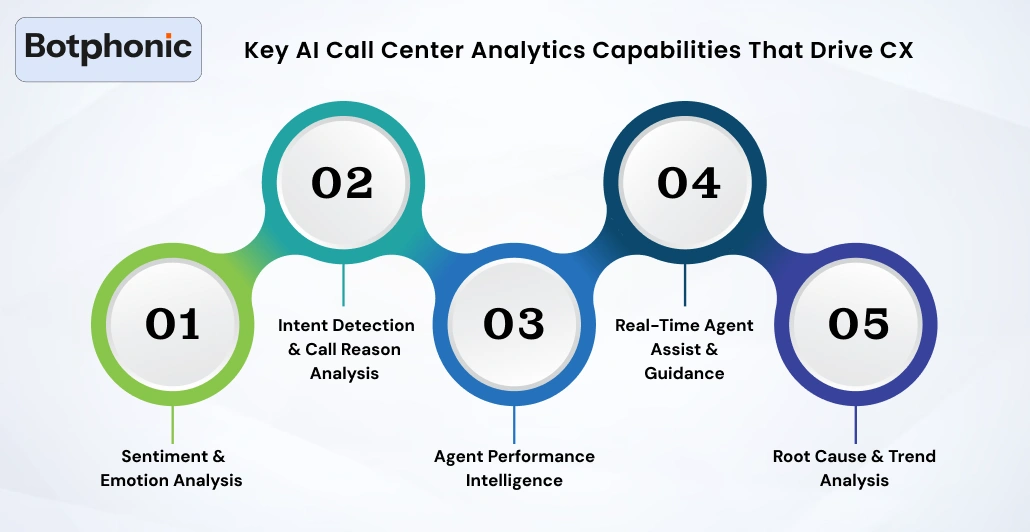
Let’s find the balance, structured yet precise and commercial. Below are what I call my five powerful AI capabilities of AI call center software that provide positive impacts to the customer experience when applied with discipline.
1. Sentiment & Emotion Analysis
Emotion AI continuously reads emotional signals in real-time during customer interaction, not just at closure. By evaluating the tone, choice of words, and flow of conversation, it can detect signs of frustration, confusion, urgency, or relief.
This allows organizations to pinpoint where sentiment is low, which policies create negative emotions, and which agents can de-escalate difficult calls. This proactive CX management allows for building customer relationships rather than merely performing reactive damage control.
2. Intent Detection & Call Reason Analysis
AI picks up the clues as to why customers call from the caller’s language pattern or by the context, even if the intent is not clearly articulated. It can highlight any primary or secondary reasons, like a churn risk hidden behind a simple billing question.
This enables teams to resolve true causes, improve self-service, and reduce unnecessary repeat contacts, ultimately benefiting CX and cost efficiency.
3. Agent Performance Intelligence
This AI analyzes 100% of interactions against consistent criteria, thus removing bias and sample limitations imposed on traditional QA. It measures the degrees of empathy, talk-to-listen ratio, script adherence, and resolution effectiveness.
Thus, the focus of training suddenly shifts from opinion feedback to evidence-based improvement, thus enabling the agents to improve while being honest and fair.
4. Real-Time Agent Assist & Guidance
The AI gives real-time agents targeted prompts and recommendations for knowledge base material and alerts to compliance lapses in live calls. It can also forewarn agents about deterioration in sentiment and missed disclosures, before they become an issue.
Together with AI, agents ensure that accurate and confident support is delivered in the moment-where the CX is either won or lost.
5. Root Cause & Trend Analysis
This AI call assistant tracks interaction data over time looking for consistent pain points, trending omissions, or systemic breakdowns. It connects upticks in calls to product changes, policy shifts, or to service outages.
By solving these root causes, organizations lower the friction right at the source, effectively translating their call center into a strategic function rather than just being a support operation.
These five capabilities do not just measure CX; they also improve it. When truly actionable insights are generated via AI, the call center transformation from a cost center to a competitive advantage.
AI Call Center Analytics KPIs That Actually Matter
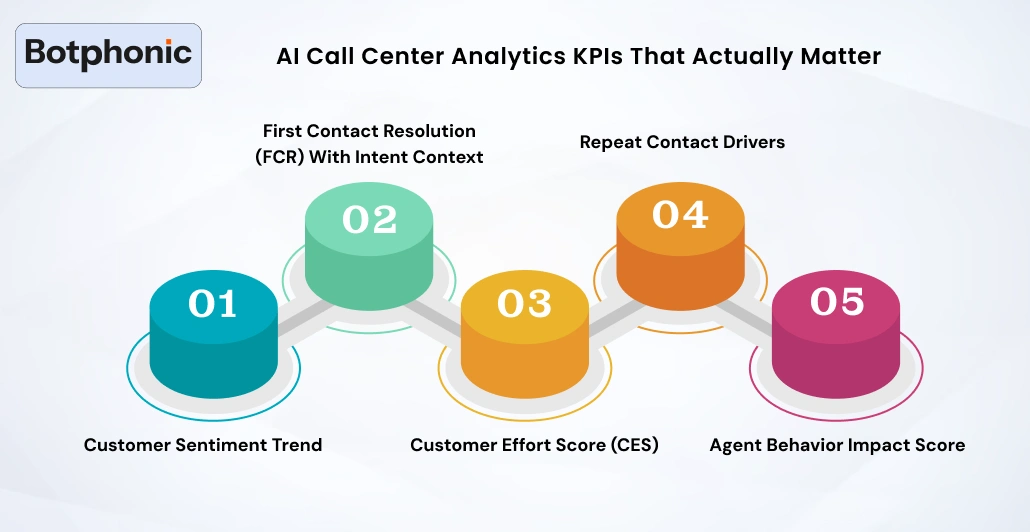
Most call center KPIs have become just traditional relics. They were just built for efficiency reporting and never related to customer experience. AI isn’t just giving sharing metrics but it encourages to choose smarter and better ones.
Let’s check out the KPIs that actually matter when an AI call center analytics is in game, because they are actually tied to direct outcomes.
1. Customer Sentiment Trend
Static CSAT scores tell you how customers have felt after the interaction was made. AI tracks how sentiment has changed during and across conversations.
This KPI also reveals whether CX is improving with time or just deteriorating in real time. Also, which teams or process is triggering the frustration and more importantly, where actual intervention is required before churn occurs.
2. First Contact Resolution (FCR) with Intent Context
AI-enhanced FCR have gone beyond, “issue resolved” and measures whether the actual intent was addressed. Conversational AI in call centers identifies repeat contacts tied to the same underlying problem, even when customers are phrasing it differently.
This KPI also exposes broken processes and false resolutions that traditional FCR metrics are routinely missing.
3. Customer Effort Score (CES)
AI measures effort by analyzing repeat calls, channel switching, and also conversational friction. Moreover, it also shows how hard customers have to work to get answers, approvals, or fixes.
High effort is the silent killer of loyalty, lowering it also delivers immediate CX and retention gains.
 PRO TIP
4. Repeat Contact Drivers
Instead of just counting repeat calls, the system helps identify why customers are coming back. It links repeat interactions to specific intents, products or even policies. This KPI shifts the whole leadership focus from volume management to problem elimination.
5. Agent Behavior Impact Score
AI correlates agent behaviours, empathy, listening balance, clarity, with outcomes like resolution, sentiment improvement, and escalation avoidance. And this KPI finally answers the questions that executives usually ask, like what do top performers actually do differently?
Integrating AI Call Center Analytics with Existing Tech Stacks
Integrating AI call center analytics doesn’t actually require ripping out what already works. The smart move is augmentation, not just disruption.
Modern AI platforms plug directly into existing systems such as:
- Contact center platforms (CCaaS)
- CRM tools
- Business intelligence dashboards
- Workforce management and QA systems
The key is seamless data flow. AI adds the interaction data, analyzes it, and pushes insights back into the tools teams already use, agent desktops, coaching workflows, and executive reports. And to choose a smart AI platforms ensure to evaluate it thoroughly in the demo.
Best practice is incremental rollout, start with visibility, prove value, then expand. Great integrations might just sound bold but they just stall operations.
Use Botphonic And Make It Happen Today
Request A Demo!!Conclusion
AI call center analytics is not about reporting what went wrong, but it’s about engineering better outcomes before things break. When applied smartly, it changes overwhelming volumes of raw interaction data into structured, actionable intelligence that improves customer experience, agent performance, and also operational efficiency in parallel.
The organizations who are winning this deal are not the one who collects the most data, but the ones acting on it with discipline. AI exposes the friction, bias, broken processes, and also hidden risks with uncomfortable clarity. Moreover, this also gives leaders the visibility of the data that they should always have, and also the ability to move from reactive firefighting to proactive CX design.