
Summarize Content With:
Summary
This blog details how U.S. marketing teams can measure AI call automation ROI by monitoring key metrics and steering clear of common scoring mistakes with clear dashboards. It illustrates how AI-driven call analytics tie phone calls to revenue, efficiency and customer experience so that teams can confidently make smarter budget and growth decisions.
Introduction
Imagine this: your marketing team launches campaign after campaign, measuring every click, impression and conversion on digital channels. But when a high-intent customer gets on the phone and calls, that interaction can often disappear into a black hole. U.S. companies invest billions of dollars in digital analytics each year, yet most fail to fully capture the value created by phone-driven leads.
Some of the most valuable marketing interactions can come from phone calls, but their impact is invisible to budgets and strategies without adequate measurement. This blindside can lead to teams wasting tens of thousands of dollars on missed opportunities and misplaced spending.
It’s precisely why AI Call Automation ROI USA counts. Finally, marketers can attribute the financial value of voice interactions and link callbacks to campaigns with AI-based call tracking and automated call management that are designed to optimise performance and budget decisions.
In this blog, you’ll find out exactly what AI calls automation ROI looks like and how to begin measuring it yourself, step by step, along with the reasons behind why teams that track phone interactions are succeeding over those that don’t.
Why Measuring ROI Is Crucial for Marketing Automation
The majority of U.S. marketing teams concentrate on digital metrics such as website clicks, form submissions, or email opens. These metrics are flashy and can be monitored with the standard tools of analytics. But phone calls generally bring greater intent and a higher revenue potential than most digital interactions. And yet, many companies still don’t track phone calls as well as they should, creating a significant blind spot in their understanding of actual campaign value.
Enter Overview Calls So it’s not too surprising to hear that over 65% of U.S. marketing driven calls go untracked or under-attributed, according to industry data, which is to say, those calls aren’t being tied back properly to the campaigns that caused them. This introduces measurement blind spots, which can obfuscate areas of poor performance as well as opportunities for optimisation.
What This Means for Your Marketing Efforts
Without call attribution, teams cannot:
- Direct leads from the phone channel with a precise value.
- Know which ads and keywords drive revenue-generating calls.
- Efficiently allocate budgets using real ROI information.
That’s where call automation through AI comes in handy. It doesn’t just grab and automate phone interactions: it aligns those interactions to your broader marketing performance metrics, thereby guaranteeing that all the important touchpoints are captured in your ROI models.
Attorney Info AI Call Automation ROI USA Financial returns resulting from the implementation of AI-based calling systems for U.S. marketing campaigns. It examines cost savings, revenue growth, time efficiencies and customer experience enhancements delivered through call automation.
Understanding ROI in AI Call Automation
AI call automation ROI isn’t just about saving money. It also demonstrates how automation increases income, saves time, and enhances the customer experience. When U.S. marketing teams evaluate them together, they can see the data in full not just its surface-level numbers.
AI Call Automation ROI USA revolves around how AI calling systems save time, enhance lead management and streamline customer interactions. This enables teams to tie phone calls directly to business results, such as increased sales, faster response times and improved customer loyalty.
| ROI Type | What It Measures | Simple Example |
| Cost ROI | Money saved by reducing manual work | $5,000/month saved on staffing |
| Revenue ROI | Sales driven by AI-managed calls | 35% more lead conversions |
| Time ROI | Hours saved through automation | 20+ hours saved weekly |
| Experience ROI | Customer satisfaction improvement | 15% higher retention |
All these types of ROIs contribute together. Cost ROI demonstrates efficiency, revenue ROI indicates growth, time ROI enhances productivity, and experience ROI deepens long-term
 PRO TIP
How to Calculate ROI for AI Call Automation
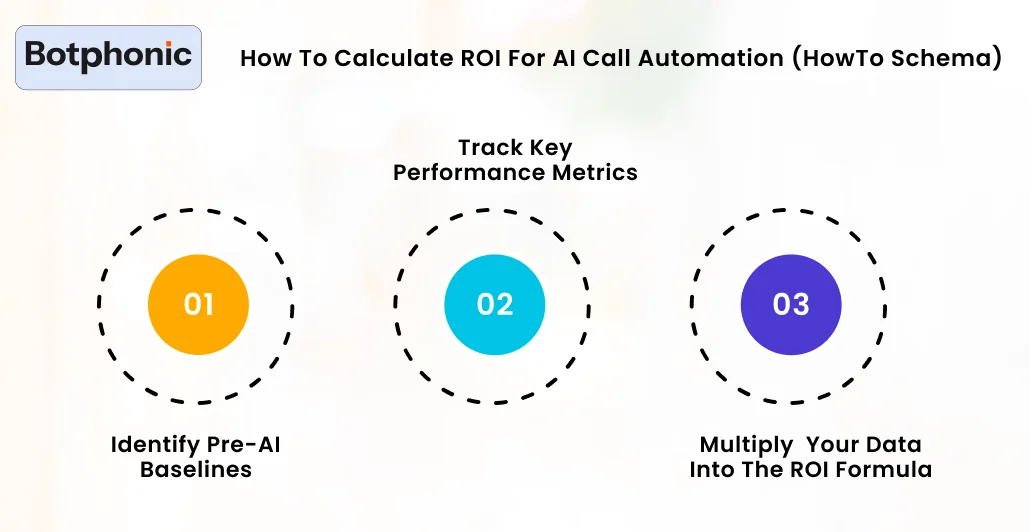
Return on investment (ROI) on AI call deflection isn’t complicated mathematics; you don’t need sophisticated formulae or tools. All you need are clear baselines, the right performance metrics and a straightforward comparison of gains versus costs. And when marketing teams adopt AI call automation for U.S. businesses, they can effectively quantify the benefits of automation for their leaders.
It’s also a way that teams can understand when automation has its largest impact, whether it is in generating new revenue, cost savings or improvements to efficiency over time.
Step 1 – Identify Pre-AI Baselines
Before you bring AI in, you need to know how your call system is doing right now. These figures lie to you, and it’s mandatory that realize this. These are your bench markers used to track real development as opposed to conjecture.
You’ll want to begin by determining your monthly call volume, the number of calls that go unanswered, average agent cost per hour, and your current conversion rate. These numbers reveal how much inefficiency is present in your current process.
For instance, you might receive 1,000 calls a month retain only 70%, pay agents $20 an hour. That is hundreds of potential customers that never get answered, and the cost of labor doesn’t go down even when a call isn’t turned into business.
Tip: Be sure to record a minimum of 30 days of pre-AI data. LODs for short term do not reflect the true value of ROI.
Step 2 – Track Key Performance Metrics
Once you roll out AI call automation, there are certain metrics you should be measuring that tell a real business story. This data tells us whether automation makes things better or just moves work somewhere else.
Conversion rate indicates how many calls convert into qualified leads or sales. The call response time is how long the system takes to respond to and route calls. Cost per call represents all labor and infrastructure costs. Average Sale X Conversion Rate Revenue per Call as the average sale multiplied by your conversion rate. Retention rate measures the percentage of customers who return for subsequent engagements after a customer’s first.
When these two metrics get better in concert, it’s a signal that automation works throughout the funnel, not just a single point.
TIP: Connect these metrics to your CRM and ad platforms so you can see which campaigns are driving the highest AI ROI & performance analytics.
Step 3 – Multiply Your Data Into the ROI Formula
Once you’ve collected your data, the ROI calculation is also easy. Use this formula:
ROI (%) = [(Net Return – Investment Cost) ÷ Investment Cost] × 100
let’s say Botphonic is $800 per month. If that equates to $2,400 in new monthly revenue for example, your ROI is 200 percent. When you read your spending ratio (probably three to one), you hear that as if it’s two, because you are paid by companies in dollars but buy stocks in fractions of those dollars.
That kind of clarity allows marketing teams to defend budgets, justify growth, and predict increases with confidence.
Note: Recalculate ROI monthly. This allows you to track trends rather than rely on single snapshots.
Key Metrics Marketing Teams Should Track
Tracking the correct metrics also ensures that your ROI calculations always remain useful and actionable. Some American marketing teams focus in on lead volume alone, but this can mask true performance gaps.
Conversion rates are directly impacted by the speed of response. In fact, when teams reply in under 60 seconds, they tend to have close rates that are drastically (5X-ish) higher. Missed calls signal inefficiencies, which translate into revenue loss.
Duration of call Call time allows you to know the level of engagement. Cost per conversion visualizes the real ROI not just performance at face-value. NPS scores or CSAT scores indicate how happy your customers are with your product and company in the long term.
In conjunction, these measurements provide a full view of the impact AI call automation has on revenue, operations and experience.
PRO TIP
Real Case Study AI ROI for a U.S. Marketing Agency
The 25-person team at a California-based SaaS marketing agency was experiencing missed calls, slow lead qualification and increased labour costs. Their calls still came in but as inbound leads which usually were called during peak hours and agents could never keep up.
They use Botphonic to automatically qualify inbound leads, route high intent calls, and instantly collect lead data. More3over, it also helps with AI voice campaigns & marketing automation.
The agency made huge gains over the next three months. Missed calls fell 82%, meaning they were able to pick up more opportunities. The lead conversion rates of Alien Soft boost to 46% as the system reacted immediately. Cost per lead decreased by 37%, thanks to less manual work. Their overall ROI increased to 260%, demonstrating that automation not only paid for itself, but delivered more value.
ROI Dashboard – What U.S. Marketers Should Measure
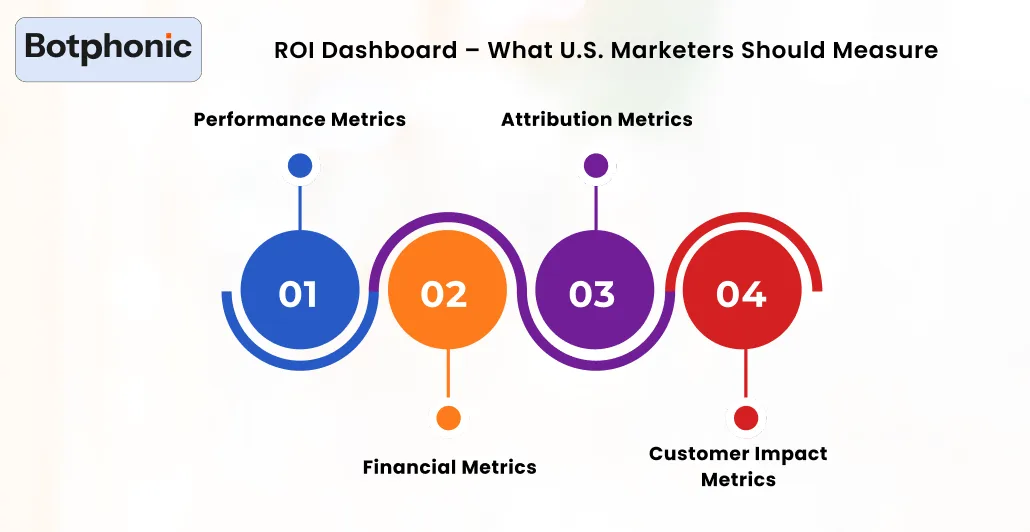
An ROI dashboard lets US marketing teams link call activity to actual business outcomes. Instead of playing guessing games with performance, teams can start to see what works and where things need improvement in a single place.
1. Performance Metrics
Call automation AI performance metrics The performance numbers that illustrate how well call automation AI is processing both your incoming and outgoing calls. Teams should monitor the number of calls taken, average length of call and answer rates. These numbers allow marketers to get a sense of whether the callers are being quickly attended to and if AI helps reduce call bottlenecks during peak hours.
2. Financial Metrics
Money metrics expose how automation directly affects on the bottom line. Cost savings indicates lesser agent workload, and ROI percentage determines the time it takes for the system to cover its own cost. Revenue per call allows teams to see how much income each conversation generates.
3. Attribution Metrics
Attribution metrics link calls to marketing initiatives. Teams will want to monitor which campaigns and sources of traffic are driving calls, and how AI can divide call handling with human agents. This information allows marketers to invest more in high-performing channels and scale back their spend on those of low impact.
4. Customer Impact Metrics
Customer impact measurements quantify the influence of automation on experience, loyalty. The satisfaction rates and repeat call statistics inform us as to whether callers have faith in the system and call back when they need something again. In fact, according to HubSpot’s ROI Measurement Report (HubSpot, 2025), organizations who measure multi-channel ROI including that of calls are more capable of making confident decisions around budget allocations and become increasingly efficient over time.
PRO TIP
Common ROI Tracking Mistakes
- Tracking Too Few Metrics: Some teams measure only call volume, or perhaps conversions. This disguises cost wasting and experience problems. Without the benchmark, ROI statistics do not put in context and are misleading.
- Disregarding The Value Of Missed Calls: But missed calls are typically more high-intent leads, which many teams just ignore and do not attach a dollar value to. This oversight obscures the loss of revenues and underestimates how much automation has affected revenue.
- Relying on Manual Tracking: Manual sheets and hand-tagging lead to errors and inconsistencies. And finally, data accuracy is lost and the ROI reports are untrustworthy due to human mistakes.
- Lack of CRM Integration: Without calls data syncing into CRM systems, teams lose sight of lead quality and closed revenue. This is a hole in the ROI chain between call and sale. Botphonic dashboards address these issues by tracking automatically, assigning value to missed calls, integrating into CRM systems and providing real-time ROI analytics.
Compliance & Data Transparency in ROI Reporting
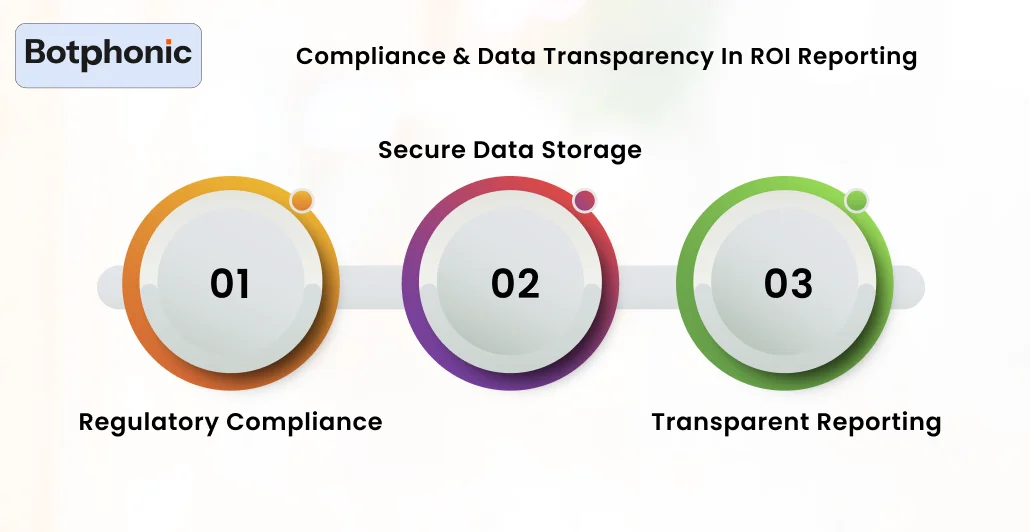
Clean is good, but clean ROI reporting also requires something more. It also requires robust compliance and transparency policies that protect customer data.
- Regulatory Compliance: U.S.-based marketing teams need to adhere to GDPR, TCPA and SOC 2 Type II. These regulations influence the process that teams can collect, store and use for call data to ensure it is done in a lawful and ethical way.
- Secure Data Storage: Botphonic securely maintains analytics on U.S. based servers, allowing for data sovereignty and security. Safe storage lowers the risk and higher trust from customers and stakeholders.
- Transparent Reporting: Transparency of ROI reporting teams explanations about where the data comes from and how calculations are performed. Transparent reporting instills trust in leadership and reduces friction over the numbers.
 NOTE
NOTE
ROI Benchmarks Across U.S. Industries
| Industry | Avg ROI (%) | Key Impact Area |
| Healthcare | 240% | Missed call recovery |
| Real Estate | 210% | Lead qualification |
| Finance | 280% | Outbound follow-ups |
| Retail | 190% | Order confirmation |
| Logistics | 260% | Dispatch calls |
The Future of ROI Tracking with AI Calls
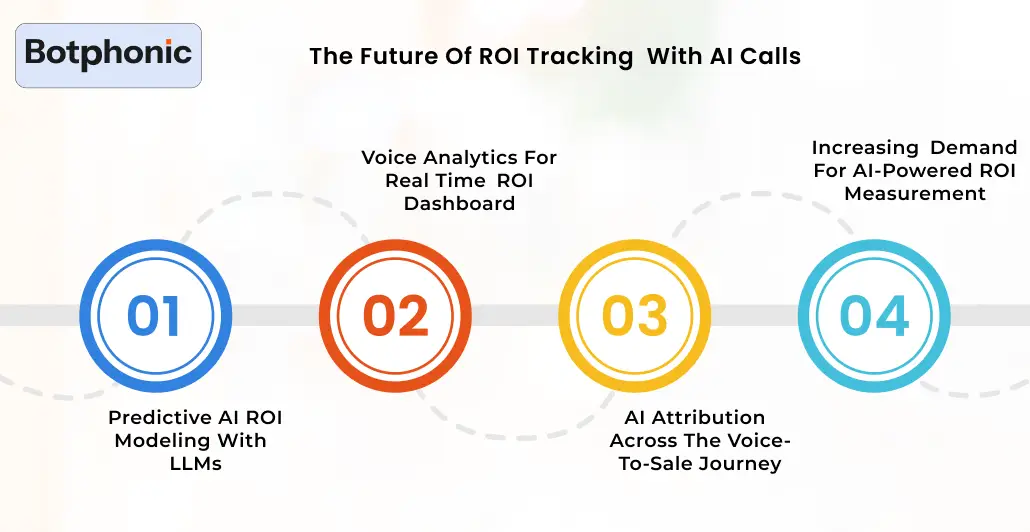
AI call automation trends are progressing beyond simple tracking. U.S. marketers are now focusing on the more intelligent, predictive and real-time measurement of ROI that links every voice interaction to business growth.
1. Predictive AI ROI Modeling with LLMs
Today, in fact, looking at historical call data, conversion trends and the performance of your campaign will enable big language models to forecast ROI. These are the models that make it possible for teams to predict revenue impact before campaigns go out, leading to more effective budget spend and lower risk.
2. Voice Analytics for Real Time ROI Dashboard
Voice analytics tools allow marketers to look at ROI shifts in real time. Real-time dashboards display call performance, revenue impact, and cost savings as they happen to help teams make campaign adjustments without waiting for end-of-month reports.
3. AI Attribution Across the Voice-to-Sale Journey
AI attribution ties phone calls together with the complete customer journey. From someone clicking on an ad for the first time to when a sale is completed, AI connects voice conversions to digital touchpoints so marketers can see the full picture of how calls impact revenue.
4. Increasing Demand for AI-Powered ROI Measurement
ROI tracking powered by AI will soon be expected. By 2028, 80% of U.S.-based marketing organizations will rely on AI for cross-channel measurement of ROI, as reported by McKinsey in stressing the transition towards an automation-informed analysis.
Monitor precisely how each call affects earnings, expenses and conversions with Botphonic’s AI-powered ROI dashboards.
Book a DemoFinal Thoughts
The measure of AI Call Automation ROI USA allows U.S. marketing is to realize the actual contribution of phone calls in driving revenue and growth. Organizations, who are measuring the ROI on call automation from teams that use AI call tracking USA and by incorporating insights in relation to AI campaign analytics, make smarter decisions and waste less. And with the right AI call assistant and transparent ROI dashboards, marketers can confidently demonstrate AI marketing ROI from any initiative, as well as acquire insights to apply to future campaigns.