Summarize Content With:
Introduction
The companies have significantly developed the AI call assistant market. And along with its development, platforms are exploding by offering more or less similar packages – improved customer service, less staff workload, 24/7, better call management.
In the case of a retail business considering such opportunities, the problem is not the search for AI call assistants. It is the determination of which of them actually support retail operations, and which ones are generic tools that will require a lot of workarounds to be useful.
The aspects that render AI call assistants useful in a retail environment are particular. This article presents them in a straightforward manner in order to enable retail decision-makers to weigh options.
Real-Time Inventory Integration for Retail AI Call Assistants
This is the inadmissible characteristic of retail. Unless an AI call assistant can access your inventory system and have live data on the stock levels. It will be unable to respond to the most frequent query that callers ask: ‘Do you have this in stock?’
A system that relies on a fixed list of products is updated:
- Either once a day
- One that just informs the callers to visit the site.
The team must operate the integration or at least update it on a frequent basis to ensure a high degree of accuracy.
Questions to Ask Vendors
In the assessment of vendors, it is necessary to pose the following questions: What inventory and point of sale systems do you have native integrations? What’s the data refresh rate? Does the AI check stock at different locations of the stores? These queries will narrow fast between platforms constructed via retail and those retrofitting a general-purpose AI.
 NOTE
NOTE
There should be a natural flow of conversation, rather than menu navigation. Interactive Voice Response (IVR) systems that make callers go through a menu displayed in number form. Before even receiving any assistance is one of the most annoying customer experience irritants. ‘Press 1 for store hours, 2 to find out the availability of products, 3 for returns.’ Callers do not desire this and good AI call assistants do not do this.
What Modern AI Should Do
Find a system where the caller can speak a natural language. Start as, “I am seeking a certain coffee table, I need to know whether you can engrave something on my behalf” etc. And the system can figure out the purpose behind the spoken request rather than trying to confine the caller to a menu approach.
Natural language understanding has made this possible. And platforms highly differentiate the level of this. You can only judge it by trying the system with real callers using the type of questions your specific customers are prepared to pose. Demos in laboratories can be even better than in practice.
Intelligent Escalation to Human Agents
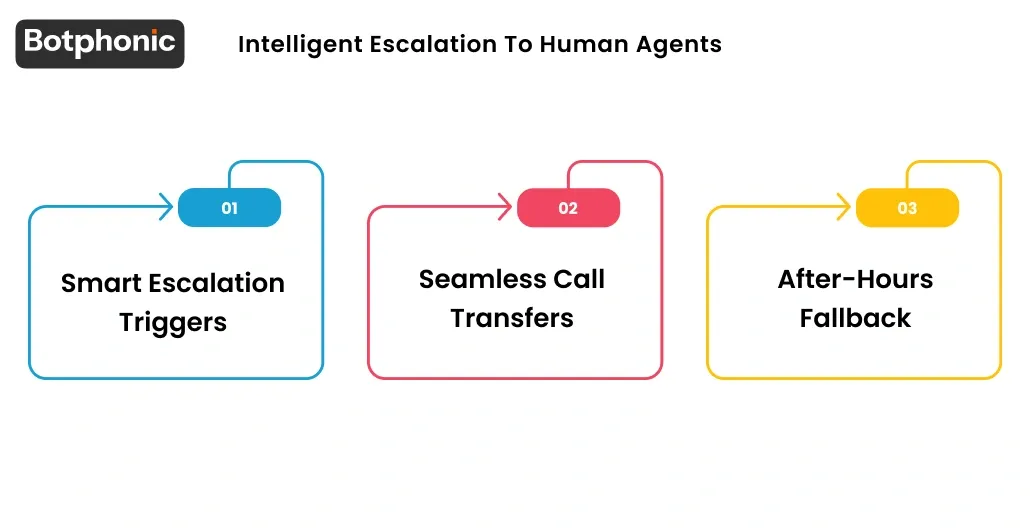
Every retail AI call assistant will insist that it can be escalated to a human agent. It is a question of how smart it makes it. This can be evaluated in a number of dimensions.
1. Smart Escalation Triggers
Escalation triggers are the system that is able to identify sentiment. Such as, presence of a frustrated caller, an out of scope question, or a situation where a human judgment is needed?
Do not limit the escalation process to instances when the caller specifically requests a human to be involved. But also escalate when the AI realizes that the discussion is not successful.
2. Seamless Call Transfers
On call transfer, it’s observed, that the human agent is provided:
- With a summary of the conversation
- If the caller is required to restart all over again
The difference between an escalation that seems seamless and one that increases the frustration of the caller is a smooth handoff, in which an agent who receives the handoff has all the context to continue with.
3. After-Hours Fallback
In the event of the absence of a human, i.e. after hours or when overflow is critical, how does the AI receptionist respond? Does it capture a callback request detail enough to be of use? Does it provide the caller with alternatives?
 PRO TIP
Reservation Scheduling Integration and Appointment
Any type of retailer that provides:
- In-store consultations
- Installation
- Custom order consultations
Or any form of an appointment-based service requires their AI call assistant to make scheduling a native feature. This implies that it will be integrated with whatever scheduling or calendar program that the retail operation is utilizing – not a workaround in which the AI is able to gather the availability of the caller and then an individual would have to input it into the system at some point in the future.
What True Automation Looks Like
Live scheduling integration implies the AI verifies actual availability in real time, makes the appointment, delivers the confirmation, and records the whole process without the human intervention in case of making daily bookings. This saves retailers much time at the moment when they should make calls to schedule appointments by using forward and backward calls.
CRM Logging and Lead Capture
Each and every caller is a potential customer, and every contact provides information.An effective AI call assistant captures calls on the CRM automatically, recording who called, what they inquired, what the outcome was, and whether a follow-up was necessary.
This leaves a contact record even when no sale is made that can enable the sales team to make appropriate follow-ups.
Why This Matters for Retail
Among retailers that obtain substantial revenue through consultative selling. Such as,
- Furniture stores
- Custom jewelers
- High-priced electronics stores
Getting the information on leads of callers who are interested but do not make purchases at that moment is essential.
AI Should Be Able To
The AI must be capable of recognition of purchase intent, collecting contact data, and labeling the lead with interest in the product in order to make outreach follow-up applicable and timely.
Multi-Location Support
The complexity of retailers with more than one location is specific. When the call goes to the central number:
- You have to forward it to the appropriate location.
- You have to process it knowing which of the locations has the inventory.
- or the system is able to provide the necessary service.
How Does AI Call Assistant Help
An AI call assistant, which is informed about the inventory in only one place, does not perform as well in multi-location operations.
Seek systems that will check inventory across the locations and give the caller choices. Such as, “We do not have that in the downtown shop, but we have three at the west side store.” Instead of just saying that it is out of stock at the called location.
Analytics and Reporting
What the retailer AI answering service says about your customers is one of the under-estimated advantages of a good AI call assistant. When call data is analyzed in aggregate form, it shows, what:
- The majority of your customers inquire about most
- Questions about products arise frequently
- Complaints are asked about repeatedly
- Drives a purchase.
How Retailers Can Use This Data
Those retailers who are sensitive to such data may use it to better:
- In-store display
- Web strategies
- Marketing communications
- Employee training
A platform that offers useful analytics, as opposed to a total of call volume, but intent analysis, commonly asked questions, and escalation patterns, provides business intelligence as well as its operational role.
An example of that is Botphonic which integrates analytics into its retail call assistant providing service, enabling retailers to observe trends in call data that would otherwise not be present when calls are merely being answered by human operators without real-time logging.
Stability During Peak Retail Periods
The AI call assistant must work at the most critical time and that is during peak retail times. When the calls are more than when the staff capacity is at its worst. A system that works well in a normal situation but fails when there is a high demand of the system is counterproductive.
Inquire directly with vendors in regards to their uptime guarantees and how their system can handle load and their record throughout known high-demand times such as Black Friday. This will be available to any serious vendor. When they are not able to do it, that in itself is informative.
Start with enhancing operational efficiency of your retail business
Schedule a demoConclusion
Choosing an AI call assistant in retail business is not a feature comparison game, it is the strategic choice as to what operational issues you are attempting to address and whether the platform that you are considering can address them in a retail business environment.
The aspects that make the difference include real-time inventory integration, natural language understanding, intelligent escalation, scheduling integration, and meaningful analytics, which make tools designed to support retail unlike general-purpose systems that happen to support phone calls. Test, test, test and select what works in your particular operating environment.