Summarize Content With:
Introduction
Let’s have the conversation. Most operators are quietly sidestepping. Phones are ringing. Leads are slipping. Teams are stretched. And everyone acts like this is just how it’s always been. It isn’t. It’s leakage masquerading as operations.
The point of this piece isn’t to lionize automation or diss call centers. It’s to confront a simple truth of business: responsiveness is the new margin. Customers don’t compare you to yourself; they compare you to whoever answers first. Quickness is a sign of acumen. Silence is a sign of ineptness.
The trouble is, this is a structural issue. The traditional call center model relies on human availability in a world that no longer honors business hours. Nights, weekends, overflow calls – that’s where the revenue quietly leaks away. Unanswered calls are more than just unanswered calls; they’re also unanswered decisions already made by someone else who answered first. Add in the rising cost of labor, burnout, and turnover, and the numbers just don’t add up.
The answer isn’t replacing humans. The answer is redesigning the front line. The AI call assistant intervenes as the always-on intake layer, answering immediately, qualifying intent, gathering data, and directing complexity where humans actually matter. Not a gimmick. Not a chatbot with a headset. A structural improvement to how inbound demand is handled.
This isn’t about being a futuristic-sounding thing. It’s about reclaiming something old-fashioned: answering when someone calls. The technology changed. The point wasn’t.
Is Automation Declining Client Trust?
There is one thing we may put out of the way. Automation is not despised by customers. They hate bad automation. There is a difference. A massive one. Individuals do not like systems that place them in circles. They dislike the robot voices which they feign to hear. They hate an AI that:
- Not innovation
- Carelessness in an artificial voice
- Cannot get riled when something really counts
Missed Calls Are Lost Deals
Whether to automate calls or not is not really the question. The real question is simple. Automation without sabotaging trust?
To save your dashboard metrics, you lose your trust. The reason why businesses desire call center automation is closely tied to Silicon Valley delusions and has nothing to do with missed calls.
Missed calls are not neutral. They are:
- Lost deals.
- Lost patients.
- Lost contracts.
- Lost appointments.
Each ring in which one does not respond is an opening note by a competitor.
Industries Affected by Missed Calls
Such industries as healthcare, home services, real estate, and local retail become very familiar with this pain. Failure to pick up will result in someone picking up. Brands that are first to respond to the call are a luxury in terms of loyalty. Then it is the cost issue. Human agents are expensive. Not unfairly expensive. Simply costly to the structure. Pay, perks, development, turnover, re-hiring. It adds up. Fast.
The Mirage of 24/7 Coverage
And coverage is a mirage. Even financially well-endowed groups are hardly able to provide 24/7 human access without draining the margins. Nights, weekends, holidays. Customers still call. Humans still need lives. Add churn. Call center turnover is a legend. Constant onboarding. Constant retraining. The institutional knowledge is vaporized on a quarterly basis. Efficiency bleeds quietly. It is the pressure cooker that none of the slick blog posts would like to talk about.
Why Hate AI Call Centers, Customers?
The Lazy Implementation of AI
Most of them are lazy because of the way they are implemented. That is the blunt truth. Businesses apply automation to engineering malfunctioning processes and demand applause. Instead, they get backlash. One-way AI is spam. Two-way AI is the baseline. In case your system cannot be interrupted, cannot adjust in the middle of a conversation, cannot go to a human, then it is not intelligent. It is an obstacle. Instantaneously, customers experience that.
People Are Not Anti-AI, They Are Anti-Being Ignored
People are not anti-AI. They are anti-being ignored. Something interesting occurs when automation is effective. Customers stop noticing it. That is the goal. Not flashy. Invisible competence.
Effective Use of AI in Home Services
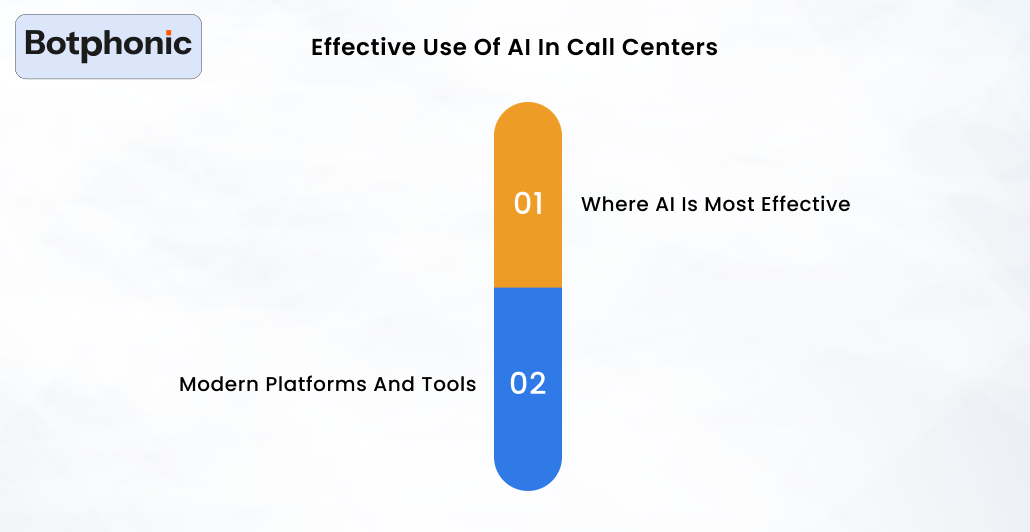
Where AI is Most Effective
The AI answering service is currently really effective in particular types of work. For instance, repetitive tasks, predictable workflows, low-emotion, and time-sensitive. The tedious things that silently consume operational bandwidth. Picking up inbound calls in real-time. Qualifying leads. Booking appointments. Handling FAQs. Checking order statuses. Including after-hours enquiries. This all does not involve the brilliance of humans. It requires consistency.
Modern Platforms and Tools
This is where the contemporary platforms pay off. And some of the tools are years ahead of the game. In case you desire the raw chain of command, alternatives such as Botphonic have established a reputation in terms of providing what most vendors say but very seldom deliver: human-like conversations, solid intent recognition, and actual action taking, rather than the romanticized voicemail with a better name.
The Hybrid Model: Where AI Meets Human Interaction
Philosophical Change: Automate the Right Things
The most important change is philosophical. Quit attempting to mechanize all. Automate the right things. Since the hybrid model is the only one that passes through reality. Complete automation fails when things become complicated. Total human staffing fails miserably. The reason behind the success of hybrid systems is that they adhere to both limitations.
The Winning Flow: AI First, Humans When Needed
The winning flow is direct. AI Answering Service helps instantly, understands intent. AI resolves simple requests. It is in the case of nuance or feeling that humans intervene. No theatrics. No ideology. Right division of labor done right.
The Benefits of AI Call Assistants
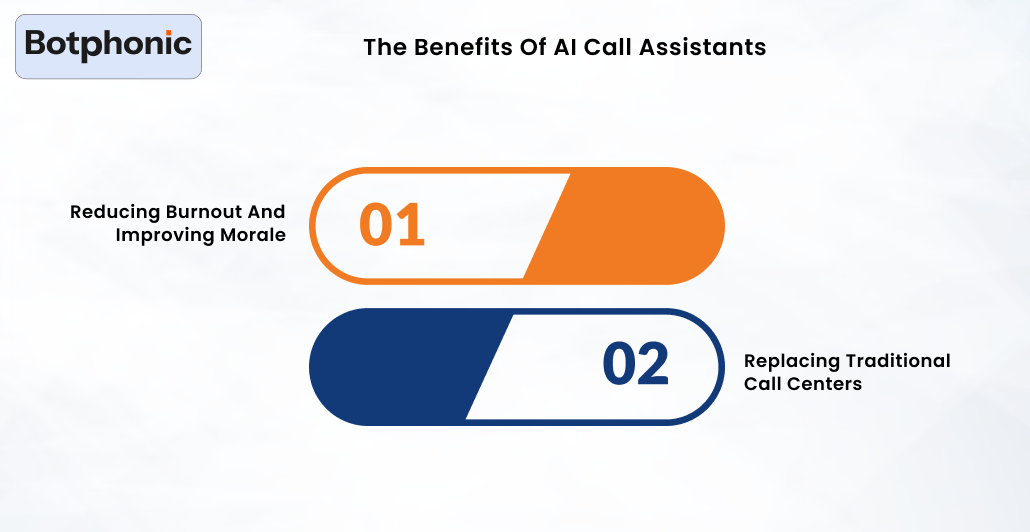
Reducing Burnout and Improving Morale
This is usually embraced by frontline teams more than the executives anticipate. Now agents are released out of cognitive quicksand when AI swallows repetitive calls. They deal with meaningful discussion rather than repeating hours of operation one hundred times in a day. Burnout drops. Morale stabilizes. Service quality improves. Funny how that works.
Replacing Traditional Call Centers
And next one must demolish a popular myth. Automation of call centers does not imply the conversion of buildings into robots. It implies that there will be no need to have a traditional call center at all. The modern stack is lean. An intelligent voice interface. An automatic data capturing CRM. Definite escalation policies where complicated processes are diverted to humans immediately. No cubicle farms. No endless phone trees. There are no fake buyers who like to press the buttons.
Voice AI: The Competitive Advantage
Effective Automation for SMBs and Overwhelmed Businesses
This strategy is absolutely effective with companies who are overwhelmed by incoming calls. Realtors balancing viewing. Service business lacks leads in the field. SMBs who can neither pay to use a full support floor, nor can pay to remain quiet at the same time. This is where performance becomes a winner or noise. Voice AI platforms do not all get created equally. Others still are as 2010 IVR systems dressed in a neural network costume. The rest, to their credit, have narrowed it down so that the majority of the callers can be unable to notice the difference.
Botphonic’s Conversational Realism
It is an accent that Botphonic has an inclination to conversational realism. Natural cadence. Context retention. Real-time actions. There is a vast distinction between speaking to a piece of paper and conversing. It is an instant feeling for customers.
The Limits of AI: Emotional Complexity
Emotional Talks and Legal Subtleties
And this is where marketers hardly ever tell the truth. There are still areas in which AI Call Assistant does not perform well. Emotional talks are, in any case, hard to make. Anger, grief, panic. These have to do with human sympathies, rather than algorithmic guesses. There is also legal subtlety and medical complexity, which advance the limits of safe automation. When a vendor tells you that AI can do it all nowadays, the same goes as a late-night infomercial. Entertaining, not reliable. Skepticism is healthy. Blind adoption is expensive.
The Decision: To Automate or Not?
Ask the Right Questions
But what is the decision on whether to automate your call center or not? Ask embarrassing questions. Do you miss calls regularly? Do inbound calls made to you most of the time represent repeats? Are customers calling during the out of business hours? Is there an apparent escalation route in the instance of complexity?
In case your answers to those are yes, automation is not an option. It is overdue. When you say no on every card, you will be creating friction with your push of AI to the stack. Technology is not supposed to defend budgets.
The Cultural Shift: Moving Towards Speed
The New Brand Identity: Speed
The more profound change that is occurring currently is the cultural one. Companies are shifting towards responsiveness discussions as opposed to staffing discussions. The question no longer is how numerous are the agents you hire. It is concerning the speed of response. The new brand identity is speed.
Voice AI: The Future of Communication
Instant Replies and Data Dividends
When market share becomes disproportionate, the first responder ends up gaining market share in an environment in which the attention span is becoming smaller and the number of alternatives is increasing. Not because they are the best. Because they showed up. The response time is reduced to almost zero by the AI receptionist. That is what transforms the competitive forces. An instant reply business is bigger, more organized, more trustworthy. The number of people behind the curtain may still be small. About 89% of customers have stated that they prefer brands who offer voice support.
Another sort of dividend is the data dividend, which is not much discussed. Robotic call management generates systematic information. Call transcripts. Intent patterns. Objection trends. Conversion signals. This is not usually documented by human teams. AI does it by default. That three-way loop is piled on. An improved data results in improved scripts. Improved scripts translate into increased conversion. Increased conversion is enough to invest more in automation. Flywheels love clean data.
The Real Shift: Beyond Technology
Building a Living System
But we shall not idolize the transition. There are new duties brought forth by automation. You have to build escalators. Conversations have to be audited. You need to sharpen prompts and knowledge bases. Set it and forget it is a myth. The firms with voice AI that have succeeded use it as a living system. They iterate, they monitor. They tune. The training that was previously done on agents is now being done on systems.
The Role of Conversational Design
It is also a branding factor. The voice is intimate. Purchasers literally listen to your brand. When your AI is robotic or dismissive, then that is what you are. When it comes out clear, confident and helpful, then that is your reputation. People should act rather than intend to act.
The Future of Call Centers: Let Go of Nostalgia
Inertia and Resistance to Change
Yet another unpleasant fact. Numerous companies are holding on to the conventional call centers due to their inertia rather than reason. It is not a strategy to do things the way we have always done them. It is a weakness shrouded in nostalgia. The past deserves respect. Not blind loyalty.
The Need for Adaptation
Call centers used to solve an actual problem. The world of communication that was centralized. However, the communication layer is different. Infrastructure must follow. Switchboard operators are no longer insisted upon by us. We adapted. This transition is occurring here but with more speed and volume.
The Real Shift to Responsiveness
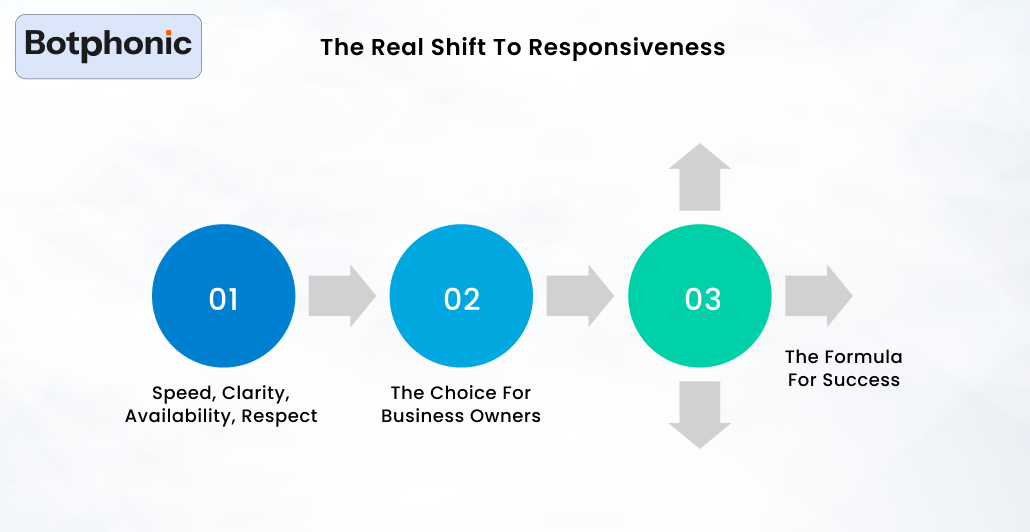
1. Speed, Clarity, Availability, Respect
And yet, caution remains wise. Automation must be that which feels like friction, but not humanity elimination. The customers are supposed to feel assisted and not treated. When automation starts to be extractive, resistance sets in. That is why conversational design is the new frontier. Not only what AI is telling you, but the way it is telling you. Tone, pacing, recognition, micro-pauses. The specifications that used to be a part of the actors are transitioning to engineers. Firms that invest in this silently take over.
2. The Choice for Business Owners
What is the position of the average business owner who looks at ringing phones and increasing payroll?
In a position of choice. Not inevitability. You can continue to increase the number of people and absorb the mess. Or you can re-architecture the system such that calls will be intelligently handled by default and intelligently escalated when necessary. The majority of enduring strategies reside in the middle ground.
3. The Formula for Success
The thing is that the most effective automation can be traditional in nature. Reliable. Polite. Responsive. Centuries-old values that precede AI. Technology changes. Expectations do not.
Answer quickly. Listen carefully. Resolve efficiently. Escalate respectfully. That formula worked in 1950. It works now. The mechanism of delivery simply changed.
If missed calls are still part of your operating model, it’s time to rethink the front line.
Listen to a real AI call in action.Conclusion
Voice AI is not concerned with people replacement. It is concerning the responsiveness of scale. Organisations recover lost income. The customers recover their time. Human beings regain the discussions which really need to be judged. All these other things are infrastructure. Quiet, invisible, always on.
The companies that have this are not putting their heads in the clouds. They are reestablishing communication on first principles. Speed. Clarity. Availability. Respect. And then when you perceive this, the question ceases being should you automate calls. It will be more difficult to explain why you have not.