Summarize Content With:
Trust, responsiveness, and human relationships founded healthcare. However, today’s hospitals face an ever-increasing operational paradox: rising patient demand clashes with limited staffing and congested phone lines. These challenges overwhelm front desks.
The uncomfortable truth? The last playbook that hospitals can use to scale patient communication is yesterday.
This is exactly the reason why the AI call assistant For Healthcare is no longer a futuristic addition. It has turned into one of its working necessities.
In this paper we will dissect the reasons why hospitals need such technology not five years down the line but now and how it is transforming accessibility, efficiency, compliance, and patient satisfaction in realistic and quantifiable ways.
What Is an AI Call Assistant For Healthcare and Why Does It Matter Today?
Its essence is to be an intelligent voice automation system adapted to the medical setting. It takes incoming and outgoing calls, makes appointments, replies to frequently asked questions, directs emergencies in the right direction, makes reminders, appointments, the following up, and is also integrated with hospital systems, without human involvement in most routine activities.
However, the thing is, here is how it does this 24/7, without feeling exhausted, without making any mistakes in this case of multitasking, and without keeping patients on hold.
Hospitals today are in a high pressure ecosystem where:
- When a call is not answered it is lost revenue.
- The response time decreases patient satisfaction.
- When employees are overworked, they burn out quicker.
- The amount of administrative overhead is increasing.
With 100 percent calls, traditional call centers are simply not able to match peak volumes, particularly in the case of flu seasons or health crises, insurance cycles. More agents are recruited, and the payroll expenses do not ensure the steadiness of quality. Compliance and privacy issues have been common with outsourcing.
The AI receptionist alters the situation. And it is not a substitute of care, it guards it by reducing the communication burden that often wastes medical staff time, on repetitive communication.
Let us term it as it is, hospitals are hemorrhaging money through unanswered phones.
Every missed appointment booking, ignored insurance follow-up, and unreturned call creates friction in the patient journey. Over time, this friction damages the organization’s reputation and drives up economic costs.
Following are typical everyday situations:
- One of the patients calls to book another appointment but has to wait in line for 12 minutes and gives up.
- One of the family members attempts to check the visiting hours but can never converse with a human.
- No follow-up reminder was made, which gave a no-show.
Now multiply this with hundreds of calls a day and the effect becomes evident.
This is squarely confronted by an AI call assistant for healthcare. It provides an option of answering all calls at once and automatically validates appointments. Moreover, it also carries out real-time rescheduling and does not miss sending reminders.
The result? Decreased no-shows, less hassle in scheduling and quantifiable increase in operational throughput. Hospitals that are not paying attention to this shift may have to face the risk of losing to their competitors who have taken communication efficiency as a strategic instrument.
 PRO TIP
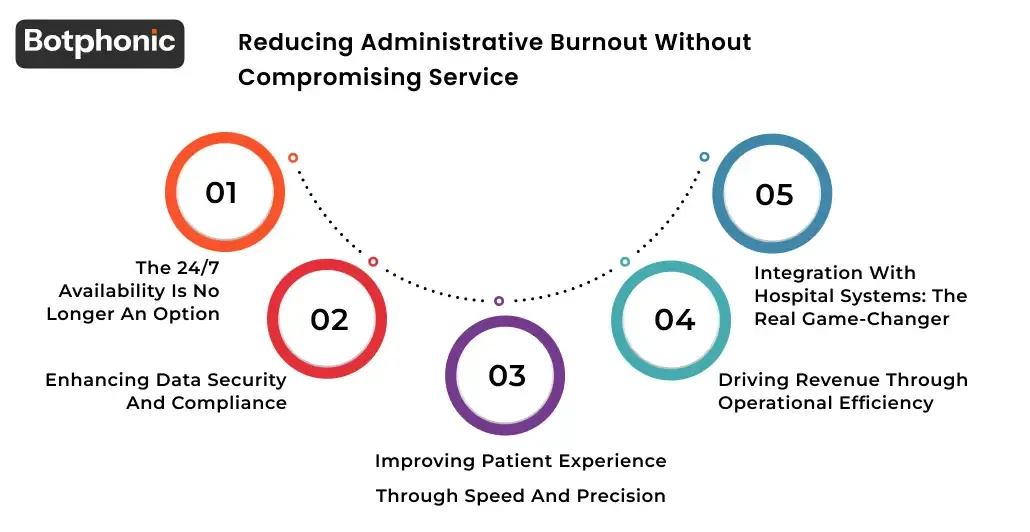
Reducing Administrative Burnout Without Compromising Service
Burnout is not merely clinical in healthcare but also administrative.
Front-desk teams deal with repetitious queries on daily basis:
- “What are your hours?”
- “Do you accept my insurance?”
- “Can I book an appointment?”
- “Has my lab report come in?”
These calls waste precious hours that staff could channel into in-depth patient interactions.
In reality, high-quality trained personnel should not spend most of their time repeating information that automation could handle safely and correctly. An AI call assistant for healthcare absorbs this repetitive work.
It automatically triages calls and escalates when needed, and does routine interaction automatically.
This shift does two things:
- Lessens the psychological exhaustion of administrative work teams.
- Enhances patient service delivery.
Human personnel no longer have to cope with monotonous work, but by concentrating on the empathy-based interaction, which is not possible in the case of machines.
When used wisely, automation complements the human touch, as opposed to killing it.
1. The 24/7 Availability Is No Longer an Option
Healthcare requirements do not work within business hours. Late at night, patients phone in seeking clarifications on the prescription. Parents are in need of acute pediatric consultation. Older patients require assistance in instructions.
When the hospitals are not available after 5 pm, patients go to other places, usually to the urgent care or competitors whose accessibility is more convenient.
An AI call assistant For Healthcare guarantees 24/7 access. It can:
- Book next-day appointments.
- Give clinical directions that are already recorded.
- Emergencies along the route.
- Send digital follow-up links.
- Get patient information to use in call back queues.
This isn’t about luxury. It has become more about meeting new demands. Retail, banking, travel – all other industries have universally adopted the norm of 24/7 support. Healthcare can not afford to be left behind. And that’s one of the main reasons why AI voice assistant for healthcare is required.
2. Enhancing Data security and Compliance
Communication in healthcare is not informal. It will have to comply with tight regulatory regulations, such as HIPAA and area privacy laws.
Call Handling through manual means is risky:
- Lack of consistency in identity verification.
- Misplaced notes.
- Mistake in human documentation.
- Unsecured leakage of data.
Developers can easily program a sophisticated AI call assistant with integrated compliance protection. The assistant performs standardized identity checks and captures meetings safely. It then codes the data and incorporates it into hospital management systems.
Automation brings about auditing. Any exchange has a traceable record.
This degree of uniformity is not only useful, but safeguarding, in a regulatory climate where fines are stiff.
3. Improving Patient Experience Through Speed and Precision
The patients make their verdict on the hospitals even before they step in the building.
Their initial meeting is usually through the phone. When such an experience includes music, transfers, and confusion, trust goes away instantly.
On the other hand, patients who were provided with:
- Instant call pickup,
- Understandable, conversational responses,
- Easy-flowing booking of appointments,
- Instant confirmation messages,
confidence rises.
This consistency is achieved via an AI call assistant For Healthcare. New systems are based on natural language processing which reduces conversational speech as opposed to strict command prompting. The communication is smooth and meaningful.
Speed sends the message of competence. Professionalism is expressed through precision. The improvement in patient satisfaction scores, as well as online reviews, can be observed tangibly when hospitals modernize communication.
4. Driving Revenue Through Operational Efficiency
Let’s talk numbers.
The hospitals have a small margin. Large proportions of budgets are swallowed by personnel expenses, investment in infrastructure and compliance with regulations.
An AI call assistant For Healthcare has a direct effect on financial performance by:
- Lessening the no-show rate by use of automated reminders.
- Securing after-hours booking.
- Reducing payroll dependency so as to handle calls.
- Increasing the rate of call conversions.
- Reducing outsourcing costs.
The payback is not a concept. It can see it in monthly performance reports.
Automation does not remove human jobs It redistributes resources to higher value positions that lead to clinical excellence. Efficiency is not about compromising. It’s about eliminating waste.
5. Integration with Hospital Systems: The Real Game-Changer
Isolated technology causes more challenges than solutions. The actual force of AI call assistant
For Healthcare is to be integrated with:
- Electronic Health Records (EHR),
- Practice management systems.
- Billing platforms
- CRM databases
With the proper connection, the assistant can:
- Retrieve real-time availability of appointments.
- Automatic patient record updates.
- Ensure that there is insurance eligibility.
- Issue trigger billing signals.
- Summary of the log into the patient files.
This helps in eradicating redundancy in data entry and clerical errors.
It is not only the digital future of the hospital operations it is interconnected.
A Subtle Shift: The Emergence of Intelligent Voice Platforms Like Botphonic
With automation, not every solution fits well in hospitals as they seek to automate. The pre-built generic call bots used in retail settings or telecommunication settings are frequently ineffective in medical settings. Healthcare needs domain intelligence, compliance knowledge, and verbal sensitivity.
New platforms such as Botphonic are created based on this realization. They not only make hospitals change their technology to fit the strict forms but also fit automation into the actual clinical procedures. Botphonic is not about glitzy features but it’s also a HIPAA – compliant AI call assistant. It’s more about the practicability of its implementation- smooth integration, deploy-at-will and quantifiable performance values.
Hospitals that use specialized voice automation platforms are experiencing a much easier onboarding and a shorter time-to-value than patchwork solutions.
The moral is straightforward; healthcare should be given purpose-built tools and not hack and slash ones.
 NOTE
NOTE
Hospitals in a Rapidly Changing Landscape Future-Proofing
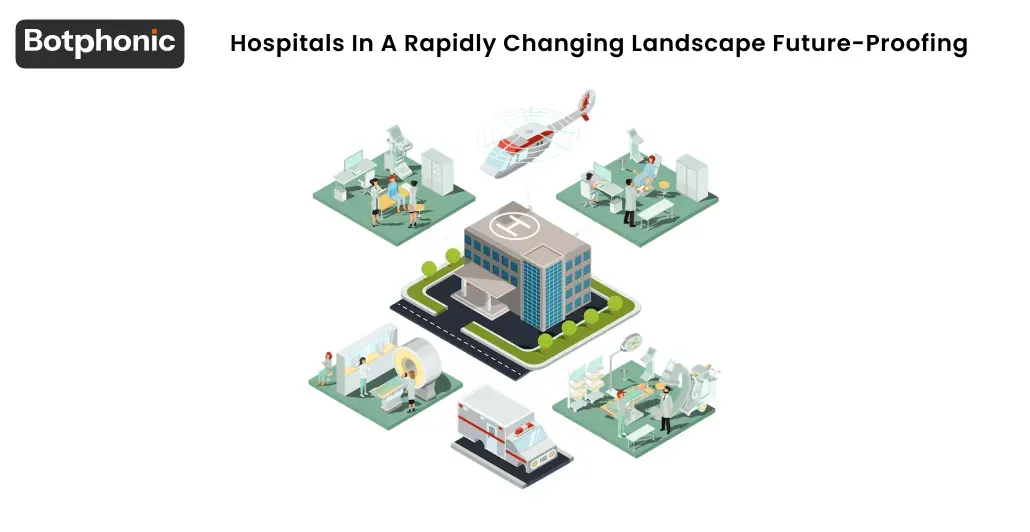
The healthcare sector is getting into a decade characterize by:
- Aging populations,
- Workforce shortages,
- Rising operational costs,
- Heightened patient expectation,
There is a digital transformation requirement.
Hospitals using only the traditional communication models will not be able to scale in a sustainable manner.
A Healthcare AI call assistant is not an ad hoc efficiency solution. It forms the backbone of the future generation of hospital operations.
Consider it the online front door. With the rise of telemedicine, remote monitoring, and the popularity of decentralized models of care, voice automation becomes the glue that holds patient communication together. Hospitals that do so today are place as progressive organizations. The ones that wait too long are the ones that may now find themselves competing on the losing side of a fast-moving competitive situation.
Conclusion
It has been a traditional field that has always been a realm of innovation. The stethoscope used to be a symbol of improvement. Electronic records have appeared disruptive. Intelligent voice automation is today at a crossing point.
An AI call agent For Healthcare is not the question of its replacement of man. It is regarding strengthening the human aspect of medicine through eliminating administrative friction. It
- Minimizes lost opportunities.
- Strengthens compliance.
- Enhances patient satisfaction.
- Supports staff wellbeing.
- Protects revenue.
Hospitals are unable to absorb increased demand using the same resources. Communication should be intelligent. The ones that will not only survive but be ahead of the pack is that institution that realizes this change and takes definitive action. The adoption of voice automation is not a risky venture in an industry where seconds and each call count. It’s simply good management. And in healthcare, it is not only good management that saves more than money, it protects care itself.
Let Botphonic schedule a demo to show you the power of an AI call assistant For Healthcare.
Try Now