
Summarize Content With:
Quick Summary
White-label reselling allows businesses to sell established products or services under their own brand while a third-party provider manages fulfillments. This model reduces startup costs, eliminates R&D expenses, lowers fixed overhead, and enables faster market entry.
The key white label reseller benefits include higher profit margins through service arbitrage, recurring revenue potential, scalable growth without any operational complexity, brand ownership, and competitive market positioning.
Introduction
White label reselling has become the strategy that even small businesses can apply to expand without sinking their budget. To put it simply, white-label reselling means offering an established product or service under your own brand, turning someone else’s expertise and infrastructure into your own revenue-engine.
As per survey, it’s said that white-label ecosystem is going to skyrocket into a near-$100 billion industry by 2026. It’s driven by demand from agencies, service providers, and SMBs who are seeking cost-effective growth solutions and broader offering.
Across different sectors such as SaaS platforms and digital marketing services and even consumer products like cosmetics, the white-label approach is empowering even smaller businesses to compete with larger ones. In the white-label cosmetics segment alone, the market was valued over 1 billion in 2024 and is projected to grow as much as USD 1.57 billion by 2030.
What Is a White Label Reseller Model?
A white label reseller model is a business structure where one company has created a product or delivers a service and another company rebrands and sells them as their own.
The original provider, who is also called as white-label partner or supplier remains invisible to the end customer and the reseller owns the client relationship, pricing strategy, brand positioning, and also overall market response.
How the White Label Reseller Model Works
The mechanics of white label reseller model is pretty straightforward, let get into it:
- The Provider Develops the Product or Service: The developed product could be anything from SaaS software and digital marketing services to hosting, cybersecurity, AI tools, or consumer goods.
- The Reseller Rebrands It: The product is then delivered under the reseller’s logo, brand name, and even visual identity. In service industries, reports, dashboards, and communication are fully customized.
- The Reseller Sets Retail Pricing: The reseller then proceeds to purchase the product at wholesale or discounted rates, meanwhile it also markups the product for profit.
- The Provider Handles Fulfillment: Systems such as delivery, infrastructure, support systems, and even backend operations are managed by the original provider.
- The Reseller Manages Customer Relationships: Sales, onboarding, communication, and retention policies stay in the reseller’s hands.
How It Differs from Similar Models
To avoid confusion in further labels, let us tell you how white-label differs from others:
- White Label vs Private Label: White label products are usually standardized and sold to several resellers, whereas private label products are customized for a single brand.
- White Label vs Affiliate Marketing: Affiliates are those who earn commission via referrals. White label resellers control their pricing, client relationship, and smartly manage brand equity.
Lower Startup Costs and Reduced Capital Risk
One of the most appealing white label reseller benefits include its ability to expand without even draining capital. Earlier business growths used to demand heavy upfront investment, such as product development, hiring specialists, purchasing software, securing infrastructure, and absorbing payroll risk even before something is earned.
But with white label reseller model it has become easier. Instead of creating something from scratch you can just optimize any existing product or service that’s already developed, tested, and operational. The primary investment can easily be shifted from production to sales and marketing.
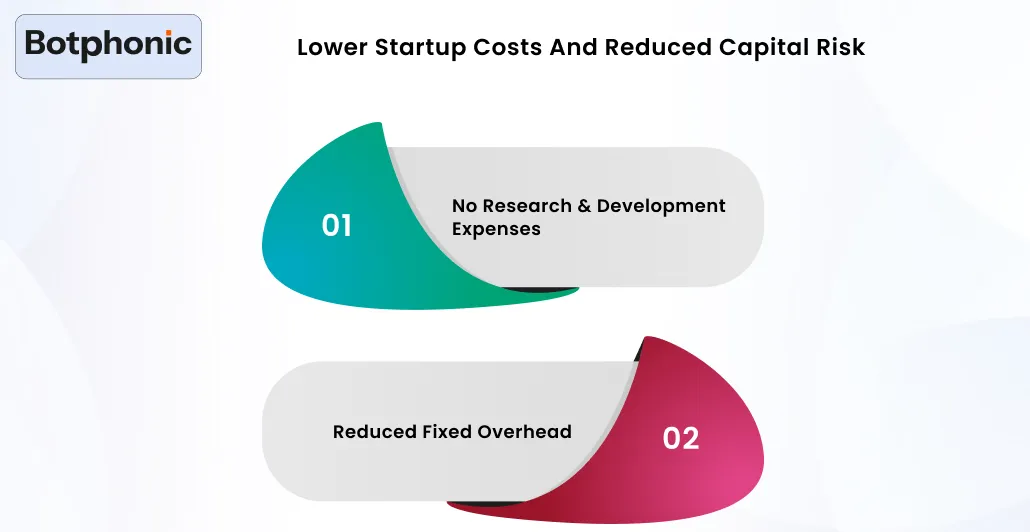
1. No Research & Development Expenses
Product development has always been expensive and time-consuming. Whether it’s about building SaaS software or developing a digital marketing service framework, even customer service automation R&D costs can escalate into five to six categories.
With white-label reselling, there won’t be any necessity for:
- Engineering teams
- Product testing cycles
- Infrastructure buildout
- Compliance or technical certification burden
For small businesses who’re asking how to start a white label business, it just lowers the barrier to their entry.
2. Reduced Fixed Overhead
Traditional expansion usually means increasing fixed expenses, like salaries and benefits, office space, equipment and software licenses, and most importantly training and onboarding.
With white-label reselling, you can convert many of these fixed costs into variable costs. You’ll just have to pay the provider per client, per project, or per subscription. If sales increase, costs increase proportionally, but so does the revenue. For SMBs who operate on margins, this flexibility is a smart strategic move.
Real-World Example
Consider a small IT consultancy who wants to offer managed cybersecurity services. Even hiring certified cybersecurity professionals could cost about $100,000+ annually per specialist. And ensure to add software licenses and compliance requirements which makes the capital risk significant.
Instead, the firm partners with a white-label cybersecurity provider, results in:
- No requirement of full-time hires
- There won’t be any need for long-term payroll commitments
- Immediate service expansion
- Wholesale pricing with built-in profit margin
With this one can test its demand without even risking financial overexposure.
Higher Profit Margins Through Service Arbitrage
Another stronger white label reseller benefits is their ability to increase margins while scaling revenue without proportionally increasing costs.
1. Higher Profit Margins Through Service Arbitrage
Service arbitrage allows resellers to purchase desired services at wholesale rates and sell them at retail pricing under their own brand. The difference between what a service provider is paying to deliver a service and what they actually are charging to the client is direct profit, especially when it can be done repetitively without any additional proportional costs.
2. Margin Control and Pricing Flexibility
On the contrary to those affiliate models, white-label resellers maintain full control over their pricing structure. It enables in:
- Custom markup strategies
- Tiered pricing models
- Bundles service packaging
- Premium positioning
With a smarter pricing anatomy, it ensures margin protection even in competitive markets.
3. Recurring Revenue Potential
There are many white-label services that operate on subscription models, generating:
- Predictable cash flow
- Monthly recurring revenue (MRR)
- Higher customer lifetime value (LTV)
Recurring billing actively transforms one-time sales into long-term revenue streams that compound profitability over time.
4. Infinite Capacity Expansion
As fulfillment is getting outsourced, growth doesn’t need to be built parallel infrastructure. Providers can absorb increased workload, allowing resellers to expand client volume without any operational strain.
Scalability Without Operational Complexity
The white-label reseller model allows small businesses to grow lean, actively avoiding the common trap of scaling into chaos.
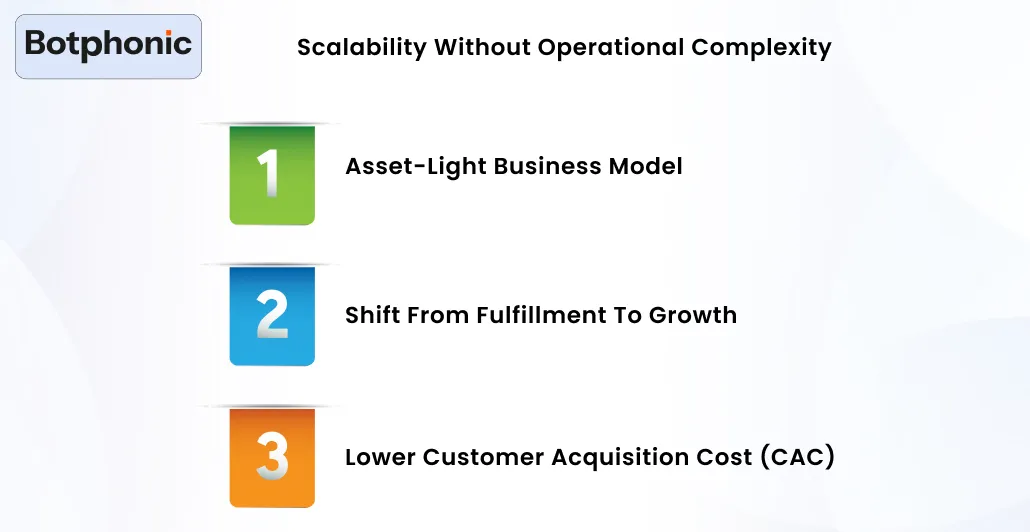
1. Asset-Light Business Model
A white-label structure help eliminate
- Infrastructure investments
- Continuous training expenses
This asset-light business model helps in keeping fixed costs low and converts expenses into variable costs.
2. Shift from Fulfillment to Growth
Instead of managing service execution, business owners can just redirect their energy toward:
- Sales strategy
- Strategic partnerships
- Marketing optimization
- Customer experience
This shift from fulfillment to growth is one of the major competitive advantages for SMBs.
3. Lower Customer Acquisition Cost (CAC)
White-label wrestling helps in reducing acquisition costs via:
- Cross-selling to existing clients
- Bundled service offerings
- Expanded value propositions
When you offer more services to the same client base, CAC drops while average revenue per customer increases.
Brand Ownership and Market Positioning
Beyond the financial upside, white-label reselling strengthens brand equity and market perception.
1. Sell Under Your Own Brand
One of the valuable aspects of the model is its ability to sell under your own brand. You just need to maintain:
- Full brand ownership
- Custom reporting and packaging
- Branded client communications
Customers associate their results with your company and not the provider behind the scenes.
2. Authority and Client Retention
Offering a broader service stack helps in increasing perceived expertise. When clients see you as a comprehensive solutions provider, you benefit from:
- Increased authority
- Stronger trust
- Higher retention rates
This positioning also helps in improving long-term revenue stability and reduces churn.
Competitive Advantage in Saturated Markets
In industries where there’s already a crown, being a differentiator matters. White-label partnership enables small businesses to compete with larger firms without any enterprise-level infrastructure.
1. Faster Innovation Cycles
As providers are continuously update and improve their products, resellers can gain access to:
- Advanced tools
- New features
- Emerging technologies
Business benefits from faster innovation cycles without having to fund R&D internally.
2. Market Responsiveness
White-label reselling enables rapid adaptation, with this businesses can introduce:
- New services
- Trending solutions
- Emerging tech integrations
 NOTE
NOTE
Who Should Consider Becoming a White Label Reseller?
If you are thinking strategically about growth, sustainability, and scaling without any massive internal investment. There’s also a clear set of businesses who can benefit with the help of white label reseller model.
1. Digital Marketing Agencies
Marketing agencies often need to expand their service offerings without even hiring experts in every niche but with white-label reselling you can easily solve those issues.
According to industry data, it can also be seen that about 73% of agencies already use white-label services to scale efficiently. And it was observed that about 40-60% of their workload tend to grow around 2.3x faster with 18-22% higher margins.
Source : Promethean Research, Digital Agency Industry Report
If you are already offering services like web design, branding, or social media management, adding white-label services like:
- SEO
- PPC advertising
- Content marketing
- Email automation
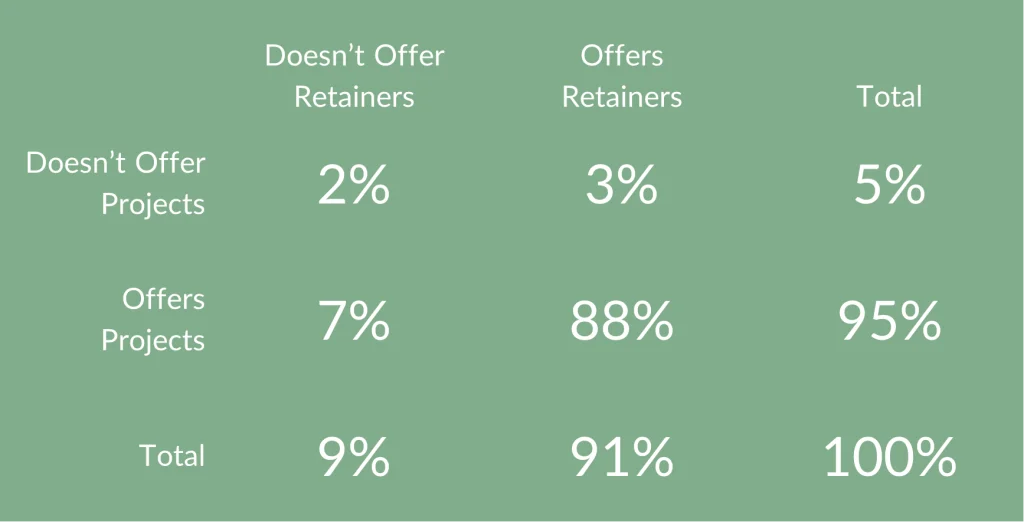
Can instantly expand the value proposition. In How Digital Agencies Grow Report, it was found that agencies usually generate revenue through a mix of projects and retainers. By offering both the project-based and retainer-based engagements, it was seen growing agencies completed 24% more projects while serving 16% fewer retainer clients than average.
2. IT Service Providers (MSPs)
IT firms often face pressure to offer cybersecurity, cloud solutions, data backup, or even compliance services. Rather than building in-house departments, white-label partnerships allows you to:
- Sell enterprise-grade solutions
- Maintain lean operations
- Protect margins
With the broader outsourcing trend increasing, about 80% of companies have now outsourced at least one service, which drives higher demand for white-label offerings.
3. Consultants And Coaches
Consultants are already equipped with two main factors that drive business, trust and influence. But that they actually lack is productized and scalable offerings. White label solutions such as:
- CRM systems
- Online learning platforms
- Marketing automation tools
- Analytics dashboards
Enables consultants to monetize beyond their advisory services, for instance subscription-based revenue, increasing customer lifetime value, and also the shift from project work to recurring revenue.
Saas Startups
Early-stage SaaS companies have found smarter benefits from reselling. Rather than developing secondary features like CRM integrations, analytics modules, or automation add-ons from scratch, SaaS companies can white-label existing solutions to extend their platform firmly.
This doesn’t just cut the development time by 60-70% compared to in-house build but it also accelerates launch timelines by weeks.
Web Development Firms
Web firms are the ones who usually have to face questions like, “Can you manage our marketing as well?” or “Can you do more than just builds?”
But with white-labeling you can solve this by allowing firms to offer:
- SEO & SEM management
- App development
- Hosting & maintenance
- Monitoring & reporting dashboards
Potential Challenges to Consider
White-label reselling has always delivered strong upside but it’s not frictionless. Every business model has pressure points and the key is understanding them early, that helps you manage them intelligently.
The five most important challenges to evaluate before committing to a white-label reseller strategy are:
- Vendor Dependency Risk: The white-label partner you choose directly impacts your brand’s reputation. If delivery quality drops or timelines slip, your brand will have to absorb the damage. Strong SLAs, performance monitoring, and careful partner selection is important.
- Margin Compression: While serving arbitrage can easily generate strong profits, the competitive pricing and rising wholesale costs can squeeze margins. Sustainable growth essentially requires value-based pricing and strategic positioning.
- Limited Product Control: You don’t actually control product development or feature updates. If clients have requested customization outside your provider’s scope, flexibility might get limited.
- Brand Reputation Exposure: Clients usually associate the service with your company not your supplier. Ongoing quality oversight and proactive communication helps protect trust and retention.
- Market Saturation: Since many businesses might use similar white-label providers, differentiation becomes crucial. And most importantly niche specialization and strong branding prevents standardization.
 PRO TIP
Best White Label Reseller Services to Consider
To maximize white label reseller benefits, choosing the right partner is critical. The provider you select directly impacts service quality, scalability, margins, and even client satisfaction. L
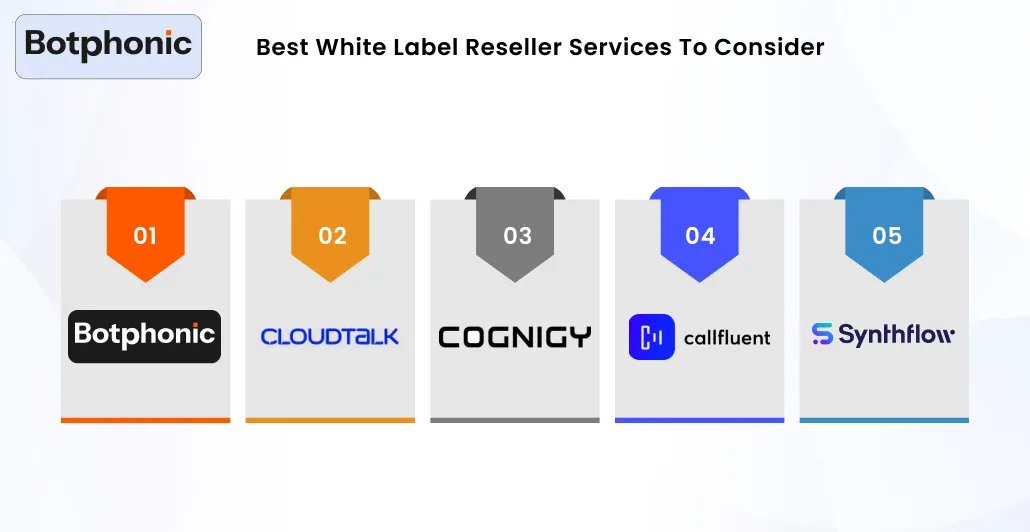
1. Botphonic
Botphonic is a white-label AI voice agent platform that is designed for businesses who want to deploy automated calling and email outreach solutions under their own brand. It has enabled agencies, SaaS providers, and even service firms to offer AI-powered voice assistants for lead qualification, appointment booking, and customer support.
For resellers. Botphonic actively provides customization options, branded dashboards, and also scalable automation capabilities. This feature makes it particularly attractive for companies who are looking to enter AI automation space instantly without even having to develop proprietary voice technology. Its model actively supports recurring revenue via subscription-based deployments.
2. CloudTalk
CloudTalk is a cloud-based business calling software that is widely used by sales and support teams. With white-label and reseller capabilities, it has enabled businesses to offer branded VoIP and call center solutions to their clients.
It’s well-suited for IT firms, telecom sellers, and even SaaS companies who are aiming to expand into communication services. Features like call analytics, CRM integrations, and international number coverage makes it a strong addition to a scalable service stack.
3. Cognigy
Cognigy specializes in AI-driven conversational automation, offering enterprise-grade chatbots and voice bots. Its white-label capabilities allows businesses to resell advanced AI solutions under their own branding.
This is valuable for agencies and technology consultants who are serving enterprise clients requiring smart automation tools. Cognigy’s strength is its NLP capabilities and omnichannel deployment options.
4. CallFluent
CallFluent focuses on AI-powered call automation and virtual sales agents, It has enabled businesses to resell automated inbound and outbound calling systems under a private brand.
For entrepreneurs who are exploring how to start a white label business, CallFluent offers a lower technical barrier to entry into the AI calling market. Agencies can package automated lead follow-ups, appointment reminders, and also sales qualification services without hiring any call center staff.
5. Synthflow
Synthflow is a no-code AI voice assistant solution. It has enabled businesses to build and deploy conversational AI systems quickly. Its white-label structure supports agencies and SaaS providers looking to integrate AI voice capabilities into their own service portfolio.
Synthflow’s flexibility makes it ideal for small and mid-sized businesses who want to test AI-driven services with minimal upfront investment. It has enabled resellers to position themselves as a premium automation solution while maintaining pricing control and recurring subscription models.
Is Being a White Label Reseller Worth It?
Yes, but only if you are approaching it strategically. The white-label reseller model isn’t just a shortcut but it’s one of the most efficient growth frameworks that is available to small and mid-sized businesses. When executed properly, it works by combining low overhead, scalable infrastructure, recurring revenue, and strong margin control into one cohesive system.
Pick Botphonic, a trusted white-label provider and launch services that lets your business grow without limits.
Contact Sales!!Conclusion
White-label reselling isn’t just about cutting corners but scaling smarter. Instead of investing heavily in product development, staffing, and infrastructure, businesses can easily focus on what drives growth.
For small and mid-sized businesses who are looking to expand services, increase recurring revenue, and remain operationally lean, the advantage of white-label reselling is clear. When it’s paired with the right niche, reliable providers, and a disciplined pricing strategy, it becomes a sustainable and highly scalable business model.