Summarize Content With:
Summary
Both voice AI and traditional IVR have the same mission to automate business phone calls, but they function very differently. In the U.S, companies now balance customer experience, cost of operation, and efficiency against these two technologies. This comparison takes a look at why and what makes each different.
Introduction
Consider calling a business and having your problem answered when you utter only one word, no menus, no wait times, no hassle. That’s why a lot of companies in the U.S. are now moving away from traditional call automation in place of Voice AI, making voice AI IVR comparison USA an important discussion for modern businesses.
Recent studies, in fact, reveal that the overwhelming majority of consumers actually prefer AI phone systems versus traditional menu-based systems (a survey found that 89% of customers expressed a preference for an AI vs. IVR system because it offers more natural interactions and speedier resolutions).
This shift is no passing fad; it represents how consumer behavior and technology have changed in an accelerated environment like one where every call counts, especially as businesses modernize with an AI IVR system.
Quick Comparison Table on Traditional IVR vs Voice AI IVR
This table highlights a clear voice AI IVR comparison usa for businesses evaluating call automation.
| Aspect | Traditional IVR | Voice AI IVR |
| Caller Interaction | Uses button presses or fixed voice commands | Allows natural, free-flowing conversation |
| Understanding Intent | Follows pre-set rules and keywords | Understands meaning, context, and intent |
| Call Flow | Rigid and menu-driven | Flexible and conversational |
| Customer Experience | Often feels slow and frustrating | Feels smooth and human-like |
| Accuracy | Misroutes calls when callers vary in phrasing | Handles different speech styles accurately |
| Scalability | Requires manual updates to grow | Scales easily as business needs change |
| Learning Ability | Does not improve over time | Learns and improves from past calls |
| Maintenance | Needs frequent manual changes | Requires fewer ongoing adjustments |
| Handling Complex Queries | Struggles with multi-part questions | Manages complex conversations well |
| Best Fit | Simple, predictable call needs | Dynamic, high-volume U.S. businesses |
Understanding Traditional IVR Systems
What Is a Traditional IVR and How It Works
A classic IVR (Interactive Voice Response) is an option for a telephone system that can answer calls as well as send callers on their way by using prerecorded prompts and limited keypad or voice recognition input.
When callers dial, they’re greeted with a list of options: “Press 1 for Sales, Press 2 for Support,” and so forth, which can be navigated by hitting buttons or speaking short commands to get through menu systems. The system uses rules-based logic to redirect calls or offer basic information without a live agent.
Years ago, standard IVR systems made their job load lighter and enabled them process large amounts of phone calls. They’re good for simple requests such as routing calls, verifying account status, or pointing callers to an agent.
Key Features of Traditional IVR in U.S. Businesses
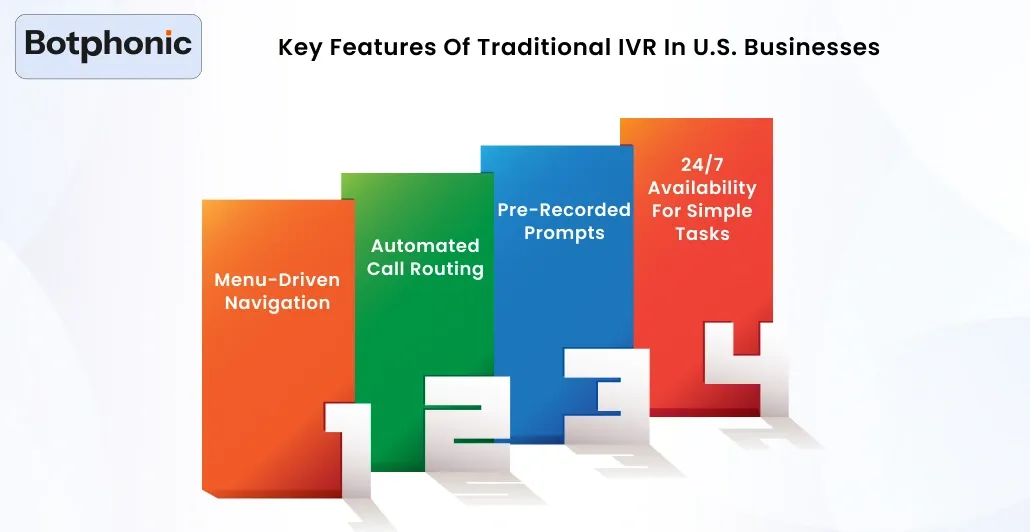
The following are traditional features of IVR systems that U.S.-based businesses have yet to shed:
- Menu-Driven Navigation: People navigate telephone menus with numbered or oral prompts. The paths are predefined and predictable, which maintains orderly calls but restricts flexibility.
- Automated Call Routing: IVR assists in routing callers to the appropriate department or queue without involving a live agent. This lightens the agent load of simple asks and can help you handle peak call times.
- Pre-Recorded Prompts: Scripts and prompts are all published in advance and pre-recorded. They give great direction, but it can feel a bit fake or robotic to callers (and overly repetitive when you have intricate questions).
- 24/7 Availability for Simple Tasks: Conventional IVR systems keep working, be it in the middle of the day or night, to answer basic questions such as inquiries about an account status or company hours.
 PRO TIP
Where Traditional IVR Performs Well
There’s still a place for old-fashioned IVR in some businesses. It is great for predictable call volumes that only require the routing of basic information or simple task assignment. For example:
- High call volume: phone menus assist in the distribution of traffic.
- Straightforward questions: Basic inquiries such as balance, hours, or appointment confirmations tend to be smooth.
- Cost control: Small businesses without the budget to invest in a tech-heavy sales workflow can automate basic functions.
- Routine inquiries: For queries that seldom deviate from a certain set of requirements, IVR is dependable.
What Is Voice AI IVR and How It Works
Voice AI IVR, which involves an artificial intelligence app for phone calls in conversation without having to deal with fixed menus. Callers can converse in natural language, and the system will extract meaning, respond clearly, and execute transactions without requiring button presses. Voice AI listens, learn,s and responds like a seasoned human agent, transforming how U.S. companies handle both inbound and outbound calls.
Contrary to standard IVR, Voice AI IVR is not bound by a pre-defined script. It adjusts in real time, asks follow-up questions when necessary, and routes or resolves calls based on meaning, not guesswork. So what platforms like Botphonic do is they take the Voice AI, and they design it to work in conversational business, real conversations for businesses, as opposed to shoehorning a person into a phone, supported by strong AI CRM integration USA capabilities.
Core Components Behind AI Call Assistants
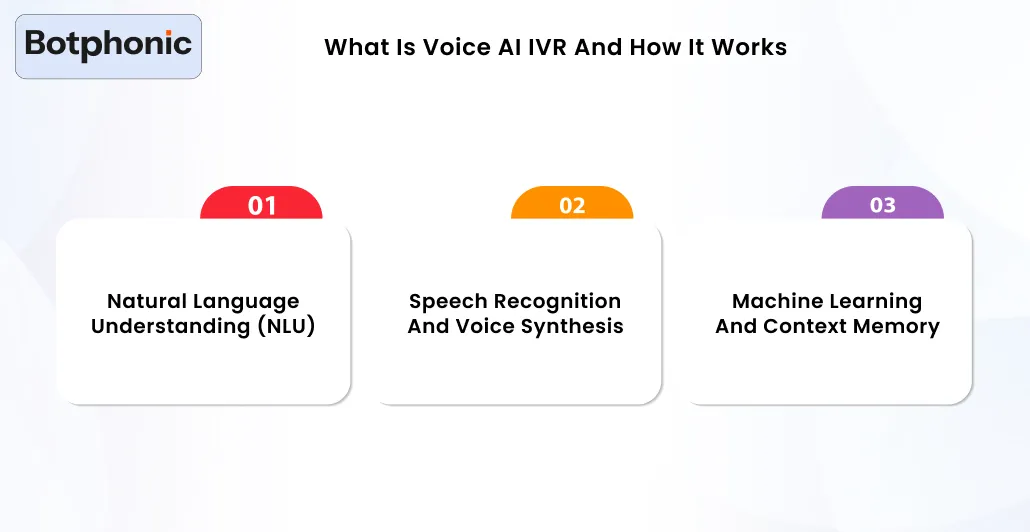
1. Natural Language Understanding (NLU)
NLU enables the system to comprehend what callers are saying, not just the words that they say. It reads intent even when callers are speaking informally, shifting gears or describing issues in their own parlance. This feature alleviates the headache of inflexible voice prompts.
2. Speech Recognition and Voice Synthesis
Voice AI accurately transcribes spoken words, replying in natural tones. It’s a natural, human-seeming conversation that helps hold callers’ attention and keeps them calm throughout the interaction, strengthening overall AI customer service performance.
3. Machine Learning and Context Memory
Voice AI will get better with more calls by using machine learning capabilities. The system can keep context within a call, and it learns from results as time goes on. This learning helps in subsequent sharper and more relevant responses.
 NOTE
NOTE
How Voice AI IVR Fits into U.S. Business Operations
1. Frontline Call Handling
Voice AI responds to incoming calls immediately and automatically manages standard inquiries such as scheduling, order status, and lead qualification. This 24/7 assistance not only lightens the load on the agents but also helps in decreasing waiting times while maintaining a good level of service.
2. After-Hours and Peak-Time Support
Voice AI for U.S. companies: A better way to always be open in the off-hours,s as well as when calls spike. The system is never turned off, enabling businesses to keep up with the pace of customers’ rising demands for quick answers.
3. Integration with Business Tools
Voice AI ties in CRMs, calendars, ticketing systems, and databases. It’s updating its records while on calls and grabbing data without any manual efforts, keeping operations accurate and effective through seamless AI CRM integration USA.
Voice AI vs Traditional IVR: Feature-by-Feature Comparison
Determine the most flexible Voice AI Solutions vs. Traditional IVR U.S. Enterprises. Now, compare Voice AI to traditional IVR based on flexibility, accuracy, and preparation for growth. The disparities have an effect on customer satisfaction, costs, and long-term performance.
This section offers a detailed voice ai ivr comparison usa by evaluating flexibility, accuracy, and readiness for growth across U.S. enterprises.
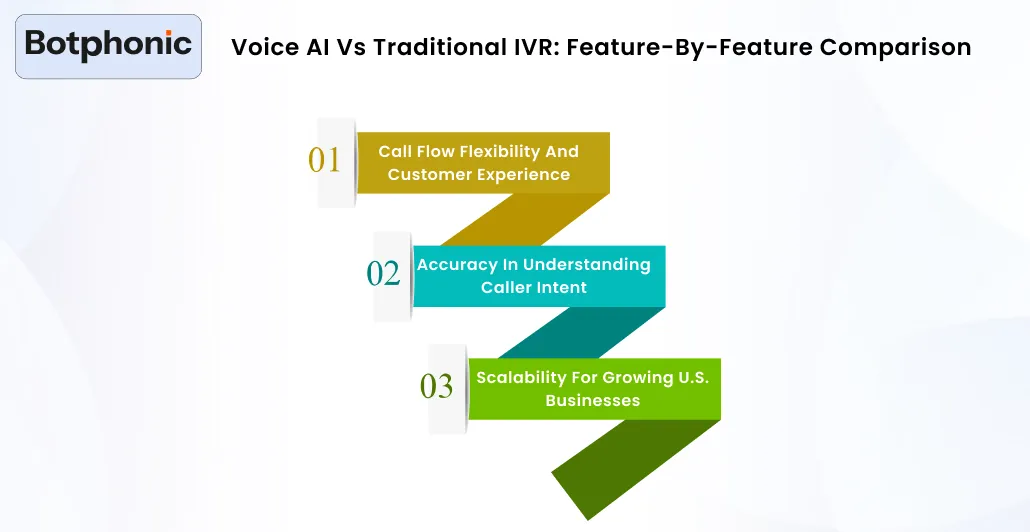
1. Call Flow Flexibility and Customer Experience
At traditional IVR, callers are funneled through static menus, which can be slow to navigate and confusing. Voice AI allows callers to speak their needs in natural language and helps route conversations naturally. This is a less mechanical-sounding approach and tends to cut down on call abandonment.
2. Accuracy in Understanding Caller Intent
Old-school IVR systems require the caller to press buttons instead of using words, or at least super-constrained buttons, especially when wrong routing occurs when callers stutter or rephrase. Voice AI listens to full sentences and grasps intent even when you’re talking with an accent or a dialect found in other parts of the U.S.
3. Scalability for Growing U.S. Businesses
In non-rcu IVR, adding a new option or department requires manual changes. Voice AI can be readily scaled with your growing business, and as new services are launched or when expanding into new geographic regions. Without call trees being rebuilt, the system has to learn and adapt from new data.
NOTE
Cost Comparison: Voice AI IVR vs Traditional IVR
The U.S. costs too much for businesses. Cost is a major contributing factor to U.S. companies deciding in favor of automation. Traditional IVR may initially appear cheaper. And when you peel back the covers, Voice AI IVR frequently creates far more value in the long run by slashing hidden costs and improving outcomes.
1. Initial Setup and Implementation Costs
With typical IVR, there’s that front-end of needing to design call trees, prompt recordings, and script routing rules. Businesses typically pay additional fees when they change menus or add new choices.
Voice AI IVR requires an initial setup, and many teams rely on a structured botphonic setup guide USA to configure conversational flows efficiently rather than just static menus, saving them time in redesign later.
2. Ongoing Maintenance and Upgrade Costs
Legacy IVR requires constant real-time updates with service, department, and call flow changes. And every update requires technical support and testing. Voice AI IVR updates more quickly since teams tweak intent models and responses without needing to redeploy from scratch.
3. Long-Term ROI for U.S. Businesses
By understanding the caller’s need, Voice AI IVR increases call resolution, minimizes transfers, and decreases agent workload. Such enhancements have an immediate impact on operating costs and customer satisfaction. As businesses grow, they’ll ultimately derive more return from Voice AI in the long term as it expands with them rather than holding them back.
Use Cases: When Traditional IVR Makes Sense
There are still use cases for traditional IVR, where ease-of-use and predictability are key.
- Very Simple Call Routing: Those whose calls are only directed to a few departments can use simple IVR menus. It is limited in scope, and that is what makes it easy to set up and manage.
- Low Call Volume Environments: Not all businesses with few inbound calls require this level of conversation management. Conventional IVR copes with a few users and without having complex logic.
- Highly Regulated Message Playback:Other sectors make use of IVR to simply play warnings or disclaimers. Static scripts can satisfy this requirement in the absence of a chatbot.
- Fixed and Repetitive Requests: Where callers only ever want to ask the same question and never vary, traditional IVR performs well.
Use Cases: Where Voice AI IVR Clearly Wins
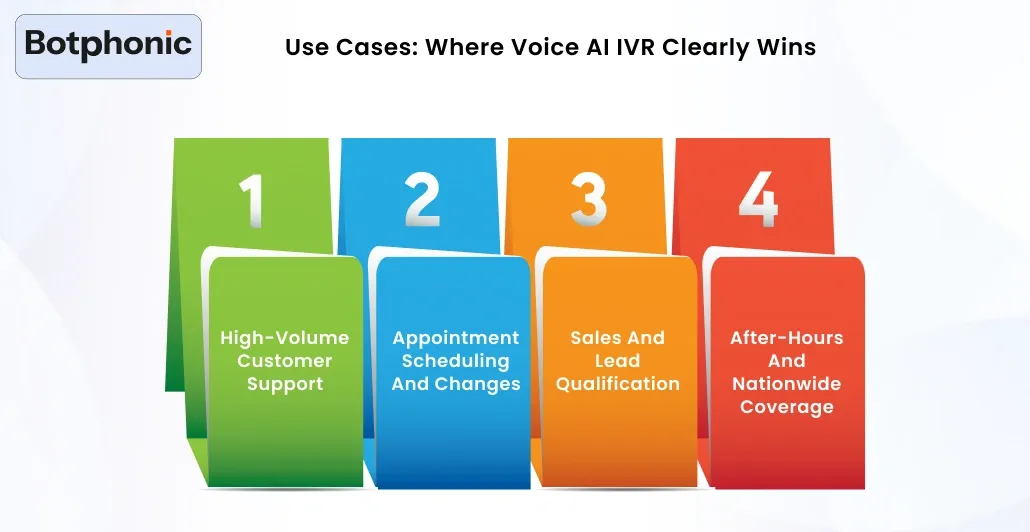
Voice AI IVR best fits for dynamic and customer-oriented setups.
- High-Volume Customer Support: Voice AI manages high call volumes and the variety of customer issues they could have. It cuts out hold times and prevents callbacks.
- Appointment Scheduling and Changes: Callers describe dates, preferences, and modifications using natural language. This is all done together by Voice AI without any confusion.
- Sales and Lead Qualification: Voice AI prompts follow-up questions, identifies intent, and routes hot leads in real-time. This approach increases conversion efficiency.
- After-Hours and Nationwide Coverage: U.S. businesses that work in multiple time zones depend on Voice AI to provide consistent service around the clock.
Why Botphonic Voice AI Fits Modern U.S. Businesses
Botphonic is creating Voice AI for how real business calls flow, not just automation.
- Natural, Human-Like Conversations: Botphonic Voice AI speaks naturally and is attentive. Callers describe their needs without having to chew through menus, which increases satisfaction.
- Easy Integration with Business Systems: Botphonic integrates with CRMs, calendars, and support software. During calls, the system updates records and maintains accurate data.
- Scalable for Growing Teams: Botphonic is flexible to business growth, as services, locations, and call volume expand. Dev teams tweak conversation logic without rebuilding systems.
- Built for U.S. Customer Expectations: Botphonic supports accents, colloquial speech, a nd quick paced interactions typical of the U.S. market.
Now, let Botphonic AI call assistant listen and understand, then respond in the same way without menus or delays.
Try it Today!Final Thoughts
For years, traditional IVR has been a way U.S. businesses manage calls. Voice AI IVR has now raised the bar for speed, accuracy, Accuracy & Customer experience. Growth, flexibility, and efficiency-oriented companies tend to select Voice AI.
Traditional systems don’t take up so much when you have less to begin with, but an AI call assistant can help manage growing call demands more efficiently. The best solution will be determined by the complexity, volume of call traffic, and your long-term plans.