Summarize Content With:
Quick Summary
Modern businesses are no longer asking if I should add AI, but they are evaluating which AI to pick. The basic evaluation metrics involve cost efficiency, scalability, and compliance that now actively drives adoption. AI communication platforms have to deliver measurable value without even any rigid pricing. Moreover, Vapi AI actively addresses this gap smartly with a usage-based plan. Moreover, it has enterprise-ready pricing model that is built for real-world operations.
Introduction
As AI is replacing traditional call centers and manual workflows, pricing transparency has become mission critical. Vapi AI offers a pricing structure that aligns with operational reality. Also, it’s defined consumption-based for agility and customizable for enterprise governance.
For developers building AI-powered communication systems or even a simple AI call assistant, pricing must reflect infrastructure reality. Abstract SaaS tiers rarely align with real-world usage patterns such as call volume spikes, concurrency limits, or model compute costs.
Vapi AI Plans Overview
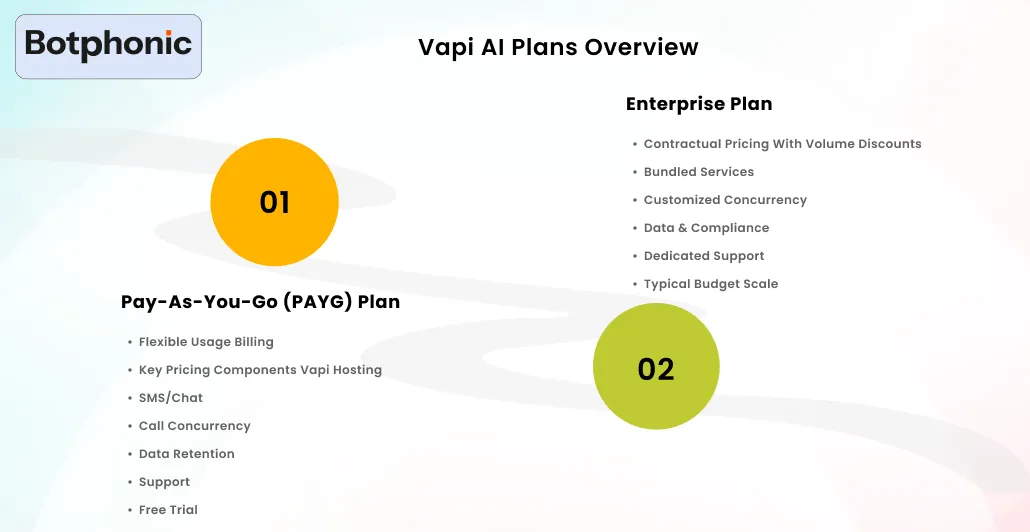
Vapi AI technically offers two primary pricing tracks which are tailored to very different use cases. The pricing plan is as follow as:
- Pay-As-You-Go (PAYG): The Entry Point
- Enterprise Plan: Predictability at a Price
Each plan is designed to reflect different ideas behind smart pricing, for instance:
- PAYG maximizes control and technical flexibility
- Enterprise packages offer predictability and support at scale
Understanding the scope, boundaries, and business implications of each aspect is important before signing up.
1. Pay-As-You-Go (PAYG) Plan
This plan is best suitable for developers, prototype builds, early experimentation, and even low-volume users can easily imply that.
The core characteristics of this plan are:
- Flexible Usage Billing: There aren’t any long-term commitment issues and you only pay based on minutes and usage patterns.
- Key Pricing Components
- Vapi Hosting: $0.05 per minute (this is the core orchestration fee)
- SMS/Chat: $0.005 per message
- Call Concurrency:
- 10 concurrent lines are included
- $10/month per additional line is required
- Data Retention
- For 14 days call logs are stored
- 30 days for chat history
- Support
- Offer email support
- Community discord
- Free Trial
- Offers $10 in credits new accounts
What’s Not Included
This plan does offer flexibility but what it doesn’t include is
- AI model usage fees
- Speech-to-Text charges
- Text-to-Speech (TTS) fees
- Telephony charges
And those who ask for these features need to pay and include these.
Use Cases
- API experimentation
- Early feature testing
- Proof of concept builds
- Lightweight personal or developed tools
2. Enterprise Plan
It’s best studied for medium and large businesses, who need high volume deployments and regulated environments.
Its main features include:
- Contractual Pricing with Volume Discounts
- Annual or multi-year agreement
- Custom pricing based forecasted usage
- Bundled Services
- AI model
- TTS
- STT
- Telephony
Meanwhile it also reduces the complexity by adding multiple cost centers in just one single contract.
- Customized Concurrency
- Offers tailored limits for simultaneous calls
- And offers predictable capacity planning
- Data & Compliance
- Offers customizable retention policies
- Enables businesses to include SOC 2, HIPAA, and other certifications
- Dedicated Support
- Account manager
- Private support channels such a Slack
- Typical Budget Scale
- Costs usually between $40,000 – $70,000+ per year
- Some large enterprises might be able to negotiate beyond this range
Use Cases
- Full-scale voice AI deployments
- Customer support AI integrations
- Enterprise automation with compliance requirements
- High-throughput voice interactions
 PRO TIP
To exactly understand Vapi pricing means going beyond the label of each plan.
| Cost Type | Description |
| AI Model Fees (LLM) | OpenAI, Anthropic, etc.; varies by model and usage |
| Speech-to-Text (STT) | Converts audio input; charged by provider |
| Text-to-Speech (TTS) | Generates spoken output; separate provider billing |
| Telephony | Phone network fees; Twilio, Vonage, etc. |
Total Cost Estimation
When all components are active even an average AI voice agent might cost you about $0.13 – $0.31+ per minute.
This is something much more than the claim of $0.05/min and shows why absolute transparency is one of the most important aspects in budget planning.
Feature & Add-On Breakdown
Let’s see what features are options and what are some mandatory for a realistic enterprise usage:
- Compliance Add-ons
- HIPAA or SOC 2 compliance, might costs you approx $1,000/mo in PAYG
- Premium Support
- In Enterprise plan dedicated support is offered
- PAYG does get community and still offers ticket or email support
- Retention and Logging
- Extended retention usually requires Enterprise or Custom arrangement
 NOTE
NOTE
The Real Cost Stack: What a Single Call Actually Costs
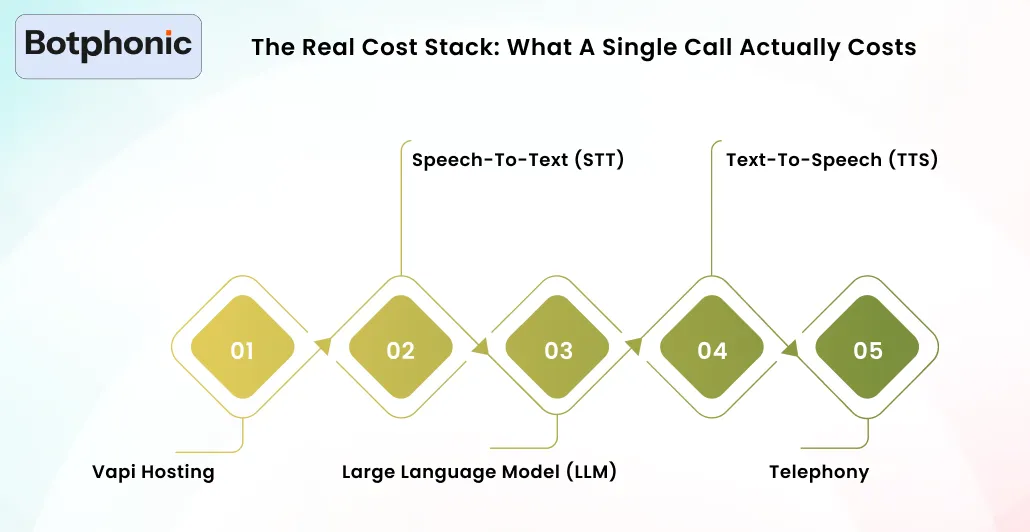
Pricing confusion starts when access costs are counted as total costs. Vapi charges for platform access, but it costs real-world usage differently. Every AI customer service call on Vapi activates five different cost centers while how it manages. Meanwhile, each sector is owned by a different vendor and each invoiced separately.
Let’s check out the whole stack, layer by layer:
1. Vapi Hosting
Costs: $0.05 per minute
This is the only thing that Vapi AI claims smartly, it significantly covers real-time call orchestrations, session management, API routing between services.
But, what it doesn’t offer is
- AI reasoning
- Speech recognition
- Voice generation
- Phone connectivity
2. Speech-to-Text (STT)
Cost: ~$0.01 per minute
Every spoken word is transformed into text before the AI can respond. And, usually providers in the same plan are Deepgram and AssemblyAI, too. The key cost drivers are:
- Audio quality
- Language support
- Real-time vs batch processing
These can not be avoided.
3. Large Language Model (LLM)
Cost: ~$0.02 – $0.20+ per minute
This is the most volatile item, and the most importantly, why it fluctuates is:
- Model choice (GPT-4o vs lighter models)
- Prompt length
- Response verbosity
- Tool or function calling
High-quality conversations might cost more while cheap conversations sound not too efficient.
4. Text-to-Speech (TTS)
Cost: ~$0.04 per minute
Once the AI starts to respond, text is then converted into audio and shared. The usual providers are Elevenlabs and Play HT, whereas, the factors that increases the cost are:
- Natural voices
- Emotional prosody
- Multilingual output
5. Telephony
Cost: ~$0.01 per minute
This is the real phone connection that includes inbound and outbound call routing, carrier fees, and also phone number provisioning. Its providers are as follows:
- Twilio
- Vonage
This cost might not be too big but it’s relentless, which makes every minute count.
Total Cost Per Minute
| Cost Component | Typical Cost |
| Vapi Hosting | $0.05 |
| STT | $0.01 |
| LLM | $0.02 – $0.20 |
| TTS | $0.04 |
| Telephony | $0.01 |
The real total cost per minutes ranges from $0.13 – $0.31+
Why This Matters in Production
A 10 minute call doesn’t cost $0.50 but about $1.30 – $3.10+. And now try multiplying this to thousands of calls per month. Along with this add variance, spikes, and even retries. Just think how much it’s going to cost.
And this is how teams work endlessly with past budgets thinking they are paying “only five cents a minute.” Its disaggregated faction is good for engineers who want to optimize systems but dangerous for businesses who want to forecast their spend.
Vapi AI vs. Botphonic: A Practical Pricing & Feature Comparison
Now we’ll get into the essentials like pricing structure, feature sets, ideal use cases, and even cost predictability.
1. Pricing Structure: Headline vs. Delivered Cost
Vapi AI
- Platform Access Fee: $0.05 per minute is base infrastructure fee, and every other feature is additional which costs different.
- Real Cost Per Minute: Once all components are included in the plan such as telephony + STT + LLM + TTS, it goes about $.23 to $0.33+ per minute.
- Free Credits: Free minute tiers or free credits of about $10 exist but they are limited.
- Other Factors: Telephony fees, phone numbers, model interference, and even voice providers costs are billed separately.
Characteristics
- Usage-based billing with multiple vendors are invoiced separately.
- No inclusive minutes or flat monthly bundles
- Support and compliances are add-ons or they are just tied to higher tiers
It’s best suited for teams who want full control of their AI components and vendor choices as well.
Botphonic
- Botphonic has its own fixed monthly plans with pre-included minutes, such as:
- Starter: ~$20/mo (≈50 minutes)
- Pro: ~$55/mo (≈120 minutes)
- Enterprise: Custom allocation and scale.
- Minutes are counted as part of plans that easily simplifies the budget
- Overage and concurrent call limits tend to be defined within the plan tier itself such as 5-25+ concurrent calls.
- Offer a free trial period of more than 10 days which allows efficient testing before full commitment.
To explore Botphonic AI’s pricing plan in detail, click here!!
Characteristics
- Bundled pricing with predictable monthly charges are shown.
- Minutes, telephony, and core AI handling are packaged.
- Compliance and Enterprise features are pre-added in higher tier plans.
It’s well designed for business who want predictable spend and built-in features.
Feature Set: Developer Toolkit vs Business-Ready AI
| Category | Vapi AI | Botphonic |
| Pricing Model | Usage-based with add-ons | Bundled monthly tiers |
| Setup Complexity | High – developer/engineer centric | Low – business user friendly |
| Telephony Integration | Requires manual provider setup | Included within plans |
| AI Conversation Logic | Custom scripting/API | Pre-built workflows + UI |
| CRM & Calendar Support | Through integrations you configure | Native or easy connect |
| Compliance Options | Add-on or enterprise negotiation | Included at enterprise level |
| Support | Community / ticket unless enterprise | Included up to dedicated at higher tiers |
Contact Botphonic and get a plan that aligns with your business.
Contact us!!Conclusion
Vapi AI offers a smart pricing model that reflects how modern AI infrastructures actually work. Whether it has become modular and highly configurable or not. For teams who want to understand these dynamics, PAYG approach allows flexibility and also technical control that right SaaS pricing won’t be able to match.
However, this flexibility also introduces complexity. This widely advertised $0.05 per minute actively represents only the platform access layer, not the true cost of operating an AI-powered voice system. Besides, this is where Botphonic becomes a clear choice as it offers smart customizations and smart pricing that gives you surety of how you can work with your AI.