
Twilio voice has become a go-to programmable calling platform, and it has its own good reasons for the same. Twilio has helped teams spin up their functionality quickly and scale globally. Meanwhile as businesses are growing and so is their call volume, some have started asking one of the most practical questions one could ask: is Twilio Voice still the best fit?
For a growing number of companies, the answer is simply no. Rising costs, complex configurations, and even inconsistent call quality across different regions have made teams reassess their decision. Once it felt flexible but now this feels really expensive, what was considered powerful first is now considered heavier than required.
Meanwhile, the voice API landscape has now evolved and there are new providers, some established ones. They are offering competitive voice capabilities, simpler pricing models, and more predictable performance. As a result, businesses aren’t just experimenting with Twilio voice alternative but they are replacing it/
Why Many Businesses Are Replacing Twilio Voice
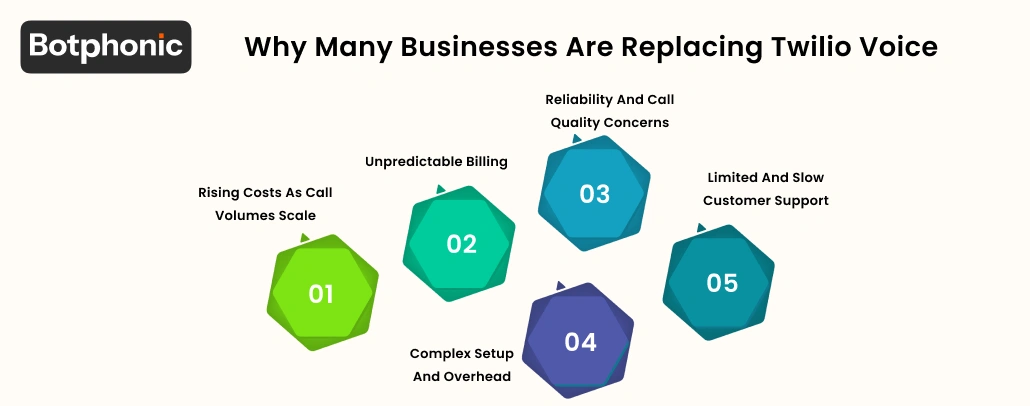
Twilio voice is a capable platform, but capability alone doesn’t justify long-term dependency. As businesses are scaling with their voice operations, many have discovered that Twilio voice introduces cost volatility, operational complexity, and support challenges that weren’t shown early on. But you should know what works well for prototypes and early growth often becomes harder to justify once voice traffic becomes mission-critical.
And this is why more companies are actively searching for Twilio voice alternatives, it’s not solely because Twilio “doesn’t work,” but because it no longer aligns with how modern teams want to manage their voice infrastructure at scale.
Rising Costs as Call Volumes Scale
One of the most common reasons businesses are looking for Twilio voice alternatives is cost. Twilio’s per-minute pricing might appear reasonable at low volumes, but it does escalate quickly as inbound and outbound call traffic grows.
Add call recording, transcription, or international routes, and even the monthly spend can sum up a lot without any clear path of optimization. For high volume uses cases like call center or SaaS platforms, these rising Twilio voice costs often becomes unsustainable factor
Unpredictable Billing
Twilio voice billing isn’t always straightforward. Charges might vary by destination, call type, call duration, and even additional features makes it difficult for finance teams to forecast monthly expenses accurately. Many businesses have reported billing surprises which are tied to usage spikes, routing changes, or features that were enabled without even full cost visibility.
This lack of predictability is one of the major drivers behind the search for more transparent Twilio voice pricing alternatives.
Reliability and Call Quality Concerns
Voice is one of the major factors that is non-negotiable. Dropped calls, latency, or even poor audio quality directly impacts customer trust. Twilio voice performs well in many regions, businesses operating globally have experienced inconsistent call quality depending on carrier routes and geography.
As voice is one of the core customer touchpoints, companies have started prioritizing reliability and carrier control, leading them to explore Twilio voice competitors with stronger regional performance.
Complex Setup and Overhead
Twilio programmable voice offers flexibility but that flexibility also comes with complexity. Configuring call flows, managing webhooks, debugging failures, and maintaining infrastructure often requires dedicated engineering sources.
For teams who want to move faster with less overhead, simpler voice API alternatives to Twilio can easily deliver the same outcomes without engineering tax.
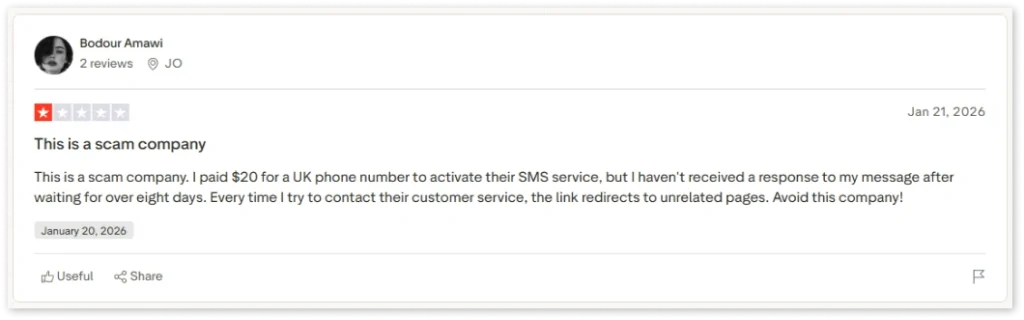
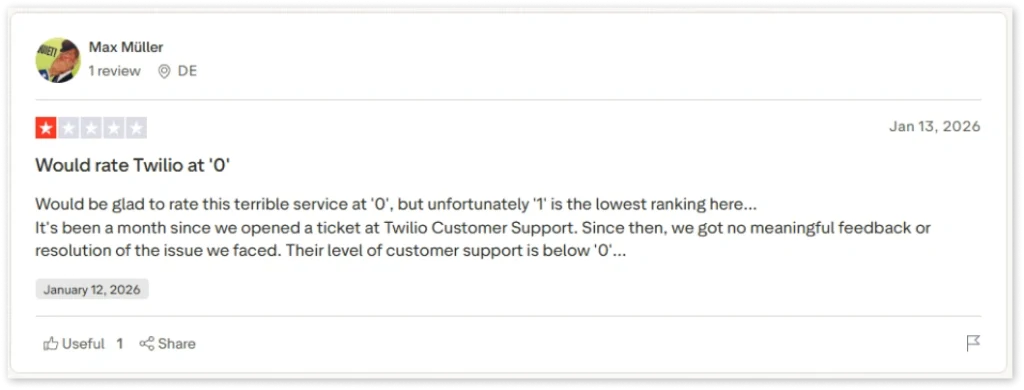
Limited and Slow Customer Support
Support is where customer frustration is detected. Many businesses have reported delayed responses, limited hands-on assistance, or even the need to upgrade plans just to receive meaningful support. When voice systems are down, waiting hours or even days for resolution is not really acceptable.
This is one of the major reasons why enterprise teams in particular look for Twilio voice alternatives with stronger customer support.
Why Twilio Voice Is Often More Expensive Than Alternatives
When you factor in base call rates, feature add-ons, engineering time, and support costs, Twilio voice ends up as more expensive than competing platforms. Businesses that compare total cost of ownership and not just per-minute pricing often find that alternatives are offering better value with fewer trade-offs.
The realization is not enough to enable many teams to seriously evaluate affordable and more predictable alternatives to Twilio voice.
What to Look for in a Twilio Voice Alternative
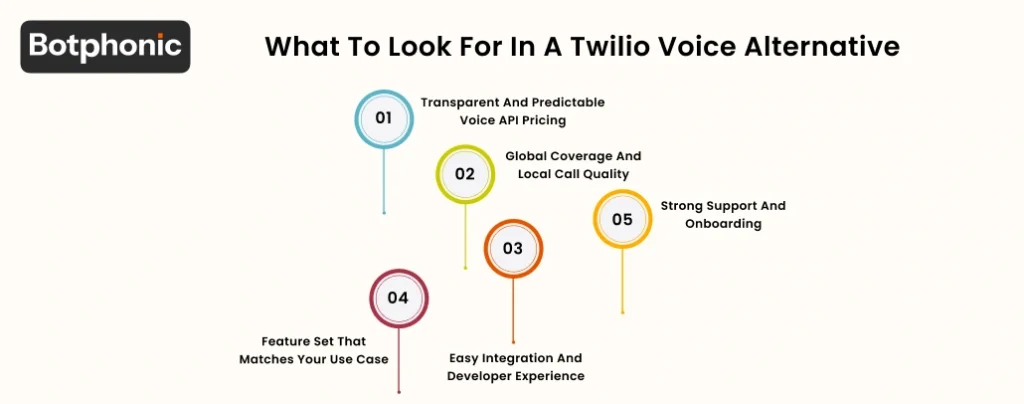
Selecting the right Twilio voice alternative isn’t just about picking the cheapest or flashiest API. But finding a platform that delivers predictable costs, rock-solid reliability, developer productivity, and operational clarity.
Let’s check the key criteria that modern teams use when evaluating voice API alternatives to Twilio:
Transparent and Predictable Voice API Pricing
One of the biggest pain points with Twilio voice is it’s unpredictable billing. You should look for alternatives that offer clear, usage-based pricing with minimal surprises. Your ideal voice provider should make it easy to estimate your monthly spend based on minutes, features used, and even geographic routes, so you don’t end up with unexpected charges.
Global Coverage and Local Call Quality
Voice quality can vary depending on region, because of its carrier router and network peering. A strong Twilio voice alternative will undoubtedly provide broad global coverage with consistent call quality, especially in regions where your user base is concentrated.
It only matters if you are supporting international customers or distributed teams.
Easy Integration and Developer Experience
Instead of wrestling with complex webhook configurations, engineers are demanding clean SDKs, solid documentation, and predictable APIs. You should evaluate how quickly your team can stand up inbound and outbound calling, IVR menus, and call monitoring without even an endless sprint of engineering cycles.
Feature Set That Matches Your Use Case
Not all voice APIs are designed in the same way. Depending on your needs, you should look for:
Call recording, conference calling, IVR and automated routing, and most importantly Web RTC capabilities.
Ensure to match your requirements against each Twilio voice alternative’s feature set to ensure that you are not trading a limitation for another one.
Strong Support and Onboarding
When voice systems are mission-critical, you need support that’s faster than “submit a ticket and wait.” Top competitors to Twilio voice provide onboarding assistance, responsive technical support, and escalation paths that actually work well.
Ensure to look for providers who prioritizes that support quality, because real time matters when customers are actually on the line.

BotphonicVersatile Call Handling
- Can easily be optimized for cold calls, customer care and sales engagement.
Best Twilio Voice Alternatives Compared
Botphonic: Best for AI-Driven Voice Automation
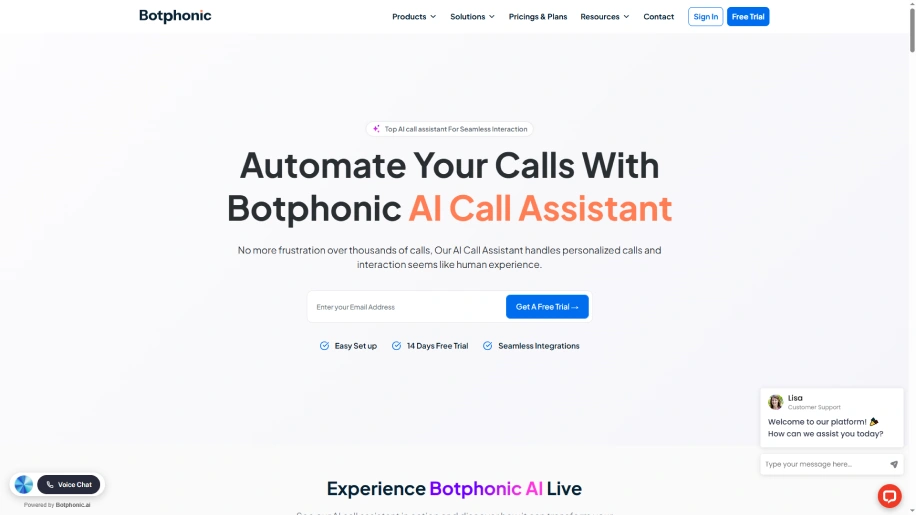
Botphonic is engineered to automate call interactions, whether inbound or outbound. It manages voice interactions using AI assistants that manage inbound and outbound calls, lead qualification, and even conversational tasks. Moreover, Botphonic is especially useful when looking for AI voice capabilities as an alternative to Twilio voice that goes beyond basic call handling.
Key Voice Features
- AI call assistant with human-like conversations
- Multilingual voice support
- Branded caller ID
- Actionable insights and dashboard
- Call tracking and analytics
Pricing & Cost Model
Botphonic offers subscription based pricing and a 14 days free trial, which makes it appealing for teams who are experimenting with automated voice agents before scaling.
| Plans | Price per month |
| Starter | $ 20 |
| Pro | $ 55 |
| Enterprise | Custom pricing |
Best For
Teams who need scalable AI automation for inbound and outbound calls and even voice workflows.
Retell AI: Best for Natural AI Voice Interactions
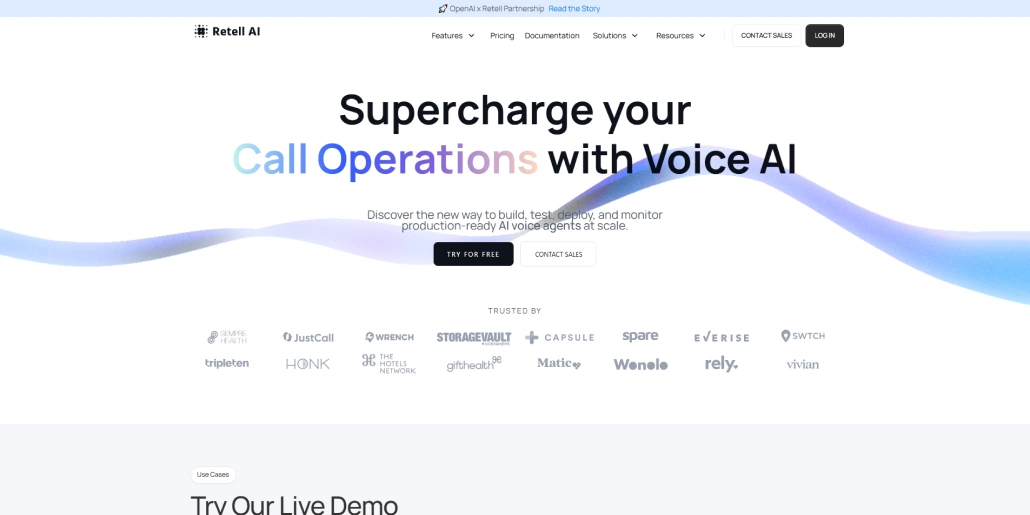
Retell AI specializes in conversational AI voice agents that feel human. It’s a strong choice when its about comparing voice automation alternative to Twilio voice. Moreover, Retell AI also helps in managing edge cases with smarter inputs.
Key Voice Features
- Easy implementation
- Supports multi-turn and outbound use cases
- Offers flexibility and customization
- Seamless integrations
Pricing & Cost Model
Retell functions on pay as you go pricing with $0.07+/minute for AI voice agents. Moreover it offers custom pricing for enterprise plans.
Best For
Teams who need quick and natural voice automation without requiring deep engineering.
Ringover: Best for Cloud Business Phone System
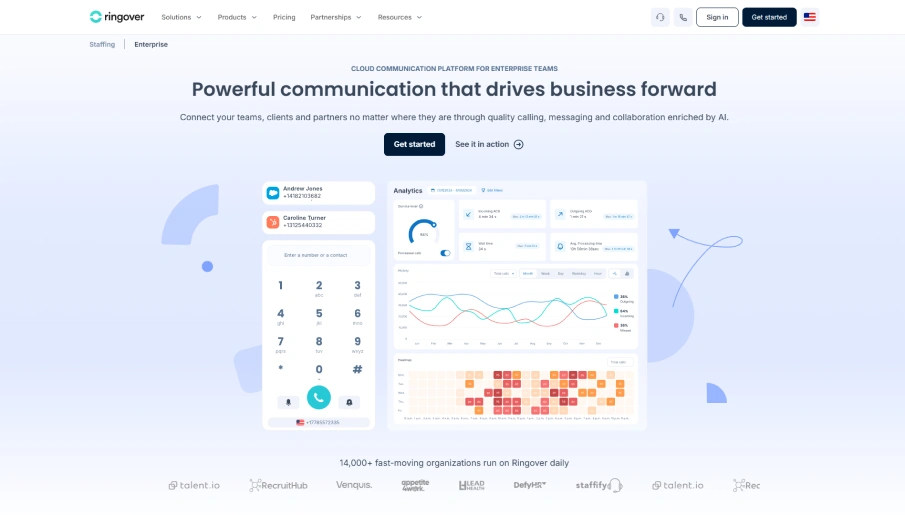
Ringover is a cloud-based business phone and VoIP system with AI enhancements like automated routing and real-time voice features. It’s usually chosen as a Twilio voice competitor when businesses need an integrated telephony platform rather than just voice APIs.
Key Voice Features
- Voice automation
- Cost effective solution
- Offers security and reliability
- Reduces communication silos
- Active customer support
Pricing & Cost Model
Ringover offer tiered cloud phone plans which is designed for business of all sizes
| Plan | Pricing |
| Smart | $21/user/month |
| Business | $44/user/month |
| Advanced | Custom |
Best For
It’s best suited for SMBs and enterprises who need full telephony with AI enhancements.
CallHippo AI: Best for Automated Voice Handling
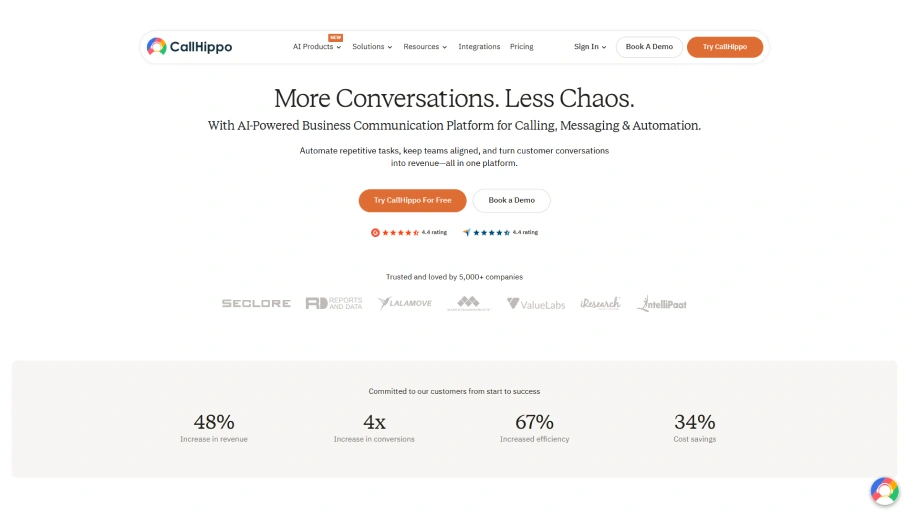
CallHippo’s AI voice agents are usually focused on inbound call automation with CRM integrations, lead screening. And 24/7 support bots. Moreover, it’s also a solid AI voice alternative to Twilio voice for customer support and sales teams. It also provides business phone systems and AI voice agents while offering smart integrations.
Key Voice Features
- Automated inbound and outbound call handling
- Real-time insights and analytics
- Multilingual support
Pricing & Cost Model
CallHippo’s pricing is ultra-light with the Basic plan allowing teams to start with low risk.
| Plan | Approx. Price (USD / User / Month) |
| Basic | $1.18 |
| Starter | $22.42 |
| Professional | $34.22 |
| Ultimate | $46.02 |
| Enterprise | Custom |
Best For
Teams who need automated voice handling with dashboards and CRM integrations can opt for CallHippo.
Learn more: 5+ CallHippo AI Alternatives
Voiso: Best for Workflow Automation
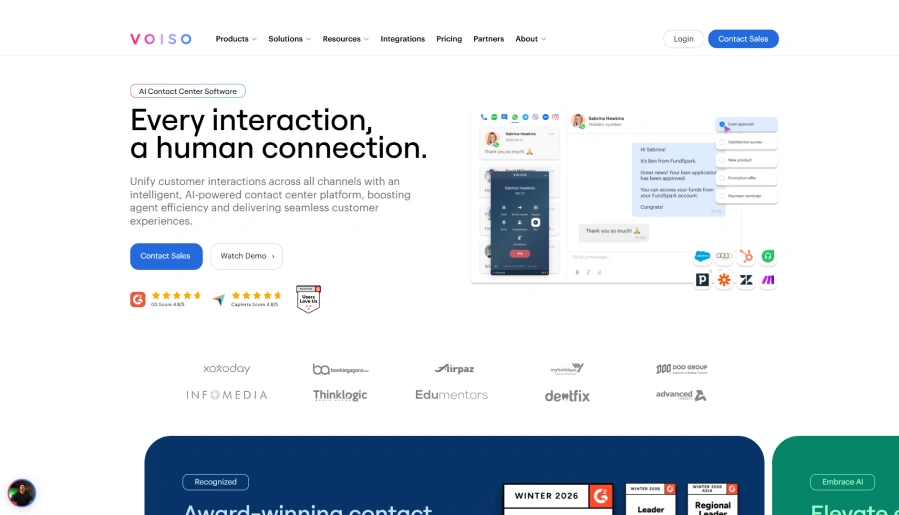
Voiso is well-known for offering advanced telephony features like IVR, predictive dialers, and even AI call summaries with smart omnichannel support. Moreover it also helps businesses by offering global coverage and an easy onboarding process.
Key Voice Features
- AI-driven insights
- Omnichannel integration
- Personalized support
Pricing & Cost Model
Voiso offers smart pricing to fit businesses of all sizes. It provides smart features as business grows with plan.
| Plan | Pricing |
| Core | $24/user/month |
| Pro | $52/user/month |
| Custom | Tailored pricing |
Best For
SMbs and mid-sized businesses who need fast setup, predictive dialers, and multi-channel communication
Fin AI: Best for AI-Driven Customer Support
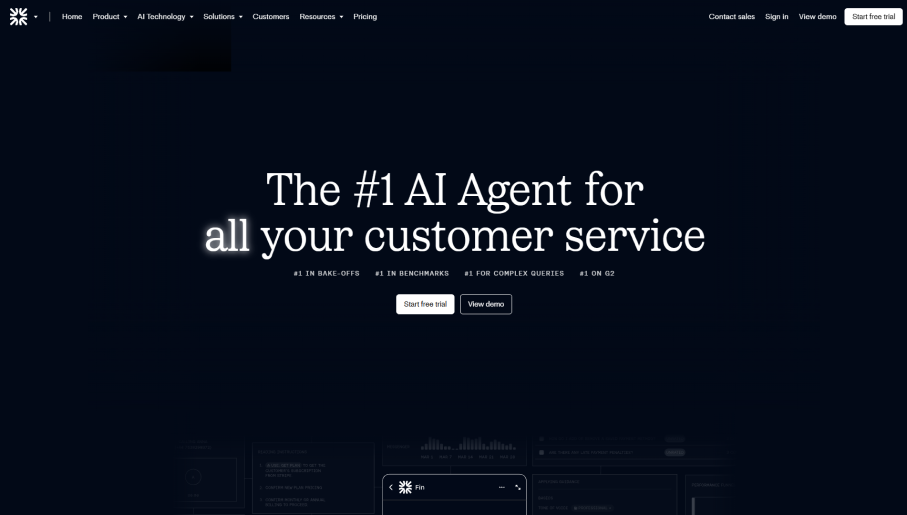
Fin AI delivers automated phone support that manages real conversations. It’s designed around an AI agent that helps in answering calls, understanding human speech context, and resolving complex issues with call escalation or on its own.
Key Voice Features
- Custom brand voice
- Integrates with telephony system
- Manages interruptions and dynamic call paths
- Context-aware voice conversations
Pricing & Cost Model
Best For
Business and enterprise support teams who want AI-first voice support can opt for Fin AI.
 PRO TIP
Twilio Voice vs Competitors: Feature and Pricing Comparison
| Provider | Best For | Pricing (USD / User / Month) | Notes |
| Botphonic | AI‑Driven Voice Automation | Starter: $20 Pro: $55 Enterprise: Custom | 14-day free trial; best for scalable AI automation for inbound/outbound calls |
| Retell AI | Natural AI Voice Interactions | Pay-as-you-go: $0.07+/minute Enterprise: Custom | Quick deployment; minimal engineering required |
| Ringover | Cloud Business Phone System | Smart: $21 Business: $44 Advanced: Custom | SMBs and enterprises needing integrated telephony + AI enhancements |
| CallHippo AI | Automated Voice Handling | Basic: $1.18 Starter: $22.42 Professional: $34.22 Ultimate: $46.02 Enterprise: Custom | Teams needing dashboards and automated handling with CRM integration |
| Voiso | Workflow Automation | Core: $24 Pro: $52 Custom: Tailored | Fast setup for SMBs and mid-sized businesses |
| Fin AI | AI-Driven Customer Support | $0.99 per resolution (min commitments) Intercom add-on: +$29/seat Copilot: $35/user | Enterprise-grade AI-first voice support with human escalation & multichannel coverage |
Switch smarter and scale your business with AI
Request a Free DemoConclusion
Twilio voice remains a smart and powerful platform but as businesses scale, so as their costs, complex setups, and even their inconsistent global performance affects productivity. And this has led teams to explore smarter and predictable alternatives.
Whether you are a startup, SaaS company, or enterprise, the landscape or Twilio voice alternatives are offering solutions which are tailored to different needs.
Botphonic and Retell AI are good at offering AI-first and natural voice interactions. Ringover and CallHippo help in providing reliable and cost-effective telephony with real-time insights. Voiso is considered ideal for workflow automation and multi-channel communication. Whereas Fin AI delivers context-aware and enterprise-grade AI support.