Summarize Content With:
Summary
This blog details how enterprises can be compliant with AI Calling Compliance USA FFCPA and state rules, including TCPA, HIPAA, FCC Rules and NAIC standards. It includes best practices for healthcare, finance, and insurance calls; ethical AI voice usage; and what to expect when future AI calling regulations are passed. By virtue of transparent, secure, and responsible AI systems like Botphonic, it is possible to ensure compliance and build trust in your customers.
Introduction
Imagine getting hit with a $1,500 penalty for just one AI-powered call before you even knew you did something wrong. Every company that makes the calls must comply with U.S. regulations or will face hefty fines, customer outrage or potential legal problems. In an age when AI makes calling faster and smarter, the rules matter more than ever, especially as enterprises increasingly evaluate AI ROI marketing USA to justify automated outreach investments.
Whether your marketing campaigns, customer service outreach, or appointment reminders are run by bots, getting the rules right helps keep your team safe and your customers happy and preserves trust in your brand.
Why Compliance Is the Foundation of AI Calling in the USA
AI-powered calling platforms are powerful. They assist businesses in managing high-volume calls, personalising outreach and minimising manual work. But U.S. regulators have an eye on when and how automated calls are made. Lawmakers had created rules to protect the privacy of consumers from uninvited intrusions.
Many of those rules, and a few more, directly apply to AI calling tools, especially where it comes to marketing, health care and customer engagement, as AI call automation trends USA continue to accelerate adoption across industries.
Big stat you should know:
Penalties under TCPA can be over $1,500 per unauthorised call, and compliance is critical for every business using voice automated systems, whether AI-based or not.
Definition: AI Calling Compliance USA is about adhering to all the U.S. federal and state laws that govern automated voice outreach, including consent, call behaviour, privacy and how data is both stored and used.
The Core U.S. Calling Regulations Every AI Platform Must Follow
| Regulation | Who Enforces It | What It Requires | Who It Affects |
| TCPA | Federal Communications Commission (FCC) | You must get prior express consent before making automated or AI calls | Any U.S. business using AI calling |
| HIPAA | U.S. Department of Health & Human Services (HHS) | You must protect medical voice data and patient privacy | Healthcare and health-tech companies |
| FCC Automated Call Rules | FCC | You must identify the caller and provide a clear opt-out option | Sales, marketing, and CX teams |
| CCPA / CPRA | California Attorney General | You must allow users to opt out of call recording and data use | Businesses calling California residents |
How Botphonic Ensures Full Compliance
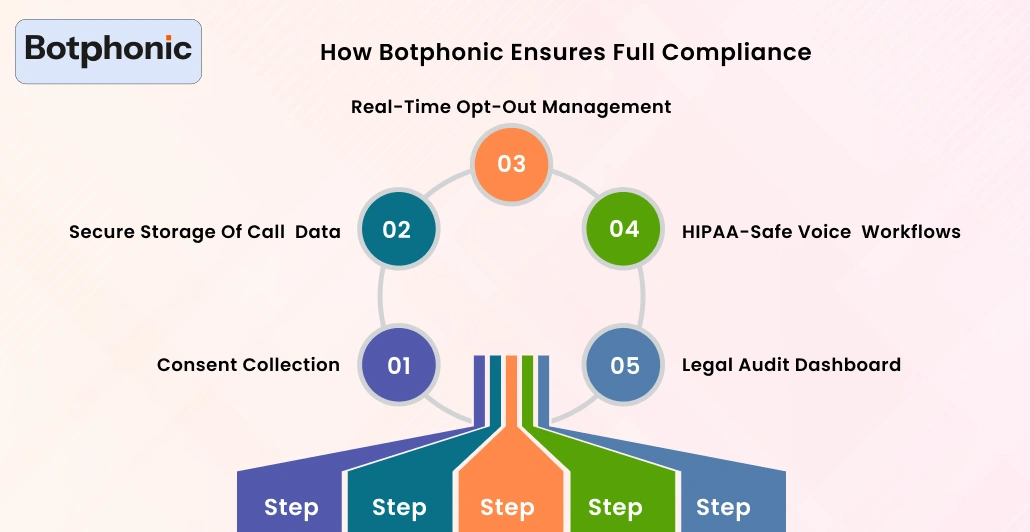
Compliance is baked into every layer of Botphonic’s AI calling system. The platform is not an afterthought in regulation. It creates workflows that proactively safeguard businesses and customers every step of the way. By following this path, businesses can achieve AI Calling Compliance USA compliance without increasing the burden on human workers or relying upon legal interpretations.
Here is a straightforward, step-by-step explanation for how Botphonic navigates compliance in realistic AI calling scenarios.
Step 1 – Consent Collection
Botphonic begins compliance right at the first touchpoint.” Double opt-in is available for AI voice campaigns – where contacts are unequivocally opting in to receiving automated calls. This minimises risk and provides a robust consent trail for auditing purposes.
Botphonic also offers an upfront disclosure at the outset of each call. Pre-recorded or dynamically generated messages can be used by the system, including, for example:
“This call is sponsored by Botphonic AI for [Brand].”
This announcement is consistent with the FCC’s requirement and fosters goodwill among those receiving calls.
Tip: Sannoy Fences – Consistently timestamp consent information along with date, delivery channel and message copy.
Step 2 – Secure Storage of Call Data
Botphonic secures call data with robust security measures that comply with U.S. standards of compliance. Voice files are encrypted with AES-256, and data in transit is protected using TLS v 1.3. These safeguards can thwart unauthorised access and data leaks.
All data is saved exclusively on U.S.-based servers that are SOC 2 Type II certified. This configuration supports healthcare, finance, and regulated industries that need stringent data residency rules under AI Calling Compliance USA.
Tip: Opt for platforms with open, transparent policies about the storage and use of your call data.
Step 3 – Real-Time Opt-Out Management
Opt-Out: Botphonic provides an easy one-click opt-out. On any AI call, press 9 to be removed immediately. The contact is immediately taken off the active call lists by the system, thereby preventing further potential violations.
Botphonic also instantly mirrors opt-out action back to integrated CRM systems. This enhancement will make sure that future campaigns exclude opt-out contacts seamlessly with teams and tools.
Tip: Test opt-out flows before each campaign to verify that they’re working properly.
Step 4 – HIPAA-Safe Voice Workflows
For healthcare and health-tech applications, Botphonic provides HIPAA-compliant voice workflows. The system and method remove or obfuscate PHI prior to the transcription/translation or analysis. This will minimise exposure but still provide good insights from calls.
AI by Botphonic will only do voice metadata; it won’t do any identifiable patient details. This architecture enables healthcare teams to satisfy their HIPAA voice compliance using AI-driven scheduling, reminders and follow-ups.
Tip: Minimise the number of staff who have access to voice data to those who absolutely require it.
Step 5 – Legal Audit Dashboard
Botphonic comes with an internal compliance audit dashboard that tracks compliance for each AI calling campaign. It documents consent status, call time, opt-outs, disclosures and retention in one central place.
These records can also be quickly exported when a team is undergoing an audit for TCPA or HIPAA, which makes life just that much better. This decision functionality enables long-term AI Calling Compliance USA readiness without manual tracking.
Tip: Don’t just audit when under a lawyer’s magnifying glass, but on a regular basis.
Be sure that your AI calls are completely compliant with TCPA, HIPAA, FCC and state laws. With Botphonic, you can safely and securely automate calls, ensure sensitive data is protected, and create confident customers.
Take A Free DemoTop Compliance Mistakes (and How to Avoid Them)
Even experienced teams find themselves falling afoul of regulations when launching AI calling campaigns. The following table identifies typical errors, the potential for harm they present and what can be done to prevent the damage.
| Mistake | Risk | Fix |
| Using purchased call lists | Up to $1,500 fine per call | Collect and verify direct opt-ins |
| Not identifying the AI voice | FTC and FCC violations | Use a clear opening disclaimer |
| Missing opt-out option | Class action lawsuits | Add a “Press 9” opt-out command |
| Cross-border data storage | HIPAA and privacy breaches | Store data only on U.S. servers |
| Auto-calling at the wrong hours | FCC violations | Limit calls to 8 a.m.–9 p.m. local time |
U.S. State-Level Call Laws to Know (2026 Update)
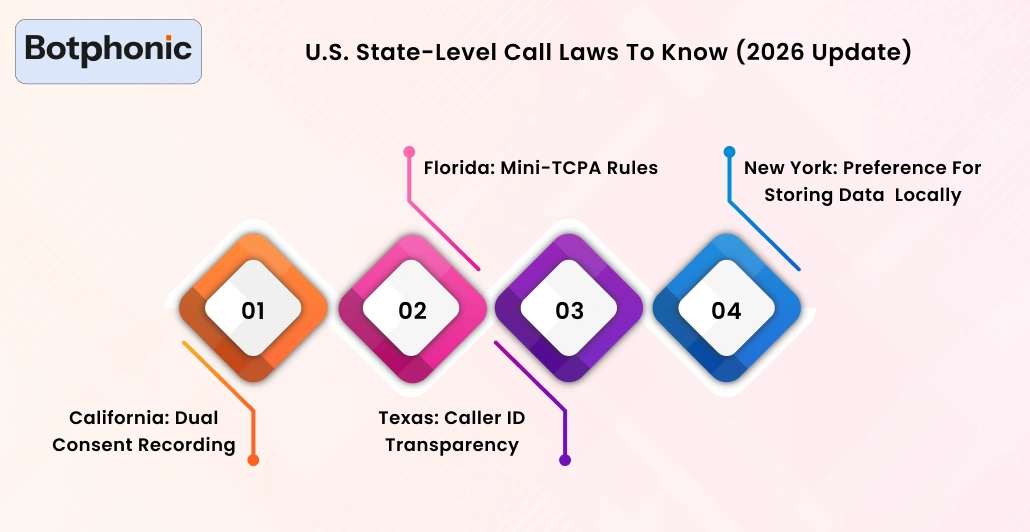
Federal laws serve as the foundation of AI Calling Compliance USA, but laws made at the state level are frequently even more stringent. These laws can alter how you track calls, store information, or label your AI call assistant. Businesses have to monitor state laws carefully, especially for outgoing calls and those in the healthcare industry.
Below is a brief chart of some important state laws to be aware of as we head into 2026:
1. California: Dual Consent Recording
In California, two-party consent is necessary to record calls. This policy applies to customer service, sales and health-related AI calls, especially recordings that are used to train or analyse a system.
At the beginning of all calls AI calls are required to state that the call will be recorded.
Note: Include recording disclosures even if just one state mandates them.
2. Florida: Mini-TCPA Rules
Mini-TCPA under Florida, Tightened Restrictions for AI and Automated Calls. The new regulations put in place stricter limitations on automated and artificial intelligence calls. It broadens consent rules and ramps up penalties for violators beginning in July 2025.
Marketing-heavy AI call campaigns are the biggest losers under this law.
Tip: Consider Florida calls to be high-risk and revisit consent more frequently.
3. Texas: Caller ID Transparency
Texas mandates that businesses show a company name on the caller ID. For AI calls that obscure or misrepresent the caller’s identity enforcement action may get triggered.
Transparency rules apply even if the AI voice sounds human.
Tip: Brand your caller ID names and disclosures to align them with your brand.
4. New York: Preference for Storing Data Locally
New York’s regulators have always cared a lot about where the call data is stored, particularly for medical or sensitive calls. Local or US-based storage, however, minimises compliance friction.
This preference has been affecting AI call recording and analytics solutions.
Note: Do not store New York healthcare calls overseas.
Compliance for Healthcare and Finance Calls
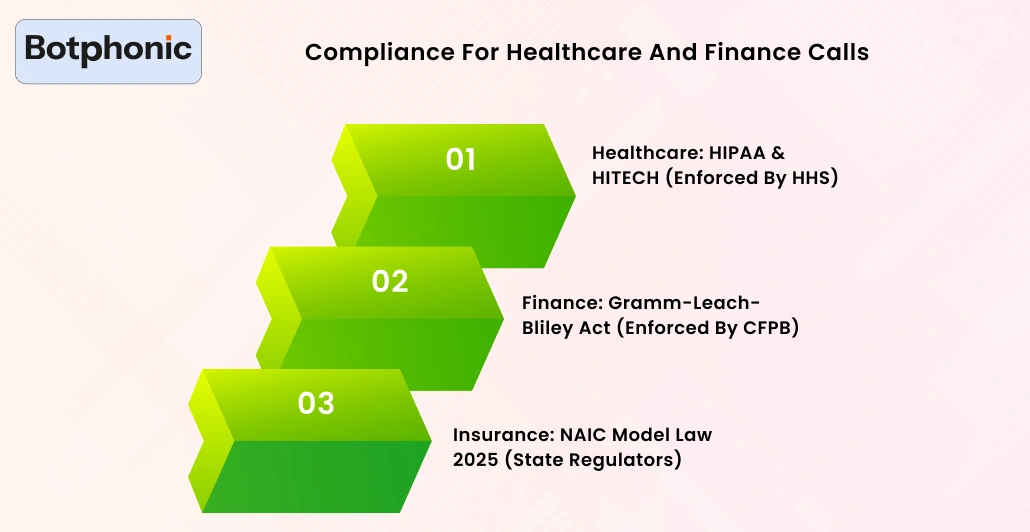
AI calls in healthcare, finance and insurance are regulated more tightly since they deal with sensitive personal information. Enterprises need AI Calling Compliance guidelines for the USA to comply with both general artificial intelligence calling compliance as well as directives specific to their industries in order not run into legal and privacy issues.
1. Healthcare: HIPAA & HITECH (Enforced by HHS)
Healthcare AI calls frequently involve appointments, reminders or updates about care, often delivered through an AI voice assistant. And HIPAA and HITECH have security mandates around voice data, limited access and protection from patient data leakage.
AI-based call assistants need to maintain data confidentiality during the life cycle of a call.
2. Finance: Gramm-Leach-Bliley Act (Enforced by CFPB)
Financial AI calls include account alerts, payment reminders and fraud notifications. The Gramm-Leach-Bliley Act demands that customer financial information remain anonymous when automation of the process starts. AI assistants should provide information and take sensitive actions only through secure routing, ensuring adherence to policy while reducing threat exposure.
3. Insurance: NAIC Model Law 2025 (State Regulators)
Insurance AI calls are required to satisfy the fairness and transparency obligations underwritten by the NAIC Model Law 2025. These policies centre on the responsible usage of AI and an open dialogue with policyholders. Every state governs these laws differently, and businesses should ensure they are complying with specific state regulations before launching nationwide campaigns.
 NOTE
NOTE
AI Voice Transparency & Ethics
1. Use Clear AI Disclosure Taglines
All AI-led calls should start with an explicit warning – “This is an AI-led call.” Premature publicization prepares the recipient, eases complaints, and coordinates with FCC regulations. Clear tagging is also good to gain/maintain customer trust and show that regulations are being followed.
2. Avoid Deceptive Impersonation or Emotional Manipulation
AI voices should never pose as human or pressure emotions to make decisions. Unscrupulous or manipulative methods add legal liability and damage brand trust. Responsible AI respects the listener’s autonomy and supports that interactions are truthful and professional.
3. Follow OECD AI Ethics Guidelines
The OECD AI Principles, which centre on transparency, accountability and human oversight of AI systems, are being embraced by many institutions. These principles empower businesses to use AI responsibly and remain trusted in a world where regulations are ever-changing. Adhering to ethical principles minimises risk and future-proofs AI voice strategies.
The Future of U.S. AI Calling Regulations
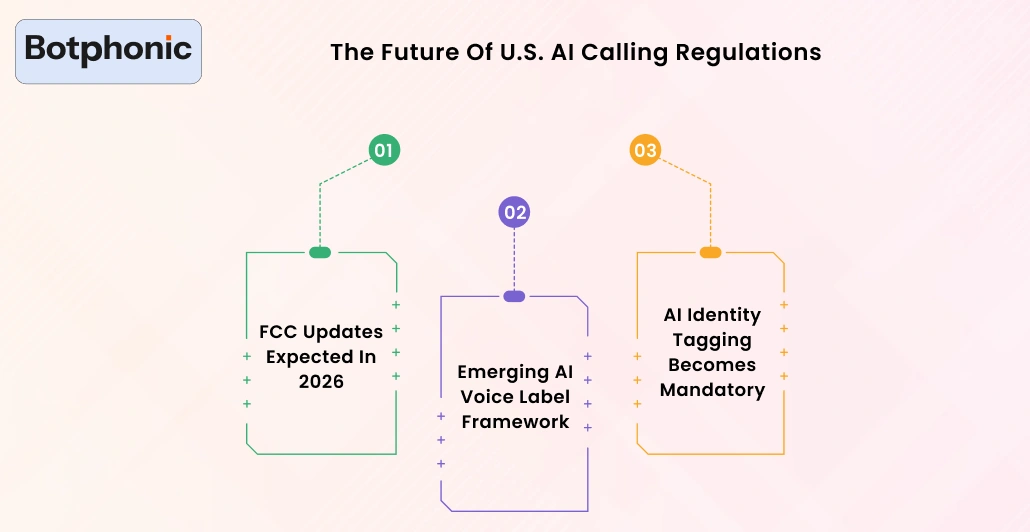
1. FCC Updates Expected in 2026
The FCC is going to set explicit standards for AI voice disclosure. It’s going to proceed by outlining how companies are expected to make clear that AI is present at the other end of the line. Outbound and CX agents will have to change scripts and call flows to be compliant. Anticipate and be ready for this change now in order to reduce the productivity hit of adoption.
2. Emerging AI Voice Label Framework
Regulators are considering a standardised “AI Voice Label” for consumer business interactions. This tag will indicate that the call was handled by an AI system, which could help eliminate confusion and regulatory risk. Compliance becomes easier across IT systems and across industries through standardised labelling.
3. AI Identity Tagging Becomes Mandatory
Gartner forecasts that 100% of U.S. electronically originated calls will need AI identity tagging by 2028. This requirement will bring uniformity to AI disclosure across different sectors, with early adoption being key to cutting down on any resultant compliance friction.
Conclusion
AI Calling Compliance USA will help keep your business, the very customers who use your products or services and on this basis, the reputation of your brand! By adhering to HIPAA, TCPA, FCC and state laws as well as leveraging ethical AI practices, you can make AI-powered calling work for healthcare, finance and insurance businesses.
One can prepare for the new regulations by leveraging transparent, responsible AI tools such as Botphonic that guarantee future-proof compliance & operational efficiency.