Summarize Content With:
Summary
Voice automation is transforming the way Americans communicate with businesses, their devices and services. Technology based on AI voice predictions and AI call assistants already enables millions of conversations every day. In the US, by 2030, voice automation will be an accepted mode of interaction in industries throughout the country.
Introduction
Voice automation is not some future trend; it’s already here. The voice assistant market in the US alone is predicted to hit almost $30.72 billion by 2030, indicating just how quickly this technology is developing. Ours is an era of smart speakers, phones and AI voice assistants where talking to devices and automated systems actually feels natural.
Today, artificial intelligence call assistants and automatic voice systems are not only answering straightforward questions, but they are managing sophisticated interactions, learning preferences and enhancing customer support. In this article, we will see what voice automation is like in 2025 and what to expect from the next five years by 2030, as well as why AI voice predictions 2030 usa will be important for businesses and consumers.
Quick Overview
| Area | What to Expect by 2030 |
| AI Call Assistants | Handle most routine customer calls with natural conversations |
| Customer Experience | Faster support, less waiting, and more personal responses |
| Business Impact | Lower support costs and easier scaling for growing companies |
| Industry Adoption | Healthcare, retail, banking, and real estate will lead |
| Future Readiness | Early adopters will stay ahead in service quality and trust |
What Is Voice Automation? How Does It Work Today?
Voice automation is the use of voice recognition technology in computer systems to receive and interpret spoken commands, and instantly provide a result. Such systems merge the capabilities of speech recognition, natural language processing (NLP), and artificial intelligence to convert the spoken words into meaningful actions.
- Speech recognition listens to what a user says and transcribes the utterance into text that the machine can interpret.
- NLP models understand the meaning between words, establish intent and determine the next action.
- Response engines or call assistants then create spoken responses, take actions, or provide information to callers.
Nowadays, most voice systems sit in phones, smart speakers playing music for you at home, virtual assistants and customer service bots. Already, many businesses use automated voice systems to handle calls, assist customers or perform simple tasks. These voice assistants serve as digital helpers, ever-present, always listening and ready to help.
Current State of Voice Automation in the USA (2024–2025)
1. How American Businesses Use AI Voice Today
In 2024–2025, U.S. companies are using AI voice tools in various ways. (AI call assistants are not that far removed from other companies letting chatbots handle relatively simple conversations with customers, only in 90s voiceover guy-like fashion,n perhaps?) In retail, banking, and healthcare industries, operators are used for automating appointment scheduling, FAQs, and order support in voice automation.
Big brands also incorporate voice AI into their mobile apps, call centres, and websites to create comfortable experiences, a shift supported by ongoing voice AI statistics in the USA that highlight increased enterprise adoption.
2. Customer Expectations from Voice AI
Today’s customers are accustomed to quick, precise , and personalised help. When people call businesses, they want help and to have it fast without long waits or redundant menus. Voice automation addresses this with instant service and the ability to clear simple queries as fast as possible. Consumers now expect intelligent systems that are aware of context, such as recalling past calls or preferences,s and respond instead of just making them repeat information.
Natural-sounding voices that are relatable and friendly, rather than robotic, are also prized by American consumers. When done right, people trust and like how a company uses voice automation, leading to peaceful interactions and more consistently high satisfaction for brands, reflecting evolving AI consumer attitudes USA over time.
Key AI Voice Predictions for 2030 in the USA
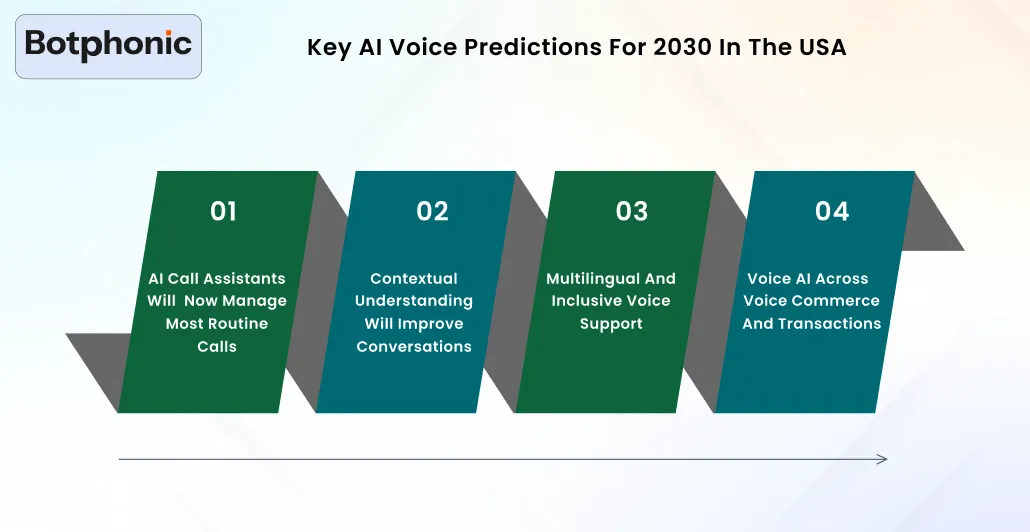
As we glance towards 2030, AI voice predictions 2030USAa demonstrate a few expect significant innovations:
1. AI Call Assistants Will Now Manage Most Routine Calls
And by 2030, there’s a good chance that the majority of routine customer calls, including account queries and status on orders or basic troubleshooting, will be fielded entirely by AI call assistant systems. These helpers will be able to decipher meaning, tone and context, enabling them to have unnatural and productive conversations.
2. Contextual Understanding Will Improve Conversations
Voice systems of the future will store a user’s history and preferences over calls, responding personally to suit their needs. This context will eliminate the frustration of repeating information and provide faster and smoother interaction with a device.
3. Multilingual and Inclusive Voice Support
Voice AI will also be available in more languages, as well as American dialects, by 2030. This enhancement will assist organisations in reaching a wider and more diverse customer base regardless of language, thereby ensuring that voice-first automation is more inclusive and accessible.
4. Voice AI across Voice Commerce and Transactions
The use of voice automation will move beyond its current structure to include secure transactions. Handy for those quick calls home, and convenient in the kitchen for research or timers, customers are more comfortable than ever using voice to shop.
 PRO TIP
How AI Voice Automation Will Change Customer Experience
Voice automation is a matter of convenience, sure, but it’s also about connection. Here’s what it will do to experiences by 2030:
1. Faster Support Without Long Queues
AI call agents will pick up calls automatically, which can help decrease hold times and assist customers in finding information without having to wait. This alone will improve satisfaction and loyalty.
2. Conversations That Feel Human
Advanced voice systems are going to sound completely natural, and within conversation, they’re going to understand your tone; interactions will seem more like talking to a friend than a machine. This creates a sense of comfort and reliability between the user and us.
3. 24/7 Support Anytime
Voice automation never sleeps. Customers can ask for help anytime, day or night, weekday or weekend, and brands start to feel always “on.” This could be particularly useful in sectors such as travel or healthcare where there is a high demand for out-of-hours assistance.
4. Efficient Issue Resolution
Each conversation will inform AI assistants, sharpening their responses and enhancing their solutions as time goes on. This translates to fewer transfers, faster resolutions and less frustration for customers.
Business Benefits of AI Voice Automation by 2030
Voice automation creates value for customers and companies alike. Here are some key highlights we can likely expect by 2030:
- Reduced Operating Costs: Businesses will save money on big contact centres and tedious support roles as AI call assistants take care of routine tasks. Bots take the pressure off by removing the need for staff and allowing teams to focus on higher-value tasks.
- Higher Customer Satisfaction: Customers want fast, relevant answers. And Voice AI can provide anytime, consistent support that increases satisfaction and decreases frustration from extensive hold times and menus.
- Better Lead Engagement: Voice automation, however, can reach callers effectively, qualify leads and funnel high-value prospects to real human sales reps. It increases engagement and also creates more conversion chances for businesses.
- Scalability for Growth: AI call assistant scale easily. And as a business moves from handling tens to thousands of calls per day, voice automation scales without requiring additional human agents, which keeps support costs in check.
Challenges AI Voice Automation Must Solve Before 2030
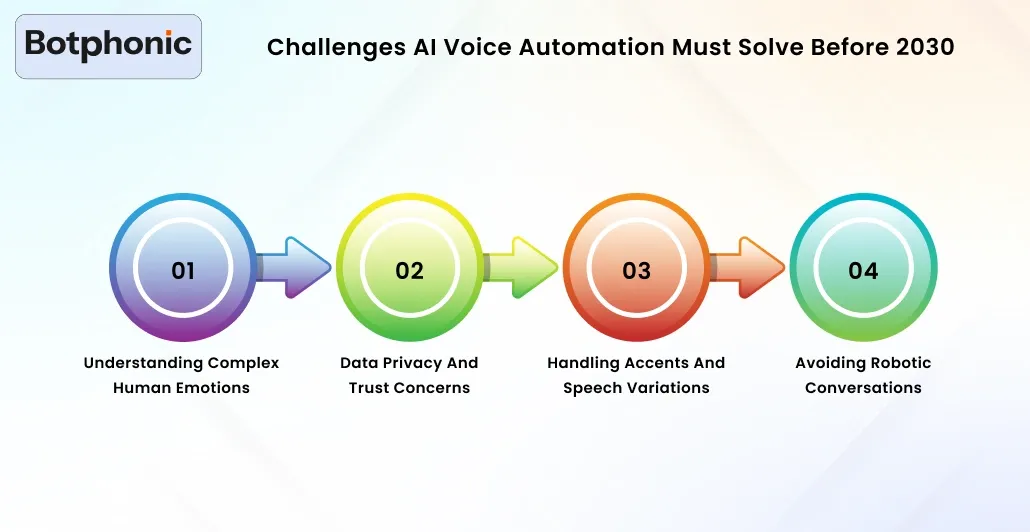
1. Understanding Complex Human Emotions
AI voice systems are still not great at understanding emotions like frustration, urgency or confusion. The ability for machines to analyse vocal tone is getting better, but many machines still miss out on emotional context during sensitive conversations. Companies need to make sure AI treats people in sensitive situations with empathy; no one wants a bot that’s terrible at reading moods.
2. Data Privacy and Trust Concerns
Customers are concerned about how companies are storing and using voice data. Voice recordings include personal information, and misuse can damage trust in an instant. AI voice automation has to be compliant with the rigorous privacy regulations in the USA and operate with secure data techniques.
3. Handling Accents and Speech Variations
USA. There is a wide variety of accents and languages in the USA. AI voice automation can also get confused by people who speak quickly, quietly, or possess regional accents. These holes can agitate customers and stunt adoption.
4. Avoiding Robotic Conversations
For many users, AI voices can still too often sound scripted or unnatural. When conversations are stilted, customers lose interest and trust. Voice automation will need to be more natural and conversational so that it is adopted broadly by 2030.
Role of AI Call Assistants in Small and Mid-Sized Businesses
Companies of this size do not tend to have large support teams. AI call assistant systems answer calls immediately and resolve simple inquiries without needing to hire additional agents. This backup enables businesses to remain responsive, even during peak hours.
1. Enhancing Customer Experience on the Cheap
Voice automation provides the tools of professional customer service to small businesses. AI voice systems can give the same answer and politely respond every time. Small teams make customers feel like they are being supported.
2. Supporting Sales and Lead Qualification
Suggested use cases include having AI-based assistants greet callers and ask a few straightforward questions, or as a way to identify high-quality leads for sales teams. The process is both time-saving and guarantees that your sales teams get to speak only with the serious prospects.
3. Enabling Owners to Focus on Expansion
Business owners field fewer calls when AI is handling the routine ones. They can concentrate on strategy, marketing and customer relations rather than managing phone calls all day.
 NOTE
NOTE
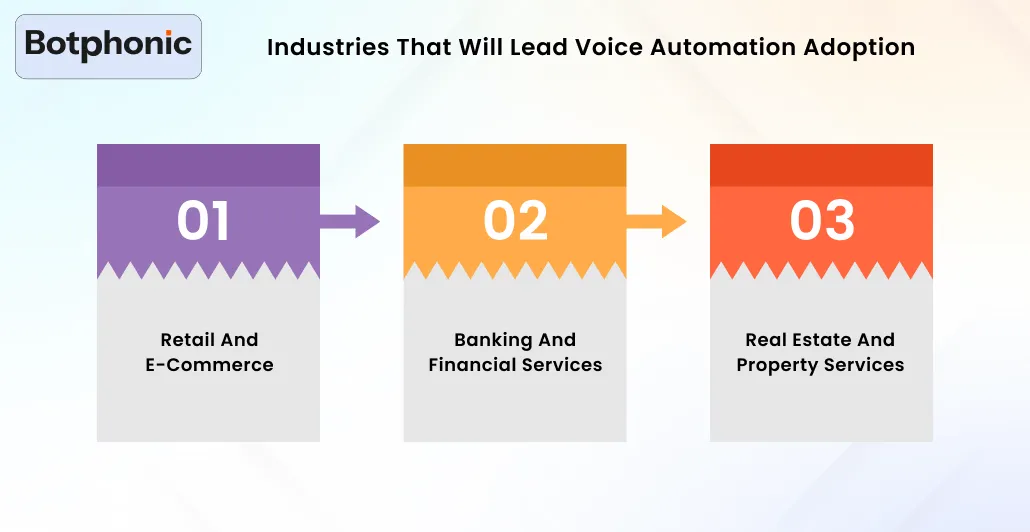
Industries That Will Lead Voice Automation Adoption
Healthcare and Medical Services
Voice automation will be used by health care companies for appointment scheduling, reminders and patient support. AI voice assistants will alleviate call centre strain and enhance care access.
- Retail and E-Commerce: Retailers will implement voice automation for order tracking, returns processing and support for voice shopping. Instead of typing, customers will have to use their voice to sound out what they would like.
- Banking and Financial Services: Banks will use AI voice systems to power balance checks, transaction alerts and basic account help. Voice-controlled, military-grade identities will ease wait times and safeguard people.
- Real Estate and Property Services: Real estate agencies will employ AI call assistant to book property viewings, respond to questions about listings and follow up with buyers using an AI virtual assistant that can handle inquiries efficiently. Voice automation is also supposed to allow agents to field questions more quickly.
How Businesses Can Prepare for AI Voice in 2030
Businesses should begin preparing now, rather than waiting for widespread adoption. Businesses will need clean customer data, clear call flows, and defined voice automation objectives. There will also be a place for training teams to function with artificial-intelligence voice systems.
Making small bets on voice automation can help companies learn what works best. 24 scheduling is going to get the AI voice predictions 2030 usa.
Why Botphonic Fits the Future of Voice Automation
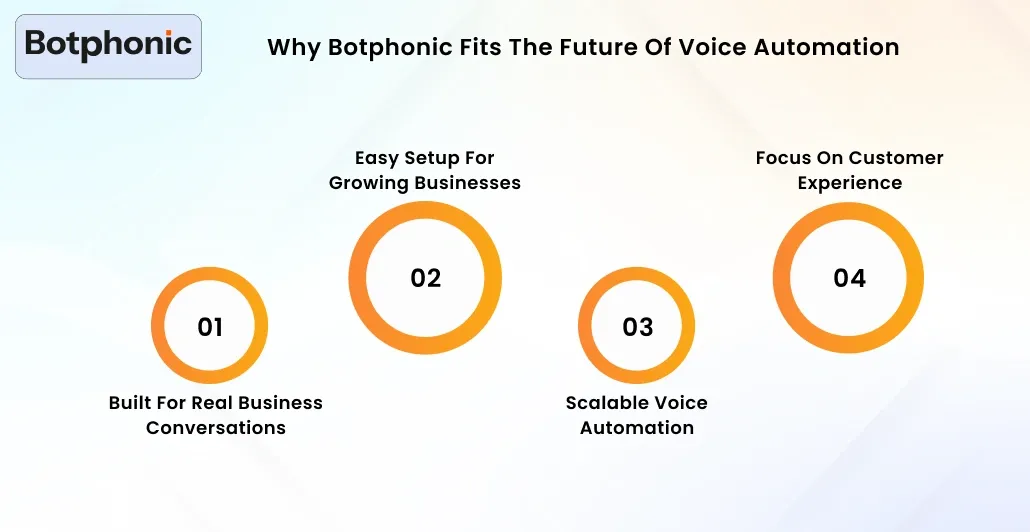
1. Built for Real Business Conversations
Botphonic emphasises natural-sounding conversations over robotic script. Its AI call assistant tools get what the user is trying to accomplish and are able to shepherd conversations through interaction without feeling robotic.
2. Easy Setup for Growing Businesses
Botphonic is good for small and mid-sized businesses looking to quickly roll something out without having to implement an intricate system. Teams can introduce voice automation with no technical overload.
3. Scalable Voice Automation
Botphonic grows with your business. No matter if you see a volume in calls which varies per day or per season, the system can handle this volume without compromising quality.
4. Focus on Customer Experience
We’re also building Botphonic’s voice robot with that same attitude towards real user needs. It enables businesses to shrink wait times, enhance how calls are managed and provide better service.
Discover how your business can have smarter conversations now.
Try Botphonic Demo!!Final Thoughts
Voice automation will drive how Americans do business in the next decade, with AI call automation for U.S. businesses becoming a core part of everyday customer communication. Telephony AI call assistant systems will get smarter, faster, and more human. Early movers among organisations will remain competitive; latecomers will fall behind.
The future of voice automation in the USA is based on trust, simplicity and real value for customers. The next generation of innovation is going to be driven by companies that specialise in these areas.