Summarize Content With:
Quick Summary
AI in call centers is one of the most critical management decisions, and it has already proved its worth. The real question is where it fits, and how fast does it pay back, what are AI call center examples. Moreover, one of the critical questions is what if it’s done poorly.
In this article, we are going to break down how AI call centers align with traditional operations, generating the highest ROI. Moreover, we will also see how AI voice agents compare to human agents and real-world examples of AI call centers in production.
Introduction
AI call centers have moved from just being an innovation to daily operations. Initially, started just as basic IVR automations has now evolved into full-scale AI voice agents that are capable of handling real conversations, resolving issues and routing customers intelligently.
In this era, AI call centre have become a core asset of operational infrastructure. When deployed correctly, AI voice agents can easily reduce cost per calls, enforce compliance, and even stabilize the whole workforce. Many of the successful organizations use AI as a first-line operator, and reserves human agents for complex, emotional, and high-value interactions. When AI is used as a first line of defense rather than final decision-maker, it reduces burnout and lowers operational costs. Moreover, it also effectively improves service reliability without even compromising with customer service quality.
How AI Call Centers Fit Into Traditional Call Center Operations
AI works best when it works with boundaries and rules. In smart and well-run call centers, escalation paths, scripts, QA checks, and KPIS are already structured. The system just enforces them with consistency that humans can’t maintain at scale.
Moreover, successful deployments treat AI as the first line of defense, not the final authority. Simple requests are resolved on its own whereas complex, emotional, or other high-value interactions are usually directed to experienced representatives along with context. The hybrid structure also preserves institutional knowledge while it reduces burnout and turnover.
 NOTE
NOTE
Where AI Call Centers Deliver the Highest ROI
Not all calls are created equal, but AI delivers high value in areas where there’s repetition and low ambiguity as well. For instance, billing inquiries, appointment scheduling, order status checks, password resets, and even lead qualifications. These are interactions that consume high-value time and letting AI call assistant take over these reduces cost per call instantly.
Organizations that chase AI for edge cases might face disappointment, instead those who just automate these tedious tasks see 60% margins as it improves the service quietly and quickly.
AI Voice vs Human Agents: A Practical Divide
AI voice agents are good at offering precision while showing endurance to these cases. They are designed to never forget scripts, lose patience, or even to call in sick. Instead they lack situational awareness when conversation drifts away from the script.
Whereas human agents are still dominating in negotiations, emotional disputes, and complex decision making. The winning formula has always been delegation instead of replacement.
Learn more: What is an AI call center?
Quick Comparison
| Aspect | AI Voice Agents | Human Agents |
| Core Strength | Speed, consistency, and automation | Empathy, judgment, and problem-solving |
| Best Use Cases | Billing inquiries, appointment scheduling, order status, reminders | Escalations, complaints, negotiations, complex support |
| Availability | 24/7 AI call handling with zero downtime | Limited by shifts and staffing |
| Cost Structure | Low cost per call, scalable automation | Higher cost per interaction |
| Accuracy | Script-perfect, no deviation | Flexible but variable |
| Learning Curve | Continuous improvement via machine learning | Training-dependent, experience-based |
| Scalability | Instantly scalable AI voice bots | Slow and expensive to scale |
| Emotional Intelligence | Limited conversational empathy | High emotional intelligence |
| Compliance Consistency | Enforced AI scripts and policies | Subject to human error |
| Ideal Role | First-line AI call center automation | Final authority in customer resolution |
Best-Practice Tips for AI Call Center Adoption
- Start with inbound calls before scaling outbound automation
- Check for easy integration during the demo itself.
- Always disclose AI voice usage to maintain trust
- Measure re-contact rate, not just containment
- Optimize scripts weekly during the first 90 days
Real Examples of AI Call Centers in Production
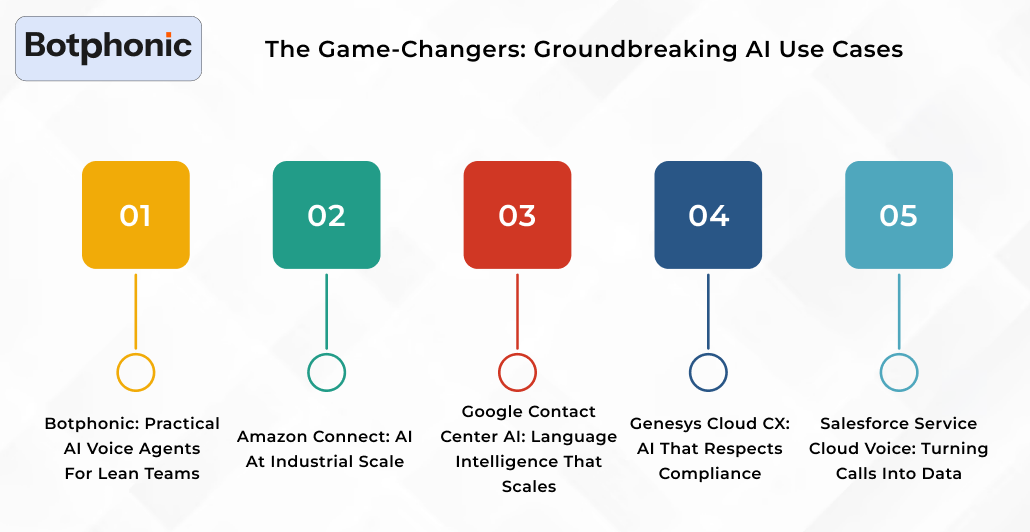
1. Botphonic: Practical AI Voice Agents for Lean Teams
Botphonic offers a newer but most agile approach to AI call centers. It is especially designed for businesses who want fast deployment without receiving enterprise complexity. Botphonic’s AI voice agents have handled inbound and outbound calls autonomously, where they have handled appointment scheduling, lead qualification,payment reminders, customer follow-ups, and support inquiries. These agents smartly operate 24/7 and scale instantly without even increasing headcount.
It focuses on practicality rather than theory. Moreover, its implementation is fast, customization is straightforward, and ROI is visibly early. These characteristics make it effective for startups, service providers, and also for mid-market companies.
Start today by detecting which call types generate the highest volume and lower ambiguity.
Try Botphonic Today!!2. Amazon Connect: AI at Industrial Scale
Amazon Connect is generally built for volume-driven businesses that treat customer service like logistics. It effectively blends traditional IVR logic with AI-powered speech analytics, sentiment detection, and even intelligence call routing. To talk about its practice, Amazon Connect automates routine inquiries like order tracking, refunds, and delivery updates as well. While it also routes complex or high-value calls to human representatives.
Moreover, its real-time analytics detects frustration early, allowing supervisors to intervene even before the problem gets bigger. Its effectiveness is usually because of its discipline, the system enforces consistency at scale, just what high-volume operations require.
3. Google Contact Center AI: Language Intelligence That Scales
Google Contact Center AI is usually used in utilities, telecom, and public services, industries where callers explain problems in most unpredictable ways. The platform usually relies on advanced natural language understanding to know what clients want to say, not just looks for keywords.
Google’s advantage is straightforward, language is their core competency. The AI ensures to keep conversations, reduces misunderstandings, and lowers escalations rates even without pretending to replace human judgement.
4. Genesys Cloud CX: AI That Respects Compliance
In regulated industries, innovations should behave themselves and just as said, Genesys Cloud CX does that. It is designed for banks, insurers, and healthcare providers that need AI efficiency without any regulatory exposure. The platform effectively works by predicting callers intent and orchestrates customer journeys across different channels. Moreover it also monitors interactions continuously for risk and compliance issues. Meanwhile AI functions in the background, guiding routing and analytics, leaving final authority to trained agents.
Genesys succeeds by understanding institutional reality.
5. Salesforce Service Cloud Voice: Turning Calls Into Data
Salesforce Service Cloud Voice integrates AI directly into CRM workflows, ensuring each conversation is structured and formed in usable data. Calls are transcribed and summarized autonomously and customer records are updated in real time. AI also recommends next-based actions, providing guidance to agents without removing autonomy. Managers also gain visibility without relying on manual reports or other incomplete notes.
Salesforce philosophy is also uncompromising, they mean if it’s not documented, it doesn’t exist. AI reinforces that discipline at scale.
Organizations across healthcare, finance, logistics, and SaaS are already deploying these models in production.
AI Call Center Metrics That Actually Matter
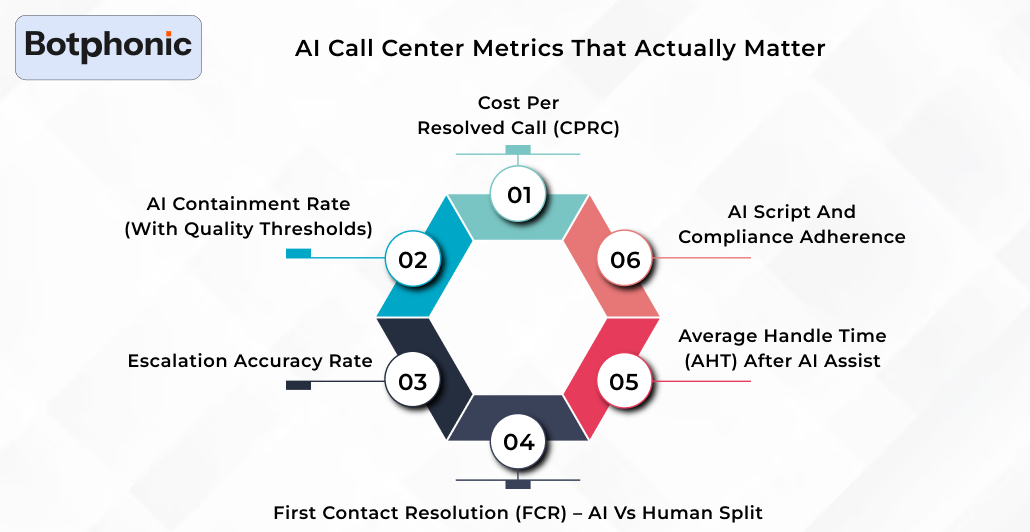
Let’s cut through the chase. If a metric isn’t showing visible results, it’s just decorative and won’t help you. Below are some AI call center KPIs that actually drive ROI and operational discipline, based on how call centers have always been operating.
1. Cost per Resolved Call (CPRC)
This is one of the major metrics that makes or breaks the AI’s performance. If AI isn’t assisting in lowering the cost to resolve an interaction entirely, it’s not functioning properly. CPRC exposes the half-baked automations that can manage the call but dumps the work silently on human representatives.
Executive Reality
If CPRC isn’t actually dropping within a 60-90 days period, not the AI but deployment is the problem.
2. AI Containment Rate (With Quality Thresholds)
Containment without providing quality is considered fraud, ensuring to track the percentage of calls which are resolved end-to-end by AI without any follow-up, escalation, or customer frustration.
Reality Check
High containment with low CSAT is an invisible force that slowly destructs a brand’s credibility. This metric should always be ensured to pair with post-call sentiment.
3. Escalation Accuracy Rate
Escalation accuracy usually measures whether an AI is able to hand calls to representatives, for appropriate reasons, and at the right time along with the right context. Early escalation might just result into lost money and late escalation might just frustrate customers
 PRO TIP
4. First Contact Resolution (FCR) – AI vs Human Split
Ensure to track FCR separately for AI-handled calls and human-handled calls. This comparison helps you understand where AI is excelling and where it should just step aside. The issue resolution on the first interaction is segmented by AI-only calls, Human-only calls, and also AI-to-human hybrid calls. Ensure to use this metric to reassign call types.
5. Average Handle Time (AHT) After AI Assist
The goal is never the shorter calls but shorter human representative involvement. It effectively measures agent handling after AI has identified intent, collected information, and summarized the issue. This will positively provide shorter calls, faster resolutions, and less agent fatigue.
6. AI Script and Compliance Adherence
AI should be capable of executing scripts and disclosures smartly and accurately, every time. It effectively measures how consistently AI is following required disclosures, regulated phrasing, and even approved workflows.
Executive Reality
Compliance failures directly means AI design failure, not technology so ensure to test it appropriately.
Real-World Case Study
Deliveroo, a food delivery company, functions in over 200 locations in Europe, which means they have a diverse customer base. To assist their rapid business growth, it needed robust support that helped with multiple languages.
They later implemented an AI solution that had two-way translation. It functions by using Amazon Connect, Amazon Transcribe, Amazon Comprehend, Amazon Lex, and also Contact Lens from Amazon. Moreover it allowed clients to text in their preferred language and share support answers in their native language as well.
By resolving this language barrier issue, it led to a 20% decrease in average handling time (AHT) and even 83% first call resolution.
Start with a pilot focused project with billing, scheduling, or order status, and then scale once ROI and compliance have proven.
Try Demo Now!!Conclusion
AI call centers were never about replacing people, but restoring operational efficiency. In industries, organizations are always stressed by rising costs, agent burnout, and even inconsistent service. AI effectively brings discipline back to where it was.
Handling the repetitive and predictable work effortlessly, it enables human assistants to focus where actually judgment and empathy is required. The AI call center real-world use cases have outlined, AI-first teams to enterprise-scale platforms, that proves only one thing, AI is delivering results, when it’s scoped realistically and secured properly.
Organizations who are chasing edge cases or emotional nuance with AI are going to struggle, but who are just automating routine interactions, enforcing compliance and measuring the right KPIs are able to see fast and effective wins.