
Summarize Content With:
Summary
While automated calling will resolve all your communication issues, many U.S. businesses fail, however, because they assume too much and get burned by common AI mistakes when they finally push an AI call assistant into the wild, especially as AI call automation trends USA continue to evolve rapidly.
Introduction
Think of what would happen if a customer called for assistance and received only the puzzling voice of an automaton. This problem isn’t rare. Almost 90 per cent of people say they expect to receive an immediate response to any support request, according to HubSpot. If a system fails to respond well, businesses miss out on critical relationships and revenue.
In the following blog, we delve into how and why U.S. businesses get it wrong with automated calling, where AI mistakes occur most frequently, and above all else, how a properly honed AI call assistant can finally work for you.
Why Automated Calling Still Fails Many U.S. Businesses
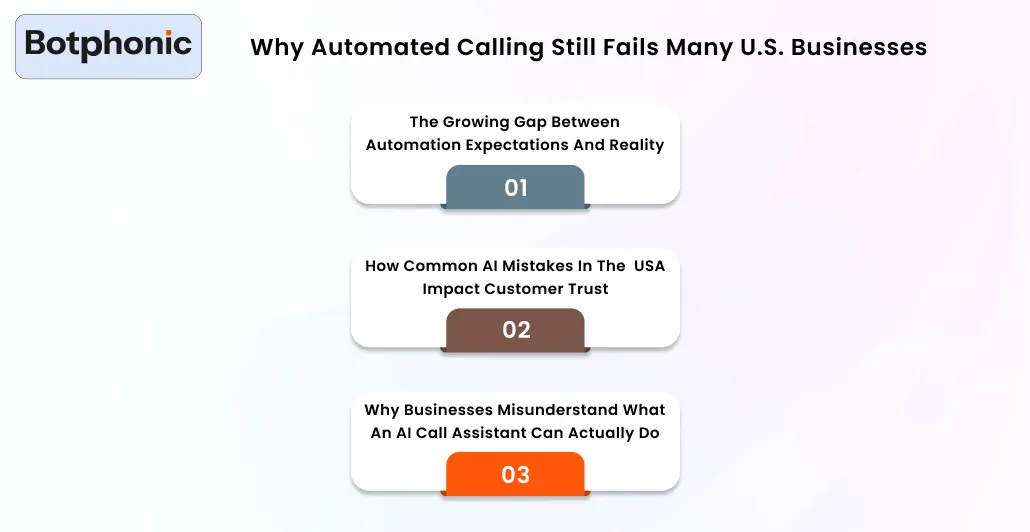
A lot of companies get into automated calling without realising what really drives its success. This creates issues that damage your customers’ experience and ROI, particularly in AI voice automation for customer support (USA).
1. The growing gap between automation expectations and reality
American companies often assume that anything a live agent can do, an automated system can do better. They want it to be perfectly informative and emotionally connected with customers. The fact of the matter is that automation still has trouble with nuance, context, and solving complex customer problems. And when expectations run up against performance, businesses get frustrated and feel their customers are feeling neglected.
2. How common AI mistakes in the USA impact customer trust
One of the greatest AI fails is using poorly created scripts and voices. See-bot-style robotic unnatural answers turn away callers and make them know they are not speaking to real people,e eroding their trust. Customers hang up, leave bad reviews, or switch to rivals.
3. Why businesses misunderstand what an AI call assistant can actually do
An AI call assistant is seen as a panacea by many business leaders. They expect it to get every call right without instruction or context. In reality, a great AI call assistant requires careful design, real conversations for training, and careful monitoring to function well. Without these, performance degrades,s and customers become frustrated.
 PRO TIP
Confusing Automation With Human Conversation
In the world of automated calling, one major problem results from treating machine responses as though they’re conversations between humans, which undermines modern digital transformation voice USA strategies.
1. Why scripted calls sound robotic to U.S. customers
A lot of the automated systems run like old IVR menus; they only speak in set phrases. They are not divisive, and they don’t take proper account of real human language. Callers feel trolled by this and get caught in bad loops where they are forced to keep repeating themselves, or they simply hang up.
2. How poor call flow design creates AI mistakes in the USA
When companies design automated paths without actual customer understanding, they build bad call flows. Even the best AI call assistant won’t work correctly if the call flows aren’t mapped out properly, regardless of AI call automation trends USA.
3. Where an AI call assistant needs guidance, not guessing
An AI call assistant should steer conversations towards tangible actions like setting up appointments and providing answers to FAQs. But without data, training, and ongoing improvement, the assistant is guessing what customers want. Between those guesses, errors, misunderstandings, and unsatisfied callers.
Ignoring Customer Experience During Automated Calls
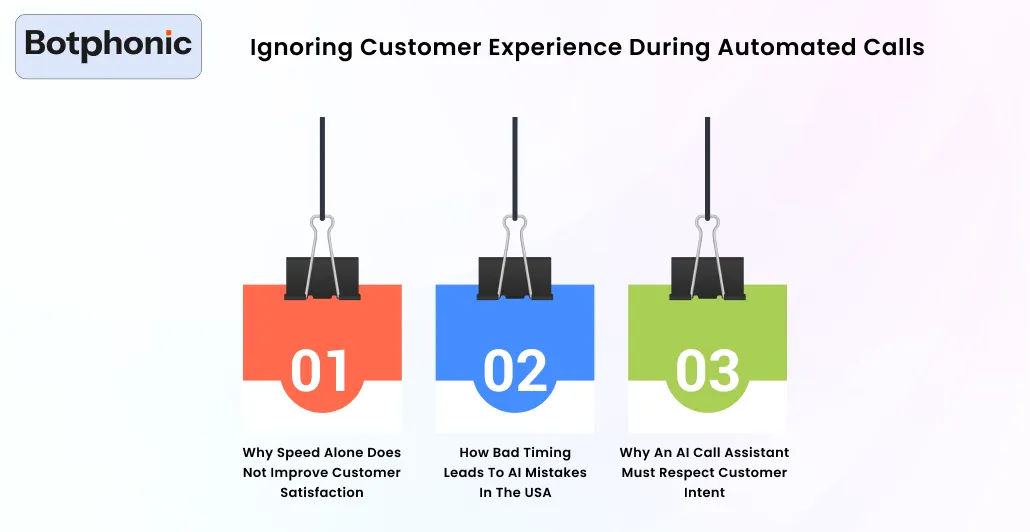
Recorded calls tend to be about getting through the exchange, not the consumer, which is a common pitfall in AI customer service deployments.
1. Why speed alone does not improve customer satisfaction
Fast call resolution sounds good in theory, but if the system feels too rushed to have conversations, your customers will feel unappreciated. Speed, sadly, does not substitute for empathy or clarity. Businesses usually only look at call duration metrics, and they forget that satisfaction levels begin to plummet when calls start feeling impersonal.
2. How bad timing leads to AI mistakes in the USA
Customers get tired of being called at work or randomly. An automated call that is rushed or timed incorrectly will make the AI call assistant seem uncaring. If the timing is bad, they say goodbye, hang up, and could start becoming resentful because you regularly call at inconvenient times.
3. Why an AI call assistant must respect customer intent
An AI call assistant should first listen to the caller, and not force pre-set scripts. Respecting intent is how calls become both relevant and effective. When Businesses ignore that intent, they easily repeat the sameAIi mistakes – the net result being more hang-ups or complaints.
Poor Data Use in Automated Calling Systems
Data drives automated calling. Even the most accurate AI call assistant will not do well if the information is wrong or stale.
1. How outdated contact data hurts call success
Bad numbers or old email addresses slow you down and harm your brand, a silent killer for AI voice automation for customer support (USA) campaigns. This is something that many businesses forget, and they end up making simple AI mistakes. This is due to their AI adoption projects, which could have been prevented with a little bit of thought about the various types of data.
2. Why bad data causes repeated AI mistakes in the USA
A system trained on inaccurate, incomplete information continually makes the wrong decisions. Without clean data, the AI call assistant will not train properly, resulting in frustrating interactions and lost revenue.
3. How a smart AI call assistant uses clean data to respond better
When you keep contact details updated in this tool, the AI call assistant can personalize calls and answer accurately. Clean data boosts precision, tone, and relevance, minimizing the common AI mistakes.
Botphonic enables U.S. businesses to prevent common AI mistakes. Simply put, we’re helping it become easy for Enterprises in the U.S. to develop natural, compliant and customer-friendly AI conversations. If you’re hours are spent talking to an call assistant that is robotic or confusing it’s time to step up the platform designed for real human interaction.
Request a Free DemoNot Training the AI Call Assistant Properly
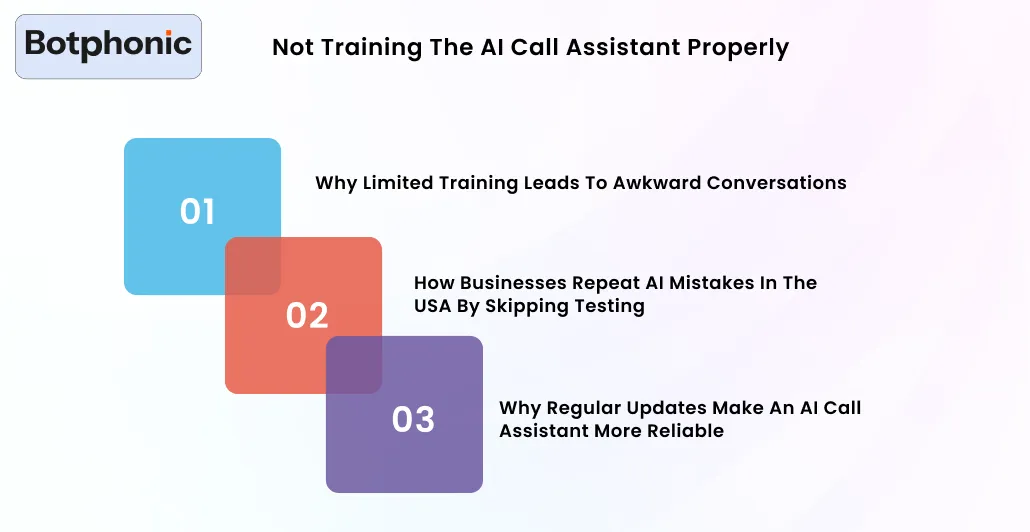
Without intelligent training, the smartest AI call assistant fails. One of the most common AI mistakes is skipping this step.
1. Why limited training leads to awkward conversations
A poorly trained assistant is more likely to stumble over an accent, slang, or unexpected questions. Calls can be robotic or confusing, which irritates callers. The right training leads to natural, flowing conversation.
2. How businesses repeat AI mistakes in the USA by skipping testing
Some organizations put an AI call assistant into service right away, with no trial runs. This results in recurring mistakes and poor customer experience. Testing and feedback loops are crucial to the process of getting better.
3. Why regular updates make an AI call assistant more reliable
Customer behavior changes constantly. Keeping the scripts, responses, and AI models up-to-date while reducing common AI mistakes helps keep the system relevant. Incremental improvement is way more meaningful than another bunch of features thrown at the wall.
Over-Automating Without Human Backup
No, automation can never do away with human touch. Too much computing leads to frustration, misunderstanding, and AI mistakes.
1. Why customers still want human support options
Some involve empathetic reasoning, moral judgment, or flexibility that an AI can’t currently replace. When the human backup is absent, consumers perceive it,t and this reduces satisfaction and trust.
2. How a lack of a fallback plan creates AI mistakes in the USA
Letting theAIi call assistant guess could lead to misinterpretation of requests or query repetition. Businesses routinely fail to take this into account, producing repeated mistakes and unhappy customers.
3. How an AI call assistant should hand off calls smoothly
The best systems know when to bring in one of their human colleagues and can transfer calls smoothly. Good handoff reduces frustration, gets a better outcome for the patient, and minimizes all four of those common AI mistakes.
 NOTE
NOTE
How Botphonic Helps U.S. Businesses Avoid These Mistakes
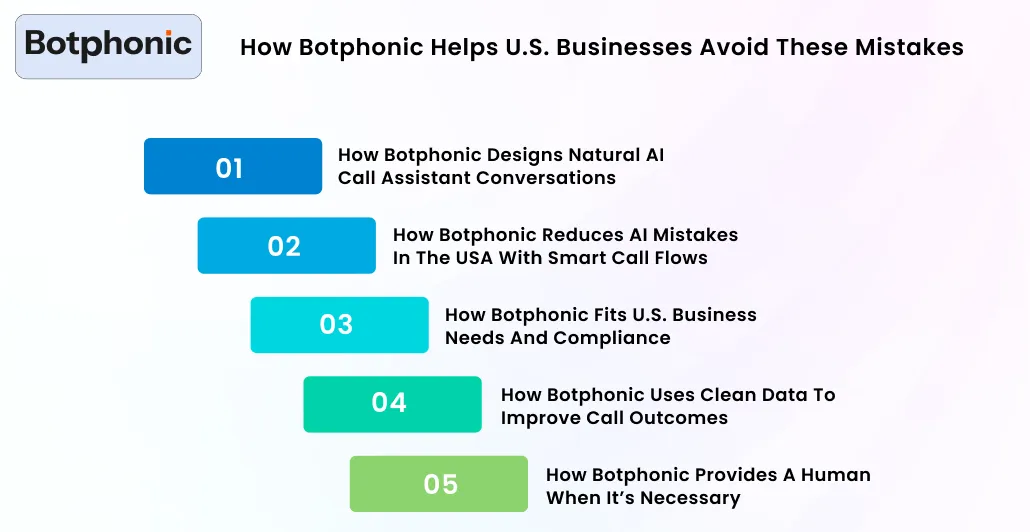
Botphonic also offers a clever workaround to avoid these roadblocks and make your/autocalling work. Here’s how:
1. How Botphonic designs natural AI call assistant conversations
Botphonic designs conversation flows that simulate how the bot would interact if it were a human. With thoughtfully designed prompts and real customer language, your AI call assistant naturally empathizes and speaks in a friendly manner to help make the following.
2. How Botphonic reduces AI mistakes in the USA with smart call flows
It tracks the customer at every touch point with distinct decision roots. This avoids misunderstandings and errors in consecutive operations, making yourAIi call assistant work seamlessly in all situations.
3. How Botphonic fits U.S. business needs and compliance
Botphonic’s solution is the first to be TCPA (Telephone Consumer Protection Act), as well as other US regulation-compliant, out-of-the-box. This lowers the chances of compliance-borne AI mistakes while ensuring your calls are, most likely, secure and legit.
4. How Botphonic uses clean data to improve call outcomes
Botphonic makes yourAIi call assistant dial the right people with the right information at the right time by syncing fresh contact lists and validating customer data to eliminate mistakes.
5. How Botphonic provides a human when it’s necessary
It has seamless handoffs to human agents. Should the AI call assistant meet a complicated request, it automatically transfers the call. A new and smooth method, the most effective way to improve customer satisfaction rate and lower errors.
NOTE
Final Thoughts
In conclusion, automated calling can redefine outreach and engagement when implemented thoughtfully, and AI call automation for U.S. businesses becomes a true growth lever when aligned with clean data, human handoffs, and continuous improvement.
Typical AI mistakes in the USA, such as neglecting the customer experience, relying on outdated information, over-automation, or avoiding AI training programmes, frustrate and result in failure to materialise. A well-designed AI call assistant, like Botphonic, ensures natural conversations and compliance with U.S. regulations and clean data use with powerful human handoffs.
By keeping customer intent, as well as ongoing improvement, in sight, AI businesses can learn from mistakes and ensure every single call matters. When your month-to-month budget or quarterly bandwidth is on the line, getting the right platform can save you hassle and enhance hand-off, satisfaction, and ROI with AI-powered automated calling campaigns.