Summarize Content With:
Quick Summary
AI phone call system for schools have stepped up the game. As schools today have started juggling more communication responsibilities than ever. Maintaining attendance records to event reminders, admission updates, and urgent notifications. By automating repetitive tasks and delivering accurate with consistent results, the system has proved its role. In addition, handling real-time communication while reducing operational costs, and strengthening parent engagement has made it prefererd choice for smart schools.
In this blog, we will uncovering how AI phone calls are helping schools to manage parent communication, while improving operational efficiency.
Introduction
Technology has been a driving force in the education sector for ages, but in recent years, AI has taken center stage. From elementary grade to higher education, schools are now effectively adopting AI to streamline several administrative functions, and communication is obviously no exception. School administrators have not just one thing to manage, for example, scheduling meetings, answering parent inquiries, notifying parents of school events, and even handling emergency alerts. These tasks have tendency to overwhelm even the best of the team.
An AI phone call system for schools is effectively alleviating this burden by managing many of these routine communications processes.
For instance, an AI phone call system can easily handle everything from answering basic questions about school hours to just sending reminders about a parent-teacher meeting.
What is an AI Phone Call System for Schools?
Artificial intelligence phone call systems in educational institutions are advanced. They use state-of-the-art technologies such as speech recognition and natural language processing to communicate with parents through their phone calls. Unlike the earlier answer machine, AI phone call system for schools have been designed such that they can understand many types of questions and requests in real-time. These systems can manage simple confirmations and updates, provide answers to frequently asked questions, and they are even able to escalate complicated issues to human staff if necessary.
How it Works:
- Automated Calls: The AI phone call system for schools can easily initiate calls with parents, whether they are scheduled or on demand. For example: to convey important messages or announcements. For instance, if the school is closed due to inclement weather, the notification for closure can be easily relayed via the AI by calling the parents instead of making individual manual calls.
- Voice Interaction: On calling, the parent communicates with the AI system that effectively utilizes voice recognition to understand the reason for the call and provide a proper response. This may include confirmation of attendance, updates on the student’s performance, or just informing parents about future events in school.
- Personalization: Advanced AI systems can even tailor the message. When the system identifies a specific parent based on the caller ID, it can even greet them by name and provide customized information related to their child. For example, upcoming assignments or performance reports.
Example:
A parent calls to ask about the parent-teacher meeting. Rather than having to hunt through a phone tree or wait on hold for a staff member, the AI system will instantly understand the request. Then it will inform the caller about the date, time, and venue for the conference.
How AI-Powered Communication is Revolutionizing Schools
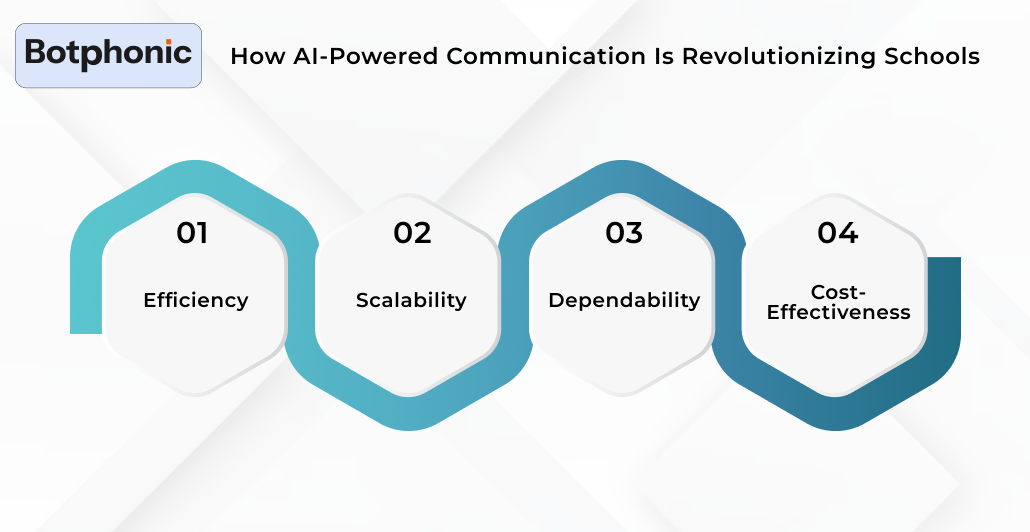
AI-equipped communication systems are quite truly far more than a mere technological upgrade; they signify a complete overhaul in the way in which schools have traditionally communicated with their parents. Let’s see why this has become a game-changer for schools:
- Efficiency: An AI call assistant is used to save time on routine tasks such as calling parents to tell them about school events, marking attendance, or providing updates. This kind of calls can be done going up the scale, allowing the school resource to be directed.
- Scalability: With the rising enrollments in the school, the volume of parent calls and queries can even grow exponentially. Thus, hiring of extra staff does not even become necessary.
- Dependability: An AI phone call system for schools can dispense information in a consistent and accurate manner every time it gets asked. It also helps to minimize the risks of human miscommunication or error. Thus fostering fewer misunderstandings and greater trust with parents.
- Cost-Effectiveness: By delegating routine communications to an AI, schools avoid costs associated with hiring extra administration. Over time, the technology pays for itself by lowering labor costs and increasing efficiency.
In one illustration, one large school district of 5,000 students employed an AI phone system to communicate with parents. With this system, the district was able to save 40% of the time its staff spent making phone calls. For example, this translates into cost savings and improved parent satisfaction.
 PRO TIP
Return Of Operational Value: The Numbers That Work For The CFO
AI call assistants can decrease operational costs by anywhere between 30 and 40 percent. They automate repetitive activities such as attendance calls, notifying parents, and even appointment scheduling. They free up staff from routine activities to engage in more valuable work. Schools can also use AI in the communication space to save even hundreds of hours every year. Next up are things like absence reporting, enrollment reminders, and even emergency alerts in real-time, using minimal human input.
AI systems can do mass calls and text interactions by the thousands, raising the operational ceiling. This means schools can meet demands to grow along with their student populations, cost-effectively. Reservations, reminders, follow-ups, and constant engagement of parents via AI are shown to increase parent engagement. Parents are also constantly updated on their child’s progress, events, and major announcements. Thus, it fortifies the relationship between schools and communities. Early research suggests that AI-mediated communication tools have been linked with increased parent-school contact.
AI call assistants will capture the call and interaction notes. Thus ensuring that schools keep proper and auditable records of all their communications. This also places schools in a state of compliance and protects them from any litigation that could arise from communication lapses. Besides, AI handles calls 24 hours a day, 7 days a week, making time for essential notifications. Moreover, it also boosts operational efficiency and enhances parent satisfaction.
Put simply, the CFOs have almost a crush on AI call assistants for the clear operational value. They have already started delivering, in terms of lower costs, savings in time, improved scalability, and now, better compliance.
Key Tasks Handled by AI Call Assistants:
- Attendance Update: Schools can easily automate attendance calls to parents, letting them know if their child has been present or not. The AI phone call system for schools can even provide a follow-up call if the parent isn’t responding within a certain timeframe, ensuring no one is missing out on important information.
- Event Reminders: Parents usually struggle in keeping track of school events, especially during busy times. AI phone systems for schools can remind parents about key dates such as PTA meetings, report card distribution, and extracurricular activities.
- Parent Surveys: AI systems can also be used to gather feedback from parents, which provides a convenient way for schools to conduct surveys on school climate, teacher performance, or parent satisfaction.
Potential Pitfalls: Addressing Concerns About AI in Schools
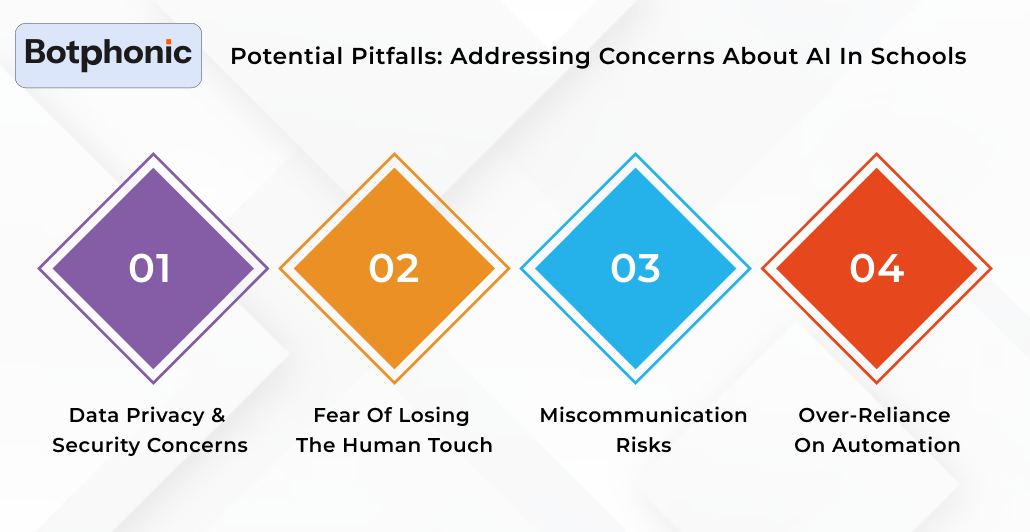
Even the smartest technology has its own fair share of complications, and AI in school communication is no exception. Schools need to approach AI adoption with clear thoughts and solid leadership, because while AI is delivering speed and scalability, it’s also introducing challenges that must be addressed head-on.
1. Data Privacy & Security Concerns
Schools cater some of the most sensitive pieces of information a person can own-student identification, attendance, health alerts, family contact details, and all that jazz.
- The worry: Parents have had a bad experience about how automated systems store or analyze data.
- Non-negotiable requirement: AI systems must comply with FERPA and local law, backed with data transparency policies and strong access control.
 NOTE
NOTE
2. Fear of Losing the Human Touch
No parent wants to feel like they’re speaking to a robot about the most private matter of their kid. Such fears are quite valid: AI will never be able to have the empathy, nuance or emotional intelligence needed for conversation when things are tricky.
- Where it fails: Bullying and academic trouble, mental health issues.
- Intelligent solutions: AI should play the function of the front desk, not the school counselor; it covers all the basics but redirects sensitive issues in real time to a qualified human professional.
3. Miscommunication Risks
AI is really powerful but not infallible. Misinterpretations in accents and noise in the environment or emotional tone get wrong and give irrelevant responses.
- The risk: Gave wrong information or misunderstanding about what the parent really needs-frustrating for everyone involved.
- Fix: Continuous model training and human oversight must be part of the plan. Schools must treat AI as an instrumental-learning assistant instead of fire-and-forget tools.
4. Over-Reliance on Automation
There is a real danger that schools could find themselves depending on AI for everything, just because doing things this way is convenient.
- The danger: Parents have begun to feel neglected; the attention of their staff takes a backseat to growing concerns; the communication culture of the school has grown cold and transactional.
- Balanced approach: AI phone call system for schools handles volume, not relationships. Routine updates? Perfect. Emotional conversations? Human territory.
Unlock 24/7 Agent Power and Overcome Challenges
Try Botphonic Now!!Conclusion
AI phone call systems for schools have evolved into the modern voicing of school communication- conducive to efficiency and fast-paced cost control on reliability. These systems do away with the administrative burden on the already-stretched staff and give timely, accurate, and personalized updates during the parents’ rush. From attendance alerts to reminders about admissions, and heavy announcements, AI strengthens school operations and bridges the parent-school relationship in ways the old-fashioned methods cannot dare to match! Moreover, integrating an AI phone call assistant for admissions helps in resolving admission queries easily too, without asking for extra attention.
When AI is used with schools strategically, the real magic appears. It does not replace a human; it relieves him/her so that he/she can engage in an act of human empathy, leadership, and connection that technology cannot afford. When done with clear guardrails, strong privacy, and a proper human-AI balance, it elevates standards of communication already and allows schools to have confidence, consistency, and scalability.